
Best Clamp Meter for Electricians: Top Picks for 2026
Choosing the Best Clamp Meter for Electricians is important for safety, accuracy, and faster troubleshooting. Electricians deal with live circuits, motor controls, panels, and industrial systems daily. A poor-quality clamp meter can lead to wrong readings and wasted time. That is why selecting a reliable clamp meter matters more than ever in 2026.
A clamp meter helps measure current without disconnecting wires. It saves time and reduces risk during electrical maintenance. Whether you are testing current, voltage, resistance, continuity, or frequency, the right tool can improve your work quality.
Best Clamp Meter for Electricians Chart
Our Recommedation
In this guide, we will review the Best Clamp Meter for Electricians, compare their features, and help you choose the right one for your needs.
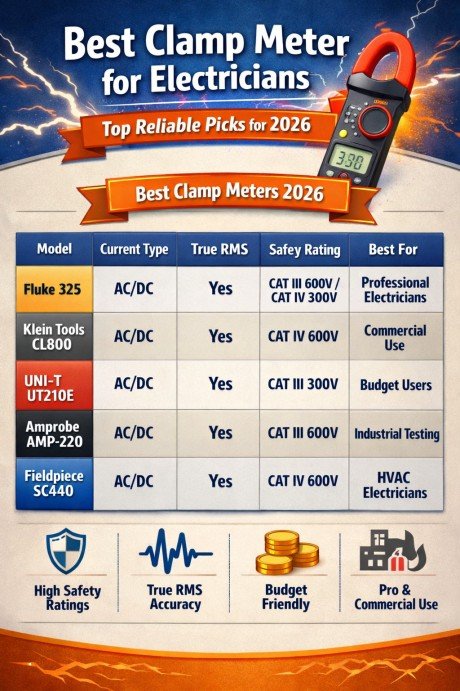
Table of Contents
Table of Contents
Top Picks for 2026
1. Fluke 325 Clamp Meter
Fluke remains one of the most trusted brands for electrical testing equipment. The Fluke 325 is often considered the Best Clamp Meter for Electricians because of its strong performance and durability.
Features
- Measures AC/DC current up to 400A
- True RMS readings
- Temperature measurement
- Frequency and capacitance testing
- Slim ergonomic design
Pros
- Highly accurate
- Excellent build quality
- Trusted by professionals
- Long-lasting
Cons
- Higher price
If reliability matters most, this is a top choice.
2. Klein Tools CL800
Klein Tools is another respected brand among electricians. The CL800 offers advanced features at a competitive price.
Features
- Measures AC/DC current up to 600A
- CAT IV 600V safety
- Low impedance mode
- Inrush current testing
- Temperature measurement
Pros
- Great value
- Rugged design
- High safety standard
Cons
- Slightly bulky
For field electricians, it offers excellent performance.
Get the Best Clamp Meter for Electricians before stock runs low
3. UNI-T UT210E
This compact clamp meter is a favorite for budget-conscious electricians.
Features
- Measures AC/DC current up to 100A
- True RMS technology
- Compact body
- Lightweight
Pros
- Affordable
- Portable
- Good for quick checks
Cons
- Smaller jaw opening
It is ideal for light-duty electrical work.
4. Amprobe AMP-220
Amprobe has a strong reputation for industrial-grade tools. The AMP-220 is solid for daily use.
Features
- AC/DC current measurement
- Non-contact voltage detection
- Resistance and continuity testing
- Backlit display
Pros
- Reliable
- Good industrial performance
- Strong build
Cons
- Limited advanced functions
It is a dependable option for maintenance teams.
5. Fieldpiece SC440
This clamp meter is designed mainly for HVAC technicians but works well for electricians too.
Features
- Inrush current testing
- Temperature functions
- True RMS
- Compact swivel head
Pros
- Excellent for HVAC systems
- Easy to use
- Accurate readings
Cons
- Specialized design
Grab your Best Clamp Meter for Electricians Buy Now and upgrade your toolkit.
Performance Comparison Table
| Feature | Fluke 325 | Klein CL800 | UNI-T UT210E | Amprobe AMP-220 | Fieldpiece SC440 |
|---|---|---|---|---|---|
| Accuracy | Excellent | Very Good | Good | Very Good | Very Good |
| Durability | Excellent | Very Good | Good | Very Good | Good |
| Ease of Use | Excellent | Good | Excellent | Good | Good |
| Price | High | Medium | Low | Medium | Medium |
Which Clamp Meter Is Best for You?
The Best Clamp Meter for Electricians depends on your work type.
- For professional electricians:
Choose Fluke 325. - For commercial and industrial use:
Choose Klein CL800. - For budget users:
Choose UNI-T UT210E. - For maintenance teams:
Choose Amprobe AMP-220. - For HVAC specialists:
Choose Fieldpiece SC440.
How to Use a Clamp Meter Safely
Using a clamp meter properly is important.
Follow these tips:
- Always inspect the meter before use
- Check the safety category rating
- Wear insulated gloves
- Clamp only one conductor at a time
- Never exceed the current rating
- Keep hands behind finger guards
Safety should always come first when working with electrical testing tools.
Read our complete How to Use a Multimeter guide for step-by-step instructions, practical examples, and essential safety tips before selecting your ideal multimeter.
Best Fluke Clamp Meter for Electrician
Fluke clamp meters are a solid choice for electricians who need accurate current readings without disconnecting conductors. The right model depends on whether you work mainly on residential circuits, industrial panels, HVAC systems, or troubleshooting jobs.
When comparing the Best Clamp Meter for Electricians, look for True-RMS measurement, suitable AC/DC current capacity, voltage range, safety ratings, and useful features such as inrush current measurement.
| Fluke Model | Current | Best For |
|---|---|---|
| Fluke 323 | 400A AC | General electrical work |
| Fluke 325 | 400A AC/DC | Electrical & HVAC |
| Fluke 376 FC | 1000A AC/DC | Industrial troubleshooting |
For a closer comparison of features, accuracy, and applications, see our detailed guide to the Best Fluke Clamp Meter for Electrician, which covers the leading Fluke options for professional electrical work.
Best Clamp Meter of Kyoritsu
Kyoritsu clamp meters are well regarded for electrical testing, especially when electricians need dependable current measurements, rugged construction, and practical safety features. If you are comparing the Best Clamp Meter of Kyoritsu for professional fieldwork, consider the measurement range, AC/DC capability, accuracy, jaw opening, CAT safety rating, and extra functions such as resistance, continuity, and frequency.
| Kyoritsu Model | Current Type | Key Advantage | Best For |
|---|---|---|---|
| Kyoritsu 2007R | AC/DC | High-current measurement | Industrial work |
| Kyoritsu 2117R | AC/DC | Compact design | General electricians |
| Kyoritsu 2200R | AC | Large conductor capacity | Electrical maintenance |
For a detailed comparison of specifications, applications, and buying considerations, see our guide to the Best Clamp Meter of Kyoritsu, which covers the leading Kyoritsu models for electricians.
Best 1000A Clamp Meter for Industrial Use
For industrial electricians, a clamp meter should combine high current capacity, safety, accuracy, and durable construction. While the Best Clamp Meter for Electricians may suit general troubleshooting, heavy-duty applications often require a 1000A-rated model for motors, feeders, panels, and industrial equipment.
| Feature | Recommended Specification |
|---|---|
| AC Current | Up to 1000A |
| Safety Rating | CAT III/CAT IV |
| Display | Backlit digital display |
| Jaw Opening | Large enough for industrial conductors |
| Key Functions | AC/DC voltage, resistance, continuity |
For detailed model comparisons, specifications, and buying considerations, see our guide to 1000A clamp meters for industrial use before selecting a meter for demanding electrical work.
Fluke 323 vs 325
When comparing the Fluke 323 vs 325, the main difference is measurement capability. The Fluke 323 is a simple, dependable option for everyday AC/DC electrical troubleshooting, while the Fluke 325 adds DC current, temperature, frequency, and capacitance measurements, making it more versatile for professional electricians and HVAC work.
| Feature | Fluke 323 | Fluke 325 |
|---|---|---|
| AC Current | Up to 400 A | Up to 400 A |
| DC Current | — | Up to 400 A |
| Temperature | — | Yes |
| Frequency | — | Yes |
| Capacitance | — | Yes |
| Best For | Basic electrical testing | Advanced troubleshooting |
If you need a straightforward clamp meter for routine electrical jobs, the 323 offers excellent value. For a more detailed comparison, see our Fluke 323 vs 325 review to determine which model better matches your testing requirements.
Fluke 324 vs 325: Which Clamp Meter Should Electricians Choose?
When comparing compact Fluke clamp meters, the Fluke 324 vs 325 decision mainly comes down to measurement capability and the type of electrical work you handle. Both models offer AC/DC voltage, resistance, capacitance, temperature, and AC current measurements, but the 325 adds DC current measurement and frequency, making it more versatile for troubleshooting motors, controls, and solar-related circuits.
| Feature | Fluke 324 | Fluke 325 |
|---|---|---|
| AC Current | Up to 400 A | Up to 400 A |
| DC Current | No | Yes |
| Temperature | Yes | Yes |
| Frequency | No | Yes |
| Best For | General electrical work | Advanced troubleshooting |
| Availability | Discontinued by Fluke | Available on Amazon |
For a detailed breakdown of measurements, accuracy, and real-world use cases, see our complete Fluke 324 vs 325 comparison.
Fluke 325 vs Fluke 902 FC
The Fluke 325 vs Fluke 902 FC comparison comes down to portability, HVAC functionality, and advanced troubleshooting needs. The Fluke 325 is a versatile option for electricians handling everyday electrical measurements, while the 902 FC is designed specifically for HVAC professionals who need temperature and capacitance measurements alongside electrical testing.
| Feature | Fluke 325 | Fluke 902 FC |
|---|---|---|
| AC/DC Current | Up to 400 A | Up to 600 A |
| AC/DC Voltage | Up to 600 V | Up to 600 V |
| Temperature | Yes | Yes |
| Capacitance | Yes | Yes |
| HVAC-focused | General purpose | Yes |
For a detailed breakdown of accuracy, features, and use cases, see our Fluke 325 vs Fluke 902 comparison before choosing your next professional clamp meter.
AC vs DC Clamp Meter
| Feature | AC Clamp Meter | DC Clamp Meter |
|---|---|---|
| Measures | AC Current | AC & DC Current |
| Best For | Residential & Commercial AC Systems | Solar PV, EV Chargers & Battery Systems |
If you work mainly on residential wiring, an AC clamp meter is usually sufficient. However, electricians handling solar installations, EV charging stations, battery banks, or industrial DC equipment should invest in a model that measures both AC and DC current. Understanding the differences between these tools helps you choose the right instrument for your work.
Read our complete guide on AC vs DC Clamp Meter to compare features, applications, and buying recommendations before making your next purchase.
Best Clamp Meter Under $100
If your budget is limited, choosing the Best Clamp Meter Under $100 can still provide reliable performance for everyday electrical work. These affordable models typically include AC current measurement, voltage testing, resistance, continuity, and non-contact voltage (NCV) detection, making them suitable for homeowners, apprentices, and professional electricians.
| Feature | Budget Clamp Meters |
|---|---|
| Price Range | Under $100 |
| Best For | Homeowners & Electricians |
| Key Functions | AC Current, Voltage, Resistance, NCV |
Looking for detailed reviews and top-rated budget models? Read our complete guide on the Best Clamp Meter Under $100 to compare features, accuracy, and the best value before you buy.
Best Clamp Meter for HVAC
HVAC technicians often need a clamp meter that measures low current accurately while also handling temperature, capacitance, and microamp (µA) testing for flame sensors. Choosing the right model improves troubleshooting speed and reduces service time on air conditioners, heat pumps, and refrigeration systems.
If your work mainly involves HVAC equipment, see our detailed Best Clamp Meter for HVAC buying guide for feature comparisons, testing tips, and model recommendations.
| HVAC Feature | Why It Matters |
|---|---|
| Temperature Measurement | Checks air supply and refrigerant line temperatures |
| Capacitance Test | Verifies start and run capacitors |
| µA DC Measurement | Tests flame sensors accurately |
| True RMS | Provides accurate readings on variable-speed HVAC systems |
Looking for a Clamp Meter for Solar Installations?
If your work involves photovoltaic (PV) systems, EV chargers, or battery banks, a standard electrician's clamp meter may not provide accurate DC current measurements. In that case, choosing a model designed for renewable energy applications is essential. The table below highlights the key differences.
| Feature | Standard Electrician Clamp Meter | Solar & DC Clamp Meter |
|---|---|---|
| DC Current Measurement | Limited or unavailable | Accurate DC current measurement |
| Solar PV Testing | Basic | Optimized for PV systems |
| Battery Bank Diagnostics | Limited | Excellent |
For a detailed comparison of the Best Clamp Meter for Solar & DC Systems, including recommended models, features, and buying tips, read our complete dedicated guide. It covers the best options for solar technicians, installers, and maintenance professionals.
Best Mini Clamp Meter for Tight Spaces
When working inside crowded electrical panels, junction boxes, or HVAC compartments, a compact meter can be easier to handle than a full-size clamp meter. The Best Mini Clamp Meter should combine a narrow jaw, reliable current measurement, and a slim body without sacrificing essential safety features.
| Feature | What to Look For |
|---|---|
| Compact jaw | Fits around wires in confined spaces |
| True RMS | Accurate readings on non-linear loads |
| Safety rating | CAT III/CAT IV protection |
| DC current | Useful for automotive and solar work |
A mini clamp meter is especially useful for electricians who frequently troubleshoot circuits where access is limited. For detailed recommendations, specifications, and buying considerations, see our guide to the Best Mini Clamp Meter for Tight Spaces before choosing your next compact testing tool.
Klein Clamp Meter Comparison for Electricians
Choose the Right Klein Clamp Meter
A quick Klein Clamp Meter Comparison can help electricians match the right model to everyday electrical tasks. The table below highlights key differences before choosing a clamp meter.
| Model | Best For | Key Advantage |
|---|---|---|
| CL120VP | General electrical work | Voltage detection |
| CL390 | HVAC & maintenance | AC/DC current |
| CL445 | Advanced troubleshooting | Higher measurement capability |
| CL460S | Professional use | Broad functionality |
For a detailed breakdown of accuracy, features, measurement ranges, and value, see our Klein Clamp Meter Comparison guide before making your final choice.
Best Clamp Meter With THD
For electricians working with VFDs, UPS systems, and sensitive electronic equipment, a meter that measures total harmonic distortion (THD) can provide valuable power-quality insight. When comparing the Best Clamp Meter With THD, look for accurate current measurement, THD percentage readings, true-RMS capability, and a suitable frequency range.
| Feature | What to Look For |
|---|---|
| THD measurement | Percentage of harmonic distortion |
| True RMS | Accurate nonlinear-load readings |
| Current range | Suitable for your applications |
| Safety rating | CAT III/CAT IV protection |
For detailed models, specifications, and buying guidance, see our complete guide to the Best Clamp Meter With THD before choosing your next professional meter.
Best Open Jaw Clamp Meter for Tight Electrical Spaces
An open-jaw clamp meter makes it easier to measure current when access around a conductor is limited. Unlike traditional clamp meters, its jaw design can slide around individual wires without requiring the conductor to be disconnected. For electricians working in crowded panels, control cabinets, or residential circuits, this can save time and improve convenience.
| Feature | Open-Jaw Clamp Meter |
|---|---|
| Access | Excellent in tight spaces |
| Conductor handling | No disconnection required |
| Best use | Panels, branch circuits, service work |
| Portability | Compact and lightweight |
For detailed models, specifications, and buying guidance, see our guide to the Best Open Jaw Clamp Meter.
Best Low Current DC Clamp Meter
For electricians working with sensitive electronics, solar systems, and control circuits, a low-current DC clamp meter can provide safer, non-invasive measurements than traditional probes. When choosing the right tool, consider its minimum current resolution, DC accuracy, jaw size, and voltage range.
| Feature | Recommended Specification |
|---|---|
| DC Current Resolution | 1 mA or better |
| DC Current Range | Up to 40–60 A |
| Jaw Opening | Around 10–15 mm |
| Best Uses | Solar, PLCs, automotive, electronics |
For detailed comparisons and buying recommendations, see our guide to the Best Low Current DC Clamp Meter to find a model suited to accurate low-amperage DC measurements.
Why Electricians Need a Quality Clamp Meter
Electricians often work on energized systems. A clamp meter allows current measurement by simply clamping around a conductor. This makes it safer than traditional multimeters in many situations.
A good clamp meter offers:
- Accurate AC/DC current measurement
- True RMS readings for variable frequency drives
- Non-contact voltage detection
- Resistance and continuity testing
- Frequency and capacitance measurement
- Inrush current testing
If you work in industrial, residential, or commercial settings, having the Best Clamp Meter for Electricians can improve both safety and efficiency.
Key Features to Look for Before Buying
Before choosing a clamp meter, check these important features.
True RMS Accuracy
True RMS is essential when measuring non-linear loads. It gives accurate readings on VFDs, UPS systems, and modern electronics.
Jaw Size
A larger jaw opening allows easier measurement of bigger conductors.
Safety Rating
Look for CAT III or CAT IV safety ratings for high-energy environments.
Auto Range
Auto-ranging makes testing quicker and simpler.
Build Quality
A durable clamp meter can survive drops and rough site conditions.
Additional Functions
Useful extra functions include:
- Temperature testing
- Frequency measurement
- Capacitance testing
- Duty cycle
- Inrush current
Final Verdict
Finding the Best Clamp Meter for Electricians can make a huge difference in your daily work. A quality clamp meter improves accuracy, saves time, and increases safety.
For most professionals, the Fluke 325 is the best overall choice because of its strong build, high accuracy, and trusted brand reputation. If you need a more affordable option, the Klein CL800 offers excellent value.
Investing in the right clamp meter today will improve your electrical troubleshooting and maintenance for years.
Frequently Asked Questions
1. What is the best clamp meter for professional electricians?
The Fluke 325 is widely considered the best due to its accuracy, durability, and advanced functions.
2. Is True RMS necessary in a clamp meter?
Yes, True RMS provides accurate readings for non-linear electrical loads.
3. Can a clamp meter measure DC current?
Yes, many modern clamp meters can measure both AC and DC current.
4. Which clamp meter is best for beginners?
The UNI-T UT210E is a good beginner-friendly and affordable option.
5. What safety rating should electricians look for?
CAT III 600V or CAT IV 600V is recommended for professional electrical work.
Related Guides
Get new guides in your feed. Follow Electrical Insights on LinkedIn for new electrical standards guides, calculators and design tips from Azad Circuit Hub.
#BestClampMeterForElectricians,#ClampMeter,#ElectricianTools,#BestClampMeter,#ElectricalTesting,#MultimeterTools,#ElectricianLife,#VoltageTesting,#CurrentMeasurement,#ElectricalSafety
