
How to Use a Clamp Meter (Complete Guide)
Working with electrical systems requires accurate measurements without compromising safety. Learning How to Use a Clamp Meter is one of the most valuable skills for electricians, technicians, DIY enthusiasts, and maintenance professionals. Unlike a traditional multimeter, a clamp meter allows you to measure current without disconnecting wires, making troubleshooting faster and safer.
Whether you are checking motor current, diagnosing HVAC equipment, testing household circuits, or inspecting industrial electrical panels, this guide explains every step in simple language.
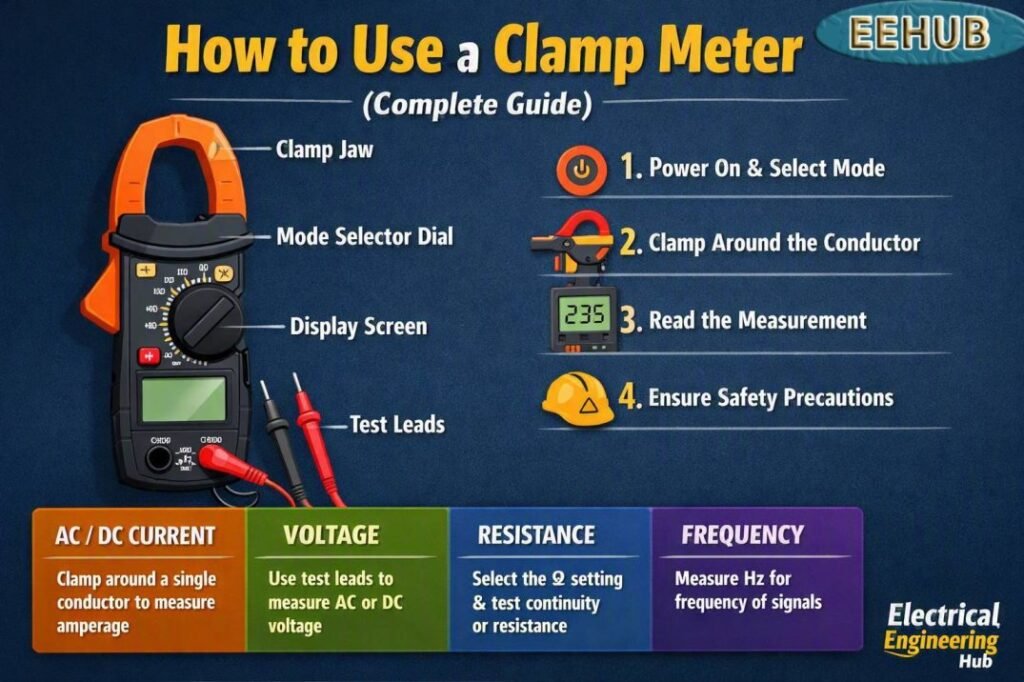
Table of Contents
Table of Contents
Quick Clamp Meter Comparison
| Feature | Fluke 325 | Klein Tools CL800 |
|---|---|---|
| Best For | Professional Electricians | DIY & Professional Users |
| AC Current | Up to 400A | Up to 600A |
| DC Current | Yes | Yes |
| True RMS | Yes | Yes |
| Temperature Measurement | Yes | Yes |
| CAT Rating | CAT III 600V / CAT IV 300V | CAT IV 600V |
| Display | Backlit LCD | Backlit LCD |
| Best Feature | Industry-leading accuracy | Excellent value for money |
| Amazon Availability | ✔ Available | ✔ Available |
Looking for a reliable clamp meter? The Fluke 325 offers professional-grade accuracy, while the Klein Tools CL800 delivers excellent features at a competitive price. Check today’s Amazon deals before prices change.
What Is a Clamp Meter?
A clamp meter is a digital electrical measuring instrument designed to measure current by clamping around a conductor instead of making direct electrical contact.
Besides current measurement, modern clamp meters can measure:
- AC Voltage
- DC Voltage
- Resistance
- Continuity
- Frequency
- Capacitance
- Temperature
- Inrush Current
- Diode Testing
Because there is no need to disconnect wiring, clamp meters greatly improve safety during electrical inspections.
Parts of a Clamp Meter
Before learning How to Use a Clamp Meter, become familiar with its main components.
| Part | Function |
|---|---|
| Clamp Jaw | Measures magnetic field around conductor |
| Trigger | Opens clamp jaw |
| Rotary Dial | Selects measurement mode |
| Display | Shows readings |
| Hold Button | Freezes display |
| Test Leads | Used for voltage, resistance, continuity |
| COM Port | Black probe connection |
| V/Ω Port | Red probe connection |
Knowing these controls makes measurements faster and reduces mistakes.
Safety Precautions Before Measuring
Electrical safety should always come first.
Follow these precautions:
- Inspect the clamp meter for damage.
- Check the insulation on test leads.
- Wear insulated gloves when required.
- Select the proper measurement range.
- Never exceed the CAT rating.
- Clamp only one conductor.
- Keep fingers behind the safety barrier.
- Verify the meter on a known live source before critical testing.
Following these simple steps helps prevent accidents and ensures accurate readings.
How to Use a Clamp Meter for Current Measurement
Current measurement is the primary function of every clamp meter.
Step 1: Turn the Meter On
Rotate the selector to AC Current (A~) or DC Current (A⎓), depending on the circuit.
Step 2: Open the Clamp
Press the trigger to open the clamp jaw.
Step 3: Clamp Around One Conductor
Place only one conductor inside the clamp.
Do not clamp around both the live and neutral wires simultaneously because the magnetic fields cancel each other, resulting in an incorrect reading.
Step 4: Center the Wire
Keep the conductor close to the center of the clamp for maximum accuracy.
Step 5: Read the Display
Wait a few seconds for the reading to stabilize.
Record the measured current.
Common Mistakes When Measuring Current
| Mistake | Result |
|---|---|
| Clamping Live and Neutral Together | Reads nearly zero current |
| Wrong Function Selected | Incorrect reading |
| Damaged Clamp Jaw | Reduced accuracy |
| Measuring Above Meter Rating | Possible meter damage |
| Loose Connection | Unstable readings |
Avoiding these mistakes improves measurement accuracy.
Need help choosing the right model? Read our complete guide on the Best Clamp Meter for Electricians to compare professional and budget-friendly options before buying.
How to Measure AC Voltage
Voltage measurement uses the test probes rather than the clamp.
Procedure
- Insert black lead into COM.
- Insert red lead into V input.
- Select AC Voltage.
- Touch probes across the circuit.
- Read the voltage.
Typical household voltage readings include:
| Supply | Expected Voltage |
|---|---|
| North America | 120V |
| Europe | 230V |
| Three Phase Line | Depends on system |
How to Measure DC Voltage
The procedure is similar to AC voltage.
Simply switch the rotary dial to DC Voltage.
Connect:
- Black probe to negative
- Red probe to positive
The display will indicate polarity if reversed.
How to Measure Resistance
Resistance testing should only be performed on de-energized circuits.
Steps include:
- Turn power OFF.
- Select Resistance (Ω).
- Connect both probes.
- Read the resistance value.
This function is useful when checking:
- Heating elements
- Motor windings
- Extension cords
- Electrical cables
How to Test Continuity
Continuity testing verifies whether an electrical path exists.
Steps:
- Turn off power.
- Select continuity mode.
- Touch both probes together to confirm operation.
- Test the component.
A beep usually indicates a complete circuit.
How to Measure Frequency
Many clamp meters can measure electrical frequency.
Applications include:
- Generator testing
- Variable frequency drives
- Industrial equipment
- Solar inverters
Simply select Frequency mode and connect the probes or use the clamp depending on the meter design.
Practical Example of Using a Clamp Meter
Suppose an air conditioner is protected by a 20A breaker.
You measure the running current.
| Equipment | Reading |
|---|---|
| Air Conditioner | 13.8A |
Since the measured current is well below the breaker rating, the equipment is operating within normal limits.
If the current exceeds the expected value, further troubleshooting may be required.
Best Applications for Clamp Meters
A clamp meter is commonly used for:
- Electrical maintenance
- Industrial troubleshooting
- HVAC systems
- Solar power systems
- EV charger installation
- Motor diagnostics
- Generator maintenance
- Residential inspections
- Commercial buildings
- Manufacturing plants
Which Clamp Meter Should You Buy?
Two highly recommended models available on Amazon are excellent choices depending on your budget and requirements.
Fluke 325
Ideal for professional electricians who need dependable measurements every day.
Key Features
- True RMS measurements
- AC/DC current
- Temperature measurement
- Compact design
- Excellent build quality
- Industry-leading accuracy
Pros
- Highly accurate
- Durable construction
- Trusted professional brand
- Fast response time
Cons
- Higher price than entry-level models
Buy the Fluke 325 on Amazon to get professional-grade performance backed by one of the most trusted brands in electrical testing. Check the latest price and customer reviews before purchasing.
Klein Tools CL800
The CL800 offers impressive functionality at a more affordable price.
Key Features
- True RMS
- AC/DC current
- Temperature
- Capacitance
- Frequency
- CAT IV safety rating
Pros
- Excellent value
- Wide measurement range
- Easy-to-read display
- Reliable safety features
Cons
- Slightly larger than premium compact models
Check today’s Amazon deal on the Klein Tools CL800 if you want advanced features without paying premium professional prices. Many electricians consider it one of the best values available.
Clamp Meter vs Multimeter
| Feature | Clamp Meter | Multimeter |
|---|---|---|
| Current Measurement | Without disconnecting wire | Requires series connection |
| Voltage Measurement | Yes | Yes |
| Resistance | Yes | Yes |
| Safety | Higher | Moderate |
| Speed | Very Fast | Slower |
| Best Use | Current testing | General electrical testing |
Both tools have their place, but clamp meters excel when measuring live current safely.
Still comparing models? Explore our detailed guides on the best current clamp meter and best electrical clamp meter to find the right tool for residential, commercial, or industrial work.
Tips for Accurate Clamp Meter Readings
- Clamp only one conductor.
- Keep the jaw fully closed.
- Use the correct measurement mode.
- Center the wire inside the clamp.
- Replace weak batteries regularly.
- Keep the clamp jaw clean.
- Verify calibration periodically.
- Avoid measuring beyond rated limits.
These practices improve both accuracy and safety.
Conclusion
Understanding How to Use a Clamp Meter makes electrical testing safer, faster, and more efficient. Whether you are diagnosing motors, checking household wiring, maintaining HVAC equipment, or servicing industrial machinery, a quality clamp meter saves time while reducing the need to disconnect energized conductors.
For professionals who demand exceptional reliability, the Fluke 325 remains one of the best investments available. If you want premium features at a lower price, the Klein Tools CL800 offers outstanding performance and value. Both models are widely available on Amazon and have earned excellent reviews from electricians around the world.
Related Guides
- Best Clamp Meter for Electricians
- Best Clamp Meter Under $100
- Fluke 323 vs Fluke 325 Review
- Best Clamp Meter for HVAC
- Best Clamp Meter for Solar
Frequently Asked Questions
1. Can a clamp meter measure both AC and DC current?
Many modern clamp meters, including the Fluke 325 and Klein Tools CL800, can measure both AC and DC current. Always verify the specifications before purchasing.
2. Why should I clamp only one wire?
The clamp measures the magnetic field around a single conductor. Clamping both live and neutral wires together causes the magnetic fields to cancel, resulting in an inaccurate reading.
3. Can a clamp meter replace a multimeter?
Not completely. While a clamp meter performs many of the same functions, a multimeter is still preferred for certain low-current and precision electrical measurements.
4. Is a True RMS clamp meter worth buying?
Yes. A True RMS clamp meter provides more accurate readings on non-linear loads, making it ideal for modern electrical systems with variable frequency drives, LED lighting, and electronic equipment.
5. Which clamp meter is best for beginners?
The Klein Tools CL800 is an excellent choice for beginners because it offers True RMS accuracy, multiple measurement functions, strong safety ratings, and excellent value. Professionals looking for premium durability and long-term reliability often choose the Fluke 325 instead.
Get new guides in your feed. Follow Electrical Insights on LinkedIn for new electrical standards guides, calculators and design tips from Azad Circuit Hub.
#HowToUseAClampMeter, #ClampMeter, #ElectricalTesting, #ElectricianTools, #MultimeterGuide, #ElectricalEngineering, #DIYElectrical, #VoltageTesting, #CurrentMeasurement, #ElectricalSafety
