
Best 1000A Clamp Meter for Industrial Use: Top 4
A reliable clamp meter is one of the most useful instruments in an industrial electrician’s toolbox. When technicians work around motors, feeders, generators, HVAC equipment, MCCs, and solar systems, measuring current without disconnecting conductors can save both time and unnecessary exposure to energized equipment.
For industrial work, a 1000A clamp meter should offer more than a high current rating. Inrush measurement, AC/DC current capability, voltage measurement, resistance, continuity, jaw size, accuracy, CAT safety rating, and build quality all matter.
As an electrical engineer with extensive hands-on experience in electrical troubleshooting, industrial equipment, power systems, and renewable-energy installations, I look at clamp meters from a field-use perspective. A meter that looks impressive on a specification sheet is not always the most useful tool when you are standing beside a loaded motor or troubleshooting a distribution panel.
The four models below are worth considering for different budgets and working conditions.
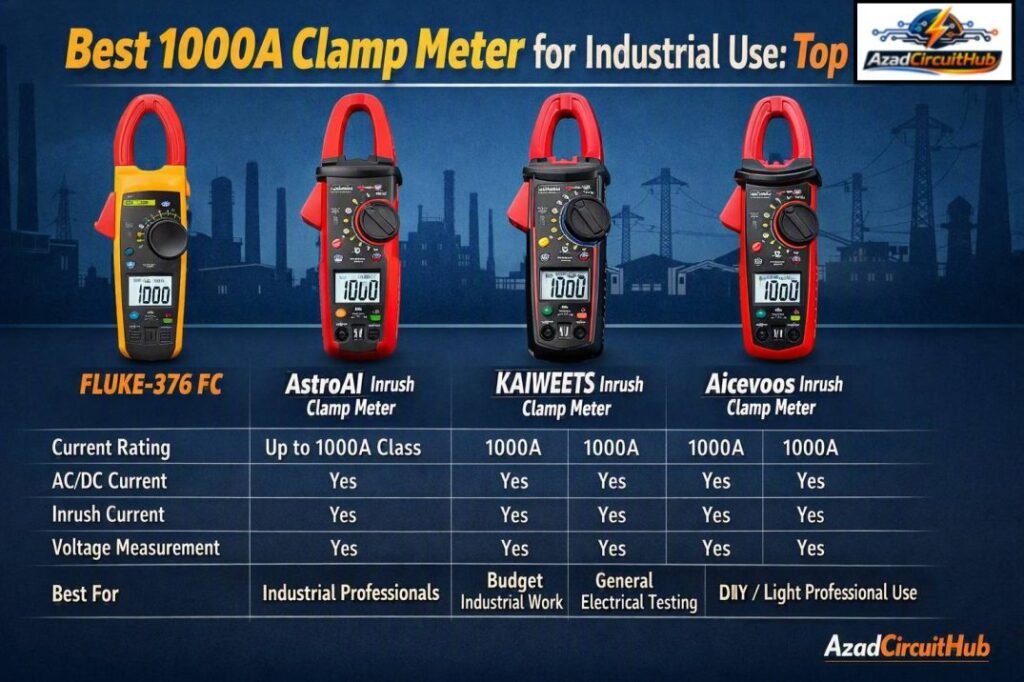
Table of Contents
Table of Contents
What Makes a Good 1000A Clamp Meter?
A 1000A clamp meter is designed to measure high current through a conductor using the magnetic field surrounding the cable. The major advantage is that you normally do not need to open the circuit or place the meter in series.
For industrial troubleshooting, several features deserve particular attention.
| Feature | Why It Matters in Industrial Work |
|---|---|
| 1000A current range | Provides useful capacity for large feeders and equipment |
| AC/DC measurement | Important for industrial, automotive, battery, and solar applications |
| Inrush function | Helps diagnose motor and compressor starting current |
| True RMS | Improves AC measurement on non-linear loads |
| Large jaw opening | Makes clamping around larger conductors easier |
| High CAT rating | Important when working inside electrical distribution systems |
| Voltage measurement | Allows basic circuit troubleshooting with one instrument |
| Resistance and continuity | Useful for general electrical checks |
| Backlit display | Easier reading in panels and plant rooms |
| Data hold | Helps capture readings when the display is difficult to see |
For industrial applications, I would prioritize safety category, AC/DC capability, inrush measurement, and physical construction before choosing extra functions that may rarely be used.
1. FLUKE-376 FC: Best Premium Choice
The FLUKE-376 FC is the strongest choice in this comparison for technicians who regularly perform professional electrical maintenance.
It is designed for AC and DC current measurement and supports high-current troubleshooting. The meter also includes True RMS measurement, inrush current measurement, voltage and resistance functions, and compatibility with the Fluke iFlex flexible current probe.
The iFlex accessory is particularly useful when conventional clamp jaws cannot easily fit around a crowded conductor. It can also make measurements around large conductors more practical in restricted spaces.
Another advantage is Fluke's reputation for industrial test equipment and electrical safety. The 376 FC is intended for demanding environments rather than occasional household testing.
Best for: industrial electricians, maintenance engineers, electrical contractors, plant technicians, and professional troubleshooting. Read complete Fluke 376 FC Clamp Meter Review here.
Why Buy the FLUKE-376 FC?
- High-current AC/DC measurement
- Inrush current measurement
- True RMS capability
- Flexible iFlex current probe compatibility
- Suitable for industrial troubleshooting
- Strong professional reputation
- Designed for electrical maintenance applications
If your work involves motors, MCCs, generators, feeders, and industrial distribution equipment, this is the model I would consider first.
Check the FLUKE-376 FC price on Amazon and compare the current seller price, included accessories, and warranty before ordering.
For readers comparing professional instruments, our best fluke clamp meter for electrician guide covers additional Fluke options for different current ranges and budgets.
2. AstroAI Inrush Digital Clamp Meter 1000A
AstroAI offers a more budget-friendly alternative for users who want high-current measurement without moving into the premium Fluke price range.
This 1000A clamp meter is aimed at electrical testing and troubleshooting and includes functions such as AC/DC current measurement, voltage testing, resistance, continuity, and inrush current measurement, depending on the exact model configuration.
The inrush function is especially useful for motors, compressors, pumps, and other equipment where starting current can be significantly higher than normal running current.
AstroAI is worth considering when the instrument will be used regularly but does not need the same level of professional positioning as a Fluke meter.
Best for: maintenance technicians, electrical hobbyists, automotive users, HVAC work, and budget-conscious professionals.
3. KAIWEETS Inrush Digital Clamp Meter 1000A
KAIWEETS is another attractive option for users looking for a versatile high-current tester at a lower price point.
Its 1000A model is designed around general electrical troubleshooting and provides current, voltage, resistance, and continuity functions. Inrush measurement makes it more useful for motor and compressor diagnostics than a basic current-only clamp meter.
A useful advantage of this type of meter is having several common troubleshooting functions in one instrument. For field technicians who do not want to carry multiple meters for basic checks, that can be convenient.
However, when selecting a KAIWEETS model, pay close attention to the exact CAT rating, measurement specifications, included accessories, and warranty because product configurations can differ.
Best for: general electrical maintenance, HVAC technicians, automotive applications, and occasional industrial troubleshooting.
For a broader comparison of professional and affordable instruments, see our best clamp meter for electricians guide before making a final purchase.
4. Aicevoos Inrush Digital Clamp Meter 1000A
The Aicevoos 1000A clamp meter is positioned as a lower-cost multifunction tester. It is suitable for users who need high-current measurement and common multimeter functions without spending heavily on a premium industrial instrument.
Its inrush function can be useful when investigating the startup behavior of motors and compressors. Voltage, resistance, continuity, and current functions also make it practical for general electrical testing.
I would place this model below the Fluke for demanding professional environments. For occasional maintenance, workshop use, or less intensive troubleshooting, however, it can offer useful functionality for the money.
Best for: basic electrical maintenance, workshop testing, HVAC troubleshooting, and budget users.
1000A Clamp Meter Buying Guide
Choosing the right 1000A clamp meter depends on the type of electrical systems you test.
AC vs DC Current
Do not assume every clamp meter measuring 1000A can measure both AC and DC current.
AC current measurement is common in building distribution, motors, transformers, and industrial feeders. DC current measurement becomes important for batteries, solar PV systems, EV equipment, control systems, and DC power supplies.
If your work covers both conventional power systems and renewable energy, AC/DC capability is a major advantage.
Inrush Current Measurement
Motor starting current can be several times higher than normal running current. A standard current measurement may capture running amperage but miss the short startup event.
An inrush function allows technicians to investigate starting current and compare it against expected equipment behavior.
This can help identify problems such as:
- Motor starting difficulties
- Compressor faults
- Undersized electrical supplies
- Excessive startup current
- Voltage drop during starting
- Weak power connections
Jaw Size
A high current rating is not enough if the jaws cannot physically fit around the conductor.
Before buying, check the manufacturer's specified jaw opening. Large industrial cables, parallel conductors, and busbar arrangements can make conventional clamp meters difficult to position.
The iFlex-compatible FLUKE-376 FC has an advantage here because a flexible current probe can be useful in confined spaces.
Safety Ratings Matter
A high-current instrument should also have an appropriate electrical safety rating.
Look for CAT III or CAT IV ratings appropriate to the installation where the meter will be used. CAT ratings indicate the types of electrical environments for which measurement equipment is designed.
| Work Location | Typical Concern |
|---|---|
| Electronic equipment | Transient protection and suitable measurement category |
| Distribution panels | CAT III suitability is commonly important |
| Building service entrance | CAT IV protection may be required |
| Industrial switchgear | High fault-energy environment requires appropriate CAT rating |
Always follow the meter manufacturer's CAT rating and the safety requirements applicable to your installation.
Never assume that a 1000A rating means the meter is safe to use anywhere current may exceed a particular value. Current capacity and transient-voltage safety are different specifications.
1000A Clamp Meter for Motor Troubleshooting
One of the best uses for a 1000A clamp meter is motor troubleshooting.
A technician can compare the current on individual phases and observe running current under load. Significant imbalance may indicate electrical supply issues, winding problems, connection problems, or mechanical loading.
A practical troubleshooting sequence is:
- Verify the motor nameplate information.
- Check supply voltage.
- Measure each phase current.
- Compare the readings under similar operating conditions.
- Use the inrush function when starting behavior needs investigation.
- Compare results with manufacturer and applicable electrical requirements.
Current measurements should always be interpreted with the actual motor load and operating conditions in mind.
For more buying guidance across different applications, visit our detailed clamp meter reviews covering professional, HVAC, automotive, and electrical troubleshooting instruments.
Which 1000A Clamp Meter Should You Buy?
The best choice depends on how frequently you use the instrument and how demanding your work environment is.
| User | Recommended Model | Reason |
|---|---|---|
| Industrial electrician | FLUKE-376 FC | Professional features and build quality |
| Electrical contractor | FLUKE-376 FC | Broad troubleshooting capability |
| HVAC technician | AstroAI | Inrush measurement at a lower price |
| General maintenance | KAIWEETS | Good multifunction approach |
| Occasional user | Aicevoos | Budget-oriented option |
| Solar/industrial technician | FLUKE-376 FC | AC/DC measurement and flexible probe option |
If your livelihood depends on electrical measurements, the premium Fluke is easier to justify. For occasional testing, one of the lower-cost alternatives may provide enough functionality.
Before purchasing, compare the current Amazon listing, seller rating, warranty, included leads, current probe accessories, and exact model number.
You can also explore our best electrical clamp meter guide if you want to compare additional models rather than limiting your choice to 1000A instruments.
Final Verdict
For serious industrial use, the FLUKE-376 FC is my preferred option from this group. Its combination of AC/DC current measurement, True RMS capability, inrush measurement, professional construction, and iFlex compatibility makes it particularly useful for industrial troubleshooting.
AstroAI, KAIWEETS, and Aicevoos provide lower-cost alternatives for users who need a multifunction clamp meter but do not require the same premium instrument platform.
The key point is to choose based on your actual application. Current range, AC/DC capability, inrush measurement, jaw size, CAT rating, accuracy, and build quality should all be considered before price alone.
Frequently Asked Questions
Is a 1000A clamp meter enough for industrial use?
Yes, a 1000A clamp meter can be suitable for many industrial troubleshooting tasks, including motors, feeders, HVAC equipment, generators, and distribution circuits. However, always check the actual circuit current, conductor arrangement, jaw opening, CAT rating, and manufacturer's measurement limits before use.
Can a 1000A clamp meter measure DC current?
Some models can measure both AC and DC current, while others may be AC-only. The FLUKE-376 FC and the listed multifunction models are designed to provide AC/DC current measurement, but users should verify the exact specification of the model being purchased.
What is inrush current on a clamp meter?
Inrush current is the short-duration current drawn when equipment starts. Motors, compressors, transformers, and some power supplies can draw substantially more current during startup than during normal operation. An inrush function helps capture this starting event.
Is Fluke better than AstroAI, KAIWEETS, and Aicevoos?
For demanding professional electrical work, Fluke generally has the stronger reputation for industrial test equipment, safety engineering, durability, and professional support. The less expensive brands can still be useful when the application is less demanding and their specifications meet the user's requirements.
Can I use a clamp meter on a large industrial cable?
Yes, provided the conductor fits completely inside the clamp and the meter is rated for the electrical environment. The jaw opening must be checked before purchase. For large or difficult-to-access conductors, a flexible current probe such as the iFlex accessory used with compatible Fluke instruments can make measurement easier.
Get new guides in your feed. Follow Electrical Insights on LinkedIn for new electrical standards guides, calculators and design tips from Azad Circuit Hub.
#Best1000AClampMeter, #ClampMeter, #IndustrialClampMeter, #1000AClampMeter, #ElectricalTesting, #ElectricianTools, #IndustrialElectrical, #ACDCClampMeter, #ElectricalMaintenance, #TestEquipment
