
Phase to Phase Clearance Calculator
Electrical panel design depends heavily on maintaining the correct spacing between live conductors. A small mistake in conductor spacing can lead to flashover, insulation breakdown, or short circuits. That is why using a Phase to Phase Clearance Calculator is important for engineers, electricians, and panel builders.
This calculator helps determine the minimum air clearance and creepage distance between conductors based on voltage level and insulation type. It follows standard practices based on IEC 61439-1 and IEC 60664 requirements, making it useful for low-voltage and medium-voltage systems.
Table of Contents
Table of Contents
Whether you are designing switchboards, motor control centers, distribution panels, or busbar chambers, proper electrical clearance ensures safety, compliance, and long-term reliability.
Know more about Phase to Phase Clearance as per IEC 61439
Phase to Phase Clearance Calculator
Phase to Phase Clearance Calculator
Estimate minimum air clearance and creepage distance for phase-to-phase insulation coordination
Design Inputs
Advanced Environmental Settings
Results
How To Use This Calculator
Select Voltage
Choose the rated phase-to-phase system voltage from the dropdown, or select Custom to enter any value manually.
Choose Insulation Type
Pick Functional, Basic, or Reinforced/Double insulation based on the protection level required by your design.
Set Environment (Optional)
Expand Advanced Settings to adjust Pollution Degree and Insulating Material Group. Pollution Degree 3 is used by default.
Read Results
Click Calculate to view minimum clearance, minimum creepage distance, and the relevant standard reference note.
- Clearance
- The shortest distance through air between two conductive parts at different phase potentials.
- Creepage Distance
- The shortest distance along the surface of insulating material between two conductive parts at different phase potentials.
- Pollution Degree
- A classification of the expected micro-environment around the insulation, ranging from PD1 (sealed, no pollution) to PD4 (continuous conductive pollution).
- Insulating Material Group
- A classification based on Comparative Tracking Index (CTI), used to determine the required creepage distance for a given material.
How to Use Phase to Phase Clearance Calculator
Using the Phase to Phase Clearance Calculator is simple. It allows quick calculations for electrical design without manually checking standard tables.
Follow these steps:
- Select the system voltage from the dropdown list.
- Choose the insulation type based on your application.
- Click calculate to get the minimum phase-to-phase clearance.
- Read the creepage distance output for insulation coordination.
- Check the standard reference note for compliance guidance.
Find all about Busbar Clearance as per IEC 61439: Minimum Distance Chart
The calculator assumes pollution degree 3 and indoor panel installation by default. Higher altitude or harsher environmental conditions may require additional correction factors. For those cases, refer to the minimum electrical clearance requirements.
Example Calculation
| Voltage | Insulation Type | Clearance Result |
|---|---|---|
| 415V | Basic Insulation | 8 mm |
| 690V | Reinforced Insulation | 14 mm |
| 11kV | Basic Insulation | 120 mm |
This makes panel spacing calculations faster and reduces design errors.
What Is Phase to Phase Clearance?
Phase to phase clearance is the shortest air gap between two energized conductors of different phases. It is measured through the air and is critical for preventing electrical arcing.
In three-phase systems, the voltage difference between phases is higher than phase-to-neutral. This increases the risk of dielectric breakdown if conductors are too close.
For example:
| System Type | Phase Voltage | Phase-to-Phase Voltage |
|---|---|---|
| Single Phase | 230V | N/A |
| Three Phase | 230V | 415V |
This means a 415V system needs enough clearance to safely withstand voltage stress between phases.
Use our online tool Creepage and Clearance Calculator
Common applications include:
- Switchgear panels
- Busbar trunking
- Motor starters
- Distribution boards
- Transformer terminations
- Cable trays
Proper phase spacing improves safety and equipment life.
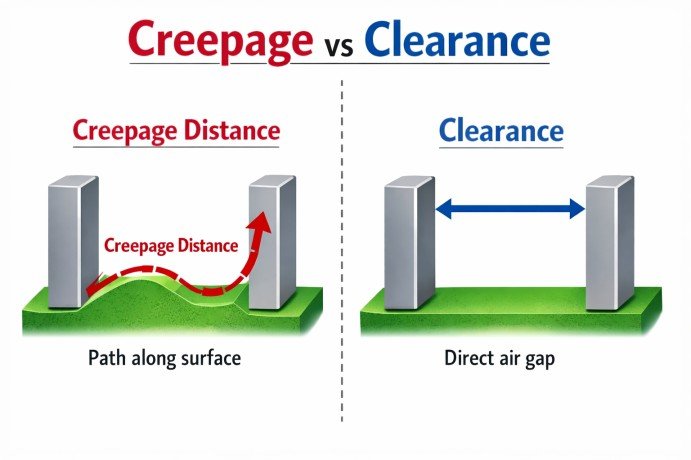
Clearance vs. Creepage Distance
Many people confuse electrical clearance with creepage distance. They are different but equally important.
| Parameter | Clearance | Creepage Distance |
|---|---|---|
| Definition | Shortest air distance between conductors | Shortest path along insulation surface |
| Measured Through | Air | Surface |
| Main Risk | Flashover | Tracking |
| Affected By | Voltage and altitude | Pollution and humidity |
Find all about Phase to Phase Clearance in 132 kV
Clearance
Clearance protects against arcing through air. If the air gap is too small, the voltage may ionize the air and cause flashover.
Example:
Two busbars in a panel separated by 10 mm in air.
Creepage Distance
Creepage protects against current leakage over insulation surfaces. Dust, moisture, and contamination reduce insulation resistance.
Example:
Current traveling along a plastic insulator surface.
Both values are essential for panel design and insulation coordination.
Clearance Chart by Voltage & Insulation Type
The table below provides a quick reference for standard phase-to-phase spacing based on voltage and insulation category.
Basic Insulation
| Voltage | Minimum Clearance (mm) | Minimum Creepage (mm) |
|---|---|---|
| 230V | 3 mm | 5 mm |
| 415V | 8 mm | 10 mm |
| 690V | 10 mm | 14 mm |
| 3.3kV | 40 mm | 50 mm |
| 11kV | 120 mm | 140 mm |
| 33kV | 320 mm | 380 mm |
| 132kV | 1300 mm | 1500 mm |
Know in detail about 33kV Phase to Phase Clearance
Reinforced / Double Insulation
| Voltage | Minimum Clearance (mm) | Minimum Creepage (mm) |
|---|---|---|
| 230V | 6 mm | 8 mm |
| 415V | 12 mm | 16 mm |
| 690V | 14 mm | 20 mm |
| 3.3kV | 60 mm | 80 mm |
| 11kV | 160 mm | 190 mm |
| 33kV | 450 mm | 520 mm |
| 132kV | 1600 mm | 1850 mm |
Functional Insulation
| Voltage | Minimum Clearance (mm) | Minimum Creepage (mm) |
|---|---|---|
| 230V | 2 mm | 3 mm |
| 415V | 5 mm | 8 mm |
| 690V | 8 mm | 10 mm |
| 3.3kV | 30 mm | 40 mm |
| 11kV | 100 mm | 120 mm |
| 33kV | 280 mm | 330 mm |
| 132kV | 1150 mm | 1400 mm |
These values are based on common IEC design practices and should always be verified for project-specific conditions.
Know more about IEC Standard for Busbar Clearance
Factors That Affect Phase to Phase Clearance
The required conductor spacing does not depend on voltage alone. Several other factors influence the final value.
1. System Voltage
Higher voltage requires larger spacing because air breakdown strength is limited.
2. Insulation Category
Basic insulation needs standard spacing, while reinforced insulation needs extra safety margin.
3. Pollution Degree
Dust, oil, moisture, and industrial contamination increase flashover risk.
| Pollution Degree | Environment |
|---|---|
| PD1 | Clean lab conditions |
| PD2 | Office or residential |
| PD3 | Industrial panels |
| PD4 | Outdoor heavy pollution |
Explore in detail IEC 61936 Clearance Table
4. Altitude
At high altitude, air density decreases. Lower air density reduces insulation strength.
Typical correction:
| Altitude | Correction Factor |
|---|---|
| 0–2000m | 1.0 |
| 3000m | 1.14 |
| 4000m | 1.29 |
| 5000m | 1.48 |
5. Installation Type
Indoor switchboards and outdoor substations have different clearance requirements.
Why Proper Phase Clearance Matters
Incorrect electrical clearance can cause serious problems.
| Risk | Impact |
|---|---|
| Arc flash | Equipment damage |
| Short circuit | System outage |
| Flashover | Fire hazard |
| Insulation failure | Reduced reliability |
Benefits of maintaining correct spacing:
- Improves operational safety
- Meets IEC compliance
- Reduces maintenance costs
- Prevents unplanned downtime
- Increases panel life
For critical industrial installations, these factors directly affect performance.
Know more about IEC Standard for Creepage Distance
IEC Standards for Phase Clearance
The calculator mainly follows these standards:
| Standard | Scope |
|---|---|
| IEC 61439-1 | Low-voltage switchgear assemblies |
| IEC 60664-1 | Insulation coordination |
| IEC 62271 | High-voltage switchgear |
| IEC 60529 | Protection against environmental ingress |
These standards define electrical spacing, insulation coordination, dielectric strength, and environmental corrections.
Engineers often cross-check these standards during panel design approval.
Learn more about Phase to Phase Clearance Chart by Voltage Level
Frequently Asked Questions
How is phase to phase clearance calculated?
It is calculated based on operating voltage, insulation type, pollution degree, and installation environment. The calculator uses standard IEC values to simplify this process.
What insulation type should I select for panel design?
Use basic insulation for normal panels, reinforced insulation for higher safety requirements, and functional insulation where only operational insulation is needed.
Does this calculator account for altitude or pollution degree?
The default calculation assumes pollution degree 3 and standard altitude up to 2000 meters. Higher altitude or severe pollution may require correction.
What is the difference between the calculator’s output and the IEC 61439 chart?
The calculator provides a quick practical result based on default assumptions, while the IEC chart offers full engineering detail including environmental adjustments.
Final Thoughts
The Phase to Phase Clearance Calculator is a practical tool for fast and reliable electrical spacing calculations. It helps engineers save time while ensuring compliance with IEC standards.
Instead of manually searching through insulation coordination tables, you can instantly find the required clearance and creepage values for your panel design.
For switchgear, busbar systems, cable terminations, and industrial power panels, accurate spacing is not optional. It is a critical part of electrical safety and system reliability.
Get new guides in your feed. Follow Electrical Insights on LinkedIn for new electrical standards guides, calculators and design tips from Azad Circuit Hub.
PhasetoPhaseClearanceCalculator, #ElectricalClearance, #IEC61439, #BusbarClearance, #VoltageClearanceChart, #ElectricalEngineeringTools, #PanelDesign, #SwitchgearDesign, #ElectricalSafety, #ClearanceCalculator
Phase to Phase Clearance Calculator
Free phase to phase clearance calculator per IEC 61439. Enter voltage and insulation type to get minimum clearance and creepage distance instantly.
Price Currency: USD
Operating System: Web Browser
Application Category: UtilitiesApplication
