
Busbar Clearance as per IEC 61439: Minimum Distance Chart
Minimum Busbar Clearance Chart (by Current Rating)
The table below shows a practical reference for Busbar Clearance as per IEC 61439 based on typical low-voltage panel designs under Pollution Degree 2. While IEC 61439 primarily defines clearance according to voltage and insulation coordination, current rating influences busbar size, heat dissipation, and spacing requirements in real-world applications.
| Current Rating | Minimum Clearance | Minimum Creepage Distance |
|---|---|---|
| Up to 100A | 10 mm | 12.5 mm |
| 101A – 250A | 12 mm | 16 mm |
| 251A – 400A | 14 mm | 20 mm |
| 401A – 630A | 16 mm | 25 mm |
| 631A – 1000A | 20 mm | 32 mm |
| 1001A – 1600A | 25 mm | 40 mm |
| Above 1600A | 30 mm | 50 mm |
This Busbar Clearance as per IEC 61439 chart serves as a general engineering guideline for switchboard manufacturers and panel builders. Actual values may vary depending on system voltage, enclosure design, altitude, and insulation material group. For higher fault levels or harsh environmental conditions, designers often increase clearance beyond the minimum to improve safety and reliability.
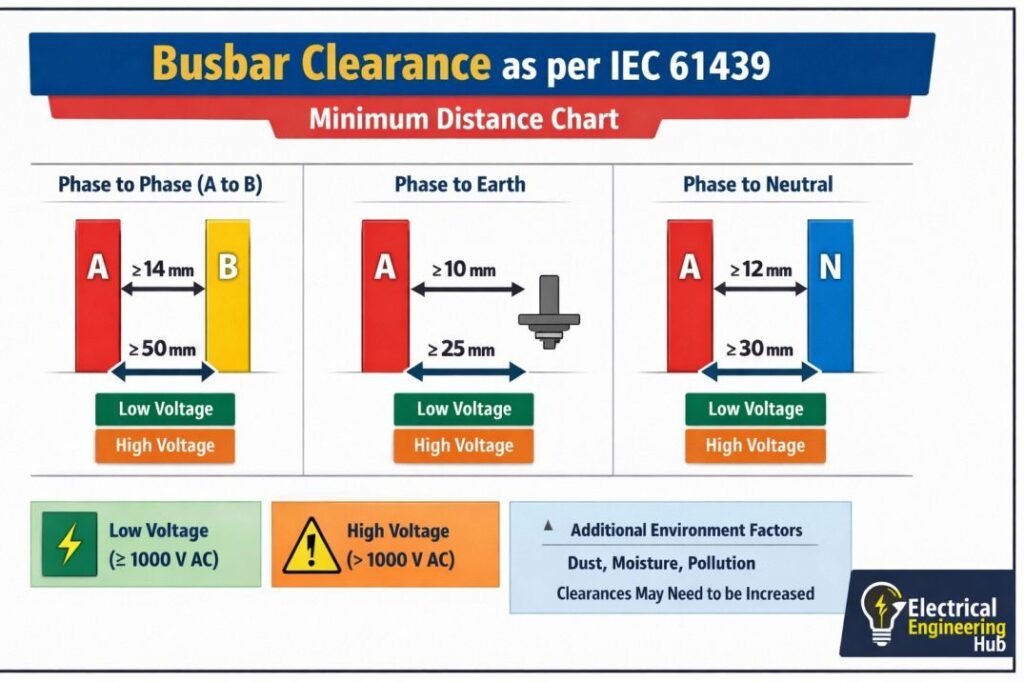
Table of Contents
Table of Contents
Busbar clearance is the minimum safe distance maintained between busbars of different phases, or between a busbar and grounded metal parts, to prevent electrical arcing, flashover, and insulation breakdown.
In electrical panels, switchboards, and busbar trunking systems, busbar clearance as per IEC is very critical to follow. Unlike general phase-to-phase clearance, which applies broadly to conductors in any electrical installation, busbar clearance specifically refers to rigid conductors (busbars) installed inside low-voltage assemblies. Since busbars carry high current in compact spaces, their clearance requirements are more controlled and standardized.
The required busbar clearance depends on several factors, including:
- Rated voltage of the system
- Pollution degree
- Overvoltage category
- Insulation material
- Environmental conditions
For example, in a 415V low-voltage panel, the minimum busbar clearance as per IEC standards is often determined based on insulation coordination and creepage distance requirements. Proper busbar clearance improves system reliability, reduces fault risks, and ensures safe maintenance access.
Busbar Clearance as per IEC 61439
Busbar Clearance as per IEC 61439 defines the minimum spacing required in low-voltage switchgear and controlgear assemblies to maintain safe insulation coordination and prevent flashover. These requirements are especially important for busbars because they are installed in compact enclosed assemblies where high current density, heat buildup, and limited space can increase the risk of electrical failure.
Under Busbar Clearance as per IEC 61439, the required spacing is determined mainly by the rated insulation voltage (Ui), impulse withstand voltage (Uimp), pollution degree, and the insulating material used inside the enclosure. The standard also refers to IEC 60664-1 for detailed insulation coordination rules.
Key Factors Affecting Busbar Clearance
1. Rated Insulation Voltage (Ui)
Higher system voltages require larger air clearances between busbars and grounded parts. For example, a 415V system will have lower clearance requirements than a 690V system.
2. Pollution Degree
Pollution inside the panel directly affects insulation performance. IEC classifies pollution into four degrees:
- Pollution Degree 1: Clean, dry environments with negligible contamination
- Pollution Degree 2: Normal industrial and commercial indoor environments (most common for LV panels)
- Pollution Degree 3: Conductive pollution or high humidity environments
- Pollution Degree 4: Severe contamination such as outdoor exposed installations
As pollution degree increases, the required busbar clearance and creepage distances also increase.
3. Impulse Withstand Voltage (Uimp)
Busbars must withstand transient overvoltages caused by switching operations or lightning surges. Higher Uimp ratings demand greater physical separation.
4. Insulation Material Group
The Comparative Tracking Index (CTI) of insulation supports affects the minimum creepage distance. Better insulation materials may reduce spacing requirements.
Typical IEC 61439 Busbar Clearance Conditions
For most indoor switchboards operating at 400V–415V under Pollution Degree 2, Busbar Clearance as per IEC 61439 is commonly designed as follows:
- Phase-to-phase busbar clearance is generally designed between 10 mm to 14 mm
- Phase-to-earth clearance often follows similar values depending on enclosure design
- Creepage distance is usually greater than air clearance and depends on insulation material
Manufacturers may increase these values for better thermal performance, short-circuit withstand strength, and maintenance safety.
Following Busbar Clearance as per IEC 61439 helps ensure compliance, improves panel longevity, and reduces the risk of insulation failure during normal operation or fault conditions.
Busbar Spacing: Clearance vs. Creepage Distance
In the context of Busbar Clearance as per IEC 61439, it is important to distinguish between two closely related safety parameters: clearance and creepage distance. Although often used interchangeably, they represent different insulation paths within a switchgear assembly.
Clearance refers to the shortest distance through air between two conductive parts, such as between phase-to-phase busbars or between a busbar and an earthed metal enclosure. It is primarily designed to prevent electrical flashover during transient overvoltages.
Creepage distance, on the other hand, is the shortest path along the surface of an insulating material between the same conductors. This becomes critical in environments where dust, moisture, or pollution can create a conductive layer on insulation surfaces.
IEC 61439 evaluates both parameters together under insulation coordination rules defined in IEC 60664-1. While clearance ensures air insulation strength, creepage ensures surface insulation integrity. Proper understanding of both is essential to correctly apply Busbar Clearance as per IEC 61439 in practical panel design and ensure long-term operational safety.
Factors Affecting Busbar Clearance
Several site and design parameters influence Busbar Clearance as per IEC 61439. Higher altitude reduces air density, requiring increased spacing for insulation performance. Enclosure IP rating also affects internal temperature and contamination levels. Busbar orientation (horizontal or vertical) changes heat dissipation and creepage paths. Additionally, pollution degree and ambient humidity directly impact dielectric strength and safe minimum clearances.
| Factor | Impact |
|---|---|
| Altitude | Increase clearance |
| IP rating | Thermal effects |
| Orientation | Heat dissipation |
Proper consideration during panel design ensures compliance, improves safety margins, and maintains reliable operation in line with Busbar Clearance as per IEC 61439 requirements standards basis.
Busbar Clearance vs. Phase-to-Phase Clearance
Busbar clearance and phase-to-phase clearance are closely related concepts under IEC 61439, but they are not identical. Busbar clearance refers to the minimum physical distance maintained around busbars within an enclosure to ensure safe insulation, heat dissipation, and prevention of electrical arcing. It includes spacing to phase, neutral, and earth as well as enclosure boundaries.
Phase-to-phase clearance, on the other hand, specifically defines the minimum distance between two energized conductors of different phases to avoid flashover.
| Parameter | Busbar Clearance | Phase-to-Phase Clearance |
|---|---|---|
| Scope | Overall busbar arrangement in panel | Between live phases only |
| Includes | Phase, earth, enclosure distances | Only phase conductors |
| Purpose | System safety & insulation coordination | Prevent inter-phase flashover |
In practice, phase-to-phase clearance is one part of overall busbar clearance design. For full IEC-based sizing and compliance values, refer back to the detailed section on Busbar Clearance as per IEC 61439.
Related Guides & Tools
- Busbar Current Carrying Capacity Calculator
- IEC Standard for Busbar Clearance
- Busbar Contact Resistance Test Procedure
- Creepage Distance Calculator
- Phase to Phase Clearance as per IEC 61439
- Phase to Phase Clearance Calculator
Frequently Asked Questions
What is the minimum busbar clearance as per IEC 61439?
IEC 61439 does not give a single fixed value. Busbar clearance depends on voltage level, insulation coordination (Ui, Uimp), pollution degree, and design verification. Typical low-voltage clearances range from a few mm up to around 10–20 mm, but final values must follow IEC-based testing and manufacturer design rules.
What is the difference between clearance and creepage distance for busbars?
Clearance is the distance through air between conductors, while creepage distance is the path along an insulating surface. Clearance prevents air flashover, and creepage prevents surface tracking.
Does busbar clearance change with altitude?
Yes. At higher altitudes, air insulation strength decreases, so IEC 61439 requires increased clearances above 2000 m using correction factors.
Get new guides in your feed. Follow Electrical Insights on LinkedIn for new electrical standards guides, calculators and design tips from Azad Circuit Hub.
#BusbarClearance, #IEC61439, #ElectricalStandards, #BusbarDesign, #SwitchgearSafety, #ElectricalEngineering, #PanelDesign, #BusbarSpacing, #IndustrialElectrical, #ElectricalCompliance
