
Solar System Sizing Calculator for Tubewells & Farms
Choosing the correct solar power system for agricultural water pumping is one of the most important decisions for farmers. An oversized system increases project cost, while an undersized system cannot deliver enough water during peak irrigation hours. A Solar System Sizing Calculator for Tubewells helps determine the ideal solar PV capacity, pump size, inverter rating, and expected daily water output based on your farm requirements.
Whether you own a small farm, a commercial agricultural field, or a deep tubewell, this guide explains how solar sizing works, which factors affect system performance, and how a solar water pump sizing calculator helps you design an efficient and cost-effective irrigation system.
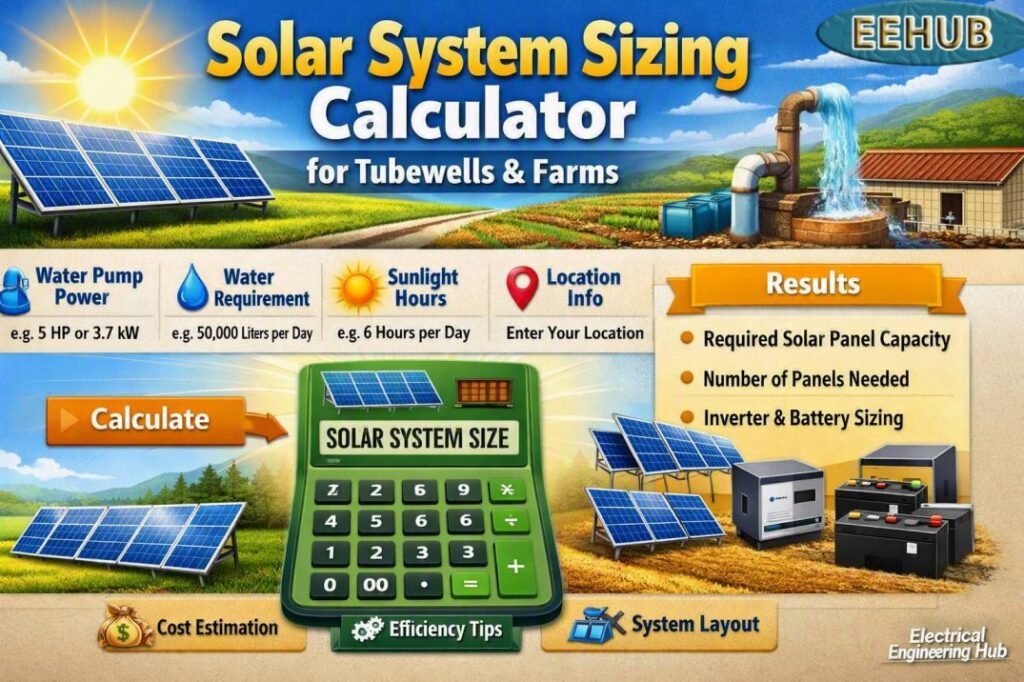
Table of Contents
Table of Contents
Solar System Sizing Calculator for Tubewells & Farms
Farm Power Planning
Solar System Sizing Calculator for Tubewells and Farms
Work out a realistic solar array, inverter and battery size for an agricultural tubewell or farm pump, starting from your actual pump nameplate and pumping schedule rather than a generic rule of thumb.
How to Use This Calculator
- Enter your pump’s nameplate power and how many hours a day you actually run it.
- Set your local peak sun hours, either by picking a general region or typing your own figure if you know it.
- Choose a system loss allowance and an inverter safety margin, or leave the suggested defaults in place.
- If you plan to run the pump on stored battery power rather than direct sun, switch on battery backup and set your backup days.
- Pick a solar panel wattage from the list, or enter a custom wattage if your supplier quoted something different.
- Press Calculate to get your recommended array size, panel count, inverter size and (if selected) battery bank size.
Pump and Load Details
Solar Resource and System Settings
Battery Backup (Optional)
Optional Cost Estimate
| Detail | Value | Notes |
|---|
Technical Notes
The daily energy figure reflects how long your pump actually runs each day, not how large the motor is. A big pump that only runs for two hours can need less energy than a small pump that runs for ten.
The array size is intentionally larger than your raw daily energy need. Real installations lose some output to dust on the panels, heat, cable resistance and inverter conversion, so the loss allowance builds in that margin rather than leaving the system undersized on a hot, hazy afternoon.
The inverter or VFD size is based on the pump’s power draw plus a safety margin, because motors pull noticeably more current for a moment at start-up than they do once running.
If battery backup is switched on, the battery bank is sized around how many days of pumping you want available without fresh sunlight, and how deeply that battery chemistry can safely be discharged. Lithium batteries can be discharged further than lead acid batteries without shortening their life, which is why lithium systems typically need a smaller battery bank for the same backup time.
Panel count is rounded up to the next whole panel, since a fraction of a panel cannot be purchased or installed.
Solar System Sizing Calculator for Tubewells at a Glance
| Parameter | Description |
|---|---|
| Water Requirement | Daily water needed (Liters or Cubic Meters) |
| Pump Power | HP or kW rating |
| Bore Depth | Water table depth |
| Dynamic Head | Total pumping height |
| Solar Irradiance | Peak Sun Hours |
| Solar Panel Capacity | Required PV size (kW) |
| Inverter Rating | Pump-compatible solar inverter |
| Pump Type | Surface or Submersible |
Not sure how many solar panels your tubewell or farm actually needs? Use our Solar Panel Calculator to estimate the required panel quantity based on your daily energy demand and system specifications.
What is a Solar System Sizing Calculator for Tubewells?
A Solar System Sizing Calculator for Tubewells is an engineering tool that estimates the required solar panel capacity for agricultural pumping systems. Instead of selecting solar panels by guesswork, the calculator uses actual operating conditions to recommend an optimized system.
The calculator considers multiple variables, including:
- Pump horsepower
- Motor efficiency
- Pump efficiency
- Daily operating hours
- Water requirement
- Bore depth
- Total Dynamic Head (TDH)
- Local solar radiation
- System losses
Using these values ensures maximum pumping efficiency while reducing installation costs.
Why Proper Solar System Sizing Matters
A properly designed solar irrigation system offers several long-term benefits.
| Correct Sizing | Benefits |
|---|---|
| Higher efficiency | Better water delivery |
| Reduced investment | No unnecessary solar panels |
| Longer equipment life | Lower electrical stress |
| Better ROI | Faster payback period |
| Reliable irrigation | Stable pumping throughout the day |
Incorrect sizing may lead to insufficient water supply, inverter overload, or wasted investment in oversized PV arrays.
Inputs Required for Accurate Solar Sizing
The calculator requires accurate field data before generating results.
| Input | Unit | Importance |
|---|---|---|
| Pump Power | HP or kW | Determines electrical load |
| Bore Depth | Feet or Meters | Calculates pumping head |
| Water Output | Liters/day | Determines energy requirement |
| Pump Efficiency | % | Affects total power |
| Motor Efficiency | % | Improves calculation accuracy |
| Peak Sun Hours | Hours/day | Depends on location |
| Cable Losses | % | Accounts for voltage drop |
| System Losses | % | Includes inverter and panel losses |
Providing correct values improves the accuracy of the final recommendation.
After sizing your complete solar system, the next step is choosing the correct number of PV modules. Try our Solar Panel Calculator to calculate panel requirements accurately before purchasing your solar equipment.
How the Calculator Works
The Solar System Sizing Calculator for Tubewells performs energy calculations based on the pump load and expected operating hours.
The basic sizing process follows these steps:
- Calculate pump energy consumption.
- Add inverter and cable losses.
- Include solar panel derating.
- Divide total daily energy by peak sun hours.
- Add a design safety margin.
Basic Formula
| Calculation | Formula |
|---|---|
| Daily Energy | Pump Power × Operating Hours |
| Required PV Capacity | Daily Energy ÷ Peak Sun Hours |
| Final Solar Size | PV Capacity × Safety Factor |
The safety factor usually ranges from 1.15 to 1.30 depending on environmental conditions.
Example Solar System Sizing
Consider the following farm.
| Parameter | Value |
|---|---|
| Pump Rating | 10 HP |
| Operating Time | 7 Hours |
| Peak Sun Hours | 5.8 Hours |
| Pump Efficiency | 70% |
| Motor Efficiency | 90% |
| System Losses | 15% |
Estimated result:
| Output | Value |
|---|---|
| Daily Energy | Approximately 52 kWh |
| Recommended Solar Array | 12–14 kW |
| Inverter Size | 11–15 kW |
| Suitable Pump | 10 HP Submersible |
The exact output depends on seasonal solar radiation and groundwater level.
Factors That Affect Solar System Size
Several environmental and technical conditions influence the required PV capacity.
Water Table Depth
Deeper groundwater requires more energy because the pump works against greater pressure.
Pump Efficiency
Efficient pumps consume less electricity and reduce solar panel requirements.
Seasonal Solar Irradiance
Winter months usually have fewer sunlight hours than summer. Designing for average annual irradiation improves year-round performance.
Pipe Friction Losses
Long pipelines and undersized pipes increase friction losses, requiring additional pumping energy.
Dust and Temperature
High temperatures and dirty panels reduce solar panel output. Regular cleaning improves overall system efficiency.
Solar Water Pump Sizing Calculator vs Manual Calculations
Many engineers still perform manual sizing using formulas. However, a solar water pump sizing calculator simplifies the process while improving accuracy.
| Manual Method | Calculator |
|---|---|
| Time-consuming | Instant results |
| Higher chance of errors | Accurate calculations |
| Requires engineering experience | User-friendly |
| Difficult to compare options | Multiple scenarios |
| Limited optimization | Optimized PV sizing |
The calculator also allows users to evaluate different pump capacities before making an investment.
Recommended Solar System Sizes
The following table provides approximate recommendations for common agricultural pumps.
| Pump Size | Suggested Solar Capacity |
|---|---|
| 2 HP | 2.5–3 kW |
| 3 HP | 3.5–4.5 kW |
| 5 HP | 6–7 kW |
| 7.5 HP | 9–10 kW |
| 10 HP | 12–14 kW |
| 15 HP | 18–21 kW |
| 20 HP | 24–28 kW |
Actual sizing should always be verified using site-specific calculations.
Tips for Selecting the Right Solar Pump System
Before purchasing equipment, consider these practical recommendations.
- Measure the actual groundwater depth.
- Verify daily irrigation requirements.
- Use high-efficiency solar pumps.
- Choose quality solar panels with proven performance.
- Install a compatible solar pump inverter.
- Minimize cable voltage drop.
- Keep solar panels free from dust and shading.
- Allow room for future expansion if irrigation demand increases.
These practices improve energy production and reduce operating costs.
Benefits of Using a Solar System Sizing Calculator
Using a professional sizing tool provides both technical and financial advantages.
| Benefit | Explanation |
|---|---|
| Accurate Design | Matches system to actual demand |
| Lower Capital Cost | Avoids oversizing |
| Better Water Availability | Reliable irrigation |
| Improved Energy Efficiency | Higher solar utilization |
| Faster Installation | Reduced engineering time |
| Better Financial Planning | Accurate project budgeting |
Proper sizing also improves the long-term reliability of solar-powered irrigation systems.
Conclusion
A Solar System Sizing Calculator for Tubewells is an essential planning tool for farmers, consultants, EPC contractors, and irrigation engineers. It helps determine the correct solar PV capacity, inverter size, and pump requirements based on actual field conditions instead of rough estimates.
By entering accurate data such as pump power, operating hours, bore depth, and solar irradiance, users can design a system that delivers reliable water pumping while minimizing investment costs. Combining these calculations with a solar water pump sizing calculator allows agricultural users to maximize system efficiency, improve crop irrigation, and achieve a faster return on investment.
Frequently Asked Questions
1. What is a Solar System Sizing Calculator for Tubewells?
It is an engineering calculator that estimates the required solar panel capacity, inverter size, and pump configuration for agricultural tubewells using parameters such as pump power, water demand, bore depth, and sunlight hours.
2. How accurate is a solar water pump sizing calculator?
A solar water pump sizing calculator provides highly accurate estimates when correct values for pump efficiency, total dynamic head, operating hours, and solar irradiance are entered.
3. What size solar system is required for a 10 HP tubewell pump?
A typical 10 HP agricultural pump generally requires around 12–14 kW of solar panels, although the exact size depends on pumping head, system losses, and local peak sun hours.
4. Which factors have the biggest impact on solar system sizing?
The most important factors include pump horsepower, water table depth, daily water requirement, total dynamic head, pump efficiency, motor efficiency, and available sunlight.
5. Can the calculator be used for both surface and submersible pumps?
Yes. Most modern calculators support both surface and submersible pumps, provided the correct pump specifications and operating conditions are entered.
Get new guides in your feed. Follow Electrical Insights on LinkedIn for new electrical standards guides, calculators and design tips from Azad Circuit Hub.
SolarSystemSizingCalculatorForTubewells, #SolarPumpCalculator, #SolarTubewell, #FarmSolarSystem, #SolarIrrigation, #SolarEnergy, #RenewableEnergy, #SolarPV, #AgricultureTechnology, #ElectricalEngineering
Solar System Sizing Calculator for Tubewells & Farms
Solar System Sizing Calculator for Tubewells & Farms helps you accurately estimate the required solar PV system size based on pump load, operating hours, and site conditions. Calculate the ideal solar capacity for agricultural irrigation, reduce electricity costs, and optimize solar-powered tubewell performance.
Price Currency: USD
Operating System: Web Browser
Application Category: UtilitiesApplication
