
Street Light Voltage Drop & Cable Size Calculator
Street lighting systems are essential for public safety, visibility, and energy efficiency in modern cities. When designing or installing street lights, one of the most critical electrical parameters to evaluate is the voltage drop in the cable. A small voltage drop ensures that every light in the line receives enough voltage to operate correctly.
The Street Light Voltage Drop Calculator is a practical online tool that helps engineers, electricians, and contractors quickly calculate voltage drop across long cable runs, ensuring optimal performance and compliance with standards.
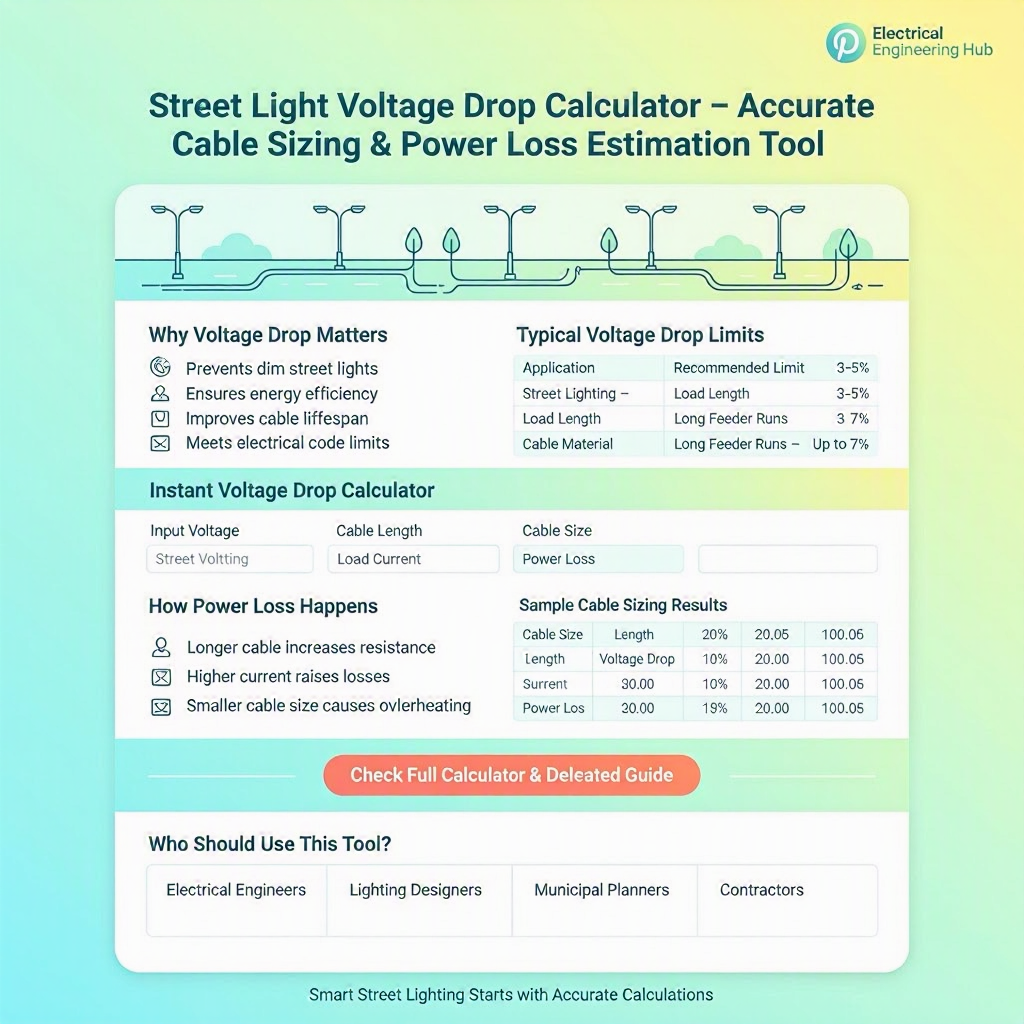
Table of Contents
Table of Contents
Street Light Voltage Drop & Cable Size Calculator
Street Light Voltage Drop & Cable Size Calculator
Work out the voltage drop along a street lighting feeder, check whether a chosen cable size meets your voltage drop limit, or find the smallest standard cable size that will meet it. Supports single-point end loads and uniformly distributed lighting loads, in either metric or imperial units.
System & Load Details
How to Use This Calculator
- Pick a mode: check a specific cable size you already have in mind, or let the calculator recommend the smallest standard size that stays within your voltage drop limit.
- Select your unit system, circuit type, and enter the system voltage supplying the feeder.
- Enter the load per fixture and the number of fixtures on that feeder. The tool totals the load automatically.
- Set the load distribution. Choose Uniformly Distributed if the fixtures are tapped at intervals along the same run, or Single Point Load if the entire load sits at the far end of the cable.
- Enter the total feeder run length, choose the conductor material, and, in Check mode, pick the cable size you want to evaluate.
- Set your maximum allowed voltage drop percentage and press Calculate. Adjust any field and press Calculate again to compare scenarios; the results also update as you change inputs.
Why Voltage Drop Matters for Street Lighting
Street lighting feeders are often long and lightly loaded compared to their length, which makes them especially prone to excessive voltage drop. Fixtures at the far end of a run can receive noticeably less voltage than those near the source, leading to dimmer output, reduced lamp life, and inconsistent brightness across a street.
Distributed vs Single Point Loads
When fixtures are tapped at intervals along one feeder, the effective voltage drop is noticeably less severe than if the same total load sat at the very end of the cable, because current only flows through the full length of cable to the first tap, not to every fixture. This calculator accounts for that difference automatically based on the distribution you select.
Choosing Between Cable Sizes
A cable can be adequately rated for current-carrying capacity and still fail on voltage drop, particularly on long runs. On long street lighting feeders, voltage drop rather than thermal capacity is usually what determines the minimum practical cable size.
Copper vs Aluminum Conductors
Aluminum conductors carry more resistance than copper of the same cross-section, so an aluminum feeder generally needs a larger size than copper to achieve the same voltage drop performance over the same length.
Find more Electrical Engineering Tools for easy electrical calculations and estimations.
What is a Street Light Voltage Drop Calculator
A Street Light Voltage Drop Calculator is a technical tool used to determine how much voltage is lost along the electrical cable that powers street lights. This voltage loss occurs due to the resistance of the wire material and the total current flowing through it. If the voltage drop is too high, street lights will appear dim, operate inefficiently, or even fail to meet illumination standards.
Using a calculator for this purpose removes the need for manual, error-prone calculations. By entering basic inputs like cable length, load current, wire size, and system voltage, the calculator quickly provides an accurate percentage voltage drop and the final voltage at the street light end.
Importance of Calculating Voltage Drop in Street Lighting
Street lighting networks are often spread over long distances, sometimes several hundred meters. A high voltage drop can cause significant light output reduction and energy wastage. In addition, regulatory standards often limit the maximum permissible voltage drop—typically around 3% for lighting circuits.
Here are a few key reasons why the Street Light Voltage Drop Calculator is essential:
- Ensures correct brightness of street lights
- Helps prevent energy losses in distribution cables
- Maintains system reliability and longevity
- Reduces unnecessary maintenance due to under-voltage issues
- Ensures compliance with IEC and IEEE electrical standards
How the Street Light Voltage Drop Calculator Works
The Street Light Voltage Drop Calculator uses standard electrical formulas that consider wire resistance, current flow, and circuit length. The voltage drop (Vdrop) can be calculated using the formula:
Vdrop = (2 × L × I × R) / 1000
Where:
- L = Length of the cable (in meters)
- I = Load current (in amperes)
- R = Resistance per kilometer of the cable (ohm/km)
After calculating the voltage drop, the percentage voltage drop is determined by:
%Vdrop = (Vdrop / Supply Voltage) × 100
The calculator performs these steps instantly when the user enters inputs, saving time and improving accuracy.
How to Calculate Street Light Cable Size
Using a Street Light Voltage Drop Calculator helps determine the correct cable size by considering load current, cable length, and allowable voltage drop. First, calculate total wattage of all street lights, then convert it into current using system voltage. Next, measure the total cable run distance and select the conductor material (copper or aluminum). Finally, use the voltage drop formula to find the minimum cable size.
| Load (kW) | Distance (m) | Recommended Cable Size |
|---|---|---|
| 1.5 | 50 | 4 mm² |
| 3.0 | 100 | 10 mm² |
| 5.5 | 150 | 16 mm² |
Proper sizing improves safety and reduces power losses. Know more about How to Size Cable for Street Lighting Circuits
Voltage Drop Formula for Street Lighting Circuits
The Street Light Voltage Drop Calculator uses a standard formula to estimate voltage loss across lighting cables. For single-phase street lighting circuits, the formula is:
| Formula | Description |
|---|---|
| Vd = (2 × L × I × R) / 1000 | Voltage drop in volts |
Where:
- L = Cable length (meters)
- I = Load current (amps)
- R = Cable resistance (Ω/km)
For three-phase street lighting:
| Formula |
|---|
| Vd = (√3 × L × I × R) / 1000 |
This formula helps engineers select the correct cable size, improve lighting efficiency, and maintain acceptable voltage levels in long street lighting networks.
Parameters Used in the Street Light Voltage Drop Calculator
The following input parameters are typically required in the Street Light Voltage Drop Calculator:
| Parameter | Description | Unit |
|---|---|---|
| Supply Voltage | The main system voltage (e.g., 230V or 400V) | Volts |
| Cable Length | Total one-way length of the cable | Meters |
| Load Current | Current drawn by the street light or lighting branch | Amperes |
| Cable Size | Cross-sectional area of the conductor | mm² |
| Conductor Type | Material of the wire, such as copper or aluminum | Type |
| Power Factor | Ratio of real power to apparent power | Decimal |
The calculator uses these inputs to compute the total voltage drop and the final voltage at the load end.
Example Calculation Using Street Light Voltage Drop Calculator
Suppose a street light circuit is powered by a 230V supply. The load current per pole is 5A, the cable length is 150 meters, and the cable type is copper with a size of 4mm².
The resistance of a 4mm² copper cable is approximately 4.61 ohms/km.
Voltage drop can be estimated as:
Vdrop = (2 × 150 × 5 × 4.61) / 1000 = 6.915V
Percentage drop = (6.915 / 230) × 100 = 3.00%
This means that the voltage at the light end will be around 223.1V, which is within acceptable limits for a lighting circuit. The Street Light Voltage Drop Calculator performs this calculation automatically, providing results in seconds. Learn more about Landscape Lighting Cable Size calculation (12V & 24V Systems)
Factors Affecting Voltage Drop in Street Lighting
Several factors can influence voltage drop in street lighting installations:
- Cable Size: Smaller cables have higher resistance and therefore greater voltage drop.
- Cable Length: Longer runs result in higher voltage losses.
- Load Current: Heavier loads increase the voltage drop due to greater current flow.
- Conductor Material: Copper has lower resistance compared to aluminum, reducing voltage drop.
- Temperature: Cable resistance increases with temperature, slightly increasing voltage loss.
By using the Street Light Voltage Drop Calculator, these variables can be adjusted to optimize the cable design and minimize energy losses.
Selecting Proper Cable Size Using Voltage Drop Results
Choosing the correct cable size is a critical step in street lighting design. The calculator helps in determining whether the selected cable meets the acceptable voltage drop range.
| Cable Size (mm²) | Typical Current Capacity (A) | Resistance (Ω/km) | Recommended Max Length for 5A Load (230V, 3% Drop) |
|---|---|---|---|
| 2.5 | 20 | 7.41 | 93 m |
| 4 | 26 | 4.61 | 150 m |
| 6 | 34 | 3.08 | 225 m |
| 10 | 46 | 1.83 | 375 m |
| 16 | 61 | 1.15 | 600 m |
This table provides a quick reference for designers to choose the right cable for a particular street light run. The Street Light Voltage Drop Calculator automates this selection by displaying results dynamically.
Street Light Cable Size Chart
A practical Street Light Cable Size Chart helps electricians choose the right conductor size based on load current, distance, and voltage drop. When using a street light cable size calculator, this chart gives a quick starting point before final verification.
| Load (W) | Distance (m) | Current (A) | Recommended Cable |
|---|---|---|---|
| 100W | 30m | 0.45A | 1.5 mm² |
| 250W | 50m | 1.14A | 2.5 mm² |
| 400W | 80m | 1.82A | 4 mm² |
| 1000W | 100m | 4.55A | 6 mm² |
Always confirm cable size using your street light cable size calculator for exact installation conditions.
Recommended Cable Size Chart (by Wattage, Distance, Voltage)
Choosing the correct cable size is essential to minimize voltage drop and maintain efficient street light performance. While a Street Light Voltage Drop Calculator gives precise values, the chart below provides a quick reference for common installations.
| Load (Watts) | Voltage | Distance (m) | Recommended Cable Size |
|---|---|---|---|
| 50W | 230V | 30m | 1.5 mm² |
| 100W | 230V | 50m | 2.5 mm² |
| 150W | 230V | 80m | 4 mm² |
| 250W | 230V | 120m | 6 mm² |
| 400W | 230V | 150m | 10 mm² |
Always verify actual load current, cable material, and allowable voltage drop before final selection.
Download Free XLS Calculator
For quick offline calculations, you can download our Street Light Voltage Drop Calculator in Excel format and estimate voltage drop, cable size, and load current without using an online tool. This free XLS sheet is ideal for electrical engineers, contractors, and maintenance teams working on street lighting projects.
| Feature | Included |
|---|---|
| Voltage Drop Calculation | Yes |
| Cable Size Selection | Yes |
| Load Current Estimation | Yes |
| Distance-Based Calculation | Yes |
Use this spreadsheet to simplify field calculations and improve cable sizing accuracy for long-distance street light installations.
Benefits of Using the Street Light Voltage Drop Calculator
- Saves Time: Instantly provides results without manual computation.
- Improves Accuracy: Minimizes human error in voltage drop estimation.
- Enhances Design Quality: Helps in choosing appropriate cable sizes for efficiency.
- Ensures Compliance: Assists in meeting IEC 60364 or NEC voltage drop standards.
- Supports Cost Optimization: Prevents over-sizing of cables, saving project costs.
Using this tool regularly during planning and maintenance ensures the lighting infrastructure remains reliable and energy-efficient.
Applications of Street Light Voltage Drop Calculator
The calculator is used across multiple sectors and design stages. Common applications include:
- City street lighting design projects
- Solar-powered street light systems
- LED retrofitting and upgrades
- Industrial area lighting networks
- Highway and expressway illumination systems
Engineers can use it both for initial cable sizing and for verifying existing installations.
Tips for Reducing Voltage Drop in Street Light Systems
To maintain efficient lighting levels, consider these design practices:
- Use copper conductors instead of aluminum for long distances
- Increase the cable cross-section when current or distance increases
- Use higher supply voltages for long runs to reduce current
- Distribute loads evenly across multiple circuits
- Periodically check connections to prevent contact resistance
These small steps can help achieve better performance and lower energy losses.
Why You Should Use Our Street Light Voltage Drop Calculator
Our Street Light Voltage Drop Calculator has been developed to simplify complex engineering calculations for practical field use. It is optimized for accuracy, quick response, and mobile compatibility. The tool allows users to test different cable sizes, materials, and load values instantly.
By integrating it into your design workflow, you can ensure that every street light receives proper voltage, improve lighting uniformity, and comply with design standards — all while reducing overall installation costs.
Conclusion
The Street Light Voltage Drop Calculator is an essential design companion for electrical engineers, contractors, and maintenance professionals. It makes voltage drop analysis easy, fast, and precise, ensuring efficient energy distribution in street lighting networks.
Whether you are planning a new lighting system or analyzing an existing one, this calculator helps you make accurate cable selections, maintain proper illumination levels, and comply with voltage drop regulations. By using this tool, you can ensure reliability, energy efficiency, and long-term sustainability of street lighting systems.
Follow Us on Social:
Subscribe our Newsletter on Electrical Insights for latest updates from Electrical Engineering Hub
#StreetLightVoltageDropCalculator, #VoltageDropCalculator, #StreetLightingDesign, #OutdoorLighting, #ElectricalCalculator, #VoltageDrop, #LightingEfficiency, #CableSizing, #ElectricalEngineering, #PowerDistribution, #LEDStreetLight, #EnergyOptimization, #LightingLoad, #VoltageLoss, #SmartStreetLighting
Street Light Voltage Drop & Cable Size Calculator
Use our Street Light Voltage Drop Calculator to accurately estimate voltage loss and select the right cable size for your street lighting system. Improve lighting efficiency, prevent energy loss, and ensure compliance with IEC standards
Price Currency: USD
Operating System: All
Application Category: UtilitiesApplication
