
Bus Bar Heat Capacity Calculator
When designing electrical systems, temperature rise inside conductors is one of the most important factors to monitor. A Bus Bar Heat Capacity Calculator helps engineers estimate how much thermal energy a busbar can absorb before reaching its maximum safe operating temperature. This calculation plays a major role in switchgear design, panel boards, substations, and industrial distribution systems.
Busbars carry high current, and their thermal behavior directly affects performance, safety, and lifespan. If the heat generated exceeds the allowable limit, insulation damage, expansion stress, and system failure can occur.
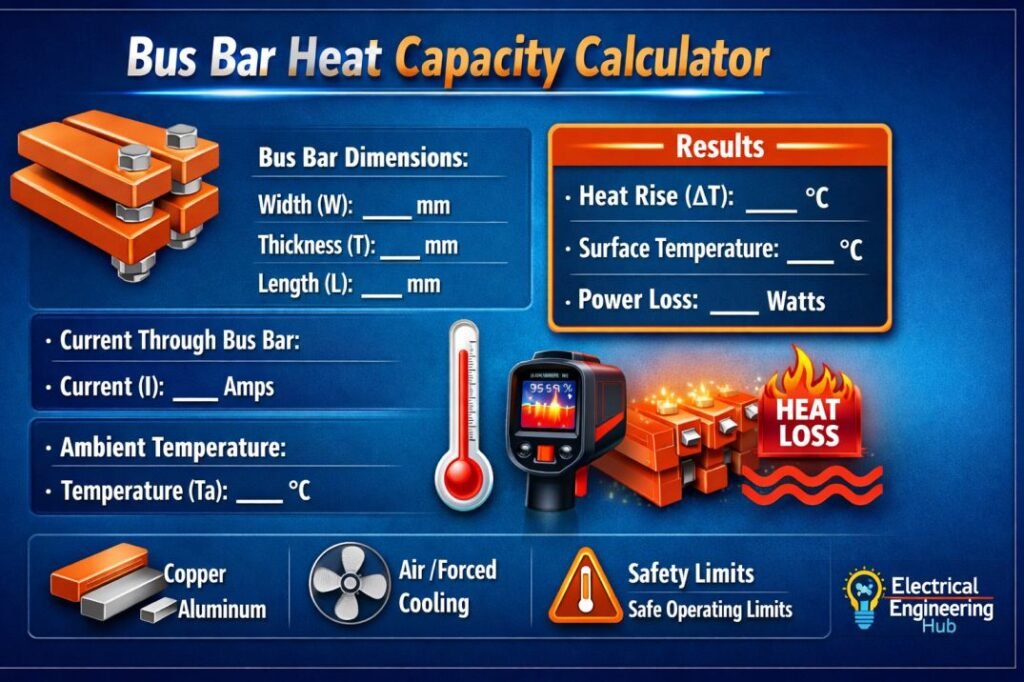
Table of Contents
Table of Contents
Bus Bar Heat Capacity Calculator
Estimate short-circuit thermal withstand current and heat energy absorbed by a copper or aluminum bus bar under fault conditions.
Bus Bar Configuration
Thermal Conditions
Results
How to Use
- Select the bus bar material, either copper or aluminum.
- Enter the width and thickness of a single bar in millimeters, and the number of bars connected in parallel per phase.
- Enter the normal operating temperature of the bar before a fault occurs, and the maximum final temperature the bar, supports, and joints are permitted to reach.
- Enter the expected fault clearing time in seconds, based on the protective relay and breaker settings used in the installation.
- Enter a bar length if you want the heat energy result expressed for a specific span, such as one meter or the full busbar run.
- Click Calculate Heat Capacity to view the short-circuit withstand current, current density, absorbed heat energy, and resulting temperature rise.
- Adjust bar dimensions or number of parallel bars and recalculate to compare configurations before finalizing a design.
Technical Notes
During a short-circuit fault, current flowing through a bus bar generates heat far faster than it can be dissipated to the surrounding air. Because the fault duration is short, the heating process is treated as adiabatic, meaning essentially all of the electrical energy generated is absorbed by the metal itself rather than escaping through convection or radiation.
The amount of heat a bus bar can safely absorb depends on its mass, its specific heat capacity, and how much its temperature is allowed to rise before reaching a limit set by insulation, support structures, or joint materials. A larger cross-section gives the bar more thermal mass, allowing it to absorb more energy for the same temperature rise, which is why short-circuit withstand current scales with bar size.
Copper and aluminum behave differently under fault conditions. Copper has a higher density and a more favorable combination of electrical and thermal properties, which generally allows it to sustain a higher fault current for a given cross-section compared to aluminum of the same size.
The permitted final temperature should reflect the weakest link in the bus bar system. Bolted joints, silver-plated contact surfaces, and any nearby insulation or support insulators typically limit the allowable temperature rise well below the melting point of the conductor material itself.
- Results assume uniform current distribution across the bar cross-section, with no significant skin or proximity effect correction.
- Results assume a fully adiabatic process, which is reasonably accurate for fault durations of a few seconds or less.
- Joint resistance, surface oxidation, and contact heating are not included and should be assessed separately during detailed design.
- This tool provides an engineering estimate for preliminary sizing and should be verified against the applicable design standard and equipment manufacturer data before finalizing a bus bar system.
Find more Electrical Engineering Tools for easy electrical calculations and estimations.
This guide explains how a Bus Bar Heat Capacity Calculator works, why it matters, and how to calculate busbar thermal capacity accurately.
What is a Bus Bar Heat Capacity Calculator?
A Bus Bar Heat Capacity Calculator is a tool used to determine the amount of heat energy a busbar can withstand under electrical load or short-circuit conditions. It calculates the thermal storage capability based on material properties, dimensions, and temperature limits.
The calculator helps in:
- Short circuit thermal withstand analysis
- Busbar sizing
- Current carrying capacity estimation
- Temperature rise calculation
- Electrical panel safety assessment
Busbars are usually made of copper or aluminum, both of which have different heat capacities and conductivity values.
Why Bus Bar Heat Capacity Matters
Heat capacity defines how much thermal energy is required to increase the temperature of the busbar material by one degree.
In practical applications, this is important because:
| Factor | Impact |
|---|---|
| High Current Flow | Produces resistive heating |
| Fault Current | Creates extreme thermal stress |
| Poor Ventilation | Increases heat accumulation |
| Undersized Busbars | Leads to overheating |
| Material Selection | Affects heat dissipation |
A properly sized busbar improves efficiency and prevents unexpected failures.
Bus Bar Heat Capacity Formula
The standard formula used in a Bus Bar Heat Capacity Calculator is:
Heat Capacity (Q) = m × c × ΔT
Where:
| Symbol | Meaning |
|---|---|
| Q | Heat energy (Joules) |
| m | Mass of busbar (kg) |
| c | Specific heat capacity (J/kg°C) |
| ΔT | Temperature rise (°C) |
This formula calculates how much heat the busbar can absorb before reaching a certain temperature.
Bus Bar Heat Capacity Calculation Example
Consider a copper busbar with:
- Mass = 4 kg
- Specific heat = 385 J/kg°C
- Temperature rise = 60°C
Calculation:
Q = 4 × 385 × 60
Q = 92,400 Joules
This means the busbar can absorb 92.4 kJ of heat before its temperature rises by 60°C.
How to Calculate Temperature Rise in a Busbar
A busbar temperature rise calculation estimates how much hotter a busbar becomes than the surrounding ambient air when carrying current. The basic approach is to determine the heat generated by electrical resistance and compare it with the busbar’s ability to dissipate heat.
| Parameter | Formula / Typical Input |
|---|---|
| Heat generated | P = I²R |
| Temperature rise | ΔT = Tbusbar − Tambient |
| Busbar resistance | R = ρL/A |
| Final busbar temperature | Tambient + ΔT |
For example, if ambient temperature is 35°C and the calculated rise is 40°C, the busbar reaches approximately 75°C. Actual results depend on material, cross-sectional area, enclosure, airflow, surface finish, and installation arrangement. For detailed follow our guide on busbar temperature rise calculation here.
Temperature Rise Limits for Busbars
Temperature rise is an important factor when selecting busbar dimensions and checking thermal performance. Excessive heating can damage insulation, loosen connections, and reduce equipment life. The allowable rise depends on the busbar material, enclosure, ambient temperature, and applicable standard.
| Factor | Effect on Temperature Rise |
|---|---|
| Higher current | Increases heating |
| Smaller busbar | Increases temperature |
| Poor ventilation | Raises operating temperature |
| Higher ambient temperature | Reduces thermal margin |
A Bus Bar Heat Capacity Calculator can help estimate heating and current-carrying capacity during design. For practical guidance on allowable operating temperatures and temperature rise limits for busbars, review the related detailed calculation guide before finalizing busbar dimensions.
Specific Heat Capacity of Common Busbar Materials
Material selection has a direct effect on thermal performance.
| Material | Specific Heat Capacity (J/kg°C) | Conductivity |
|---|---|---|
| Copper | 385 | Very High |
| Aluminum | 897 | High |
| Brass | 380 | Medium |
| Steel | 490 | Low |
Copper offers better conductivity, but aluminum provides a higher heat storage capacity.
Factors Affecting Bus Bar Heating
A Bus Bar Heat Capacity Calculator becomes more accurate when these factors are considered.
Current Magnitude
Higher current increases I²R losses, generating more heat.
Busbar Dimensions
Larger cross-sectional area reduces resistance and lowers heat generation.
Material Resistivity
Lower resistance materials like copper produce less heat.
Ambient Temperature
Higher surrounding temperature reduces cooling efficiency.
Installation Method
Enclosed panels trap heat more than open-air systems.
Bus Bar Heat Capacity and Short Circuit Withstand
During short circuits, busbars face very high thermal stress for a short duration. Heat capacity determines whether the conductor survives without damage.
The adiabatic formula is commonly used:
I²t = K²S²
Where:
| Symbol | Meaning |
|---|---|
| I | Fault current |
| t | Time duration |
| K | Material constant |
| S | Cross-sectional area |
This formula helps verify if the busbar can survive fault conditions.
Typical K Values
| Material | K Value |
|---|---|
| Copper | 143 |
| Aluminum | 94 |
This is essential for protection coordination and breaker selection.
How to Use a Bus Bar Heat Capacity Calculator
Using a Bus Bar Heat Capacity Calculator is simple if you have the right inputs.
Required Inputs
- Busbar material
- Width
- Thickness
- Length
- Current load
- Initial temperature
- Maximum allowable temperature
Calculation Process
- Calculate busbar volume
- Convert volume into mass
- Use material density
- Apply heat capacity formula
- Determine thermal withstand level
This process gives a clear idea of operating limits.
Key Takeaways
- A Bus Bar Heat Capacity Calculator helps determine thermal energy absorption.
- Heat capacity depends on mass, material, and temperature rise.
- Copper and aluminum are the most common busbar materials.
- Short circuit thermal withstand is critical for safe design.
- Proper busbar sizing reduces overheating risks.
- Installation environment affects temperature rise.
- Thermal calculations improve system reliability and lifespan.
Practical Busbar Sizing Reference
Below is a quick reference for common busbar sizes.
| Busbar Size (mm) | Current Rating (Approx) | Material |
|---|---|---|
| 25 × 3 | 150 A | Copper |
| 40 × 5 | 400 A | Copper |
| 50 × 6 | 600 A | Copper |
| 75 × 10 | 1200 A | Copper |
| 100 × 10 | 1600 A | Copper |
Actual ratings depend on ventilation and spacing.
Benefits of Using a Bus Bar Heat Capacity Calculator
Using this calculator offers several practical advantages.
Improved Safety
Prevents overheating and fire hazards.
Better System Reliability
Reduces equipment failures caused by thermal stress.
Optimized Material Cost
Avoids oversizing and unnecessary expenses.
Accurate Fault Analysis
Improves short circuit withstand verification.
Compliance with Standards
Supports IEC and IEEE design practices.
These benefits are especially useful in industrial plants, substations, and renewable energy installations.
Common Mistakes in Busbar Thermal Calculation
Many designers make these mistakes:
- Ignoring ambient temperature
- Using incorrect material constants
- Overlooking fault duration
- Neglecting ventilation effects
- Selecting undersized busbars
Avoiding these errors improves accuracy significantly.
Related Guides & Tools
- Busbar Current Carrying Capacity Calculator
- IEC Standard for Busbar Clearance
- Busbar Contact Resistance Test Procedure
- Creepage Distance Calculator
- Busbar Size Calculator According to IEC and NEC
Conclusion
A Bus Bar Heat Capacity Calculator is a valuable engineering tool for safe electrical system design. It helps calculate thermal energy absorption, estimate temperature rise, and verify short-circuit withstand capability. Proper busbar thermal analysis ensures better performance, longer equipment life, and reduced maintenance costs.
Frequently Asked Questions
How do you calculate busbar heat capacity?
Use the formula Q = m × c × ΔT, where mass, specific heat, and temperature rise are multiplied.
Which material has better busbar thermal performance?
Copper has better conductivity, while aluminum has a higher specific heat capacity.
Why is busbar temperature rise important?
It prevents insulation damage, efficiency loss, and equipment failure.
Can a Bus Bar Heat Capacity Calculator help with short circuit analysis?
Yes, it helps estimate thermal withstand during fault conditions.
What is the normal operating temperature of a busbar?
Most busbars operate between 65°C and 105°C depending on insulation class and standards.
Get new guides in your feed. Follow Electrical Insights on LinkedIn for new electrical standards guides, calculators and design tips from Azad Circuit Hub.
#BusBarHeatCapacityCalculator,#BusBarCalculator,#ElectricalCalculations,#BusBarSizing,#PowerEngineering,#ElectricalTools,#HeatCapacity,#BusBarDesign,#ElectricalEngineering,#CurrentCarryingCapacity
Bus Bar Heat Capacity Calculator
Use the Bus Bar Heat Capacity Calculator to estimate thermal capacity, improve busbar sizing accuracy, and ensure safe electrical system design.
Price Currency: USD
Operating System: Web Browser
Application Category: UtilitiesApplication
