
NEC vs IEC vs CEC Busbar Sizing: Important Differences
Selecting the correct busbar size is not only about current-carrying capacity. Different electrical standards use different design philosophies, safety margins, temperature limits, and installation requirements. Understanding these differences helps engineers, contractors, panel builders, and consultants design compliant electrical distribution systems for their region.
If you need to calculate conductor dimensions before comparing standards, use our Busbar Size Calculator According to IEC and NEC to determine the required busbar size based on electrical load and installation conditions.
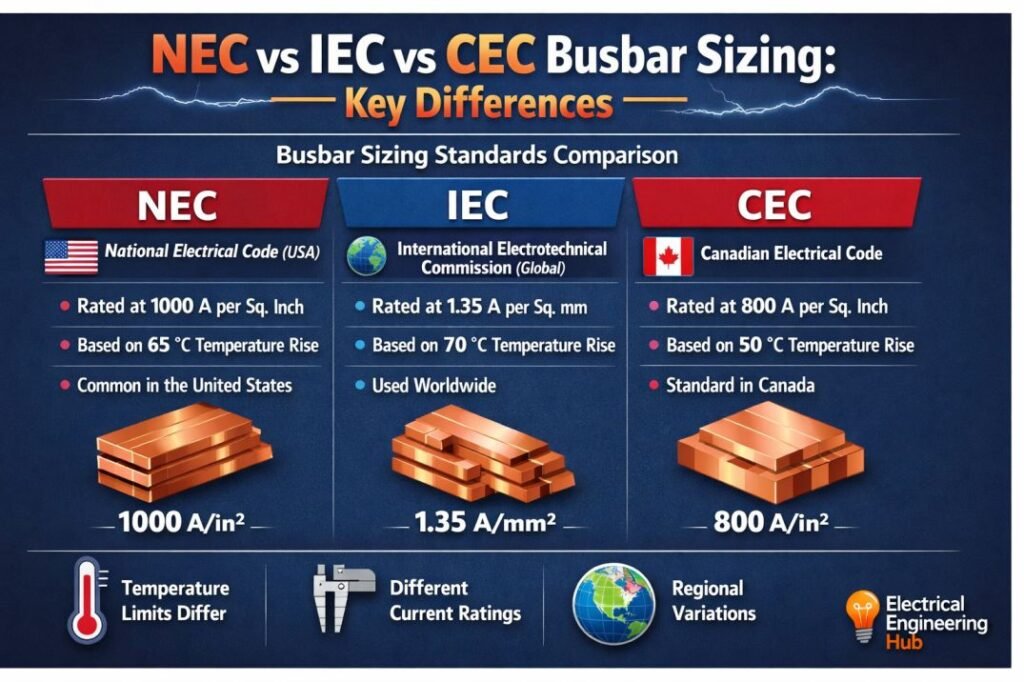
Table of Contents
Table of Contents
NEC vs IEC vs CEC Busbar Sizing at a Glance
| Feature | NEC | IEC | CEC |
|---|---|---|---|
| Primary Region | United States | Europe, Asia, Middle East | Canada |
| Governing Organization | NFPA | IEC | CSA Group |
| Main Focus | Electrical safety | Performance and international harmonization | Canadian electrical safety |
| Temperature Consideration | Installation based | Material and ambient dependent | Similar to NEC with Canadian amendments |
| Ampacity Method | Tables and manufacturer data | Calculations and testing | Code tables and CSA requirements |
| Common Applications | Commercial and Industrial | Global Industrial Projects | Residential, Commercial and Industrial |
Quick Comparison Chart
| Parameter | NEC | IEC | CEC |
|---|---|---|---|
| Copper Busbars | Yes | Yes | Yes |
| Aluminum Busbars | Yes | Yes | Yes |
| Short Circuit Verification | Required | Detailed Calculation | Required |
| Derating Factors | Limited | Extensive | Moderate |
| Global Acceptance | Medium | Very High | Canada Only |
What Is NEC vs IEC vs CEC Busbar Sizing?
NEC vs IEC vs CEC Busbar Sizing refers to comparing the three major electrical standards used worldwide for selecting busbar dimensions, ampacity, temperature limits, insulation clearances, and safety requirements.
Although all three standards aim to ensure safe power distribution, they use different approaches for determining acceptable current ratings and installation practices. Choosing the correct standard depends on the project location and local regulatory requirements.
Why Different Standards Exist
Electrical systems operate under different climates, utility practices, installation methods, and regulatory frameworks across countries. Because of these differences, each organization has developed its own design requirements.
| Standard | Used In |
|---|---|
| NEC | USA and many American projects |
| IEC | Europe, Middle East, Asia, Africa and international EPC projects |
| CEC | Canada |
Many multinational engineering companies work with all three standards depending on project specifications.
NEC Busbar Sizing Approach
The National Electrical Code focuses primarily on electrical safety rather than providing detailed busbar sizing formulas.
Typical NEC design considers:
- Continuous current
- Temperature rating
- Enclosure type
- Installation environment
- Conductor material
- Manufacturer recommendations
NEC often references equipment listings and manufacturer-certified ratings instead of prescribing exact busbar dimensions.
For practical sizing calculations, engineers frequently rely on a busbar sizing calculator based on IEC and NEC requirements before selecting commercially available busbars.
IEC Busbar Sizing Approach
IEC standards provide a more calculation-oriented methodology.
Engineers typically evaluate:
- Current density
- Permissible temperature rise
- Ambient temperature
- Skin effect
- Proximity effect
- Cooling conditions
- Busbar orientation
- Short-circuit thermal withstand
IEC allows more engineering flexibility because calculations can be adapted to different operating environments.
This makes IEC popular in international infrastructure, utility, renewable energy, petrochemical, and manufacturing projects.
CEC Busbar Sizing Approach
The Canadian Electrical Code shares many similarities with NEC but incorporates Canadian climatic conditions and CSA equipment requirements.
CEC emphasizes:
- Electrical safety
- CSA-certified equipment
- Temperature correction
- Installation practices
- Local utility regulations
Canadian industrial facilities often use manufacturer data together with CSA and CEC requirements when selecting busbars.
Major Differences Between NEC, IEC, and CEC
| Design Factor | NEC | IEC | CEC |
|---|---|---|---|
| Design Philosophy | Code Compliance | Engineering Calculation | Safety Compliance |
| Current Density Formula | Limited | Extensive | Moderate |
| Thermal Analysis | Basic | Detailed | Moderate |
| International Acceptance | Low | Very High | Canada |
| Manufacturer Dependence | High | Moderate | High |
Current Density Comparison
One of the biggest differences lies in current density calculations.
- IEC commonly uses engineering calculations to determine acceptable current density based on operating temperature.
- NEC generally relies more on equipment listings and tested ratings.
- CEC combines code requirements with CSA-approved equipment data.
- As a result, two engineers designing identical switchboards under different standards may select different busbar dimensions.
Temperature Rise Considerations
Temperature directly affects busbar performance.
IEC provides detailed guidance for evaluating:
- Ambient temperature
- Enclosure heating
- Natural cooling
- Forced ventilation
- Maximum conductor temperature
NEC generally expects listed equipment to comply with acceptable temperature limits.
CEC follows similar principles while referencing CSA-certified equipment.
Short Circuit Requirements
Busbars must withstand fault current without permanent deformation.
| Standard | Short Circuit Verification |
|---|---|
| NEC | Equipment listing and ratings |
| IEC | Thermal and dynamic calculations |
| CEC | CSA equipment ratings |
IEC usually requires more engineering calculations during switchgear design.
Clearance and Creepage Differences
Electrical clearance requirements also vary.
IEC provides detailed insulation coordination based on:
- Pollution degree
- Altitude
- Rated voltage
- Overvoltage category
NEC focuses on equipment installation requirements.
CEC aligns closely with CSA product standards.
Proper clearance selection reduces flashover risks and improves long-term reliability.
Material Selection Under Different Standards
All three standards permit copper and aluminum busbars.
| Material | Advantages |
|---|---|
| Copper | High conductivity, compact size, excellent mechanical strength |
| Aluminum | Lower cost, lightweight, larger cross-section required |
Copper remains the preferred choice for high-current switchboards, substations, and industrial motor control centers.
Which Standard Should You Follow?
The correct standard depends on project location and client specifications.
| Project Location | Recommended Standard |
|---|---|
| United States | NEC |
| Canada | CEC |
| Europe | IEC |
| Middle East | IEC |
| Asia | IEC |
| International EPC Projects | Mostly IEC |
Always verify contractual requirements before starting detailed electrical design.
Use our online tool Busbar Size Calculator According to IEC and NEC
Choosing the Right Busbar Size
Regardless of the governing standard, proper sizing should consider:
- Continuous load current
- Demand factor
- Diversity factor
- Future expansion
- Fault level
- Ventilation
- Enclosure size
- Ambient temperature
- Busbar material
Instead of relying only on thumb rules, engineers should use an accurate busbar sizing tool for IEC and NEC calculations to compare different conductor dimensions before finalizing switchboard designs.
Common Mistakes to Avoid
| Mistake | Possible Result |
|---|---|
| Ignoring temperature rise | Overheating |
| Selecting undersized busbars | Voltage drop and excessive heating |
| Ignoring fault current | Mechanical damage |
| Using incorrect regional standard | Code non-compliance |
| Not considering future load | Costly upgrades |
Avoiding these mistakes improves reliability and extends equipment life.
Best Practices
- Confirm the applicable electrical code before design.
- Verify manufacturer ratings for switchgear assemblies.
- Include short-circuit withstand calculations.
- Consider enclosure ventilation.
- Account for ambient temperature.
- Use proper insulation clearances.
- Review future load expansion.
- Perform thermal verification where required.
- Follow project specifications throughout the design process.
Frequently Asked Questions
Is IEC busbar sizing more detailed than NEC?
Yes. IEC generally provides more engineering-based calculation methods for current density, thermal performance, and short-circuit withstand, while NEC focuses more on safe installation practices and listed equipment.
Can NEC and IEC busbar sizes be used interchangeably?
Not always. The same load may result in different busbar dimensions because each standard uses different assumptions, testing methods, and design criteria.
Which standard is used internationally?
IEC is the most widely adopted standard for international engineering projects, especially in Europe, Asia, the Middle East, Africa, and multinational EPC projects.
Does CEC follow NEC?
CEC shares many concepts with NEC but is an independent Canadian electrical code developed by CSA Group and includes requirements specific to Canadian installations.
Related Guide & Tools
Conclusion
NEC vs IEC vs CEC Busbar Sizing is more than a comparison of electrical codes. Each standard reflects different engineering philosophies, safety requirements, and regional practices. NEC emphasizes installation safety, IEC focuses on detailed engineering calculations, and CEC combines Canadian safety regulations with CSA equipment standards.
Understanding these differences allows engineers to select compliant busbar dimensions, improve system reliability, and ensure long-term electrical performance in commercial and industrial power distribution systems.
Follow Us on Social:
Subscribe our Newsletter on Electrical Insights for latest updates from Electrical Engineering Hub
#NECBusbarSizing, #IECBusbarSizing, #CECBusbarSizing, #BusbarSizing, #ElectricalEngineering, #PowerDistribution, #Switchgear, #ElectricalDesign, #IndustrialElectrical, #ElectricalStandards
