
Earth Cable Size Calculator: IEC, NEC, BS 7671 & IEEE 80
Choosing the correct earthing conductor size is essential for electrical safety, equipment protection, and compliance with international standards. Different regions follow different calculation methods, making it difficult to determine the correct conductor size without referring to multiple standards.
Our Earth Cable Size Calculator simplifies this process by supporting four widely used standards in a single tool. Whether you are designing a commercial building, industrial plant, utility substation, or infrastructure project, the calculator helps you determine the minimum earthing conductor size based on the selected standard.
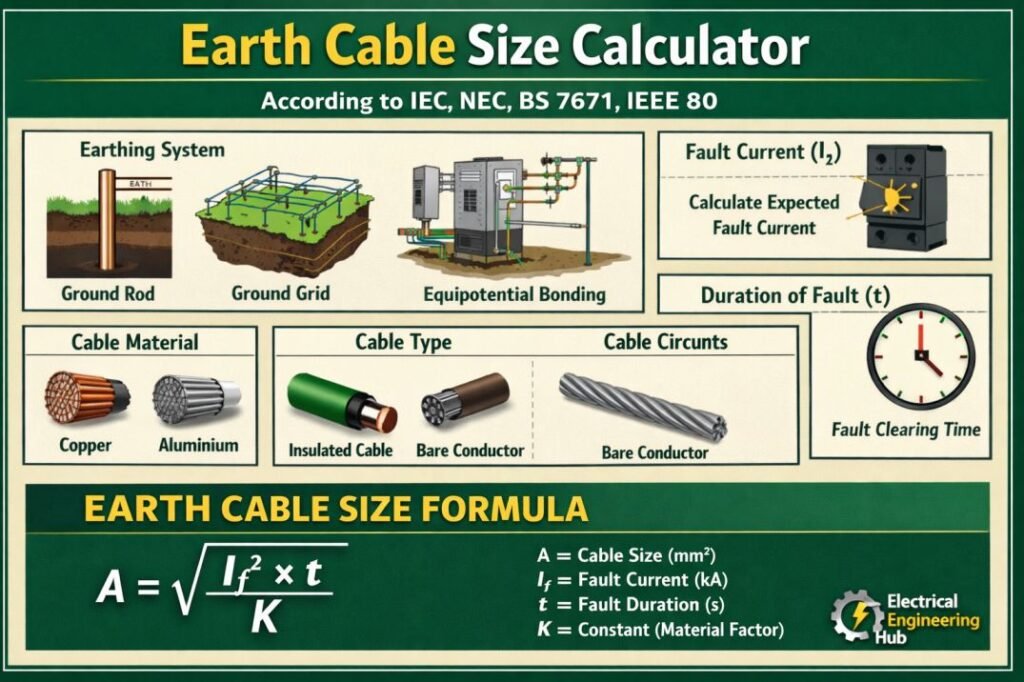
Table of Contents
Table of Contents
Earth Cable Size Calculator
Protective & Earthing Conductor Sizing
Earth Cable Size Calculator
Four sizing methods in one instrument — adiabatic (IEC / BS 7671), tabulated (NEC 250.122) and thermal-fusing (IEEE 80) earthing conductor sizing, with standard-size rounding and cross-reference readouts.
IEC 60364-5-54 — Adiabatic Sizing
Protective conductor cross-section from prospective fault current and disconnection time
BS 7671 — Circuit Protective Conductor
Choose the adiabatic method or the simplified Table 54.7 relationship to the line conductor
NEC 250.122 — Equipment Grounding Conductor
Minimum size from rating of the automatic overcurrent device ahead of the circuit
IEEE 80 — Grounding Grid Conductor
Thermal (fusing) sizing of ground grid and ground-electrode conductors for a symmetrical fault current
How to use this calculator
IEC 60364-5-54
- Select the conductor material and how the protective conductor is installed, or choose manual entry to type a k-factor directly.
- Enter the prospective earth fault current and the disconnection time of the upstream protective device at that current.
- Select Calculate. The readout shows the minimum theoretical cross-section and the recommended standard size rounded up.
BS 7671
- Choose the Adiabatic method for a calculated result, or the Table 54.7 method for a quick size based on the associated line conductor.
- For the adiabatic method, complete the same fields as the IEC tab.
- For the table method, select the line conductor size from the dropdown and Calculate.
NEC 250.122
- Select the rating of the overcurrent device protecting the circuit conductors.
- Select copper or aluminium/copper-clad aluminium.
- Select Calculate to look up the minimum equipment grounding conductor size, with its metric equivalent.
IEEE 80
- Select the grounding conductor material and how it is terminated, which sets the maximum allowable temperature.
- Enter ambient temperature, the symmetrical fault current, and the fault clearing time.
- Select Calculate for the minimum thermal cross-section and the nearest practical standard conductor size.
Technical notes
Scope and purpose
Protective and earthing conductors must carry prospective fault current for the time it takes upstream protection to operate, without exceeding a temperature limit set by the conductor insulation, the connected materials, or the properties of the conductor itself. Each standard in this tool approaches that requirement from a different angle: IEC 60364-5-54 and BS 7671 use a heat-balance (adiabatic) method suited to protective conductors within building wiring systems; NEC 250.122 uses a pre-calculated table linked to the rating of the upstream overcurrent device, reflecting long-standing US field practice; IEEE 80 addresses substation and grounding-grid conductors, where the governing limit is usually the conductor’s own fusing or annealing temperature rather than an insulation rating.
k-factors and material constants
The k-factor presets offered for the IEC and BS 7671 tabs are typical reference values for common copper and aluminium conductor and insulation combinations. Actual permitted values depend on conductor construction, insulation grade, and whether the conductor is bunched with other cables, and should always be confirmed against the specific table in the governing standard for the installation in question. The manual entry option is provided for exactly this reason.
Rounding to standard sizes
Where a calculation method returns a continuous cross-sectional area, the tool reports both the calculated minimum and the next cross-section at or above that value from the applicable standard conductor size range. The calculated minimum should never be used as the installed size; always install the rounded, standard commercial size.
IEEE 80 conductor limits
Grounding grid conductors are also subject to mechanical, corrosion, and future-fault-growth allowances that a purely thermal calculation does not capture. Many utility and industrial specifications set a mechanical minimum conductor size regardless of the thermal result; this tool flags that consideration where relevant but does not substitute for a project specification.
Limitations
This tool is intended as an engineering aid for preliminary sizing and cross-checking. It does not replace verification against the full, current text of the applicable standard, project specification, or the judgement of a qualified electrical engineer, and it does not account for every installation condition, amendment, or local regulation that may apply to a specific project.
For preliminary engineering reference only. Verify all results against the current edition of the governing standard and project-specific requirements before use in design or construction.
Inputs
| Input | Description |
|---|---|
| Standard Selector | IEC 60364, NEC 250.66, BS 7671, or IEEE 80 |
| Fault Current (A) | Required for IEC, BS 7671, and IEEE 80 calculations |
| Fault Duration (Seconds) | Used with adiabatic equation-based standards |
| Conductor Material | Copper or Aluminum |
| Service/Feeder Conductor Size | Required only for NEC 250.66 calculations |
Output
| Output | Description |
|---|---|
| Minimum Earth Cable Size | Displays the required conductor size in mm² or AWG depending on the selected standard |
| Reference Note | Shows the calculation basis, such as IEC 60364-5-54 adiabatic equation or NEC Table 250.66 |
The Earth Cable Size Calculator automatically switches between calculation methods based on the selected electrical standard. This eliminates manual calculations and helps engineers achieve consistent and standards-compliant results.
How to Use This Calculator
Using the Earth Cable Size Calculator requires only a few simple steps.
- Select the applicable electrical standard.
- Choose the conductor material.
- For IEC 60364, BS 7671, or IEEE 80, enter the fault current.
- Enter the fault duration in seconds for adiabatic equation calculations.
- If using NEC 250.66, select the service or feeder conductor size instead of entering fault current.
- Click the Calculate button.
- Review the recommended minimum earth conductor size along with the applicable clause or table reference.
Each standard follows a unique sizing methodology. IEC, BS 7671, and IEEE 80 primarily use fault current and fault duration, while NEC determines the grounding electrode conductor size from a predefined lookup table.
Always compare the calculated value with the minimum conductor sizes required by your local electrical code before installation.
For detailed Calculation explore our guide on Earthing Cable Size as Per IEC 60364-5-54
Which Standard Should You Choose?
Selecting the correct standard depends on the country, project type, and regulatory authority.
| Standard | Best Used For |
|---|---|
| IEC 60364 | International projects, Europe, Asia, Middle East, Africa |
| NEC 250.66 | Electrical installations in the United States |
| BS 7671 | Electrical installations throughout the United Kingdom |
| IEEE 80 | Utility substations and grounding grid design |
For multinational engineering companies and EPC contractors, projects often involve different client specifications. A multi-standard calculator removes the need to switch between separate calculation methods.
For a detailed comparison of calculation methods, design philosophy, and applications, read our complete guide on IEC vs NEC vs BS 7671 vs IEEE 80 Earth Cable Size Standards.
How Each Standard Calculates Earth Cable Size
Every standard approaches earthing conductor sizing differently. Understanding these differences helps engineers choose the correct design method.
IEC 60364 (Adiabatic Equation)
IEC 60364 determines earth conductor size using the well-known adiabatic equation.
The calculation considers:
- Prospective fault current
- Fault clearing time
- Conductor material
- Material constant (K factor)
The objective is to ensure the conductor can safely withstand thermal stress during an earth fault without exceeding its permissible temperature rise.
For a complete explanation of the formula, assumptions, and examples, refer to our detailed IEC earth cable sizing guide.
NEC 250.66 (Conductor Size Table)
Unlike IEC, NEC does not calculate the grounding electrode conductor using fault current.
Instead, NEC Article 250.66 determines the conductor size according to the largest ungrounded service or feeder conductor.
The calculator simply matches the selected service conductor size with the corresponding grounding conductor size specified in NEC Table 250.66.
NEC 250.66 Quick Reference
| Largest Service Conductor | Minimum Grounding Electrode Conductor |
|---|---|
| 2 AWG Copper or Smaller | 8 AWG Copper |
| 1 AWG to 3/0 AWG Copper | 6 AWG Copper |
| 4/0 AWG to 350 kcmil | 4 AWG Copper |
| Over 350 through 600 kcmil | 2 AWG Copper |
| Over 600 through 1100 kcmil | 1/0 AWG Copper |
The Earth Cable Size Calculator automatically performs this lookup based on NEC Table 250.66.
BS 7671
BS 7671 follows principles similar to IEC because it is based on the IEC framework.
The standard allows protective conductor sizing using the adiabatic equation where fault current and operating time are known. Designers must also comply with the Wiring Regulations and any applicable UK-specific requirements.
For additional regulatory guidance, visit our dedicated BS 7671 earth cable sizing article.
IEEE 80
IEEE 80 is intended primarily for high-voltage substations and utility grounding systems rather than ordinary building installations.
Although conductor thermal capacity remains important, IEEE 80 also considers:
- Step voltage
- Touch voltage
- Ground grid resistance
- Soil resistivity
- Personnel safety
These additional design parameters make IEEE 80 significantly different from general electrical installation standards.
A dedicated IEEE 80 grounding guide will provide complete design procedures for substations and switchyards.
Why Use a Multi-Standard Calculator?
Modern engineering projects often involve international consultants, multinational contractors, and equipment supplied from different regions.
Using separate calculators for every standard increases the chance of errors and slows the design process.
A multi-standard Earth Cable Size Calculator offers several advantages.
| Benefit | Description |
|---|---|
| Saves Time | Eliminates switching between different calculation tools |
| Improved Accuracy | Applies the correct calculation method automatically |
| International Compliance | Supports globally recognized electrical standards |
| Easy Comparison | Compare requirements across multiple standards |
| Better Learning | Helps students understand different design philosophies |
Electrical consultants, EPC contractors, utility engineers, commissioning teams, and engineering students can all benefit from a single calculator that supports multiple international standards.
Related Calculators
If you regularly design electrical installations, these tools can further simplify your calculations.
| Calculator | Purpose |
|---|---|
| Cable Size for Motor Calculator | Select motor supply cable based on current and voltage drop |
| Wire Gauge Conversion Calculator | Convert AWG to mm² and vice versa |
| Conduit Fill Calculator | Determine conduit occupancy and fill percentage |
| Australia Earth Cable Size Calculator | Calculate conductor sizes according to AS/NZS 3000 requirements |
These calculators work together to streamline electrical system design while ensuring compliance with applicable installation standards.
Frequently Asked Questions
What’s the difference between IEC, NEC, BS 7671, and IEEE 80 earthing calculations?
IEC 60364 and BS 7671 primarily use the adiabatic equation based on fault current and fault duration. NEC 250.66 determines the grounding conductor size from a conductor size lookup table, while IEEE 80 focuses on substation grounding and also considers step voltage, touch voltage, and ground grid performance.
Can I use this calculator for a US electrical installation?
Yes. Select NEC 250.66 as the applicable standard. The calculator determines the minimum grounding electrode conductor size using NEC Table 250.66 based on the selected service or feeder conductor size.
Does this calculator support Australian (AS/NZS) earthing requirements?
No. Australian earthing conductor sizing follows AS/NZS 3000 requirements, which are not included in this calculator. Please use the dedicated Australia Earth Cable Size Calculator for projects designed under AS/NZS standards.
Which standard applies to substation grounding?
IEEE 80 is the internationally recognized standard for substation grounding system design. It evaluates conductor sizing alongside grounding grid resistance, soil resistivity, and permissible step and touch voltages to ensure personnel safety during fault conditions.
Follow Us on Social:
Subscribe our Newsletter on Electrical Insights for latest updates from Electrical Engineering Hub
#EarthCableSizeCalculator, #EarthingCable, #ElectricalCalculator, #CableSizing, #EarthingSystem, #ElectricalEngineering, #GroundingCable, #WireSizeCalculator, #MCBCalculator, #ElectricalTools, #LoadCalculation, #ElectricalDesign, #PowerDistribution, #SafetyGrounding, #ElectricianLife
Earth Cable Size Calculator: IEC, NEC, BS 7671 & IEEE 80 : Electrical Engineering Hub
Free earth cable size calculator supporting IEC 60364, NEC 250.66, BS 7671, and IEEE 80. Select your standard, enter fault current, and get instant results.
Price Currency: USD
Operating System: All
Application Category: UtilitiesApplication
