IEC 60364 Part 5-54 Critical Guide for Safe Earthing Systems
Electrical safety in modern installations depends heavily on proper earthing and bonding practices. Among international standards, IEC 60364 Part 5-54 plays a central role in defining how protective conductors, grounding electrodes, and equipotential bonding must be designed and installed. Engineers, contractors, and inspectors rely on these rules to reduce shock hazards and ensure fault current flows safely into the earth.
In practical electrical engineering, IEC 60364 Part 5-54 is not just a document but a structured safety framework that governs low-voltage installations worldwide. Whether dealing with residential buildings, industrial plants, or commercial systems, IEC 60364 Part 5-54 ensures that earthing systems perform reliably under fault conditions and maintain human safety.
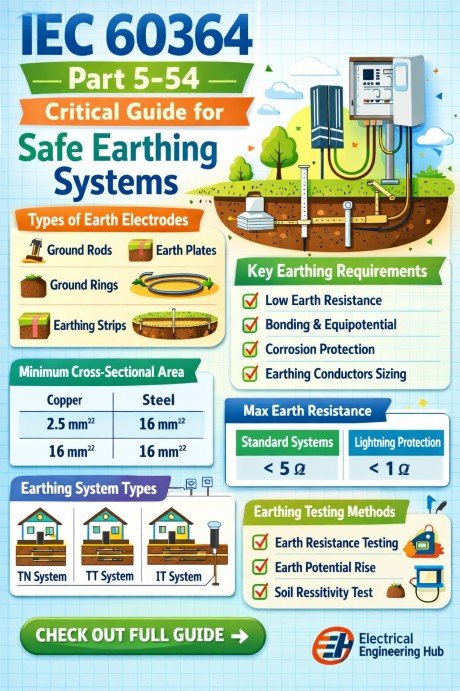
Table of Contents
This guide explains the core principles, design approach, and installation practices linked with IEC 60364 Part 5-54, while keeping real-world engineering applications in focus.
Overview of IEC 60364 Part 5-54 and Its Role in Electrical Safety
The standard IEC 60364 Part 5-54 defines the requirements for earthing arrangements and protective conductors in electrical installations. It ensures that fault currents are safely discharged and that exposed conductive parts do not reach dangerous voltage levels.
In many countries, IEC 60364 Part 5-54 is adopted as the foundation for building electrical safety codes. It covers electrode selection, conductor sizing, and bonding methods used in low-voltage systems. When applied correctly, IEC 60364 Part 5-54 significantly reduces risks of electric shock and equipment failure.
Know more about How Does Earth Fault Relay Protect Electrical Circuits? Complete Guide to Ground Fault Protection
A key strength of IEC 60364 Part 5-54 is its structured approach to equipotential bonding, which helps maintain uniform voltage levels across metallic parts of an installation.
At a conceptual level, IEC 60364 Part 5-54 bridges theoretical electrical design with practical safety execution in real installations.
Scope and Technical Importance in Modern Installations
The scope of IEC 60364 Part 5-54 extends across residential, commercial, and industrial electrical networks. It defines how earthing conductors must be selected based on fault current levels and system impedance.
In engineering practice, IEC 60364 Part 5-54 is critical for determining:
- Earth electrode resistance limits
- Protective conductor cross-sections
- Main and supplementary bonding requirements
- Connection methods for metallic enclosures
Understanding IEC 60364 Part 5-54 is essential for compliance inspections and design approvals. It ensures that electrical installations can safely handle leakage currents and short circuit conditions without creating hazardous touch voltages.
For deeper understanding of related grounding principles, you can also explore this detailed resource on IEC 60364 earthing, which complements the concepts defined in IEC 60364 Part 5-54.
Find all about IEC 60634 Cable Design
Earthing System Types Defined Under IEC Standards
Earthing arrangements are a core component of IEC 60364 Part 5-54, and selecting the correct system type is crucial for safety and performance. The standard recognizes several configurations depending on supply and installation design. Know more about IEC 60364-1
Common earthing systems include:
- TN-S system: Separate neutral and protective conductors
- TN-C system: Combined neutral and protective conductor
- TT system: Local earth electrode independent of supply
- IT system: Isolated neutral or impedance-earthed system
Each configuration under IEC 60364 Part 5-54 has specific safety implications and fault behavior characteristics. For example, TT systems rely heavily on earth electrode resistance, while TN systems depend on low impedance fault loops.
Learn more about earthing cable size as per iec
Comparison of Earthing Systems
| System Type | Key Feature | Application Area | Safety Dependency |
|---|---|---|---|
| TN-S | Separate PE and N | Industrial plants | Fault loop impedance |
| TN-C | Combined PEN conductor | Older installations | Continuity of PEN |
| TT | Local earth electrode | Rural or standalone buildings | Earth resistance |
| IT | Isolated neutral | Hospitals, critical systems | Insulation monitoring |
Proper selection according to IEC 60364 Part 5-54 ensures operational safety and minimizes electrical risks.
Design Requirements for Safe Earthing Networks
Designing earthing systems according to IEC 60364 Part 5-54 requires careful calculation of fault currents, conductor sizing, and electrode resistance.
Dive deeper into instrument earthing iec standard
Engineers must ensure that protective conductors can safely carry fault current without exceeding temperature limits. IEC 60364 Part 5-54 also emphasizes mechanical strength and corrosion resistance of earthing materials. Explore all about IEC 60364 5 52
Key design considerations include:
- Minimum conductor cross-section based on fault level
- Equipotential bonding of all metallic structures
- Soil resistivity analysis for electrode design
- Limitation of touch and step voltage
Thermal constraints are particularly important, as IEC 60364 Part 5-54 requires conductors to withstand short-circuit energy until protective devices operate.
Fault loop impedance is another critical factor, ensuring automatic disconnection of supply under fault conditions.
Find all about IEC 60364-6
Installation Practices and Field Implementation
Proper installation is where theoretical design meets real-world performance. IEC 60364 Part 5-54 provides detailed guidance on how earthing conductors and bonding systems must be installed to maintain continuity and safety.
Installers must ensure that all connections are mechanically secure and electrically continuous. Corrosion protection is also essential, especially in outdoor or underground installations.
Key installation practices include:
- Using approved clamps and exothermic welding for joints
- Maintaining straight, low-impedance conductor paths
- Avoiding sharp bends in earthing conductors
- Ensuring reliable bonding between structural steel and electrical panels
During installation, adherence to IEC 60364 Part 5-54 reduces the risk of high resistance joints that can compromise fault protection performance. Know more about European Earthing System TN-S TN-C-S TT Explained: Key Differences, Safety, and Standards
Explore all about IEC 60364-5
Testing, Inspection, and Compliance Verification
Testing is a mandatory step in ensuring that earthing systems meet the requirements of IEC 60364 Part 5-54. Without proper verification, even well-designed systems may fail under fault conditions. Know more about IEC Standard for Earthing System
Common tests include earth resistance measurement, continuity testing of protective conductors, and loop impedance verification.
Key testing parameters:
| Test Type | Purpose | Acceptable Result |
|---|---|---|
| Earth resistance test | Measure electrode effectiveness | Low resistance value |
| Continuity test | Verify bonding integrity | Near-zero resistance |
| Loop impedance test | Check fault current path | Within disconnection limits |
Compliance with IEC 60364 Part 5-54 ensures that protective devices like MCBs and RCCBs operate within required time limits during faults. Explore details on table 250.122 nec
Common Mistakes in Earthing Systems
Despite clear guidelines in IEC 60364 Part 5-54, installation errors still occur in the field. These mistakes often reduce system safety and increase risk. Explore all about methods of earthing
Frequent issues include:
- Loose or corroded earth connections
- Undersized protective conductors
- Inadequate soil testing before electrode installation
- Improper bonding of metallic enclosures
Such errors can lead to elevated touch voltage and failure of protective devices during fault conditions. Regular inspection and compliance checks help prevent these issues. Know all the basics about earth conductor size calculation
Summary of Key Technical Requirements
| Area | Requirement | Importance |
|---|---|---|
| Conductor sizing | Based on fault current | Prevents overheating |
| Earth electrode | Low resistance value | Ensures safe fault dissipation |
| Bonding | Continuous metallic connection | Eliminates potential differences |
| Testing | Regular verification | Ensures long-term reliability |
Understanding IEC 60364 Part 5-54 helps engineers maintain consistency across design, installation, and maintenance stages. Find all about substation earthing design
FAQs
1. What is the main purpose of IEC 60364 Part 5-54?
It defines requirements for earthing systems, protective conductors, and bonding to ensure electrical safety in low-voltage installations.
2. Where is IEC 60364 Part 5-54 commonly applied?
It is used in residential, commercial, and industrial electrical installations worldwide for grounding design and safety compliance.
3. Why is equipotential bonding important in earthing systems?
It prevents dangerous voltage differences between metallic parts, reducing the risk of electric shock during faults.
4. How is earthing resistance tested in practice?
It is measured using earth resistance testers, ensuring the electrode system can safely dissipate fault currents.
5. What happens if IEC 60364 Part 5-54 is not followed?
Non-compliance can lead to unsafe fault conditions, equipment damage, and increased risk of electric shock hazards.
Get new guides in your feed. Follow Electrical Insights on LinkedIn for new electrical standards guides, calculators and design tips from Azad Circuit Hub.
#IEC60364Part554,#IEC60364,#ElectricalInstallation,#Earthing,#Bonding,#GroundingSystem,#ElectricalSafety,#WiringRegulations,#PowerSystems,#ConstructionStandards