
Earth Cable Size Australia Calculator: Best Tool
Understanding earth cable size Australia is essential for ensuring electrical safety in residential, commercial, and industrial installations. The proper sizing of earth cables protects both people and equipment from electrical faults. It helps provide a clear path for fault current to flow safely into the ground. This article breaks down the technical details behind earth cable sizing in Australia, in a simple, easy-to-read format.
In Australia, earthing systems must follow the standards laid out in AS/NZS 3000, commonly known as the Australian Wiring Rules. These rules define the minimum requirements for safety in electrical installations. Proper earthing is critical not only for fault protection but also for voltage stability and equipment integrity.
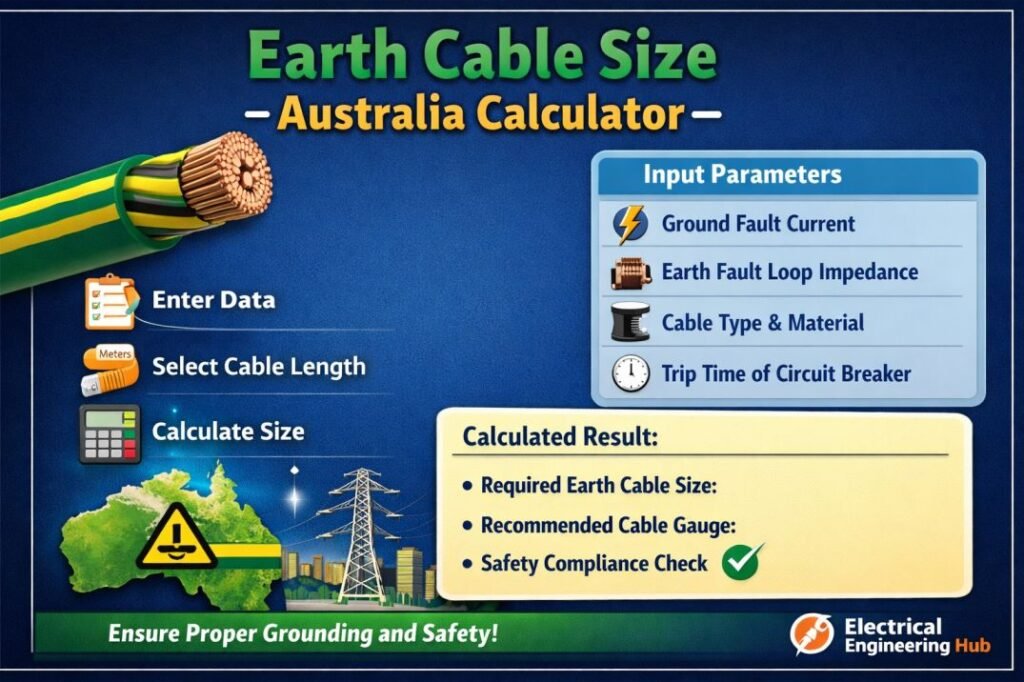
Table of Contents
Table of Contents
Earth Cable Size Australia Calculator
Earth Cable Size Calculator – Australia (AS/NZS 3000)
Earth Cable Size Calculator (Australia)
Determine the minimum protective earthing conductor size and main earthing conductor size for Australian low-voltage installations, in line with AS/NZS 3000 principles.
Protective Earthing Conductor – Table Method
Protective Earthing Conductor – Fault Current (Adiabatic) Method
Main Earthing Conductor (MEN) Sizing
How to Use This Calculator
- Choose the tab that matches how you want to size the conductor: by standard active conductor size (Table Method), by known fault current and trip time (Fault Current Method), or for the property’s main earthing conductor (MEN).
- For the Table Method, select the active conductor size that feeds the circuit you are earthing.
- For the Fault Current Method, enter the prospective earth fault current and the time your protective device takes to clear the fault, then choose the conductor material and insulation type.
- For the Main Earthing Conductor tab, select the size of the consumer mains supplying the property.
- Press the Calculate button in each section to see the recommended standard cable size, plus the underlying calculated minimum before rounding.
- Always cross-check the result against your protective device characteristics, switchboard manufacturer data, and your local network operator’s service and installation rules before installing.
Understanding Earthing Conductor Sizing
An earthing conductor needs to be large enough to safely carry fault current back to the source without overheating, melting its insulation, or failing before the protective device operates. Two common approaches are used in practice. The table method links the earth conductor size to the size of the associated active conductor, using conservative ratios that work for the great majority of standard installations without requiring detailed fault calculations.
The fault current method is more precise and is typically used for larger installations, substations, or situations where the standard table ratios may not be conservative enough. It considers how much fault current is expected to flow and how long the protective device will take to clear that fault, then works out the smallest conductor that can absorb that energy without exceeding a safe temperature limit for its insulation type.
The main earthing conductor connects the installation’s main earthing terminal back to the earthing electrode or the supply neutral, depending on the earthing system used. Its size is generally linked to the size of the consumer mains supplying the property, since it needs to be capable of carrying the same order of fault energy as the supply itself.
| Active conductor size | Typical minimum earth conductor size (same material) |
|---|---|
| Up to 16 mm² | Same size as active conductor |
| Above 16 mm² up to 35 mm² | 16 mm² |
| Above 35 mm² | Half the active conductor size |
This tool applies widely used earthing conductor sizing principles consistent with AS/NZS 3000 for general guidance only. Minimum sizes, main earthing conductor tables, and local supply authority requirements can vary between editions of the standard and between network distributors. Always verify the final conductor size against the current edition of AS/NZS 3000, your protective device manufacturer’s let-through data, and your local Distribution Network Service Provider’s requirements before installation. This calculator does not replace a qualified electrical engineer or licensed electrician’s assessment.
Find more Electrical Engineering Tools for easy electrical calculations and estimations.
Importance of Earth Cable Size Australia
Choosing the correct earth cable size Australia depends on several factors. These include system voltage, prospective fault current, cable length, and the material of the conductor. Copper and aluminium are the most common materials used. Copper is more conductive, so smaller cross-sectional areas are needed compared to aluminium.
If an earth cable is undersized, it may not handle the fault current. This could cause the cable to overheat, melt, or even start a fire. On the other hand, oversizing increases material cost unnecessarily. This is why accurate calculation is important.
Use our online Tool Earth Cable Size Calculator UK
Factors Affecting Earth Cable Size Australia
To determine the earth cable size Australia, professionals consider several parameters:
- Maximum fault current
- Duration of fault (until protection disconnects)
- Type of earthing system (TN, TT, IT)
- Cable installation method
- Cable material (copper or aluminium)
Earth Cable Size Table (Copper, Based on AS/NZS 3008)
Below is a general table showing typical earth cable size Australia recommendations for copper conductors in common scenarios. This table assumes fault duration of 0.4 seconds.
| Fault Current (A) | Minimum Earth Cable Size (mm²) |
|---|---|
| 1,000 | 10 |
| 2,000 | 16 |
| 5,000 | 35 |
| 10,000 | 70 |
| 15,000 | 95 |
| 20,000 | 120 |
| 25,000 | 150 |
These values are only indicative. Always use a proper Earth Cable Size Calculator or consult a licensed electrician to comply with AS/NZS 3000.
Copper vs Aluminium in Earth Cable Size Australia
In Australian installations, copper is more commonly used for earthing. However, aluminium is still permitted, especially in larger systems where weight and cost are factors. Since aluminium has higher resistance, larger cable sizes are needed compared to copper.
Here's a simple comparison:
| Cable Material | Conductivity (% IACS) | Relative Size Needed |
|---|---|---|
| Copper | 100% | Base Reference |
| Aluminium | ~61% | ~1.6 times larger |
When aluminium is used, the Earthing Cable Size as Per IEC or AS/NZS must be strictly followed to avoid undersizing.
Earth Cable Size for Residential Installations
For domestic settings in Australia, most circuits use 2.5 mm² or 4 mm² copper for earthing. The main earth cable, connecting to the earth electrode or grid, is usually 6 mm² or larger, depending on the installation’s total fault current potential.
For example:
- Light circuits (10A or 16A): 1.5 mm² – 2.5 mm² CPC (Circuit Protective Conductor)
- Power circuits (20A – 32A): 2.5 mm² – 4 mm² CPC
- Main earth cable: 6 mm² – 16 mm² depending on main supply size
The exact size should be calculated, not guessed. Tools like an Earth Cable Size Calculator are helpful for this.
Earth Cable Size Australia in Commercial Installations
In commercial projects, the complexity increases. Higher fault currents and longer cable runs require more precise sizing. Often, earthing and bonding are part of a comprehensive bonding and grounding strategy. Earth bars, equipotential bonding, and multiple earth electrodes may be used.
An example from a commercial site:
- Transformer capacity: 500 kVA
- Fault current: 10 kA
- Fault duration: 1 second
- Required earth cable size (Copper): ~70 mm²
In such cases, engineers often follow the instrument earthing IEC standard and AS/NZS guidelines to coordinate between protective devices and earth conductors.
Voltage Drop and Earth Cable Size
Although voltage drop is more often a concern for active conductors, it's still relevant in earthing. A high-resistance earth path might delay the operation of protective devices. That’s why keeping earth conductor lengths short and sizes appropriate is crucial.
For long cable runs in rural areas, even the Earthing Cable Size as Per IEC might need to be increased to maintain low earth loop impedance.
Installation Practices in Australia
When installing earth cables, the method affects performance. For example:
- Buried directly in soil: must be insulated and UV-resistant
- Inside conduit: easier to upgrade later
- Exposed to air: must be mechanically protected
Proper labeling, separation from active conductors, and earthing connections must comply with AS/NZS 3000. Grounding terminals, earthing pits, and bonding points should all be accessible and documented.
Earthing for Lightning and Surge Protection
In high-risk areas, such as telecom sites or tall buildings, additional measures are taken. Surge protectors, grounding rods, and mesh grounding systems are used. These installations often require much larger cable sizes — up to 120 mm² or more.
These setups usually align with both Australian regulations and instrument earthing IEC standard for sensitive electronics and signal lines.
Grounding Resistance Considerations
Earth cable size affects grounding resistance. To achieve low resistance (under 1 ohm is ideal for sensitive equipment), larger conductors, parallel runs, or enhanced electrodes are used.
If a single earth rod doesn't suffice, more rods or chemical electrodes might be needed. The size and quality of the earth conductor play a direct role in maintaining this low resistance.
Final Thoughts on Earth Cable Size Australia
Properly sizing the earth cable size Australia is essential for any electrical installation. It ensures safety, equipment protection, and compliance with legal standards. Whether you're wiring a small house or a large commercial facility, the key is to follow standards and perform accurate calculations.
Use an Earth Cable Size Calculator to start. Follow guidelines from AS/NZS 3000 and refer to IEC when needed. In sensitive installations, always check instrument earthing IEC standard to avoid errors.
Follow Us on Social:
Subscribe our Newsletter on Electrical Insights for latest updates from Electrical Engineering Hub
#EarthCableSize, #AustraliaWiring, #ElectricalStandardsAU, #CableSizingGuide, #AS3000Compliance, #GroundingCable, #ElectricalSafety, #EarthingSystems, #CableInstallationAU, #WireGaugeAustralia, #ElectricalDesignAU, #ElectriciansAustralia, #CableSelection, #EarthingCableSize, #VoltageDropAustralia
Earth Cable Size Australia Calculator: Best Tool : Electrical Engineering Hub
Use the Earth Cable Size Australia Calculator to determine the correct earthing conductor size based on AS/NZS 3000 guidelines. Calculate earth cable sizes quickly, improve electrical safety, and ensure compliant installation designs for residential, commercial, and industrial projects.
Price Currency: USD
Operating System: Web Browser
Application Category: UtilitiesApplication
