Home Wiring as per AS/NZS 3000: Complete Australian Wiring Guide
Home wiring as per AS/NZS 3000 is the foundation of safe electrical installations in Australian homes. The standard, commonly known as the Australian and New Zealand Wiring Rules, sets out requirements for electrical installation design, wiring systems, earthing, circuit protection, testing, and verification. It helps ensure that household electrical systems operate safely and reliably.
Whether you are renovating a house, planning a new build, upgrading a switchboard, or checking an existing installation, understanding these rules can help you make better decisions. Australian homeowners also need to know when a licensed electrician is required and which checks they can safely carry out themselves.
This guide focuses on Australian residential installations, with practical explanations of circuit design, cable selection, safety switches, power points, lighting, earthing, and electrical testing. It is written from a practical electrical engineering perspective, drawing on field experience with electrical panels, protection systems, industrial wiring, and troubleshooting. Although residential and industrial installations differ, the principles of sound design, correct protection, and careful verification apply to both.
Home Wiring as per AS/NZS 3000: Quick Reference
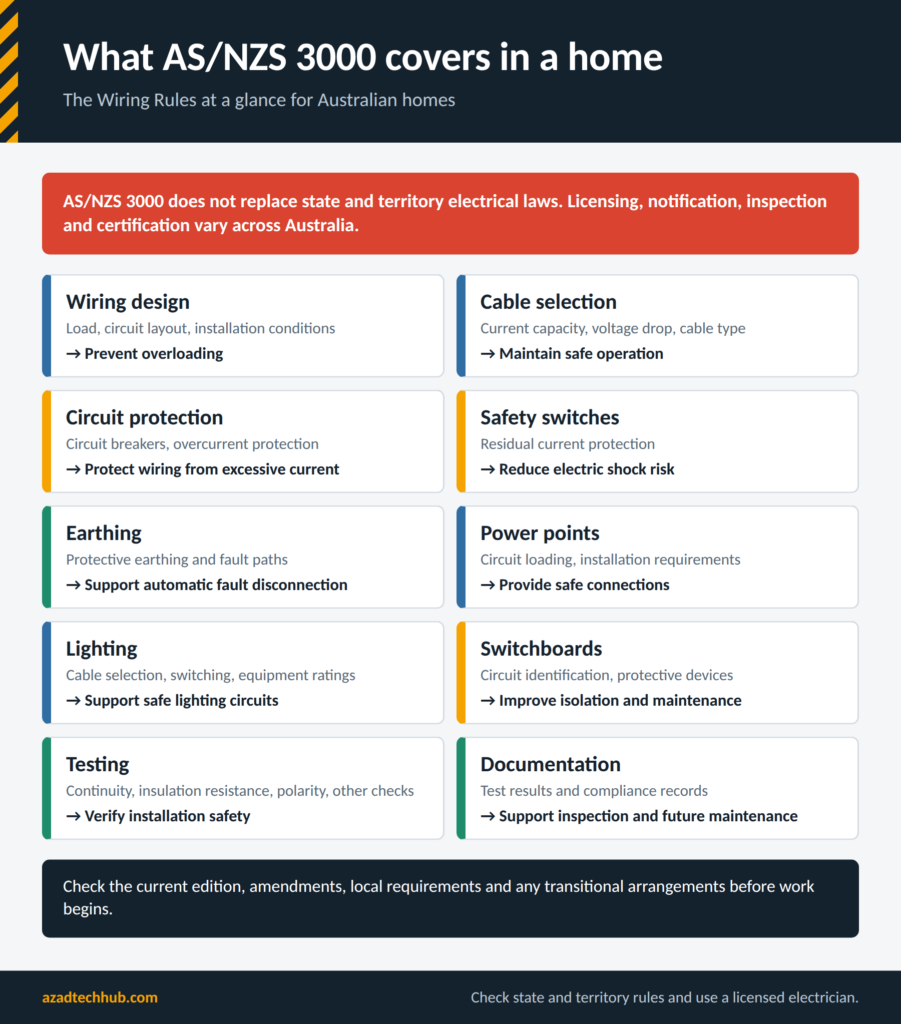
The following table summarises key topics covered by the wiring rules and their relevance to residential electrical work.
Important Australian compliance note
AS/NZS 3000 does not replace state and territory electrical laws. Electrical licensing, notification, inspection, and certification requirements vary across Australia. Most fixed wiring work must be performed by a suitably licensed electrician, subject to the rules in the relevant jurisdiction.
The current applicable edition, amendments, local requirements, and any transitional arrangements should be checked before work begins. This guide explains the principles; it is not a substitute for the full standard or a licensed electrical contractor.
What Is AS/NZS 3000?
AS/NZS 3000 is the joint Australian and New Zealand standard titled Electrical installations, commonly called the Wiring Rules. It establishes requirements for the design, construction, and verification of electrical installations.
For Australian homes, it provides a framework for selecting wiring systems, arranging circuits, providing protective devices, installing earthing systems, and verifying that the finished installation is safe.
The standard works alongside other applicable Australian Standards, equipment requirements, and state or territory regulations. Depending on the installation, related standards may cover wiring accessories, switchboards, electrical equipment, and verification testing.
Why the wiring rules matter
A home electrical installation must do more than supply power. It must also limit the risk of electric shock, fire, equipment damage, and dangerous fault conditions.
For example, a cable may carry the expected operating current under normal conditions but still be unsuitable if it is installed in insulation, grouped with other loaded cables, exposed to high temperatures, or protected by an incorrectly rated circuit breaker.
From an engineering perspective, the complete design must account for the relationship between the load, cable, protective device, installation method, and expected fault conditions. Selecting one component in isolation can leave a weakness elsewhere in the circuit.
How Australian Home Electrical Systems Are Arranged
Most Australian homes receive single-phase electricity, although larger homes and properties with substantial electrical loads may have a three-phase supply.
A typical installation includes the supply connection, electricity meter, main switch, switchboard, final subcircuits, protective devices, lighting outlets, socket outlets, and fixed appliances.
| Component | Function |
|---|---|
| Electricity meter | Measures electrical energy consumption |
| Main switch | Provides a means of isolating the installation or relevant supply |
| Circuit breaker | Protects a circuit against excessive current |
| Safety switch (RCD) | Detects residual current and disconnects a circuit when its operating conditions are met |
| Active conductor | Carries current from the supply to the load |
| Neutral conductor | Provides the normal return path in a typical single-phase circuit |
| Protective earth | Provides a fault-current path to support protective disconnection |
| Socket outlet | Supplies portable electrical equipment |
| Final subcircuit | Supplies a group of outlets, lights, or fixed equipment |
A safety switch and a circuit breaker perform different functions. An RCD provides residual-current protection, while an ordinary circuit breaker primarily protects against overcurrent. Some devices combine both functions.
Planning a Residential Wiring Installation
Before wiring begins, the installation must be planned around the building layout, expected loads, supply capacity, and applicable requirements.
A sound design process includes the following steps:
- Review the architectural drawings and identify kitchens, bathrooms, living spaces, bedrooms, outdoor areas, and plant locations.
- List fixed appliances, including ovens, cooktops, hot-water systems, air conditioners, pumps, and electric vehicle charging equipment.
- Estimate demand using the applicable design method rather than simply adding every appliance’s nameplate current.
- Divide the installation into suitable lighting, socket-outlet, and dedicated appliance circuits.
- Determine cable sizes using current-carrying capacity, voltage drop, installation conditions, and fault protection.
- Select compatible protective devices and verify their ratings and characteristics.
- Plan earthing, bonding, isolation, and switchboard arrangements.
- Allow for future loads, access for maintenance, and clear circuit labelling.
- Arrange the required inspections, testing, and electrical certification.
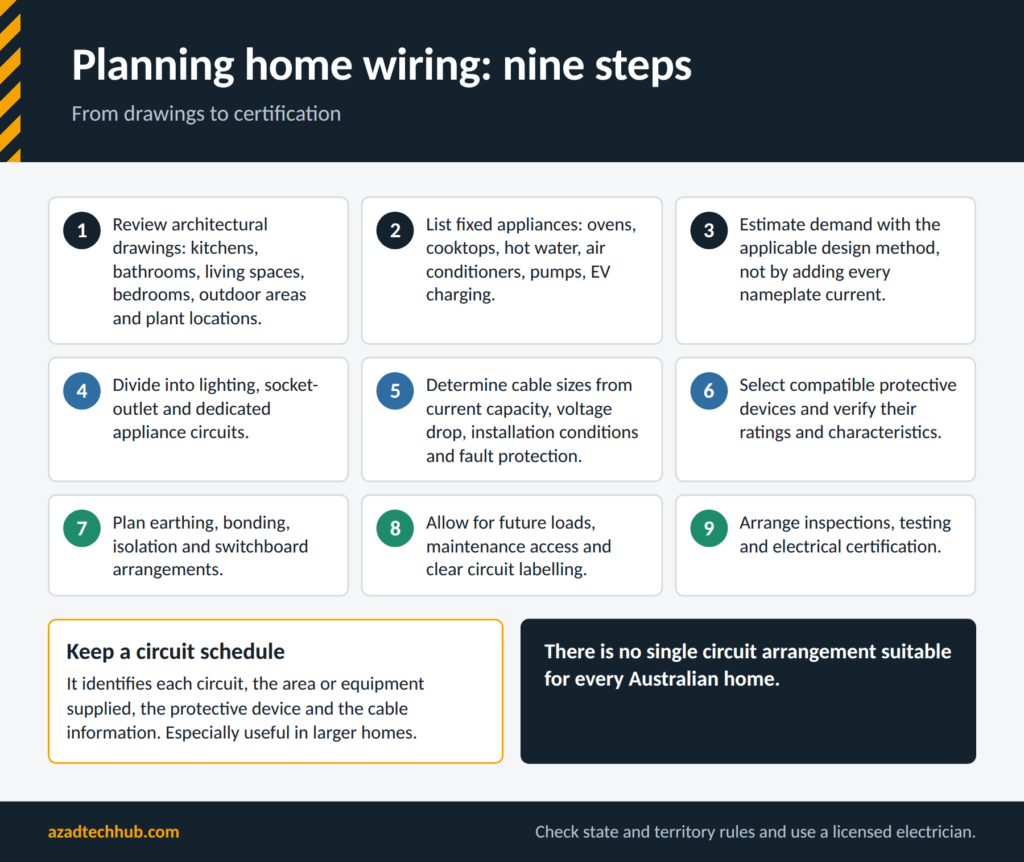
A good circuit schedule is especially useful in larger homes. It identifies each circuit, the area or equipment supplied, the protective device, and the relevant cable information.
Circuit Layout and Load Distribution
The purpose of circuit planning is to distribute electrical loads safely and avoid unnecessary interruptions. A large number of appliances on one circuit can cause overloading if the circuit was not designed for the expected demand.
For example, a kitchen may have a refrigerator, kettle, microwave, dishwasher, and other appliances operating at overlapping times. An air conditioner or electric oven may also require a dedicated circuit, depending on its load and the installation design.
| Load Type | Typical Design Consideration |
|---|---|
| Lighting | Load, switching arrangement, and circuit protection |
| General socket outlets | Expected use and connected load |
| Kitchen appliances | Demand, outlet distribution, and appliance ratings |
| Electric oven or cooktop | Manufacturer’s connection requirements and full-load current |
| Split-system air conditioner | Rated input, starting characteristics, and installation instructions |
| Electric water heater | Continuous load and specified protective requirements |
| EV charger | Charging current, supply capacity, and dedicated protection requirements |
There is no single circuit arrangement suitable for every Australian home. The correct design depends on the building, equipment, installation method, and current applicable rules.
Cable Selection and Current-Carrying Capacity
Cable sizing is one of the most important parts of home electrical design. The conductor must carry the expected load without exceeding its permitted temperature, while the protective device must provide suitable protection.
A cable’s current capacity depends on its conductor material, insulation rating, installation method, ambient temperature, grouping, and whether it is surrounded by thermal insulation. The same nominal cable size can have different allowable current ratings under different conditions.
Basic cable selection checks
A qualified designer or electrician generally needs to verify:
- Design current of the circuit.
- Cable current-carrying capacity after applicable correction factors.
- Protective device rating and operating characteristics.
- Permitted voltage drop.
- Fault-loop impedance and automatic disconnection requirements.
- Short-circuit withstand capability.
- Cable compatibility with terminals and equipment.
- Environmental and mechanical protection.
The relationship between design current, protective-device rating, and cable capacity is commonly expressed as:
Ib ≤ In ≤ Iz
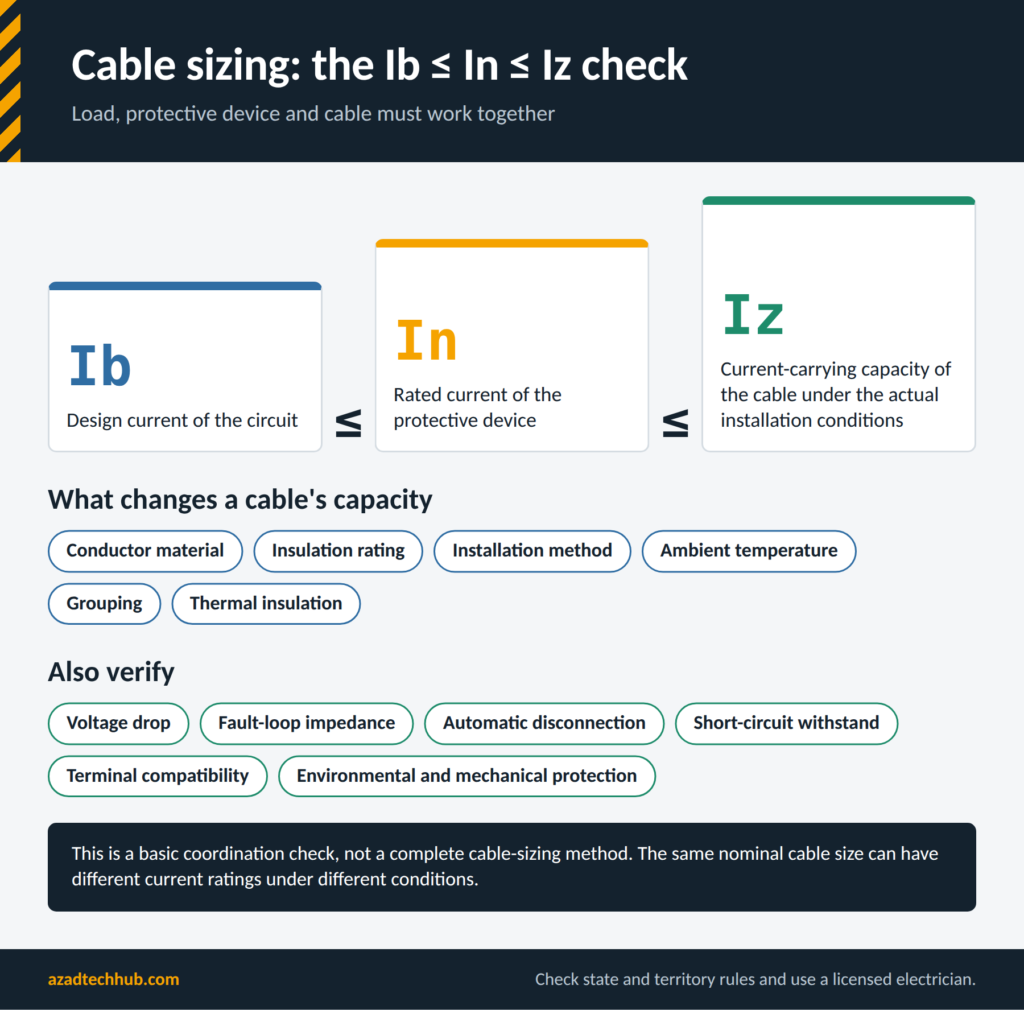
Where:
- Ib = design current of the circuit.
- In = rated current of the protective device.
- Iz = current-carrying capacity of the cable under the actual installation conditions.
This is a basic coordination check, not a complete cable-sizing method. Other requirements and protective-device characteristics must also be considered.
Voltage Drop in Residential Circuits
Voltage drop occurs when current flows through the resistance and reactance of a cable. Excessive voltage drop can affect appliance performance, lighting, motor starting, and energy efficiency.
For a simple single-phase circuit where cable reactance can be neglected, an approximate voltage-drop calculation is:
Voltage drop (V) = 2 × I × L × R
Where:
- I = circuit current in amperes.
- L = one-way cable length in metres.
- R = conductor resistance in ohms per metre at the relevant operating temperature.
- The factor 2 accounts for the active and return paths in a simple two-conductor circuit.
For a more general single-phase calculation that accounts for cable impedance and power factor, a simplified form is:
Voltage drop (V) ≈ 2 × I × L × (R cos φ + X sin φ)
Here, R and X are resistance and reactance per unit length, and φ is the load power-factor angle. The suitability of this approximation depends on the cable and circuit conditions.
The percentage voltage drop is calculated as:
Voltage drop (%) = (Voltage drop ÷ Supply voltage) × 100
For example, if a calculated voltage drop is 7 V on a nominal 230 V supply:
Voltage drop (%) = (7 ÷ 230) × 100 = 3.04%
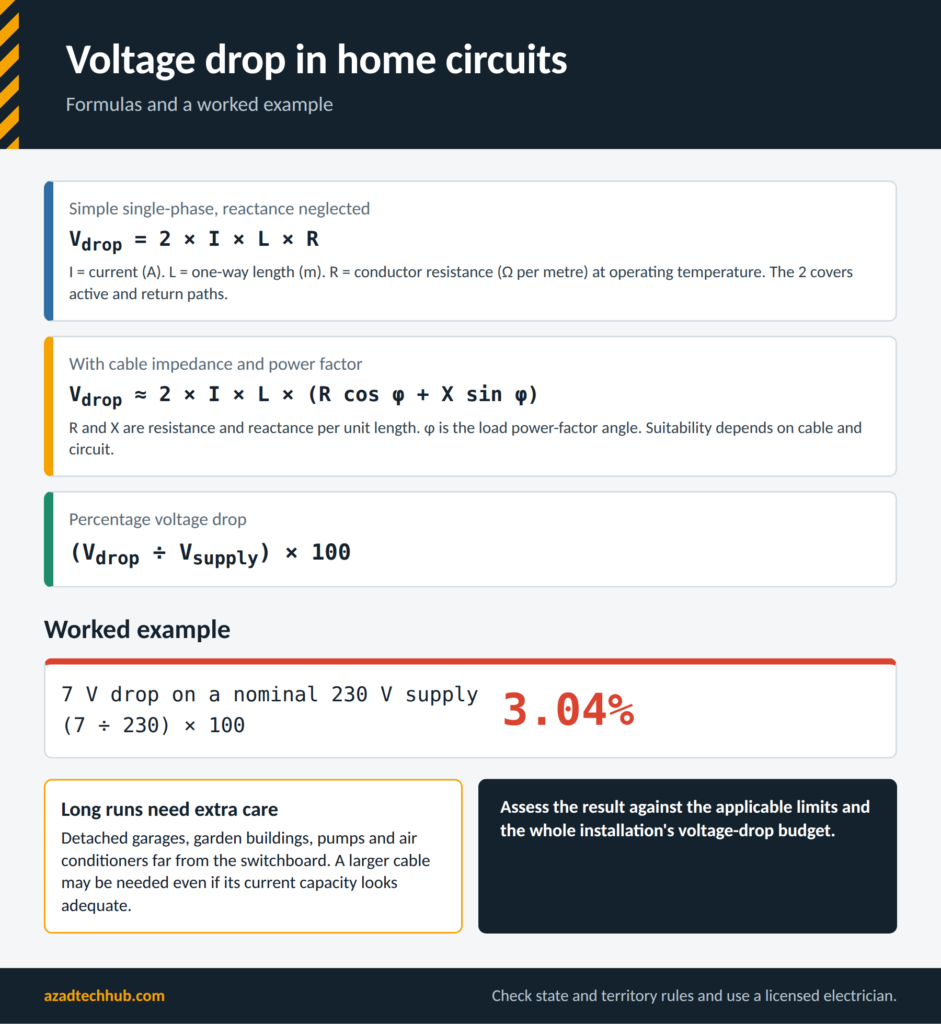
The result must be assessed against the applicable limits and the complete installation’s voltage-drop budget. Conductor resistance must be appropriate for the cable’s operating temperature, and the correct calculation method must be used for the circuit.
Earthing and Electrical Bonding
Earthing is a key part of electrical safety. A protective earthing system helps provide a path for fault current so that the relevant protective device can disconnect the supply when a fault occurs.
The protective earth conductor is not intended to carry normal load current. If an active conductor contacts an exposed conductive part, the fault path and protective arrangement must support safe disconnection.
Bonding is used where required to reduce dangerous potential differences between conductive parts. Its application depends on the type of installation, the location, and the relevant requirements.
A qualified electrician verifies the continuity and integrity of the earthing system, the suitability of connections, and the effectiveness of the protective measures. A simple visual check cannot establish that an earth connection will safely clear a fault.
Safety Switches and Circuit Breakers
Safety switches, also called residual current devices, monitor the difference between the current flowing in the active conductor and the current returning through the neutral conductor. A difference may indicate leakage current through an unintended path.
A circuit breaker, by contrast, is designed primarily to interrupt excessive current caused by overloads or short circuits. A combination device can provide both residual-current and overcurrent protection.
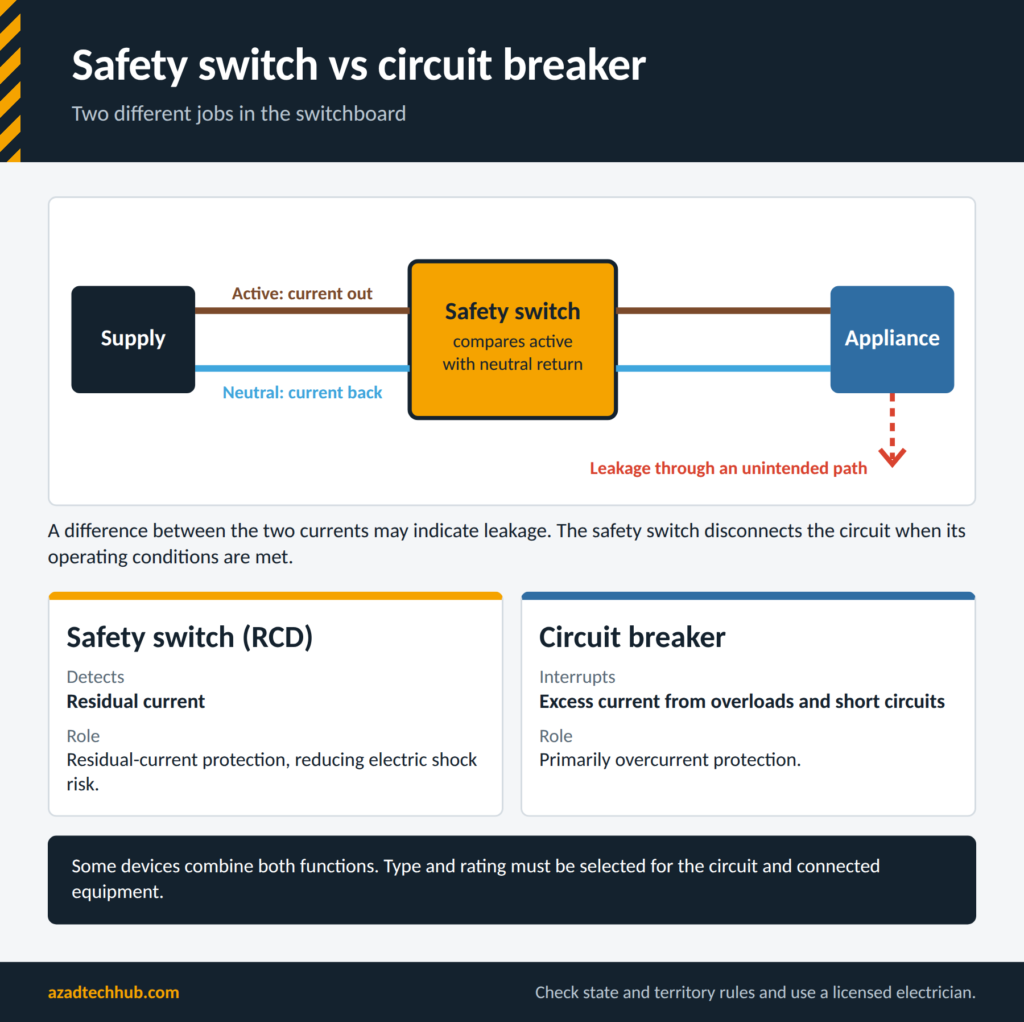
The type and rating of protection must be selected for the circuit and connected equipment. RCD requirements can vary by circuit type, installation circumstances, and the applicable edition of the standard.
Homeowners should use the test button according to the manufacturer’s instructions and any applicable guidance. If a safety switch trips repeatedly, it should not be bypassed or repeatedly reset without investigating the cause. A licensed electrician can test the circuit and identify faults in wiring or connected appliances.
Switchboards and Protective Device Coordination
The switchboard brings the installation’s protective devices and circuit controls together. It must be suitable for the installation and arranged so circuits can be identified, isolated, and maintained safely.
A switchboard review should consider:
- The condition and suitability of the enclosure.
- Main-switch and circuit-protection arrangements.
- RCD coverage and device compatibility.
- Correct identification of circuits.
- Cable terminations and conductor capacity.
- Neutral and earth arrangements.
- Available fault current and device ratings.
- Required clearances, access, and environmental conditions.
Protective devices should not be selected based only on the current rating printed on the appliance. The device must also be appropriate for the conductor, expected fault conditions, and the manufacturer’s requirements.
Changes to a switchboard or fixed wiring must be undertaken by appropriately licensed personnel and verified in accordance with applicable requirements.
Lighting Circuits and Switching
Lighting design needs to account for the number and type of fittings, switching locations, control arrangements, and the characteristics of LED drivers or other electronic equipment.
A two-way lighting arrangement allows one light or lighting group to be controlled from two locations, such as the top and bottom of a staircase. More complex installations may use additional switching arrangements.
LED fittings also require attention to compatibility, rated supply voltage, driver requirements, heat dissipation, and suitability for the ceiling space. The fact that an LED lamp uses less power does not remove the need for compliant installation and protection.
Before any lighting work, the circuit must be safely isolated and verified by a competent, authorised person. Homeowners should not open fixed-wiring enclosures or handle exposed conductors.
Socket Outlets and Dedicated Appliance Circuits
Socket outlets must be suitable for the location, intended use, and circuit design. Their placement should support normal household activities without encouraging unsafe use of extension leads or overloaded adaptors.
Kitchen benches, workshops, garages, and outdoor areas may have different practical demands. Locations exposed to moisture, weather, dust, or mechanical damage may require equipment with appropriate protection and installation methods.
Dedicated appliance circuits are often appropriate where equipment has a substantial load or specific manufacturer requirements. Ovens, cooktops, air conditioners, and EV chargers are examples where the supply and protective arrangements must be checked carefully.
The required cable size and circuit-breaker rating cannot be established from the appliance category alone. The electrician must use the actual rating plate, installation instructions, cable route, and applicable design requirements.
Inspection, Testing, and Verification
Electrical testing verifies that the installation meets its design and safety requirements. It is not enough for lights to turn on or appliances to appear to work.
Depending on the installation and applicable requirements, verification may include:
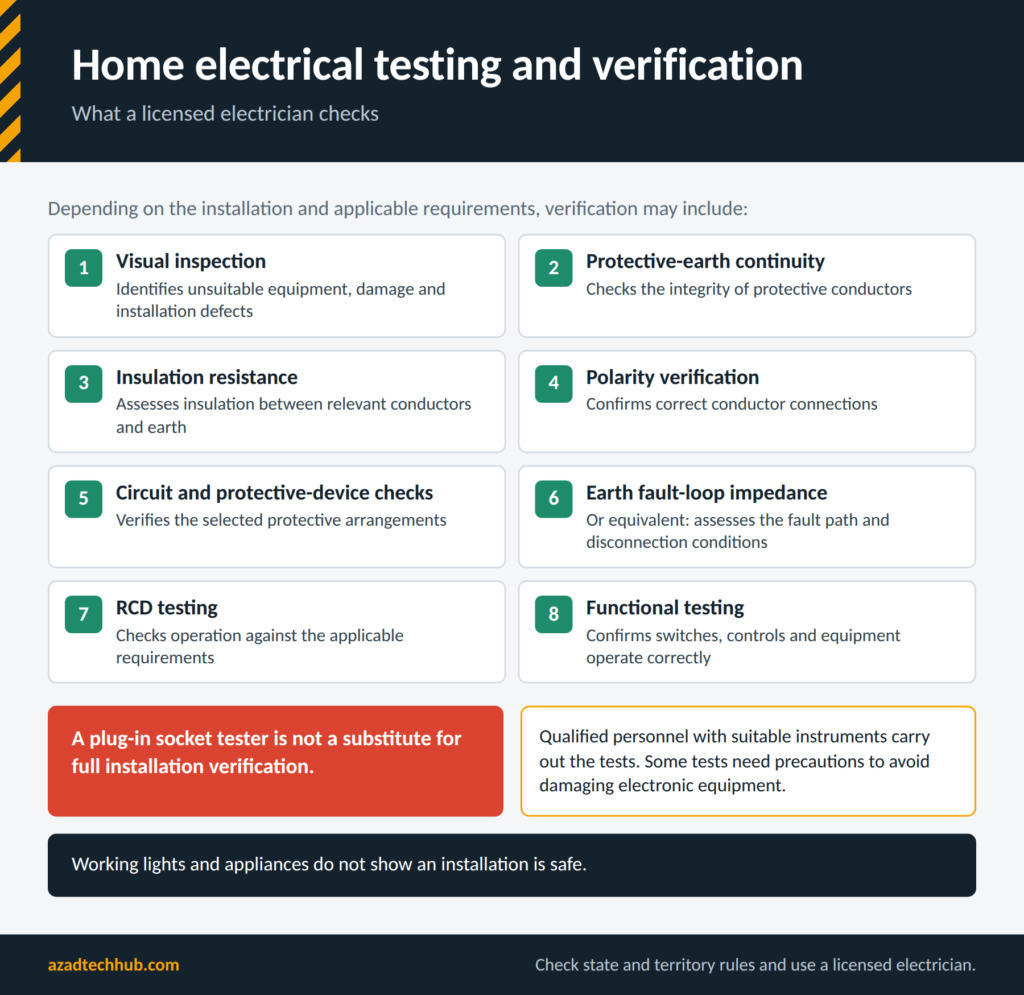
The exact sequence, test methods, instruments, acceptance criteria, and documentation depend on the installation and the applicable standard. Some tests require precautions to avoid damaging electronic equipment.
These checks must be carried out by appropriately qualified personnel using suitable instruments. A plug-in socket tester is not a substitute for full installation verification.
Common Home Wiring Problems in Australia
Many household electrical issues begin with a fault in an appliance, damaged wiring, loose connections, unsuitable protection, or a circuit that is carrying more load than intended.
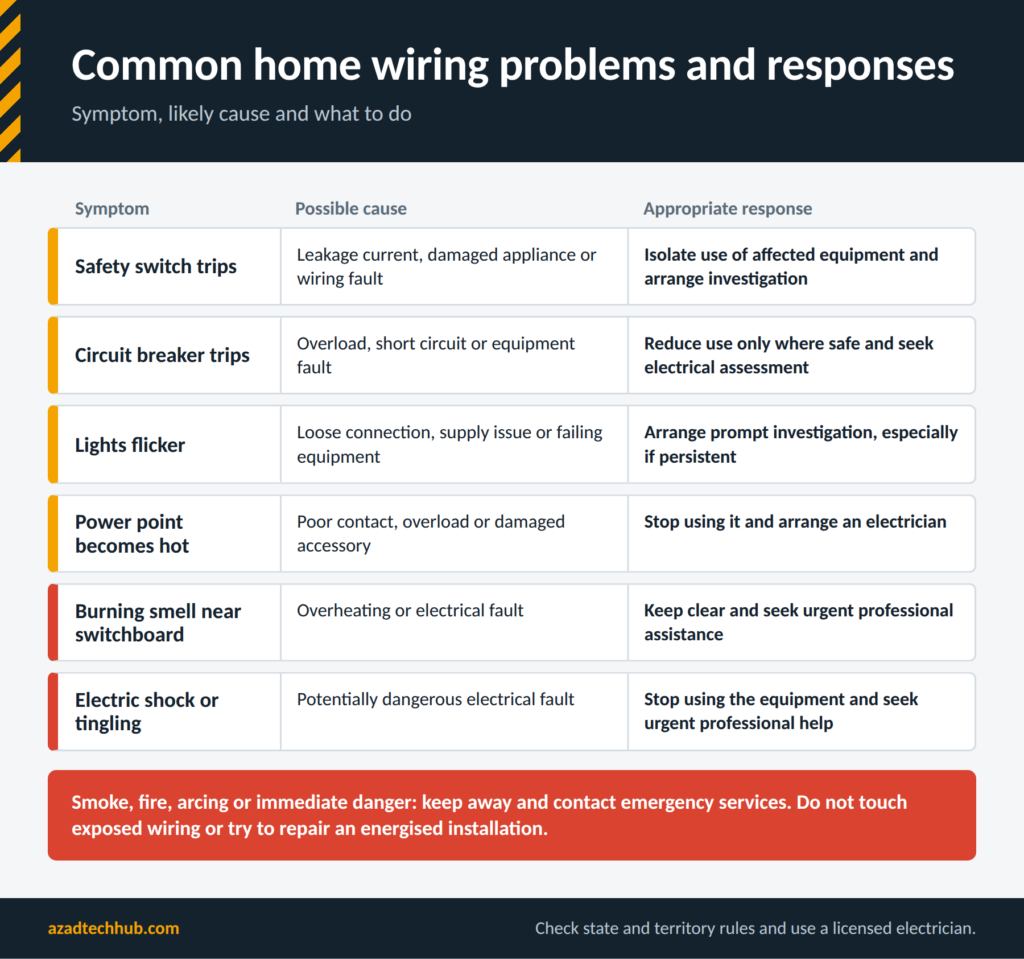
If there is smoke, fire, arcing, or immediate danger, keep away from the equipment and contact emergency services. Do not touch exposed wiring or attempt to repair an energised installation.
Australian Licensing, Inspections, and Compliance
Electrical work is regulated at the state and territory level. Requirements differ in relation to licensing, permitted work, notifications, inspections, and certificates of compliance.
Homeowners should confirm the local rules before planning alterations. Work involving fixed wiring, switchboards, new circuits, or replacement of electrical accessories should not be assumed to be legal for an unlicensed person merely because it appears straightforward.
For a new home, renovation, or major alteration, retain the electrical documentation and relevant compliance records. These can assist with future maintenance, renovations, insurance enquiries, and fault diagnosis.
The applicable requirements may also depend on when the installation was constructed or altered. Existing installations are not necessarily assessed in the same way as new work, so a qualified electrician should determine which requirements apply to the job.
Planning a Safe Home Wiring Upgrade
Before arranging an electrical upgrade, prepare a clear list of current and future needs. Include major appliances, possible EV charging, solar and battery systems, air conditioning, workshop equipment, and planned extensions.
Ask the electrician to explain the proposed circuit layout, protection, cable-sizing basis, voltage-drop assessment, and testing arrangements. A useful quotation should clearly identify the work included and any assumptions about the existing installation.
Where possible, request an updated circuit schedule and retain the test results or compliance documentation required in your jurisdiction. These records help the next electrician understand the installation without relying on guesswork.
Can Australian Homeowners Carry Out Their Own Electrical Repairs?
Australian electrical laws place strict limits on DIY electrical work. In most situations, replacing or installing fixed-wiring accessories, altering circuits, and repairing electrical wiring must be carried out by a licensed electrician. The precise rules depend on the state or territory.
Even apparently simple work can expose a person to live conductors or create a hidden fire risk. Before arranging a repair, check your local electrical regulator’s requirements. This is particularly important for rental properties, renovations, and homes being prepared for sale.
Safety Switch Operation and Routine Checks
A safety switch, or residual current device (RCD), helps protect people by disconnecting a circuit when it detects residual current. Many Australian installations have safety switches protecting relevant lighting and power circuits, subject to the applicable requirements.
The test button checks an aspect of the device’s operation, but it does not verify the complete wiring installation or prove that the earthing system is sound. Follow the manufacturer’s instructions and any supplied testing schedule. If the device fails its test or does not reset correctly, contact a licensed electrician.
Diagnosing Repeated Safety Switch Trips
When a safety switch keeps tripping, the cause may be a faulty appliance, moisture, damaged insulation, leakage current, or a fault in fixed wiring. Record when the trip occurs and which equipment was operating. This information can help an electrician narrow down the fault.
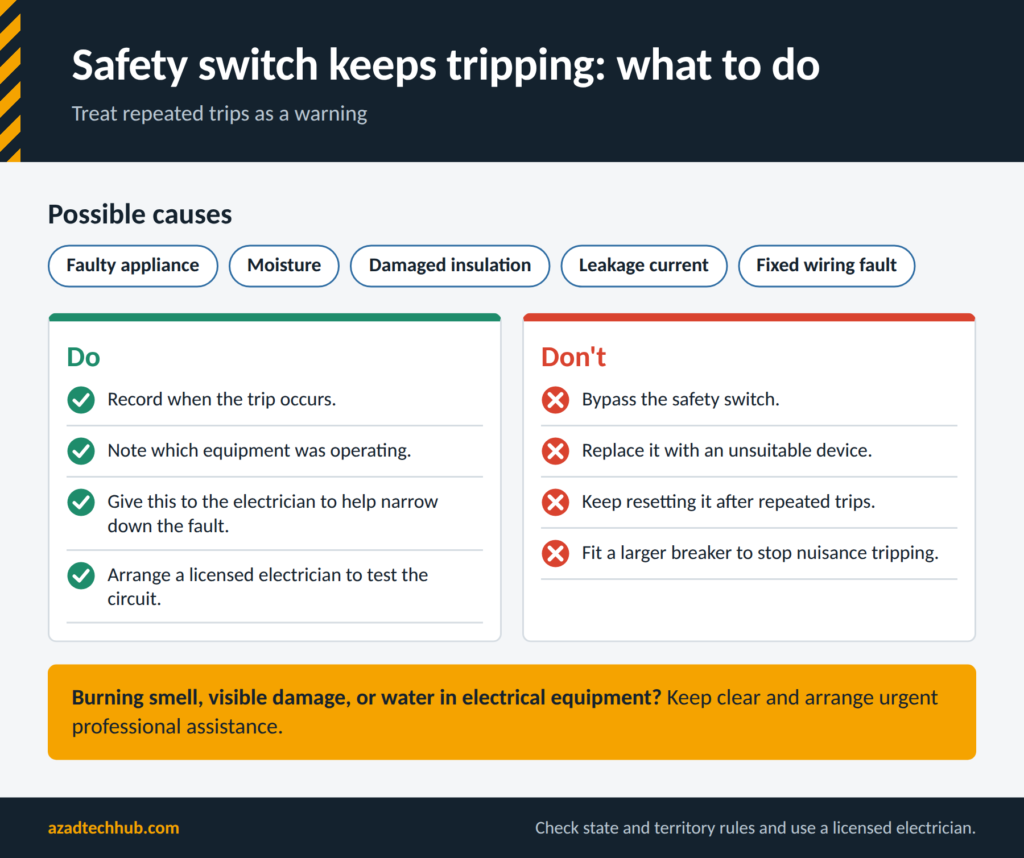
Do not bypass the safety switch, replace it with an unsuitable device, or keep resetting it after repeated trips. If there is a burning smell, visible damage, or evidence of water entering electrical equipment, keep clear and arrange urgent professional assistance.
Understanding the Australian Wiring Rules for Residential Work
AS/NZS 3000 covers electrical installation design, wiring systems, protection, earthing, and verification. Homeowners should understand that compliance involves the complete installation rather than one isolated component. Cable size, circuit-breaker rating, installation method, fault protection, and voltage drop must work together.
The applicable edition and amendments should be checked for the project, along with state or territory requirements. For a renovation or new build, ask the electrician to explain the circuit schedule, protective devices, and testing records so you can understand how the installation is designed and maintained.
Identifying Active, Neutral, and Protective Earth Conductors
Australian electrical wiring uses designated conductor colours, but colour alone is not proof of a conductor’s function. Modern single-phase installations commonly use brown for active, light blue for neutral, and green/yellow for protective earth. Older installations may contain different colours, and some equipment or cable assemblies may follow other applicable conventions.
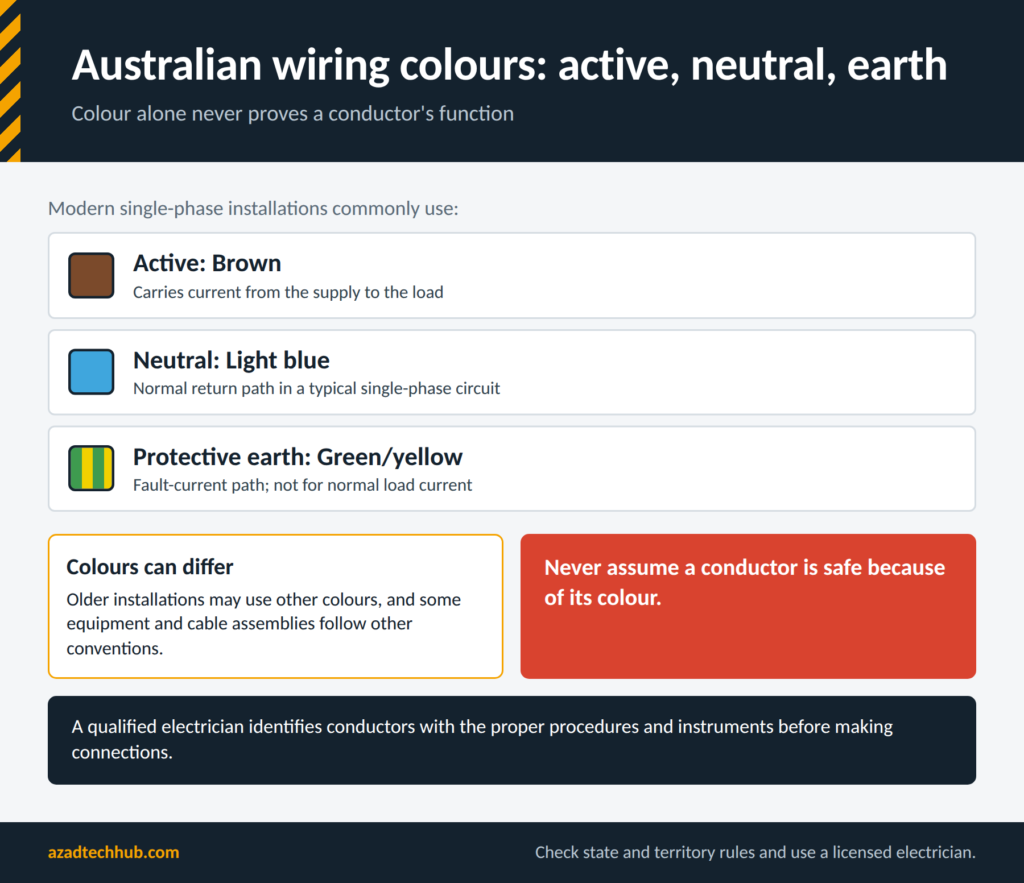
Never assume a conductor is safe because of its colour. A qualified electrician identifies conductors using the appropriate procedures and instruments before making connections. Incorrect identification can cause electric shock, equipment damage, or a dangerous fault.
Choosing Conductors for a 20 Amp Circuit
A 20 A circuit does not automatically require one particular cable size. The correct conductor depends on the cable type, installation method, ambient temperature, grouping, thermal insulation, route length, voltage drop, and protective device. The electrician must establish the design current and verify the cable’s corrected current-carrying capacity.
The relationship between design current, protective-device rating, and cable capacity is only one part of the assessment. Fault protection and short-circuit withstand must also be checked. Cable sizing should be calculated for the actual installation rather than selected from a generic online table.
Double Socket Outlet Selection and Compliance
A double power point provides two socket outlets at one location, but adding outlets does not automatically increase the capacity of the circuit supplying them. The total expected load, existing circuit arrangement, accessory rating, and applicable installation requirements must all be considered.
Replacement or installation involving fixed wiring should be performed by a licensed electrician where required by Australian law. A compliant installation also depends on suitable connections, correct polarity, protective earthing, and verification. If a socket is loose, cracked, discoloured, or unusually warm, stop using it and arrange a professional inspection.
Two-Location Lighting Control in Australian Homes
Two-way switching allows a lighting circuit to be controlled from two separate locations. It is useful for staircases, hallways, bedrooms, and entrances with more than one access point. The arrangement uses compatible switching devices and the correct conductor connections, with the design meeting the applicable wiring rules.
Existing switch wiring can vary between installations, so the position of a conductor or its colour should not be used to infer its function. A licensed electrician can assess the existing circuit, make the required changes, and verify safe operation.
Planning the Number of Socket Outlets on a Circuit
There is no single universal number of power points that suits every Australian home and every circuit. The appropriate arrangement depends on circuit design, expected demand, outlet ratings, conductor capacity, protection, and the applicable rules.
A room with several high-load appliances may need a different arrangement from a bedroom with low-power equipment. During renovations, consider where appliances will be used and avoid relying on multiple adaptors or extension leads. An electrician can assess the existing load and determine whether additional outlets, circuit changes, or dedicated supplies are appropriate.
Selecting Circuit Protection for Split-System Air Conditioners
A split-system air conditioner should be supplied according to its manufacturer’s electrical specifications and the conditions of the installation. The correct circuit-breaker rating depends on the rated input current, starting characteristics, cable capacity, installation method, and required protective arrangement.
Some units specify particular circuit or isolation requirements. The largest breaker that fits the switchboard is not necessarily suitable. Before installation, the electrician should check the unit’s nameplate and instructions, calculate the circuit requirements, and confirm that the existing supply can support the added load without compromising other circuits.
Ceiling Fan Installation and Electrical Safety
Ceiling fan installation involves more than connecting a fan to a lighting circuit. The mounting arrangement must support the fan’s weight and movement, and the electrical supply, switching, controller, and protective earthing must be suitable for the equipment.
Outdoor or damp locations may require equipment with an appropriate rating. Existing ceiling wiring may not match the assumptions made in a product manual, particularly in older homes. Where fixed wiring is involved, use a licensed electrician as required by local law. The finished installation should be checked for secure mounting, correct operation, and electrical safety.
LED Downlights, Drivers, and Ceiling Insulation
LED downlights may operate directly from mains voltage or use a separate driver or transformer, depending on the product design. The correct replacement must match the fitting’s electrical specifications and compatibility requirements.
Ceiling insulation, clearances, heat dissipation, and the fitting’s classification are important because an unsuitable installation can create a fire risk. Do not assume every LED fitting can be installed in the same ceiling space. An electrician should confirm the product’s installation instructions, driver requirements, and suitability for the location before changing fixed-wiring connections or recessed fittings.
Reading an Australian Residential Electricity Meter
An electricity meter records energy use, generally in kilowatt-hours (kWh), for billing purposes. Smart meters may also support remote readings, time-of-use tariffs, and other functions, depending on the retailer and meter configuration. To estimate energy consumption, compare readings over a known period or review the usage information provided by your retailer.
A simple calculation is: Energy used (kWh) = Power (kW) × Operating time (hours). For example, a 2 kW appliance operating for 3 hours uses approximately 6 kWh. Actual billing costs also depend on tariffs, supply charges, and other applicable fees.
Assessing Voltage Drop on Long Cable Runs
Long cable runs can produce greater voltage drop because conductor resistance increases with length. This matters for detached garages, garden buildings, pumps, air conditioners, and other loads located far from the switchboard. The calculation must use the correct conductor material, operating-temperature resistance, circuit current, route length, and circuit type.
Voltage drop is then compared with the applicable design limits for the installation. A larger cable may be required even where its current-carrying capacity appears adequate. The designer must also verify fault protection and other cable-sizing requirements before finalising the conductor size.
Main Earthing Arrangements and Protective Connections
The main earthing system forms part of the installation’s protection against electric shock. It works with protective conductors, bonding where required, and the supply arrangement to support safe fault disconnection. A visible earth wire or metal stake does not prove that the entire system is compliant. Continuity, connections, and the relevant protective conditions must be verified using suitable test equipment.
Never attempt to assess the safety of a home’s earthing system by touching metalwork or carrying out improvised tests. If you suspect a missing or damaged earth connection, arrange an assessment by a licensed electrician.
Checking a Socket Outlet With Appropriate Test Equipment
A plug-in socket tester can identify some common wiring problems, depending on the device’s capabilities, but it cannot detect every dangerous fault. Certain tests may fail to identify a missing or ineffective protective-earth connection, and an indicator pattern should not be treated as full proof of compliance.
More comprehensive verification may require polarity checks, protective-earth continuity measurements, insulation-resistance testing, and other tests performed by a qualified person. If a socket gives a shock, produces a burning smell, or shows signs of damage, stop using it. Arrange a professional inspection rather than relying on a basic tester.
Sizing Supply Circuits for Electric Ovens and Cooktops
Electric ovens and cooktops can draw substantial current, particularly when several heating elements operate together. The required cable size and circuit protection depend on the appliance rating, manufacturer instructions, supply arrangement, demand assessment, installation method, voltage drop, and protective requirements.
A 32 A circuit designation does not, by itself, determine a universally correct conductor size. The electrician should confirm the nameplate data, check the available supply capacity, and calculate the circuit design before installation. Any connection, alteration, or switchboard work must also meet applicable Australian licensing and verification requirements.
FAQs: Home Wiring as per AS/NZS 3000
Does every Australian home need safety switches?
Safety-switch requirements depend on the applicable state or territory rules, installation circumstances, and the work being undertaken. Australian requirements have expanded over time, so older homes may have different arrangements from newer installations.
A licensed electrician can inspect the switchboard and determine whether the existing RCD protection meets the requirements that apply to the property.
Can I use a larger circuit breaker if a breaker keeps tripping?
No. A larger breaker must not be installed simply to stop nuisance tripping. The existing breaker may be responding correctly to an overload or fault, and increasing its rating without verifying the cable and circuit can create a fire hazard. The cause must be identified before any change is considered.
What cable size should I use for household power points?
There is no single cable size suitable for every socket-outlet circuit. The correct selection depends on design current, installation method, cable length, thermal conditions, voltage drop, and protective-device coordination. A licensed electrician should calculate the required size for the actual circuit and verify that it meets the applicable wiring rules.
Are the wiring rules the same in every Australian state?
AS/NZS 3000 provides the central wiring framework, but electrical work is also governed by state and territory legislation, regulator requirements, and applicable adoption arrangements. Licensing, inspection, notification, and certification procedures can differ. Always confirm the requirements that apply in the state or territory where the property is located.
How do I know whether my home’s wiring is safe?
A visual check cannot establish that an electrical installation is safe. Signs such as damaged outlets, recurring trips, flickering lights, burning smells, or shocks require attention, but some faults have no obvious symptoms. Arrange an inspection by a licensed electrician, who can determine which tests and remedial work are appropriate.
Final Thoughts: Home Wiring as per AS/NZS 3000
Home wiring as per AS/NZS 3000 requires a coordinated approach to circuit design, cable selection, protective devices, earthing, and verification. A safe installation is not achieved by choosing components independently or relying on a single wiring diagram.
For Australian homeowners, the best approach is to plan loads before renovations, use licensed electrical contractors for regulated work, confirm the applicable local requirements, and retain relevant test and compliance records. These steps support reliable operation and make future upgrades easier to assess.
The key principle is simple: every circuit must be suitable for its load, its installation conditions, and its protective arrangements. When those elements are properly designed and verified, the electrical installation has a much stronger foundation for long-term safety and performance.
Get new guides in your feed. Follow Electrical Insights on LinkedIn for new electrical standards guides, calculators and design tips from Azad Circuit Hub.