NEC Article for Overcurrent Protection: Article 240 Explained (2023 NEC)
The NEC article for overcurrent protection is Article 240, and it is the first place electricians, inspectors, and designers look when they need to size a breaker or fuse. If you are searching for the NEC article for overcurrent protection, this guide shows exactly where each requirement lives, what 240.4 and 240.6 mean and how the neighboring articles (100, 230, 245, 430, and 440) fit in. It is written for the readers working with the 2023 NEC, and it pairs with our Overcurrent Relay Setting Calculator, which covers the relay side of protection in larger power systems.
Quick Answer: Which NEC Article Covers Overcurrent Protection?
Article 240 is the NEC article for overcurrent protection. It sets the general rules for selecting and installing circuit breakers and fuses so that conductors are not heated beyond what their ampacity allows. Article 240 gives the general rules, and Table 240.3 sends you to other articles when a specific circuit or piece of equipment has its own requirements.
Where in the NEC Can the Requirements for Overcurrent Protection Be Found?
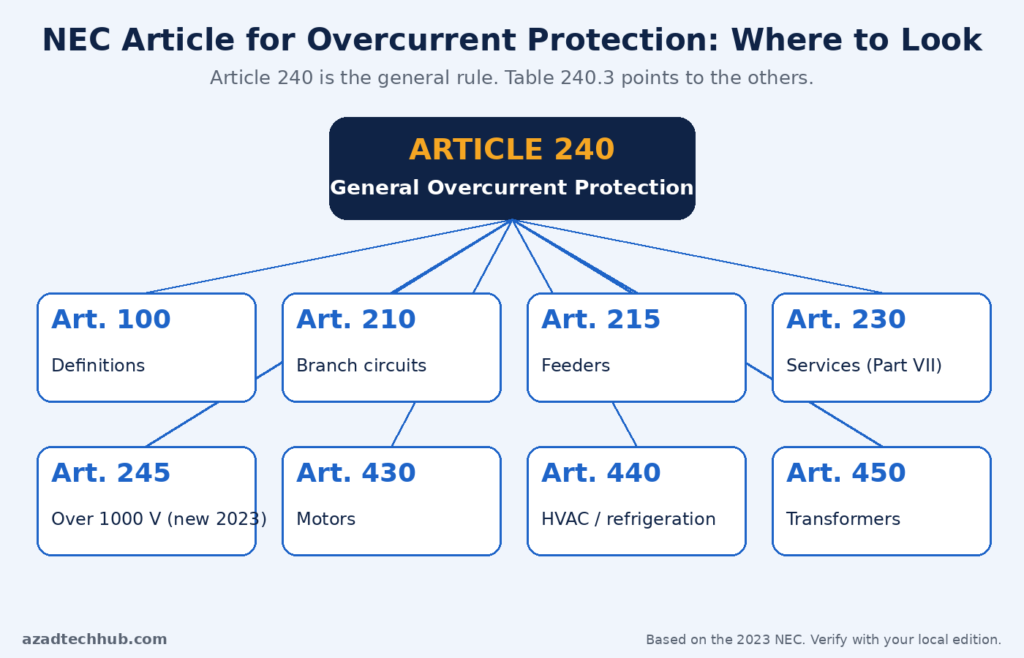
Start with Article 240, then check Table 240.3 to see whether another article changes the rule for your application. Every installation also has to respect the definitions in Article 100. The table below shows the articles most people need.
| NEC Article | What It Covers for Overcurrent Protection |
|---|---|
| Article 100 | Definitions of overcurrent, overload, and related terms |
| Article 210 | Branch circuits, including the 125% continuous load rule in 210.20 |
| Article 215 | Feeders |
| Article 230 | Services, with overcurrent rules for service equipment in Part VII |
| Article 240 | General overcurrent protection requirements |
| Article 245 | Overcurrent protection above 1000 volts, nominal (new in the 2023 NEC) |
| Article 430 | Motors, motor circuits, and controllers |
| Article 440 | Air-conditioning and refrigerating equipment |
| Article 450 | Transformers and transformer vaults |
Article 240, 344, 440, or 517?
This question shows up often in exam prep. Of the four, only Article 240 is the NEC article for overcurrent protection in general. Article 344 covers rigid metal conduit, Article 440 has special rules for HVAC and refrigeration equipment, and Article 517 covers health care facilities. So the answer is Article 240.
What Is Article 240 in the NEC?
Article 240 provides the general requirements for overcurrent protection and overcurrent protective devices (OCPDs). The NEC article for overcurrent protection is organized in parts:
- Part I, General: scope, definitions, other articles, and protection of conductors (240.4)
- Part II, Location: where the OCPD must be placed in the circuit (240.21)
- Part III, Enclosures
- Part IV, Disconnecting and Guarding
- Part V, Plug Fuses, Fuseholders, and Adapters
- Part VI, Cartridge Fuses and Fuseholders
- Part VII, Circuit Breakers
- Part VIII, Supervised Industrial Installations
In the 2023 NEC, the rules for systems over 1000 volts moved out of Article 240 into the new Article 245. The core job of Article 240 has not changed: protect conductors from overcurrent, which includes overloads, short circuits, and ground faults.
What Does NEC Code 240.4 Address?
Section 240.4 addresses protection of conductors, and it is the most used section of the NEC article for overcurrent protection. In simple terms, the OCPD must protect a conductor at its ampacity after correction and adjustment factors from Article 310 are applied. The subsections you will use most often are:
- 240.4(A): power loss hazard (for example, a fire pump circuit) where short-circuit protection is required but overload protection may not be
- 240.4(B): OCPDs rated 800 A or less, where the next higher standard rating is allowed in certain cases
- 240.4(C): OCPDs rated over 800 A, where the conductor ampacity must be at least the device rating
- 240.4(D): the small conductor rule
- 240.4(E): tap conductors, which follow the tap rules in 240.21
- 240.4(F): transformer secondary conductors of separately derived systems
- 240.4(G): specific conductor applications, which point to other articles through Table 240.4(G)
The Next Higher Standard Size Rule: 240.4(B)
If conductor ampacity does not match a standard device rating, 240.4(B) allows the next higher standard rating when the device is 800 A or less, the conductors do not supply multioutlet receptacle circuits for cord-and-plug-connected portable loads, and the load does not exceed the conductor ampacity. Above 800 A, 240.4(C) applies and you cannot round up.
NEC 240.4(D): Small Conductor Rule (There Is No Table)
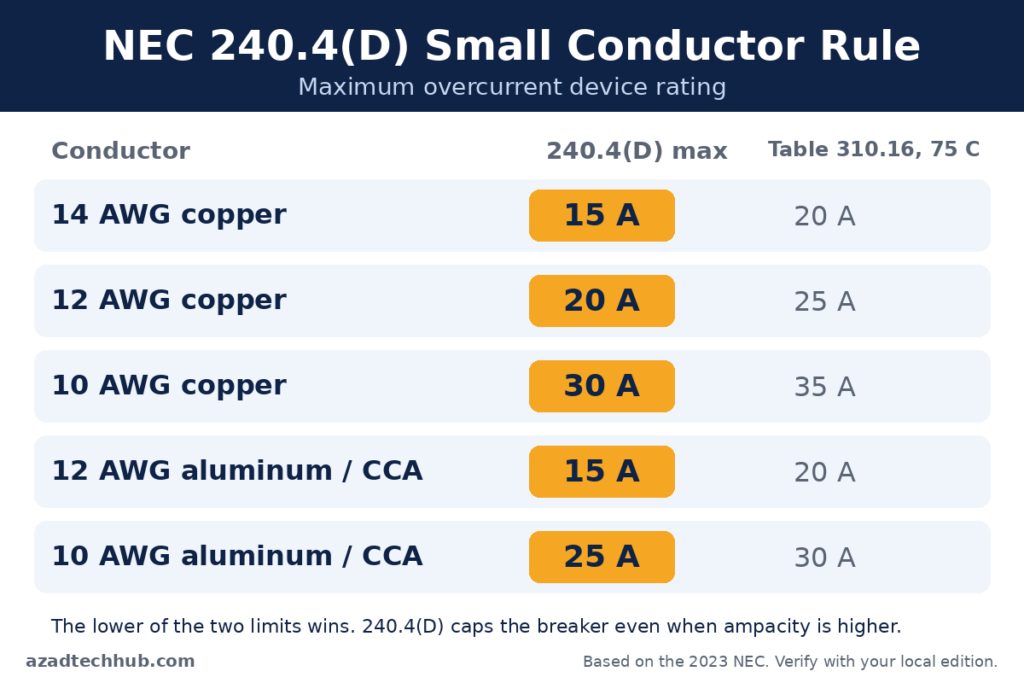
People search for the NEC 240.4(D) table, but 240.4(D) is a list of maximum OCPD ratings, not a numbered table. The limits apply even when the ampacity in Table 310.16 is higher. For example, 14 AWG copper has a 75 C ampacity of 20 A, yet 240.4(D) limits its protection to 15 A.
| Conductor | Maximum OCPD Rating |
|---|---|
| 14 AWG copper | 15 A |
| 12 AWG copper | 20 A |
| 10 AWG copper | 30 A |
| 12 AWG aluminum or copper-clad aluminum | 15 A |
| 10 AWG aluminum or copper-clad aluminum | 25 A |
The 2023 NEC 240.4(D) keeps these familiar limits, and it also includes narrow allowances for 16 AWG and 18 AWG copper in specific listed applications. Because local jurisdictions adopt different editions, confirm the edition your authority having jurisdiction enforces.
NEC 240.4(E): Tap Conductors
The NEC 240.4(E) rule is short: tap conductors may be protected as allowed by 240.21 instead of at their own ampacity. Two common cases are the 10-foot tap, where the tap ampacity must be at least one-tenth of the feeder device rating, and the 25-foot tap, where it must be at least one-third. Each case has further conditions, so read 240.21 before you design a tap.
NEC Overcurrent Protection Sizing Chart
Section 240.6(A) lists the standard ampere ratings for fuses and inverse time circuit breakers: 15, 20, 25, 30, 35, 40, 45, 50, 60, 70, 80, 90, 100, 110, 125, 150, 175, 200, 225, 250, 300, 350, 400, 450, 500, 600, 700, 800, 1000, 1200, 1600, 2000, 2500, 3000, 4000, 5000, and 6000 A. Additional fuse ratings of 1, 3, 6, 10, and 601 A are also standard. Recent NEC cycles also recognize 10 A circuit breakers, so check the 240.6 text in your edition.
The chart below shows the smallest copper conductor commonly paired with a standard breaker, based on the 75 C column of Table 310.16, before any derating.
| Breaker Rating | Minimum Copper Conductor (75 C) |
|---|---|
| 15 A | 14 AWG |
| 20 A | 12 AWG |
| 30 A | 10 AWG |
| 40 A | 8 AWG |
| 50 A | 8 AWG |
| 60 A | 6 AWG |
| 70 A | 4 AWG |
| 100 A | 3 AWG |
| 125 A | 1 AWG |
| 150 A | 1/0 AWG |
| 200 A | 3/0 AWG |
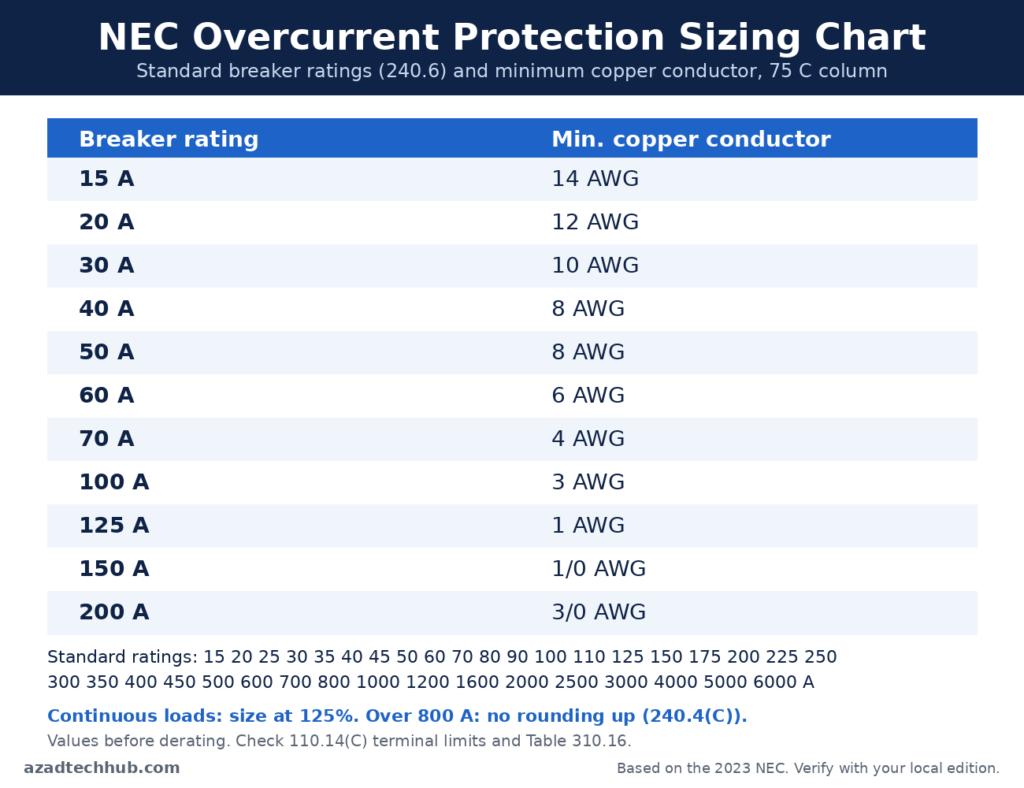
Terminal temperature ratings in 110.14(C) can limit these values, so always confirm equipment markings.
Worked Example: 4,500 W Water Heater
A 4,500 W, 240 V water heater draws 18.75 A. Treat it as a continuous load, so 18.75 x 1.25 = 23.4 A. The next standard size is 25 A, and 10 AWG copper easily covers it while staying under the 30 A cap in 240.4(D). The NEC article for overcurrent protection and Article 310 work together on every sizing job like this one.
Need the cable side? Use our AC cable size calculator and the guide to cable derating factors to check the conductor after you pick the breaker.
Overcurrent Protection Devices Are Labeled With Which Current Rating?
This question appears truncated in many searches, so here is the full picture. An overcurrent protective device is labeled with its ampere rating, which is the continuous current it is designed to carry. Many devices are also marked with a voltage rating and an interrupting rating, which is the maximum fault current the device can clear safely. Article 110.9 requires the interrupting rating to be at least the available fault current at the device.
What Is Article 230 of the NEC?
Article 230 covers services: the conductors and equipment that connect the utility supply to the premises wiring. Part VII of Article 230 contains the overcurrent protection rules for service equipment. Service conductors need overload protection, and Article 240 supplies the device requirements.
What Does NEC Article 245 Cover?
Article 245 covers overcurrent protection for systems over 1000 volts, nominal. It is new in the 2023 NEC and took over the content that used to sit in Part IX of Article 240. For ordinary building circuits, Article 240 remains the NEC article for overcurrent protection that you will use every day.
What Is Article 100 of the NEC?
Article 100 contains the definitions that apply across the whole code. For overcurrent work, it defines overcurrent as any current above the rated current of equipment or the ampacity of a conductor, and it defines overload. Reading these definitions first prevents most misunderstandings about what Article 240 protects.
NEC Article for Overcurrent Protection PDF and NEC Article 240 PDF
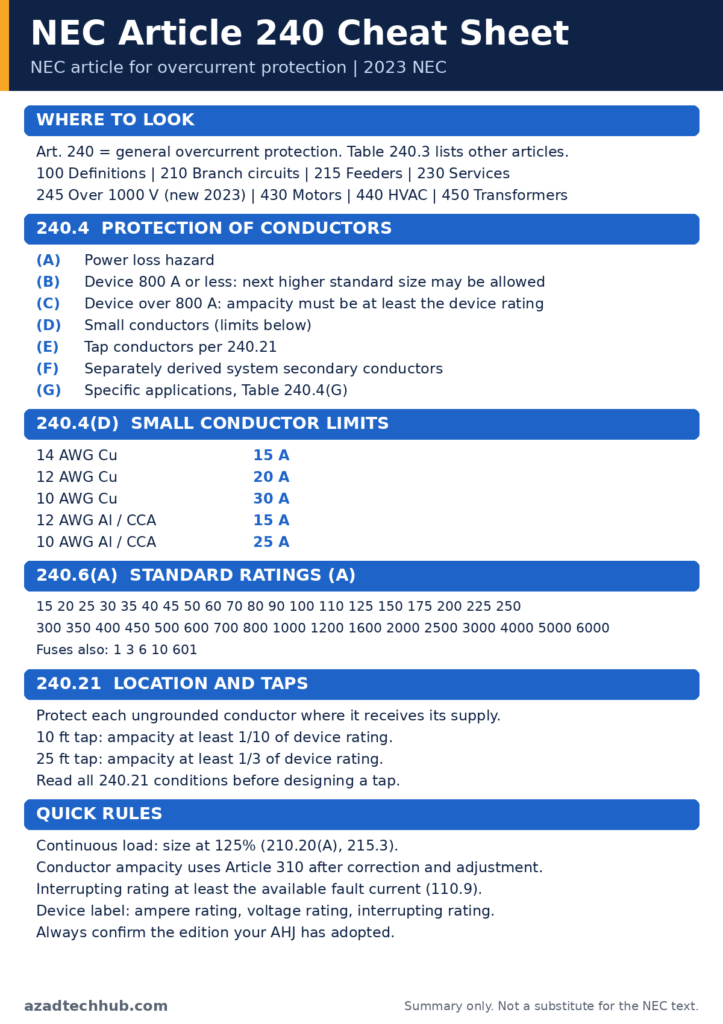
The NEC is copyrighted by NFPA, so we cannot host a PDF of Article 240. You can read NFPA 70 for free online with a free account on the NFPA website, and you can buy the printed or digital edition if you need offline access. Our downloadable article 240 cheat sheet image summarizes the key sections in this post so you can keep it on your phone.
How Relay Settings Connect to the NEC Article for Overcurrent Protection
The NEC article for overcurrent protection governs conductors and OCPDs in premises wiring, while protective relays handle coordination in industrial and utility systems. If your project includes relays, start with our Overcurrent Relay Setting Calculator and then read these related guides:
- What is an overcurrent relay and how does it work
- Causes of overcurrent in power systems
- Overcurrent protection relay settings step by step
- Types of overcurrent relays
- Overcurrent protection of a transformer
- Difference between GFCI and overcurrent protection
- Overcurrent relay testing procedure
- Overload relay setting calculator and the motor overload setting table
- Earth fault relay setting calculator
Common Mistakes When Applying the NEC Article for Overcurrent Protection
- Sizing the breaker from the load alone and forgetting the 125% continuous load rule
- Using the Table 310.16 ampacity of 14, 12, or 10 AWG wire instead of the 240.4(D) limit
- Rounding up above 800 A, which 240.4(C) does not allow
- Ignoring the motor rules in Article 430 or the HVAC rules in Article 440
- Installing a device whose interrupting rating is lower than the available fault current
- Assuming one edition of the code applies everywhere without checking local adoption
Frequently Asked Questions
What is the NEC article for overcurrent protection?
The NEC article for overcurrent protection is Article 240. It covers the selection and installation of fuses and circuit breakers, with other articles listed in Table 240.3 adding rules for specific equipment.
What is Article 240 in the NEC?
Article 240 is the general overcurrent protection article. It explains how to protect conductors, where to place the device, and what requirements apply to fuses and circuit breakers.
What does NEC code 240.4 address?
Section 240.4 addresses protection of conductors, including the next higher standard size rule, the 800 A limit, the small conductor limits in 240.4(D), and tap and transformer secondary conductors.
What does NEC Article 245 cover?
Article 245 covers overcurrent protection above 1000 volts, nominal, and was added in the 2023 NEC.
Can I use a 20 A breaker on 14 AWG copper?
No. The 240.4(D) limit for 14 AWG copper is 15 A, even though the table ampacity is higher.
Conclusion
The NEC article for overcurrent protection is Article 240. Use 240.4 to protect conductors, 240.6 to choose a standard rating, 240.21 for location and taps, and Table 240.3 to find the article that governs your equipment.
Pair the NEC article for overcurrent protection with Articles 100, 210, 230, 430, and 440 for complete designs, and use the Overcurrent Relay Setting Calculator when your project moves from premises wiring to relay coordination. Always verify the details against the edition of the NEC adopted in your jurisdiction.
Get new guides in your feed. Follow Electrical Insights on LinkedIn for new electrical standards guides, calculators and design tips from Azad Circuit Hub.