
Types of Overcurrent Relays
Overcurrent relays are one of the most widely used protective devices in electrical power systems. They detect abnormal current levels and send a trip signal to isolate faulty equipment before serious damage occurs. Understanding the different types helps engineers select the right protection for feeders, transformers, motors, generators, and distribution networks.
If you are selecting pickup current and time settings, use our Overcurrent Relay Setting Calculator to determine the correct values based on your system requirements.
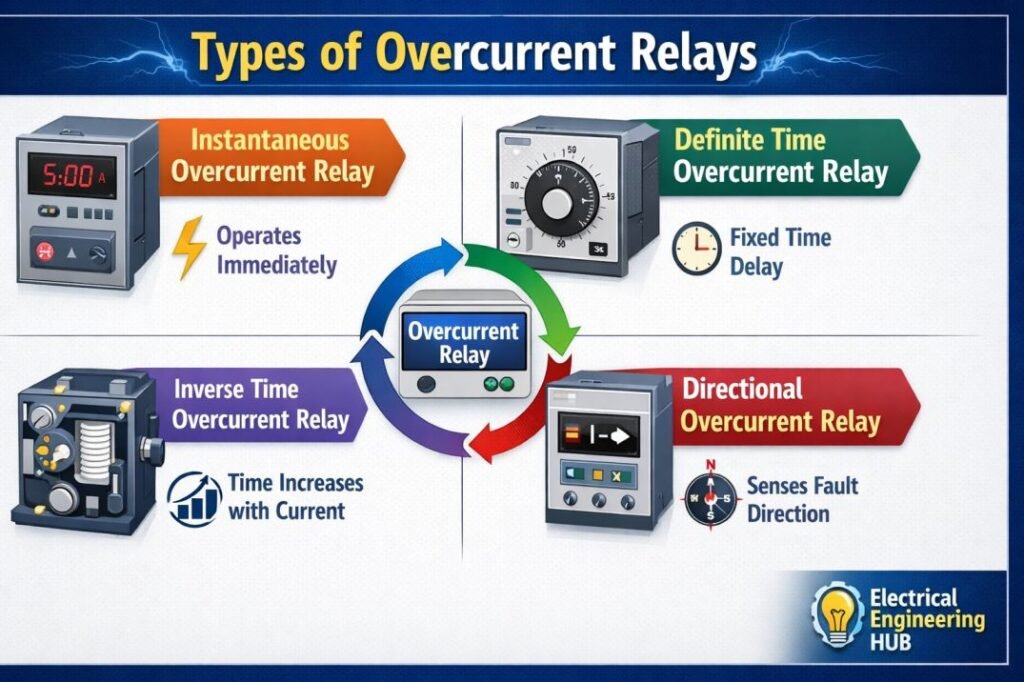
Table of Contents
Table of Contents
Types of Overcurrent Relays
| Relay Type | Operating Principle | Typical Application | Response Speed |
|---|---|---|---|
| Instantaneous Overcurrent Relay | Trips without intentional delay | Short circuits | Very Fast |
| Definite Time Overcurrent Relay | Fixed operating time | Feeders and backup protection | Medium |
| Inverse Time Overcurrent Relay | Operating time decreases as current increases | Distribution systems | Variable |
| Very Inverse Relay | Higher inverse characteristic | Long feeders | Fast at high faults |
| Extremely Inverse Relay | Very steep inverse curve | Transformer and cable protection | Very Fast |
| Directional Overcurrent Relay | Operates based on current direction | Parallel feeders and ring networks | Depends on settings |
| Voltage-Controlled Overcurrent Relay | Uses voltage supervision | Generator protection | Controlled |
Quick Selection Chart
| System Condition | Recommended Relay Type |
|---|---|
| High fault current close to source | Instantaneous |
| General feeder protection | Inverse Time |
| Long overhead distribution lines | Very Inverse |
| Transformer backup protection | Extremely Inverse |
| Parallel feeders | Directional Overcurrent |
| Generator protection | Voltage-Controlled |
What Are Types of Overcurrent Relays?
Types of Overcurrent Relays refer to protective relays that operate whenever electrical current exceeds a preset value. Although every relay detects excessive current, each type uses a different operating characteristic to improve protection coordination and reduce unnecessary tripping.
The choice depends on several factors, including fault level, equipment type, system configuration, cable length, and coordination with upstream and downstream protective devices.
Instantaneous Overcurrent Relay
An instantaneous overcurrent relay operates as soon as the measured current exceeds its pickup setting. There is no intentional time delay, making it suitable for clearing severe short circuits quickly.
Features
- No intentional delay
- Fast fault clearance
- Protects equipment against heavy faults
- Reduces thermal and mechanical damage
Common Applications
- Busbars
- Switchgear
- Large industrial feeders
- High fault current locations
| Parameter | Value |
|---|---|
| Time Delay | Nearly Zero |
| Best For | Close-in faults |
| Coordination | Limited |
Definite Time Overcurrent Relay
A definite time overcurrent relay trips after a fixed time once the current exceeds the pickup setting. The delay remains constant regardless of fault magnitude.
This relay is commonly used where simple coordination is sufficient and predictable operating times are required.
Advantages
- Easy to coordinate
- Simple settings
- Reliable operation
Applications
- Industrial feeders
- Backup protection
- Radial distribution systems
Inverse Time Overcurrent Relay
Among all Types of Overcurrent Relays, the inverse time relay is the most common in modern power systems.
Its operating time decreases as fault current increases. Small overloads take longer to trip, while severe faults are cleared rapidly.
This characteristic improves system selectivity and minimizes unnecessary outages.
For accurate pickup current and time multiplier calculations, use the online overcurrent relay settings calculator before commissioning protective relays.
Benefits
- Better coordination
- Faster response during major faults
- Suitable for varying load conditions
| Fault Current | Operating Time |
|---|---|
| Slight Overload | Long |
| Medium Fault | Moderate |
| Heavy Fault | Short |
Very Inverse Overcurrent Relay
A very inverse relay provides a steeper inverse characteristic than the standard inverse relay.
It is particularly useful on long overhead transmission and distribution feeders where fault current varies significantly depending on fault location.
Advantages
- Excellent feeder coordination
- Better discrimination
- Reduced nuisance tripping
Typical Applications
- Distribution feeders
- Rural power networks
- Long cable circuits
Extremely Inverse Overcurrent Relay
An extremely inverse relay has the steepest inverse characteristic among conventional inverse relays.
Its operating curve closely matches the thermal characteristics of transformers and cables, making it highly effective for protecting equipment against overload and short-circuit conditions.
Suitable For
- Distribution transformers
- Underground cables
- Industrial substations
- Motor feeder backup protection
| Relay Characteristic | Best Application |
|---|---|
| Standard Inverse | General feeders |
| Very Inverse | Long lines |
| Extremely Inverse | Transformers and cables |
Directional Overcurrent Relay
A directional overcurrent relay measures both the magnitude and direction of fault current. It only operates when current flows in the predetermined direction.
This feature is essential in interconnected networks where power can flow from multiple sources.
Applications
- Ring main systems
- Parallel feeders
- Grid interconnections
- Renewable energy plants
Advantages
- Improved selectivity
- Prevents incorrect tripping
- Reliable coordination in complex systems
Voltage-Controlled Overcurrent Relay
A voltage-controlled overcurrent relay combines current measurement with voltage supervision.
It becomes active only when system voltage falls below a specified level while current exceeds the pickup value.
This prevents unnecessary trips during temporary overloads.
Common Uses
- Generator protection
- Large synchronous motors
- Power plants
Comparison of Types of Overcurrent Relays
| Relay Type | Time Delay | Speed | Main Use |
|---|---|---|---|
| Instantaneous | None | Very Fast | Short-circuit protection |
| Definite Time | Fixed | Medium | Backup protection |
| Standard Inverse | Variable | Fast | General distribution |
| Very Inverse | Variable | Faster | Long feeders |
| Extremely Inverse | Variable | Fastest | Transformers |
| Directional | Adjustable | Depends | Parallel systems |
| Voltage-Controlled | Adjustable | Controlled | Generators |
How to Choose the Right Overcurrent Relay
Selecting the proper relay requires evaluating the electrical system and protection philosophy.
Consider the following factors:
- Available fault current
- Load current
- Equipment thermal limits
- Coordination with upstream relays
- Cable length
- Transformer impedance
- Motor starting current
- Network configuration
- Utility protection requirements
Proper relay coordination improves reliability while reducing unnecessary shutdowns.
Before finalizing relay settings, verify pickup current, plug setting multiplier, and time multiplier using the Overcurrent Relay Setting Calculator to ensure proper coordination across the protection system.
Advantages of Using the Correct Relay Type
Choosing the correct relay provides several operational benefits.
- Faster fault isolation
- Improved personnel safety
- Better equipment protection
- Reduced maintenance costs
- Higher system reliability
- Improved selectivity
- Better coordination between protective devices
- Reduced downtime
Industries That Use Overcurrent Relays
Overcurrent relays are installed in almost every electrical installation.
These include:
- Power generation plants
- Transmission substations
- Distribution utilities
- Manufacturing industries
- Oil and gas facilities
- Solar power plants
- Wind farms
- Commercial buildings
- Mining operations
- Water treatment plants
Frequently Asked Questions
Which type of overcurrent relay is used most frequently?
The inverse time overcurrent relay is the most widely used because it provides excellent coordination between protective devices while clearing high fault currents quickly.
What is the difference between very inverse and extremely inverse relays?
A very inverse relay has a steeper operating curve than the standard inverse relay, while an extremely inverse relay responds even faster to high fault currents and is commonly used for transformer and cable protection.
Why are directional overcurrent relays required?
Directional relays prevent incorrect tripping in systems where power flows from multiple sources by operating only when fault current moves in the selected direction.
Can one relay protect every electrical system?
No. Different electrical systems require different relay characteristics depending on equipment type, fault current levels, coordination requirements, and network configuration.
Related Guides & Tools
- Overload Relay Setting Calculator
- Earth Fault Relay Setting Calculator
- Differential Protection Relay Setting Calculator
Conclusion
Understanding the different Types of Overcurrent Relays is essential for designing a reliable protection system. Each relay characteristic serves a specific purpose, from instantaneous fault clearing to advanced directional protection in interconnected networks. Selecting the appropriate relay improves coordination, protects valuable electrical equipment, and minimizes downtime.
For the best protection performance, always calculate pickup current, time multiplier settings, and coordination parameters using the Overcurrent Relay Setting Calculator before commissioning your protection scheme.
Get new guides in your feed. Follow Electrical Insights on LinkedIn for new electrical standards guides, calculators and design tips from Azad Circuit Hub.
TypesOfOvercurrentRelays, #OvercurrentRelay, #ProtectiveRelays, #ElectricalProtection, #PowerSystems, #RelayProtection, #ElectricalEngineering, #Substation, #PowerDistribution, #IndustrialAutomation
