
Busbar Size Calculator According to IEC and NEC
Busbar sizing is a critical part of electrical system design. Choosing the correct size ensures efficiency, safety, and long-term reliability of power distribution. The Busbar Size Calculator helps engineers and electricians find the right copper or aluminum busbar dimensions based on current capacity, material type, and environmental conditions. This article explains how the calculator works, the standards it follows (IEC and NEC), and what factors influence the final busbar size.
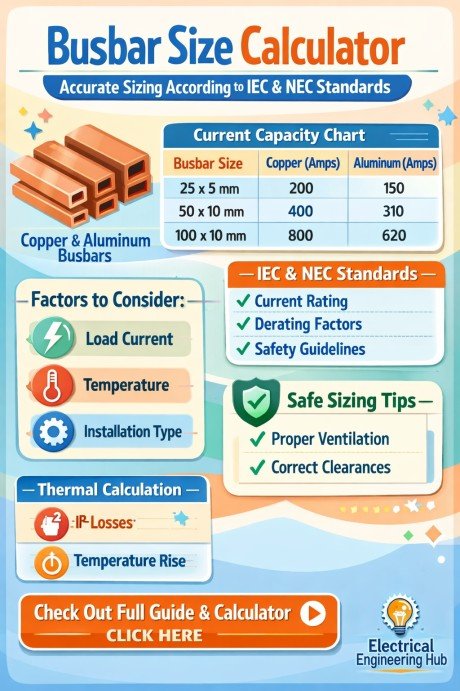
Table of Contents
Table of Contents
Busbar Size Calculator According to IEC and NEC
Find more Electrical Engineering Tools for easy electrical calculations and estimations.
What Is a Busbar and Why Its Size Matters
A busbar is a metallic strip or bar used to conduct electricity within switchboards, distribution panels, or substations. It acts as a common junction for electrical currents. The correct sizing of a busbar determines how efficiently it can carry current without overheating or causing excessive voltage drop. If undersized, a busbar can lead to dangerous temperature rise, equipment failure, or energy losses. Oversizing, on the other hand, increases cost and space requirements.
A Busbar Size Calculator simplifies this task by automatically determining the required cross-sectional area and dimensions according to international standards like IEC 61439 and NEC 366.
Understanding the Busbar Size Calculator
The Busbar Size Calculator is a practical online tool that calculates the optimal busbar size for copper or aluminum conductors. You only need to input the following parameters:
- System voltage (V)
- Maximum load current (A)
- Busbar material (Copper or Aluminum)
- Ambient temperature (°C)
- Permissible temperature rise (°C)
- Number of busbars per phase
Based on these inputs, the calculator provides the ideal width, thickness, and cross-sectional area that can safely carry the current as per IEC or NEC guidelines.
The calculator uses predefined current density values to maintain safe operation. For example:
- Copper: 1.2 to 1.6 A/mm² for natural cooling
- Aluminum: 0.8 to 1.2 A/mm² for natural cooling
These values are adjusted according to installation type, ventilation, and temperature rise limits.
IEC Standard for Busbar Sizing
The International Electrotechnical Commission (IEC) provides globally accepted guidelines for electrical installations. According to IEC 61439-1, the current-carrying capacity of busbars depends on:
- Material conductivity
- Cross-sectional area
- Ambient temperature
- Type of insulation and enclosure
- Cooling conditions
In IEC standards, current density is used to estimate the required busbar size. The formula used in most cases is:
Current Density (A/mm²) = Current (A) ÷ Cross-Sectional Area (mm²)
For copper busbars, the IEC recommends keeping current density around 1.2 to 1.6 A/mm² under normal air-cooled conditions. For aluminum, the range is 0.8 to 1.2 A/mm².
The Busbar Size Calculator applies these values automatically, ensuring the design complies with IEC safety margins.
Example (IEC Based Calculation)
| Parameter | Value |
|---|---|
| Material | Copper |
| Load Current | 1000 A |
| Current Density | 1.5 A/mm² |
| Required Area | 1000 ÷ 1.5 = 667 mm² |
If a single bar of 100 mm width is used, the thickness should be approximately 6.7 mm. The calculator gives this instantly, ensuring compliance with IEC rules. Read more in detail in our guide on IEC Standard for Busbar Sizing
NEC Standards for Busbar Sizing
The National Electrical Code (NEC) does not provide a single formula for determining busbar dimensions. Instead, it specifies installation, ampacity, protection, and equipment requirements that work alongside a Busbar Size Calculator. Engineers typically size busbars using manufacturer data, UL 891 or UL 1558 ratings, and applicable NEC articles.
| NEC Article | Purpose |
|---|---|
| NEC 366 | Busway installation requirements |
| NEC 368 | Busway ampacity and overcurrent protection |
| NEC 110.3(B) | Follow manufacturer installation instructions |
| NEC 110.14 | Electrical connections and terminations |
Always verify that the calculated busbar meets NEC requirements as well as the equipment manufacturer's tested ratings. Follow our complete guide on NEC Standards for Busbar Sizing.
How to Calculate Busbar Size for Panel
When selecting a panel busbar, calculate the design current, apply the required derating factors (ambient temperature, enclosure, grouping, and duty cycle), then choose a busbar cross-sectional area that safely carries the load without exceeding the allowable temperature rise.
Also verify short-circuit withstand capacity and voltage drop to ensure reliable operation. A Busbar Size Calculator simplifies these calculations and helps match the selected busbar with IEC or NEC design practices.
| Step | What to Check |
|---|---|
| 1 | Calculate full-load current |
| 2 | Apply derating factors |
| 3 | Select busbar cross-sectional area |
| 4 | Verify short-circuit withstand rating |
| 5 | Confirm temperature rise and voltage drop |
For a detailed step-by-step sizing procedure, read our guide on calculating panel busbar dimensions and ratings.
Copper vs Aluminum Busbars
Your Busbar Size Calculator also lets you choose between copper and aluminum materials. Both have advantages, but they differ in conductivity and cost.
| Property | Copper | Aluminum |
|---|---|---|
| Conductivity | 100% | 61% of copper |
| Current Density | 1.2–1.6 A/mm² | 0.8–1.2 A/mm² |
| Weight | Heavier | Lighter |
| Cost | Higher | Lower |
| Oxidation Resistance | Excellent | Needs coating |
Copper is preferred in compact panels or high-current applications, while aluminum is more economical in large bus duct systems. The calculator provides dimensions for both, allowing cost-performance comparison. Read complete guide on copper vs aluminum busbar here.
Factors Affecting Busbar Size
Several real-world conditions affect busbar performance. The Busbar Size Calculator accounts for these factors:
- Ambient Temperature: Higher ambient temperature reduces current-carrying capacity. The calculator derates current accordingly.
- Cooling Method: Natural air-cooled or forced air systems affect heat dissipation.
- Installation Orientation: Horizontal or vertical mounting changes the heat transfer path.
- Enclosure Type: Enclosed systems heat up faster, requiring larger busbars.
- Parallel Busbars: When more than one bar is used per phase, current sharing must be even. The calculator divides total current equally among bars.
How the Busbar Size Calculator Helps Engineers
The Busbar Size Calculator reduces design time and human error. It delivers accurate sizing results within seconds and follows both IEC and NEC methodologies. This ensures global applicability, whether you’re designing a panel for Europe, the Middle East, or North America.
It also optimizes material use. Oversized busbars increase cost unnecessarily, while undersized bars risk overheating. By finding the perfect balance, the calculator improves safety, cost-efficiency, and compliance.
Recommended Current Density Values
Here’s a quick reference table often used by engineers and integrated into the Busbar Size Calculator:
| Material | Cooling Type | Typical Current Density (A/mm²) |
|---|---|---|
| Copper | Natural Air Cooling | 1.2–1.6 |
| Copper | Forced Air Cooling | 1.8–2.5 |
| Aluminum | Natural Air Cooling | 0.8–1.2 |
| Aluminum | Forced Air Cooling | 1.4–1.8 |
These values are adjusted automatically based on user input for ambient conditions and permissible temperature rise.
Practical Example Using the Busbar Size Calculator
Imagine a 1600 A distribution board made with copper busbars in an ambient temperature of 40°C. Assuming natural cooling and 1.5 A/mm² current density:
Required Area = 1600 ÷ 1.5 = 1067 mm²
If two bars per phase are used, each bar should have 533 mm² cross-section, which corresponds to approximately 100 mm × 5.3 mm bars.
The calculator would instantly show this configuration, along with an alert if the temperature rise exceeds safe limits.
Bus Size Calculation for Transformer
Many engineers use a Busbar Size Calculator together with transformer load calculations to select the correct busbar dimensions. Transformer bus size depends on the full-load current, conductor material (copper or aluminum), allowable current density, and temperature rise.
After determining the required cross-sectional area, you can use this page to estimate the corresponding busbar weight for procurement and fabrication.
| Transformer Rating | Key Parameter for Bus Size |
|---|---|
| kVA Rating | Full-load current |
| Voltage | Current calculation |
| Material | Copper or Aluminum |
For detailed sizing steps, formulas, and examples, read our guide on Transformer Busbar Sizing Calculation.
Advantages of Using a Busbar Size Calculator
- Saves time in manual calculations
- Ensures compliance with IEC and NEC standards
- Reduces risk of overheating or voltage drop
- Provides accurate sizing for both copper and aluminum
- Optimizes cost and material usage
- Suitable for LV and MV distribution panels, switchboards, and bus ducts
Busbar Size Chart in mm
Many engineers use a Busbar Size Calculator for precise sizing, but a quick reference chart is useful during preliminary design and estimation. The values below are typical copper busbar dimensions. Always verify the final size based on current, temperature rise, installation method, and the applicable IEC or NEC requirements.
| Busbar Size (mm) | Cross-Section (mm²) | Typical Application |
|---|---|---|
| 20 × 3 | 60 | Small distribution panels |
| 25 × 5 | 125 | Light commercial loads |
| 40 × 5 | 200 | Industrial panels |
| 50 × 6 | 300 | Main distribution boards |
| 80 × 10 | 800 | High-current switchboards |
For a more comprehensive list of standard dimensions, tolerances, and selection guidance, see our complete Busbar Dimensions and Standard Size Chart.
Busbar Sizing Chart in Inches
A busbar sizing chart in inches helps electricians and panel builders quickly compare common copper or aluminum busbar dimensions before selecting a suitable cross-sectional area. The required size depends on material, continuous current, allowable temperature rise, installation arrangement, and applicable standard.
| Busbar Width | Thickness | Cross-Sectional Area |
|---|---|---|
| 1 in | 1/8 in | 0.125 in² |
| 1 in | 1/4 in | 0.250 in² |
| 2 in | 1/4 in | 0.500 in² |
| 2 in | 3/8 in | 0.750 in² |
| 2 in | 1/2 in | 1.000 in² |
For a complete ampacity and cross-sectional-area assessment, use a Busbar Size Calculator. You can also review this detailed Busbar Sizing Chart in Inches for additional dimensions, conversions, and practical sizing guidance.
Busbar Sizing Rule of Thumb
When a detailed calculation is unavailable, a busbar sizing rule guide can provide a quick starting point. A common industry rule is that a copper busbar carries approximately 1.2–1.6 A/mm² under normal operating conditions, while aluminum busbars typically carry 0.8–1.2 A/mm².
Actual busbar dimensions should always be verified for temperature rise, enclosure conditions, ventilation, and applicable IEC or NEC requirements. For practical sizing methods, examples, and limitations, read our Busbar Sizing Rules and Thumb Guidelines.
| Material | Typical Rule of Thumb |
|---|---|
| Copper Busbar | 1.2–1.6 A/mm² |
| Aluminum Busbar | 0.8–1.2 A/mm² |
Busbar Fabrication After Sizing
Once you have selected the correct busbar dimensions using the Busbar Size Calculator, the next step is fabrication. This includes cutting, drilling, punching, deburring, and bending the busbar to match the panel layout while maintaining the required clearances and mechanical strength.
Incorrect bends can increase stress, reduce electrical reliability, or make installation difficult. Before manufacturing, verify bend radius, hole spacing, and mounting locations according to your project drawings and applicable standards.
For accurate bend allowance and layout calculations, use our busbar bending calculation guide to ensure the fabricated busbar matches the required dimensions with minimal material waste.
Flat vs Tubular vs Rectangular Busbar: Which Shape Is Best?
Busbar shape affects current capacity, heat dissipation, mechanical strength, and installation space. When using a Busbar Size Calculator, consider the conductor shape along with material, allowable temperature rise, and installation conditions.
| Busbar Shape | Main Advantage | Typical Use |
|---|---|---|
| Flat | Easy to install and drill | Distribution panels |
| Tubular | Excellent rigidity and cooling | High-current systems |
| Rectangular | Good balance of capacity and space | Switchboards |
Quick Selection Guide
Flat busbars are practical for compact panels, while tubular designs offer better mechanical strength and surface-area efficiency. Rectangular busbars are widely used where high current capacity and straightforward mounting are required.
For a deeper comparison of dimensions, ampacity, and practical selection factors, see our guide to busbar shapes sizing. Always verify the final selection against applicable IEC or NEC requirements and the installation environment.
Download Busbar Size Calculation Excel
Many engineers use a busbar size calculation Excel sheet for quick preliminary sizing before validating the results with an online Busbar Size Calculator. An Excel worksheet allows you to enter current, conductor material, temperature rise, and safety factor to estimate the required busbar cross-sectional area. However, formulas must be verified against the latest IEC or NEC requirements to avoid design errors.
| Excel Input | Example |
|---|---|
| Rated Current | 800 A |
| Material | Copper / Aluminum |
| Allowable Current Density | 1.2–1.6 A/mm² (design dependent) |
| Busbar Dimensions | Calculated Output |
For faster and more reliable calculations, use a Busbar Size Calculator that automatically applies engineering formulas and minimizes manual spreadsheet errors while improving design accuracy. Download Busbar Size Calculation excel sheet right here.
Common Busbar Sizing Mistakes to Avoid
Correct busbar selection involves more than calculating current capacity. Common errors include ignoring ambient temperature, enclosure ventilation, installation arrangement, and short-circuit withstand requirements.
| Common Mistake | Potential Issue |
|---|---|
| Using current rating alone | Overheating |
| Ignoring temperature rise | Reduced service life |
| Incorrect bar spacing | Poor cooling or flashover risk |
| Skipping short-circuit checks | Mechanical or thermal failure |
A Busbar Size Calculator provides a useful starting point, but the final selection should consider applicable IEC or NEC requirements and actual installation conditions. For practical guidance on these issues, see common busbar sizing mistakes to avoid before finalizing a switchboard or panel design.
Related Guide & Tools
- Electrical Bus Bar types and Applications
- Busbar Weight Calculation
- Busbar Dimensions Calculation
- Copper Ground Busbar Sizing CEC
- Bus Bar Cross Sectional Area Calculator
- Substation Bus Size Calculator
Conclusion
The Busbar Size Calculator is an essential engineering tool that combines accuracy, safety, and efficiency. Whether you follow IEC or NEC standards, it instantly provides the correct busbar dimensions for copper or aluminum conductors based on your system’s load and environmental factors.
By using this calculator, electrical engineers can ensure compliance, improve design reliability, and save time in the sizing process. For any power distribution project, starting with the right busbar size is key to achieving safe and efficient operation.
The next time you design a switchboard or substation, use the Busbar Size Calculator to find the most reliable and cost-effective configuration that meets international standards.
Follow Us on Social:
Subscribe our Newsletter on Electrical Insights for latest updates from Electrical Engineering Hub
#BusbarSizeCalculator, #BusbarSizing, #ElectricalDesign, #IECStandards, #NECStandards, #CopperBusbar, #AluminumBusbar, #ElectricalEngineering, #BusbarCalculation, #ElectricalSafety, #PanelDesign, #SwitchgearDesign, #PowerDistribution, #CurrentCarryingCapacity, #ElectricalTools
Busbar Size Calculator According to IEC and NEC

Use our Busbar Size Calculator to find accurate copper and aluminum busbar sizes according to IEC and NEC standards. Optimize your electrical panel design with precise current-carrying capacity, material selection, and safety compliance
Price Currency: USD
Operating System: All
Application Category: UtilitiesApplication
