
ANSI vs IEC Compliance in Load Flow Studies: Standards, Methods, and Key Differences
| Comparison Point | ANSI-Based Practice | IEC-Based Practice |
|---|---|---|
| Primary market | United States and North America | Europe and most international markets |
| Voltage reference | ANSI C84.1 | IEC 60038 |
| System frequency | Commonly 60 Hz | Commonly 50 Hz, with exceptions |
| Power system studies | IEEE/ANSI standards and utility requirements | IEC standards and utility requirements |
| Load flow approach | Newton-Raphson, Gauss-Seidel, fast decoupled | Newton-Raphson, Gauss-Seidel, fast decoupled |
| Voltage assessment | ANSI voltage limits and project criteria | IEC voltage ranges and project criteria |
| Equipment ratings | ANSI/IEEE/NEMA practices | IEC equipment standards |
| Typical software | ETAP, SKM, EasyPower, CYME | ETAP, DIgSILENT, PowerFactory, CYME |
| Main focus | North American engineering practice | International and European engineering practice |
Electrical engineers often compare ANSI and IEC requirements when preparing a load flow model for an industrial plant, utility network, commercial facility, or renewable energy project. Although both approaches use the same basic power system equations, the applicable equipment standards, voltage criteria, operating assumptions, and reporting requirements can differ.
Understanding ANSI vs IEC Compliance in Load Flow Studies is important because a technically correct power flow calculation can still produce an unsuitable engineering report if the wrong voltage limits, equipment data, or standard references are applied.
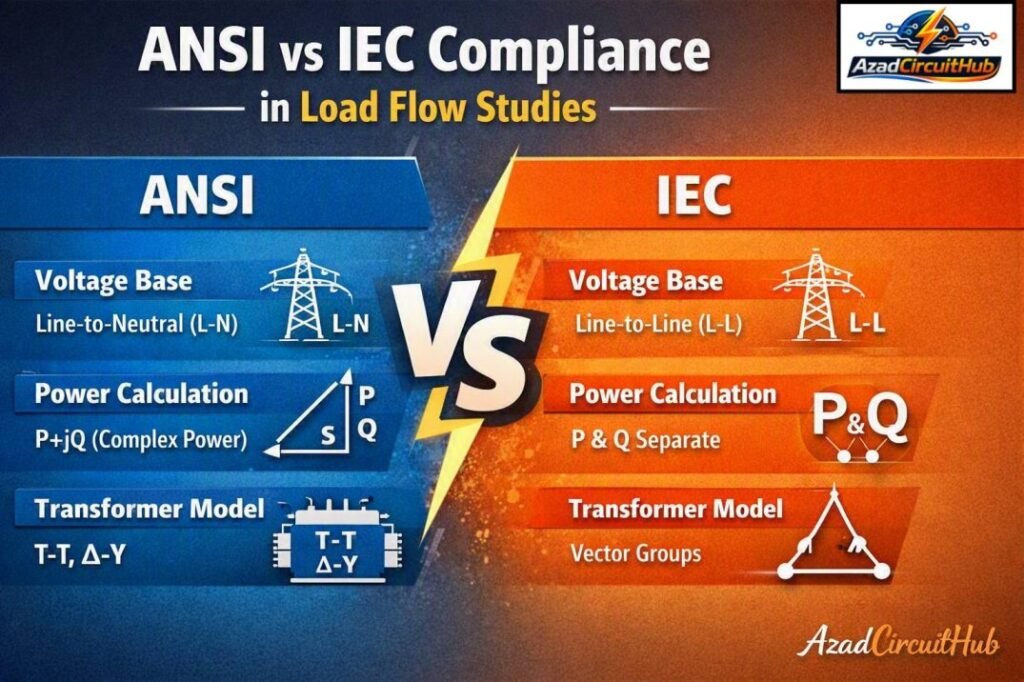
Table of Contents
Table of Contents
What Does Compliance Mean in a Load Flow Study?
A load flow study calculates bus voltages, voltage angles, real power flow, reactive power flow, transformer loading, generator output, and system losses under defined operating conditions.
The calculation itself is not normally governed by one single ANSI or IEC load flow standard. Instead, the study uses a combination of standards, utility requirements, equipment specifications, and project design criteria.
For example, a North American project may use ANSI C84.1 for service voltage considerations along with IEEE and equipment-specific standards. An international project may use IEC 60038 for standard voltage characteristics and other applicable IEC standards.
This distinction is central to ANSI vs IEC Compliance in Load Flow Studies. Engineers should identify the governing standard before setting acceptance criteria in the study software.
Typical load flow outputs
- Bus voltage magnitude
- Bus voltage angle
- Active power flow
- Reactive power flow
- Transformer loading
- Generator loading
- Cable and line loading
- System losses
- Power factor
- Tap changer position
- Reactive power compensation requirements
ANSI vs IEC Compliance in Load Flow Studies: Key Differences
The biggest difference is not the mathematical load flow algorithm. Both ANSI-oriented and IEC-oriented studies can use Newton-Raphson, Gauss-Seidel, or fast-decoupled methods.
The difference usually appears in the engineering criteria used to build and evaluate the model.
| Parameter | ANSI/IEEE-Oriented Study | IEC-Oriented Study |
|---|---|---|
| Voltage standard | ANSI C84.1 and project criteria | IEC 60038 and project criteria |
| Equipment design | ANSI/IEEE/NEMA | IEC |
| Transformer practice | IEEE/ANSI and manufacturer data | IEC transformer standards |
| Switchgear | ANSI/IEEE C37 series | IEC 62271 series |
| LV assemblies | UL/ANSI/IEEE practices | IEC 61439 |
| Motors | NEMA and applicable IEEE standards | IEC 60034 |
| Utility requirements | Utility-specific | Utility/grid-code specific |
| Frequency | Often 60 Hz | Often 50 Hz |
| Reporting | Often follows owner/utility criteria | Often follows IEC/project criteria |
These differences matter when determining acceptable voltage, equipment loading, operating limits, and model input data.
Voltage Criteria Under ANSI and IEC Practices
Voltage performance is one of the most important outputs of a load flow study. A system can have acceptable current loading but still experience poor voltage regulation.
ANSI C84.1 provides standard voltage classifications and voltage ranges for electric power systems in North America. IEC 60038 defines standard voltages for electrical systems internationally.
However, engineers should not simply enter one universal percentage into their software and call the result compliant.
Project specifications may impose tighter limits.
| Study Condition | Common Engineering Check |
|---|---|
| Normal operation | Verify bus voltage remains within project limits |
| Peak loading | Check minimum operating voltage |
| Light loading | Check excessive voltage |
| Transformer tap variation | Check voltage across available tap positions |
| Motor starting | Perform separate voltage-drop assessment when required |
| Contingency | Check voltage following defined outages |
| Generator operation | Check voltage and reactive power capability |
| Capacitor switching | Check voltage rise and operating conditions |
For this reason, ANSI vs IEC Compliance in Load Flow Studies should always be treated as a project-specific compliance exercise rather than a simple software setting.
Load Flow Methods Used in Both Approaches
The numerical method does not fundamentally change because a project follows ANSI or IEC practices.
Newton-Raphson method
Newton-Raphson is widely used for large and heavily loaded systems. It generally provides strong convergence performance and is suitable for complex transmission and industrial networks.
Gauss-Seidel method
Gauss-Seidel is simpler but usually converges more slowly than Newton-Raphson. It can still be useful for smaller networks and educational or preliminary studies.
Fast decoupled load flow
Fast decoupled methods simplify the relationship between active power and voltage angle, and between reactive power and voltage magnitude. They can provide efficient solutions for suitable network conditions.
| Method | Main Advantage | Typical Application |
|---|---|---|
| Newton-Raphson | Fast and robust convergence | Large industrial and utility systems |
| Gauss-Seidel | Simple calculation | Small or simple networks |
| Fast Decoupled | Efficient for large systems | Transmission and balanced networks |
For a deeper explanation of these methods, equations, bus types, and practical calculations, see our guide to load flow analysis in power system.
Equipment Modeling and Standard Selection
Equipment data can create larger differences between two studies than the selected load flow algorithm.
A transformer model may require:
- Rated MVA
- Primary and secondary voltage
- Positive-sequence impedance
- Tap range
- Tap step
- X/R ratio
- Connection type
- Grounding arrangement
- No-load losses
- Load losses
The engineer should use manufacturer data whenever available. Standard assumptions should only be used when reliable project data is unavailable.
Common equipment standards
| Equipment | ANSI/IEEE-Oriented References | IEC-Oriented References |
|---|---|---|
| Power transformers | IEEE C57 series | IEC 60076 series |
| Motors | NEMA/IEEE practices | IEC 60034 series |
| MV switchgear | IEEE C37 series | IEC 62271 series |
| LV assemblies | UL/ANSI practices | IEC 61439 |
| System voltage | ANSI C84.1 | IEC 60038 |
The exact standard should be confirmed against the project specification and equipment procurement requirements.
Generator and Renewable Energy Modeling
Modern load flow studies often include solar PV plants, battery energy storage systems, wind turbines, and inverter-based resources.
These systems require more than a simple constant-power load or generator representation. Engineers may need to model:
- Active power limits
- Reactive power limits
- Power factor control
- Voltage control
- Reactive power capability
- Transformer impedance
- Collector system losses
- Grid interconnection voltage
- Curtailment conditions
For renewable projects, the applicable grid code can be just as important as the ANSI or IEC equipment standard.
This is particularly important when performing ANSI vs IEC Compliance in Load Flow Studies for utility-scale photovoltaic plants and battery storage facilities.
Normal and Contingency Operating Conditions
A professional study should not rely on only one operating condition.
Typical scenarios include:
- Maximum generation and minimum load
- Maximum load and minimum generation
- Normal operating configuration
- Transformer outage
- Feeder outage
- Generator outage
- Utility interconnection conditions
- N-1 contingency conditions
- Capacitor or reactor switching
- Different transformer tap positions
| Scenario | Main Objective |
|---|---|
| Peak load | Identify low-voltage buses and overloaded equipment |
| Light load | Identify excessive voltage |
| Maximum generation | Check export and voltage rise |
| Generator outage | Verify system stability of operating voltage |
| Transformer outage | Check loading and voltage redistribution |
| Feeder outage | Assess contingency performance |
| Capacitor operation | Check reactive power and voltage effects |
How to Set Compliance Limits in ETAP or Similar Software
Software such as ETAP, SKM Power*Tools, EasyPower, DIgSILENT PowerFactory, and CYME can perform load flow calculations.
The software does not automatically determine every project-specific compliance requirement.
Before running the study, configure:
- Nominal bus voltages
- Minimum voltage limits
- Maximum voltage limits
- Transformer loading limits
- Cable ampacity
- Generator operating limits
- Power factor requirements
- Transformer tap settings
- Operating scenarios
- Contingency cases
A useful workflow is:
Project specification → Applicable standards → Equipment data → Operating scenarios → Load flow model → Compliance limits → Results → Engineering recommendations
For engineers building a complete study, our load flow analysis in power system resource can also be used as the main reference for calculation methods and practical study procedures.
Common Compliance Mistakes
Several mistakes can make an otherwise accurate load flow model misleading.
Using the wrong voltage limits
Do not assume that every project should use the same voltage tolerance. Confirm the applicable standard and owner requirements.
Mixing ANSI and IEC equipment data
Using an IEC-rated component in an ANSI-based design is not automatically wrong, but its ratings and characteristics must be correctly interpreted.
Ignoring transformer taps
Transformer tap positions can significantly affect downstream bus voltage and reactive power flow.
Using unrealistic load factors
Peak, average, and minimum demand conditions should be based on actual operating data whenever possible.
Treating grid codes as optional
Utility interconnection requirements can impose voltage, reactive power, and power factor requirements beyond general equipment standards.
ANSI vs IEC Compliance in Load Flow Studies Checklist
| Check | Required Action |
|---|---|
| Governing standard | Identify before modeling |
| Nominal voltage | Verify against project documents |
| Frequency | Confirm system frequency |
| Equipment ratings | Use manufacturer data |
| Voltage limits | Enter approved project criteria |
| Transformer taps | Model actual operating range |
| Generator limits | Include P and Q constraints |
| Load scenarios | Include realistic operating cases |
| Contingencies | Apply required N-1 cases |
| Reporting | Clearly identify standards and assumptions |
The final report should clearly state which standards were used, which assumptions were made, and which operating cases were evaluated. This makes the results easier for consultants, utilities, owners, and reviewers to verify.
Frequently Asked Questions
Is ANSI better than IEC for load flow studies?
Neither is universally better. ANSI/IEEE practices are common in North America, while IEC standards are widely used internationally. The correct choice depends on the project location, utility requirements, equipment specifications, and contractual requirements.
Is there an IEC standard specifically for load flow analysis?
IEC does not provide one universal standard that governs every conventional load flow calculation. Engineers generally apply relevant IEC equipment and system standards together with project specifications and grid-code requirements.
What voltage limit should be used in a load flow study?
The voltage limit should come from the applicable standard, utility requirement, or project specification. ANSI C84.1 and IEC 60038 can provide important voltage references, but project-specific operating limits may be more restrictive.
Can ANSI and IEC standards be used in the same project?
Yes. Many international projects use equipment designed to different standards. The engineer must ensure that ratings, test requirements, voltage characteristics, protection requirements, and modeling assumptions are compatible.
Which load flow method is most accurate?
Newton-Raphson is commonly preferred for complex power system models because of its strong convergence characteristics. However, accuracy depends more on the quality of the network model and input data than on simply selecting one numerical algorithm.
Final Takeaway
ANSI and IEC approaches do not represent two completely different ways of calculating power flow. The fundamental electrical equations remain the same. The important difference lies in how voltage requirements, equipment standards, operating limits, grid codes, and project acceptance criteria are selected and applied.
A well-prepared study should identify the governing standards first, use accurate equipment data, define realistic operating scenarios, and document every important assumption. This approach makes the results technically defensible and easier to review.
When evaluating ANSI vs IEC Compliance in Load Flow Studies, engineers should therefore focus on the complete design framework rather than treating ANSI or IEC as a single load flow calculation method. For a complete overview of load flow equations, bus classifications, solution methods, and practical applications, explore our detailed load flow analysis in power system guide.
Get new guides in your feed. Follow Electrical Insights on LinkedIn for new electrical standards guides, calculators and design tips from Azad Circuit Hub.
#ANSIVsIEC, #LoadFlowStudies, #PowerSystemAnalysis, #IECStandards, #ANSIStandards, #ElectricalEngineering, #PowerFlowAnalysis, #ElectricalStandards, #SystemCompliance, #PowerSystemDesign
