Power Factor Correction Devices for Home: Top 5 Picks for 2026
Choosing the right Power Factor Correction Devices for Home can be confusing because many plug-in products promise lower electricity bills with little technical explanation. As an electrical engineer, I recommend looking beyond marketing claims and checking how power factor correction actually works, what type of load you have, and whether your utility charges residential customers for reactive power.
For most homes, ordinary appliances are billed mainly according to real energy consumption in kWh. A small plug-in capacitor or “electricity saver” box generally cannot reduce the real power consumed by a resistive load such as a heater. However, power factor correction can be useful for specific inductive loads when properly engineered.
Affiliate buying tip: If you want to experiment with one of these plug-in devices, the VOOYVEX 8PCS Power Plug Pro Energy Saver is my preferred pick from this list because the eight-piece pack provides more units for testing different locations and appliance types. Check the current Amazon listing for specifications, price, customer reviews, and return terms before purchasing.
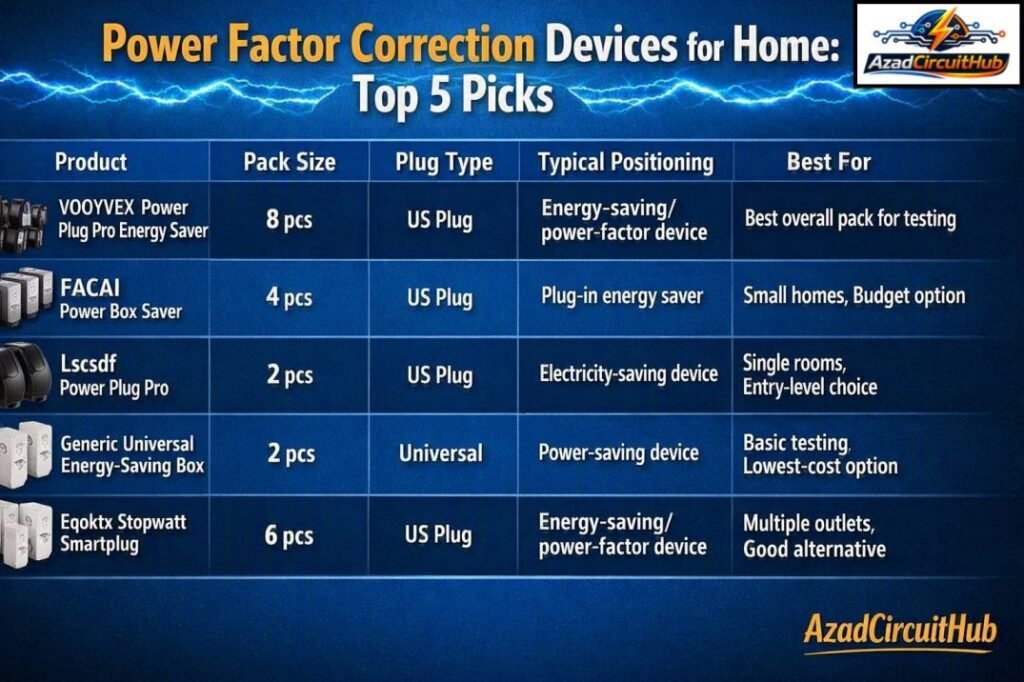
Table of Contents
Table of Contents
Quick Comparison: Power Factor Correction Devices for Home: Top 5 Picks
| Product | Pack Size | Plug Type | Typical Positioning | Best For | My Take |
|---|---|---|---|---|---|
| VOOYVEX Power Plug Pro Energy Saver | 8 pcs | US Plug | Energy-saving/power-factor device | Multiple locations | Best overall pack for testing |
| FACAIFACAI Power Box Saver | 4 pcs | US Plug | Plug-in energy saver | Small homes | Budget option |
| Lscsdf Power Plug Pro Electricity Saving Box | 2 pcs | US Plug | Electricity-saving device | Single rooms | Entry-level choice |
| Generic Universal Energy-Saving Box | 2 pcs | Universal | Power-saving device | Basic testing | Lowest-cost option |
| Eqoktx Stopwatt Smartplug Power Box | 6 pcs | US Plug | Energy-saving/power-factor device | Multiple outlets | Good alternative |
What Are Power Factor Correction Devices for Home?
Power Factor Correction Devices for Home are products intended to improve the relationship between real power and apparent power in an AC electrical system. Power factor is commonly expressed as:
Power Factor = Real Power (kW) ÷ Apparent Power (kVA)
A purely resistive load, such as an electric heater, can have a power factor close to 1. An inductive load, such as a motor, may draw magnetizing current that causes the current waveform to lag the voltage.
Capacitors can provide reactive power locally and may improve the power factor of suitable inductive loads. This principle is widely used in commercial and industrial electrical installations.
The important point for homeowners is that improving power factor does not automatically mean the electric meter will record substantially fewer kWh.
How Do Plug-In Power Factor Correction Products Work?
Many plug-in energy-saving boxes contain capacitive components designed to supply reactive current. In theory, this can offset part of the reactive current associated with an inductive appliance.
For example, a motor may require both real and reactive power. A correctly selected capacitor can reduce the reactive current supplied by the upstream circuit.
However, the situation is different in a typical house.
If your utility bills only for real energy consumption, reducing reactive current may have little or no direct effect on your monthly bill. The appliance still needs approximately the same real power to perform its job.
This is one reason I would not buy Power Factor Correction Devices for Home based solely on claims of guaranteed 20%, 30%, or 50% electricity savings.
Top 5 Power Factor Correction Devices for Home
1. VOOYVEX 8PCS Power Plug Pro Energy Saver
The VOOYVEX eight-piece pack is my preferred option among these products if your goal is to test plug-in energy-saving devices around the house.
Its main advantage is quantity. Instead of moving one device between outlets, you have multiple units that can be placed near selected appliances.
Potential applications include areas containing small motors, fans, refrigerators, or other inductive equipment. However, the device should not be treated as a guaranteed method of reducing kWh consumption.
Why I picked it: The multi-pack makes it practical for comparison and experimentation, while the relatively simple plug-in format requires no permanent electrical installation.
Buy on Amazon: Search for the VOOYVEX 8PCS Power Plug Pro Energy Saver and compare the current seller rating, specifications, reviews, and return policy.
2. FACAIFACAI 4PC Plug in Power Box Saver
The FACAIFACAI four-piece Power Box Saver is another compact option for homeowners interested in testing this type of product.
The four-pack is useful when you have several possible locations but do not want to purchase a larger quantity. It is particularly suited to buyers who want to evaluate whether the product makes any measurable difference in their own electrical setup.
Do not confuse an energy-saving box with a whole-house capacitor bank. A properly engineered correction system requires load analysis, capacitor sizing, protection, and consideration of harmonics.
Buying CTA: Check the latest Amazon price and customer feedback for the FACAIFACAI 4PC Plug in Power Box Saver before ordering.
3. Lscsdf 2PCS Power Plug Pro Electricity Saving Box
The Lscsdf two-piece package is aimed at buyers who want a small quantity for basic testing.
A two-unit pack can be useful if you want to compare an appliance with and without the device using an appropriate power meter. This is a better approach than relying solely on advertising claims.
For a meaningful comparison, measure the appliance under similar operating conditions. Motors and compressors can change their power consumption depending on load, temperature, duty cycle, and operating time.
Best use: A low-cost trial for users who want to understand how reactive loads behave before considering more advanced power-quality equipment.
4. Generic 2Pcs Universal Energy-Saving Box
The Generic 2Pcs Universal Energy-Saving Box is another inexpensive plug-in option.
The advantage is its simple concept and low entry cost. However, generic products can have limited technical documentation. Before connecting any mains-powered device, check its voltage rating, plug configuration, enclosure condition, safety certifications, and seller information.
From an engineering perspective, these checks are more important than a large percentage-saving claim printed on the package.
If the product has no clear electrical specifications or safety information, I would avoid connecting it to a permanent household circuit.
5. Eqoktx 6 Packs Stopwatt Smartplug in Power Box Device
The Eqoktx six-pack offers several units for homeowners who want to test multiple locations.
It is marketed as a Stopwatt-style smart plug-in power-saving device. As with similar products, its actual effect depends on the electrical load, power factor, internal circuit design, and the way your utility measures and bills electricity.
It should not be confused with a smart plug that provides genuine energy monitoring. A real energy monitor can show voltage, current, watts, kWh, and sometimes power factor. That data is much more useful when evaluating electricity consumption.
Buying CTA: If you want a six-pack for comparison testing, check the current Amazon listing for the Eqoktx 6 Packs Stopwatt Smartplug Power Box Device.
Are Power Factor Correction Devices for Home Worth Buying?
For most residential users, I would not purchase a plug-in correction device expecting a guaranteed reduction in the electricity bill.
The economics are different from industrial power factor correction. Commercial facilities may face demand charges or reactive-power penalties, making improved power factor financially valuable. Residential customers often do not have the same billing structure.
Before buying Power Factor Correction Devices for Home, ask these questions:
- Does my utility charge for reactive power or poor power factor?
- Which appliances have significant inductive loads?
- Can I measure power factor before and after installation?
- Does the product provide credible electrical specifications?
- Is the device properly rated for my household voltage and outlet?
- Does it have appropriate safety certification?
For homeowners interested in the fundamentals, read our guide to What is Power Factor to understand real power, reactive power, apparent power, and PF calculations.
Power Factor Correction vs Actual Energy Savings
Power factor and energy consumption are related, but they are not the same measurement.
| Measurement | Unit | What It Tells You |
|---|---|---|
| Real power | kW | Useful power being consumed |
| Energy | kWh | Electricity used over time |
| Reactive power | kVAR | Reactive component of AC power |
| Apparent power | kVA | Combined voltage-current demand |
| Power factor | Ratio | How effectively current is converted into useful power |
For example, correcting a motor's power factor can reduce the current flowing through upstream conductors. That may reduce some I²R losses and improve electrical system performance. It does not mean the motor suddenly requires substantially less mechanical power.
Understanding the ideal power factor value can help you determine when correction is technically beneficial rather than simply following a product advertisement.
Safety Considerations Before Using a Plug-In Correction Device
Never open or modify a mains-powered energy-saving box unless you are qualified to work on electrical equipment.
Also avoid using a questionable device if the enclosure is damaged, the plug becomes hot, there is buzzing or unusual odor, or the device has inadequate electrical ratings.
A capacitor connected incorrectly can create safety and power-quality problems. Capacitor selection must also account for voltage, frequency, capacitance, inrush current, harmonics, and discharge requirements.
For household applications, a properly rated and certified product is preferable to an undocumented electrical device.
How to Choose the Best Product
The best Power Factor Correction Devices for Home should not be selected only by the number of units in the package or the percentage of savings claimed.
Look for:
- Clearly stated voltage and frequency ratings
- Appropriate US plug configuration
- Quality enclosure and construction
- Credible safety information
- Good seller reputation
- Recent customer reviews
- Clear return policy
- Technical specifications rather than unsupported savings claims
If your objective is genuinely to improve electrical efficiency, measuring your loads first is usually more useful than buying several correction boxes.
Our guide to the best power factor value can also help explain what PF readings mean and when a low reading deserves attention.
My Recommendation
Of the five products listed here, I would choose the VOOYVEX 8PCS Power Plug Pro Energy Saver if you specifically want to experiment with this category. The eight-unit pack gives you flexibility to test multiple appliances without repeatedly moving a single unit.
However, I would not describe any of these plug-in products as a guaranteed electricity-bill reduction solution. Your actual savings depend on your tariff, appliance loads, operating hours, and whether your utility bills for reactive power.
For a professional installation, a licensed electrician or power-quality specialist should evaluate the electrical system before adding capacitors or permanent correction equipment.
Frequently Asked Questions
Do power factor correction devices reduce home electricity bills?
Usually, not significantly for standard residential customers who are billed primarily for kWh. Improving power factor can reduce reactive current, but it does not automatically reduce the real energy required by an appliance.
Can a capacitor improve power factor?
Yes. A properly selected capacitor can compensate for some inductive reactive power and improve the power factor of an appropriate load. Capacitor sizing should be based on the actual load and electrical system.
Is power factor correction useful for a refrigerator?
A refrigerator contains a compressor motor and therefore has an inductive component. However, the financial benefit of a plug-in correction device depends on the utility billing method and the device's actual electrical performance.
What is a good power factor for a home?
A power factor close to 1.0 is generally desirable from an electrical-system perspective. However, a homeowner should not assume that moving from a lower PF to nearly 1.0 will produce the same percentage reduction in kWh consumption.
Are plug-in electricity saver boxes safe?
Safety depends on the construction, components, ratings, and certification of the particular product. Avoid undocumented or damaged mains-powered devices, and never exceed the rated voltage or use a product with signs of overheating.
Final Verdict
Power factor correction is a legitimate electrical engineering technique, but it is frequently oversimplified in consumer advertising. The most important distinction is between reducing reactive current and reducing real energy consumption.
For buyers who still want to test this product category, the VOOYVEX eight-piece model is my preferred choice from these five because of its multi-pack format. Use realistic expectations, verify the electrical ratings, and measure actual power rather than relying on advertised percentage savings.
For larger motors, workshops, or commercial electrical systems, professional capacitor banks, automatic power factor correction panels, or active power-quality equipment may be far more appropriate than small plug-in boxes.
Get new guides in your feed. Follow Electrical Insights on LinkedIn for new electrical standards guides, calculators and design tips from Azad Circuit Hub.
#PowerFactorCorrection, #PowerFactorCorrectionDevices, #HomeElectrical, #PowerFactor, #ElectricalEfficiency, #EnergySaving, #HomeEnergySavings, #ElectricalDevices, #PowerQuality, #ElectricalEngineering