NEC Article for Generators: Article 445 and the Backup Power Rules Explained (2026)
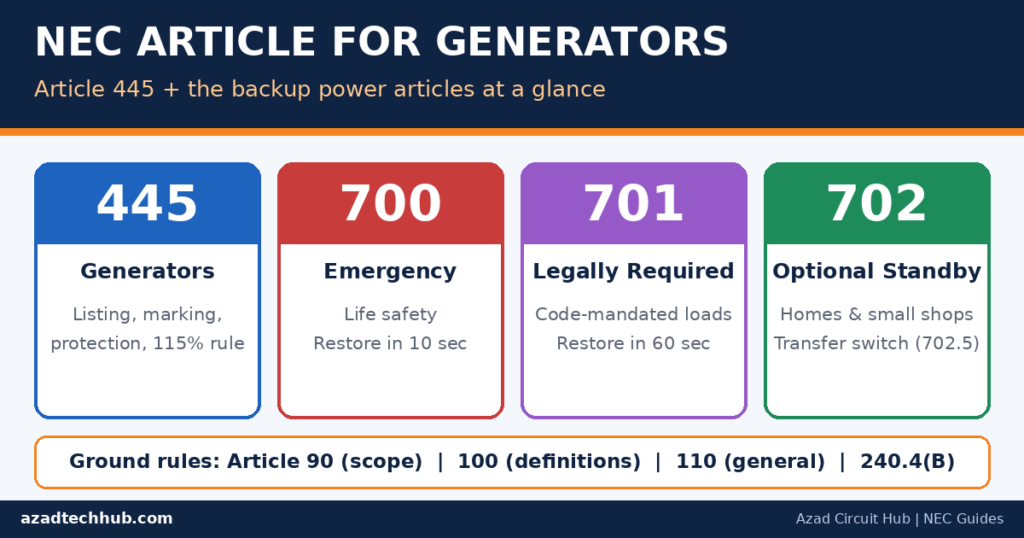
The NEC article for generators is Article 445, and it is only the starting point. Article 445 covers the generator itself, while Articles 700, 701 and 702 decide whether that generator can serve as an emergency, legally required or optional standby source. Add Articles 90, 100 and 110 for the ground rules, plus 240.4(B) for conductor protection, and you have the full picture. This guide explains each one in plain English, answers the clearance and residential questions people search for, and ends with a free 2-page PDF you can keep on your phone.
NEC Article for Generators: The Short Answer
If you need one answer, the NEC article for generators is Article 445. For backup power you also need Article 700, 701 or 702, depending on the type of system. Here is the map:
| Article | Title | What it means for generators |
|---|---|---|
| 90 | Introduction | Purpose, scope and enforcement by the AHJ |
| 100 | Definitions | Terms such as separately derived system |
| 110 | General Requirements | Listing, terminations and 110.26 working space |
| 240 | Overcurrent Protection | 240.4(B) next-size-up rule |
| 445 | Generators | Listing, marking, protection, conductors, disconnects |
| 700 | Emergency Systems | Life safety loads, 10-second restoration |
| 701 | Legally Required Standby | Code-mandated loads, 60-second restoration |
| 702 | Optional Standby Systems | Most home and small business backup power |
Section numbers in this guide follow the 2023 NEC. Many states still enforce the 2020 or 2023 edition, so confirm the adopted edition with your local authority having jurisdiction (AHJ) before you rely on any number.
Article 445: What the NEC Requires of the Generator Itself
Article 445 is the heart of any NEC article for generators discussion, and these are the sections you will use most:
- 445.6 – Listing. Stationary generators shall be listed. That is the answer to the common search “stationary generators shall be”, and the rule has been in the NEC since the 2020 edition.
- 445.10 – Location. The generator must be suitable for where it is installed, whether dry, damp, wet or outdoors.
- 445.11 – Marking. The nameplate must show rated kW or kVA, voltage, current, phases, frequency and ambient temperature.
- 445.12 – Overcurrent protection. Constant-voltage generators need protection against overload, by inherent design or by a breaker or fuse.
- 445.13 – Ampacity of conductors. Conductors from the generator terminals to the first overcurrent device must carry at least 115% of the nameplate current.
- 445.18 – Disconnecting means. The generator needs a way to disconnect it from the circuits it supplies and to shut down the prime mover.
- 445.20 – GFCI protection. Receptacles on portable generators rated 15 kW or smaller need ground-fault protection.
Worked example. A 22 kW, 240 V single-phase standby generator has a nameplate current of about 22,000 ÷ 240 = 91.7 A. Applying 445.13, the minimum conductor ampacity is 91.7 × 1.15 = 105.4 A. At 75 °C, a 3 AWG copper conductor (100 A) falls short, so you step up to 2 AWG copper (115 A). Run your own numbers with our Generator Sizing Calculator and check the feeder route with the Conduit Fill Calculator.
After installation, verify real output current instead of trusting the display on the generator. A true-RMS clamp meter does this safely, and our best clamp meter for electricians guide compares the field-proven options.
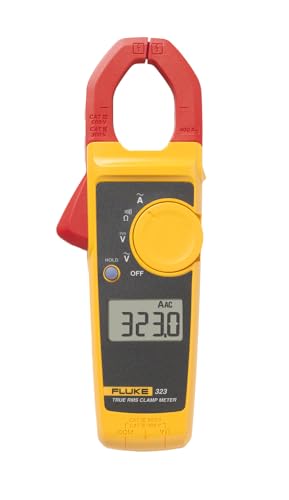
- Digital clamp meter measures AC current to 400 amp, AC and DC voltage to 600 v, and resistance to 4 kilo ohms. Does not …
- The true RMS sensing meter provides accurate readings when measuring linear or non-linear loads, regardless of waveform,…
- Jaw opening measures current in a conductor up to 30 millimeter without touching or interrupting the circuit. Resistance…
NEC Article for Generators PDF and Free Download: What Is Legal
Searches such as NEC article for generators free, NEC article 445 PDF and NEC article 702 PDF all lead to the same problem: the NEC is copyrighted by NFPA. NFPA offers free read-only online access to NFPA 70 after registration, but it does not publish a free downloadable PDF of the code, and unofficial copies are often outdated or pirated. The safe route is the free NFPA 70 online access page.
To save you time, we built a free 2-page NEC article for generators cheat sheet PDF covering Articles 445, 700, 701 and 702, the 115% conductor rule and the clearance checklist. It is our own summary, so it is not a replacement for the code book.
Prefer paper you can tab and highlight? A current-edition NEC book or an illustrated guide is worth having on a job site.

NEC Generator Clearance Requirements
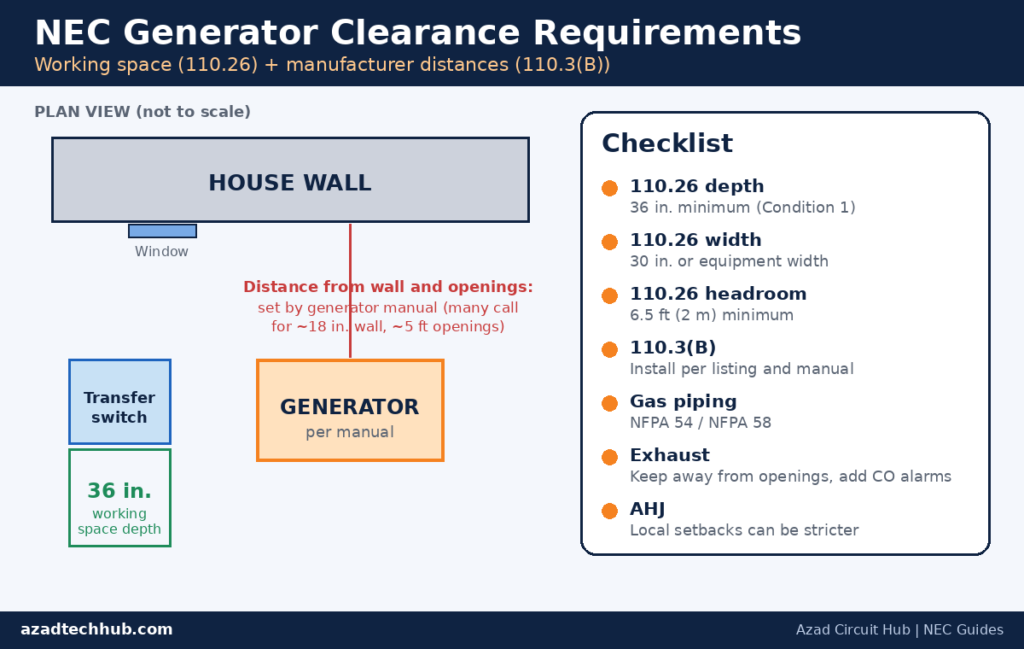
No NEC article for generators gives a single distance from the generator to the house. Clearance comes from three places:
- Working space (110.26). Controls, transfer switches and panels need 36 in. of depth, 30 in. of width (or the equipment width, whichever is greater) and 6.5 ft of headroom. See our guides to clearance in front of panels and NEC Article 110.26 A.
- Listing and labeling (110.3(B)). You must install equipment per its instructions. The generator manual sets the minimum distance to walls, windows, doors and air intakes. Many manuals call for roughly 5 ft from openings and about 18 in. from the wall, but the figure varies by model, so read yours.
- Fuel and local rules. Gas piping follows NFPA 54 or 58, and your AHJ can add setbacks, so confirm both before you set the pad.
If the generator has a disconnect on the wall, its handle height also matters. Our AC disconnect height guide explains the 6 ft 7 in. limit.
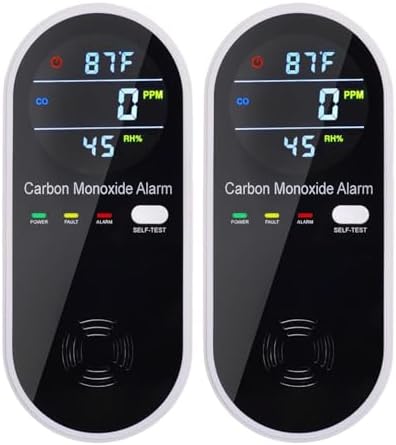
Exhaust gas is the real hazard near a house, so add a carbon monoxide alarm on every level regardless of the distance you achieve.


Residential Generator Code Requirements Under Article 702
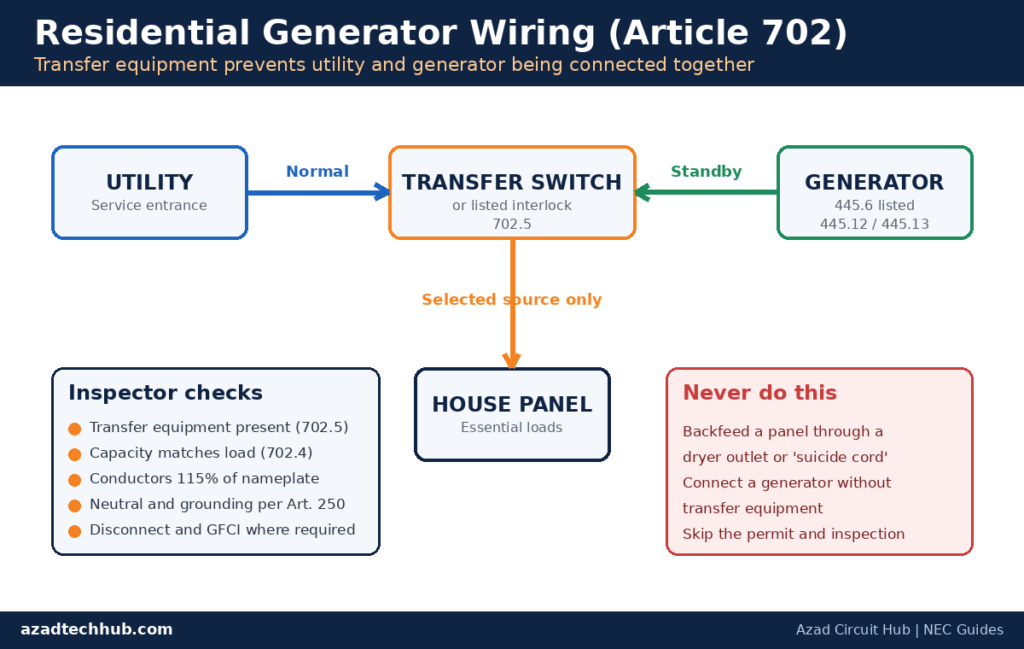
For homes, the NEC article for generators you will use most is Article 702, Optional Standby Systems. These are the points inspectors check:
- Transfer equipment (702.5). It is required, and it must prevent the generator and the utility from being connected at the same time. A listed interlock kit on the panel can serve this purpose where permitted. Never backfeed a panel through a dryer outlet.
- Capacity (702.4). The generator must carry the load it serves, which you determine with Article 220. Our guide to NEC article for demand factors shows the tables, and the Generac Generator Size Calculator gives a quick estimate.
- Grounding. If the transfer switch switches the neutral, the generator becomes a separately derived system and Article 250 grounding applies. If it does not, the neutral stays bonded at the service. Our NEC Article 250 guide covers both cases, and the Earth Cable Size Calculator sizes the conductor.
- Wiring and burial. The feeder to the house follows Chapter 3 wiring methods. For underground runs, see NEC code for buried electrical wires.
- GFCI. Receptacles on or fed from the generator may need protection under NEC Article 210.8 A.
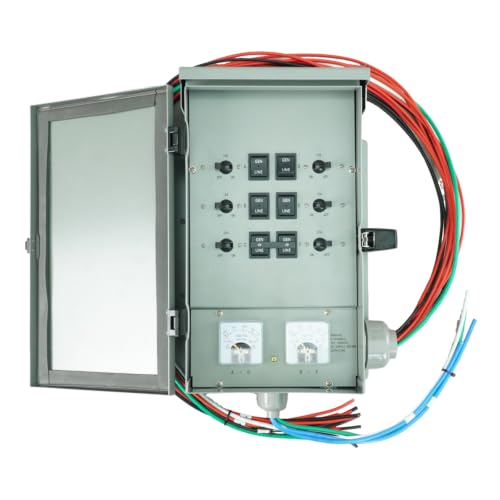
A manual transfer switch or a listed interlock kit, plus a weatherproof power inlet box, is the usual home setup.


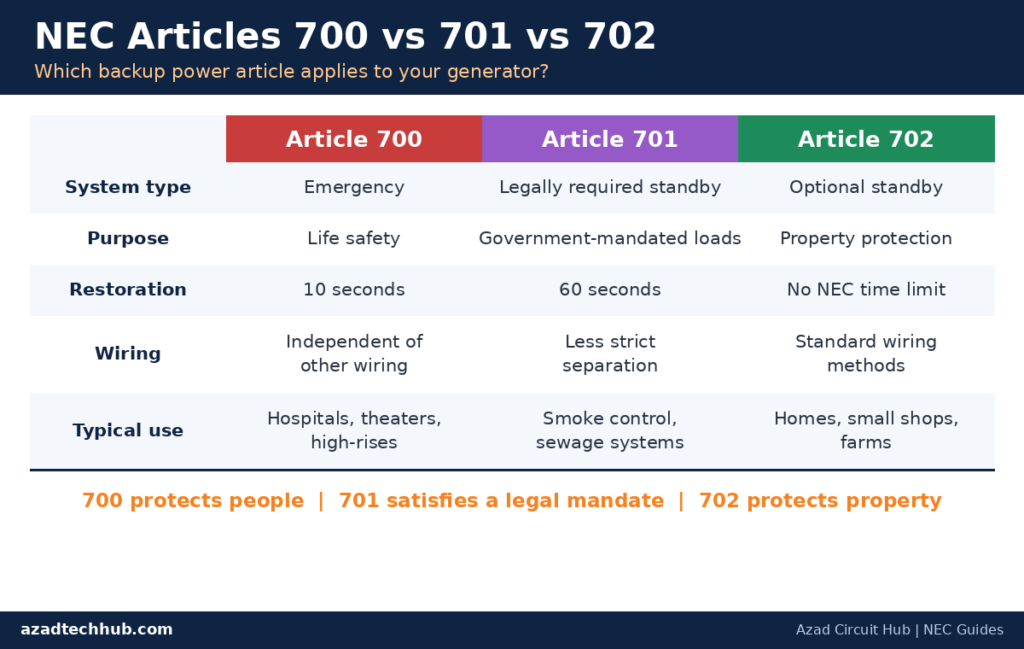
Article 700 vs 701 vs 702: What Is the Difference?
Choosing the correct NEC article for generators comes down to who requires the backup power and how fast it must start.
| Feature | Article 700 | Article 701 | Article 702 |
|---|---|---|---|
| System type | Emergency | Legally required standby | Optional standby |
| Purpose | Life safety: exit lighting, alarms | Loads required by a government agency | Property protection and comfort |
| Restoration time | 10 seconds | 60 seconds | No NEC time limit |
| Wiring | Kept independent of other wiring | Less strict separation | Standard wiring methods |
| Typical use | Hospitals, theaters, high-rises | Smoke control, sewage, firefighting systems | Homes, small shops, farms |
In short, Article 700 protects people, Article 701 satisfies a legal mandate and Article 702 protects property. The same generator can serve more than one system only if each article’s rules are met.
NEC 240.4(B) and Generator Conductor Protection
Every NEC article for generators ends up pointing to Article 240 for overcurrent protection. Section 240.4(B) lets you use the next higher standard overcurrent device when the conductor ampacity does not match a standard rating, with three conditions: the conductors do not supply multioutlet receptacle circuits for cord-and-plug portable loads, the ampacity does not correspond to a standard rating, and the next higher device does not exceed 800 A.
That last limit matters on larger generators, and the portable-load condition matters on receptacle circuits. For the full breaker sizing chart, read our NEC article for overcurrent protection and the 210.20(A) 125% continuous load rule.
Articles 90, 100 and 110: The Ground Rules
Before any NEC article for generators applies, the opening chapter sets the framework:
- Article 90 states the purpose (practical safeguarding of people and property), the scope, how the code is arranged, and that the AHJ enforces it.
- Article 100 holds the definitions, including separately derived system, which decides how you ground a generator.
- Article 110 covers general requirements: listing and labeling (110.3), terminations (110.14), interrupting ratings (110.9) and working space (110.26).
If you wire the transfer switch yourself, our bonding bushings guide and branch circuits guide fill in the details.
Related NEC Guides and Tools on Azad Circuit Hub
Use these alongside this NEC article for generators overview:
- NEC code for commercial buildings for service and emergency power in commercial work
- Generator Power Consumption Calculator for fuel and load usage
- All electrical calculators and the Electrical Standards library
Testing the transfer switch and verifying voltage before you energize is routine. A reliable meter such as the Fluke 117 or one of our best multimeters for electricians, plus a non-contact voltage tester, covers it.
Frequently Asked Questions
What is the NEC article for generators?
The NEC article for generators is Article 445. It covers listing, marking, overcurrent protection, conductor ampacity and disconnects. Backup systems are covered by Articles 700, 701 and 702.
What is Article 700 in the NEC?
Article 700 covers emergency systems that supply life safety loads such as exit signs and egress lighting. Power must be restored within 10 seconds, and the wiring is kept independent of other circuits.
What are the differences between NEC Articles 700 and 701?
Article 700 is for life safety with a 10-second restoration time. Article 701 is for legally required standby loads with a 60-second restoration time and less strict wiring separation.
What is Article 110 in the NEC?
Article 110 is General Requirements for Electrical Installations. It covers listing, terminations, interrupting ratings and the 110.26 working space rules.
What does NEC 240.4(B) say?
It allows the next higher standard overcurrent device rating when the conductor ampacity falls between standard sizes, provided the device is 800 A or less and the circuit does not supply cord-and-plug portable loads on multioutlet receptacles.
What does NEC Article 90 contain?
Article 90 is the introduction. It sets the purpose, scope, code arrangement, enforcement, mandatory and permissive rules, and units of measurement.
What is Article 100 in the NEC?
Article 100 is Definitions. Part I covers general terms and Part II covers systems over 1000 volts.
What are the NEC generator clearance requirements?
The NEC sets working space under 110.26, but distance to the building comes from the generator’s listing instructions, fuel codes and your AHJ. Check the manual first.
Are stationary generators required to be listed?
Yes. Under 445.6, stationary generators shall be listed.
Conclusion
This NEC article for generators guide comes down to a simple chain: Article 445 for the machine, Article 702 for most homes, Articles 700 and 701 for life safety and legal mandates, and Articles 90, 100, 110 and 240 underneath. Always confirm the edition your AHJ enforces, follow the generator’s installation manual, and have the work inspected. Start with the Generator Sizing Calculator, then download the free PDF cheat sheet above.
Disclaimer: This guide is educational and does not replace the NEC, your AHJ or a licensed electrician.
Get new guides in your feed. Follow Electrical Insights on LinkedIn for new electrical standards guides, calculators and design tips from Azad Circuit Hub.