Fluke 117 for HVAC Technicians: Complete Review and Buying Guide
HVAC technicians need a multimeter that can handle more than basic voltage checks. Troubleshooting an air conditioner, heat pump, furnace, or commercial HVAC control circuit often means checking voltage, continuity, resistance, capacitance, and control signals in the same service call.
The Fluke 117 is a popular option for this type of work. In this guide, I will look at how well the meter fits HVAC troubleshooting, where its features are useful, and what technicians should consider before buying it.
I have worked as an electrical engineer for more than 15 years, with hands-on experience in electrical panels, industrial automation, PLCs, controls, and troubleshooting. For HVAC work, I particularly value a meter that is quick to use, easy to read, and practical when testing live equipment.
Fluke 117 Features at a Glance
| Feature | Fluke 117 |
|---|---|
| Display | Digital display |
| AC/DC voltage | Yes |
| Resistance | Yes |
| Continuity | Yes |
| Frequency | Yes |
| Capacitance | Yes |
| Current measurement | Yes |
| Non-contact voltage detection | VoltAlert |
| Low impedance mode | Auto-V/LoZ |
| Min/Max/Average | Yes |
| Auto-ranging | Yes |
| Best suited for | Electrical and HVAC troubleshooting |
For technicians who want to compare it with other professional meters, my guide to the best multimeter for electricians covers additional Fluke and competing options.
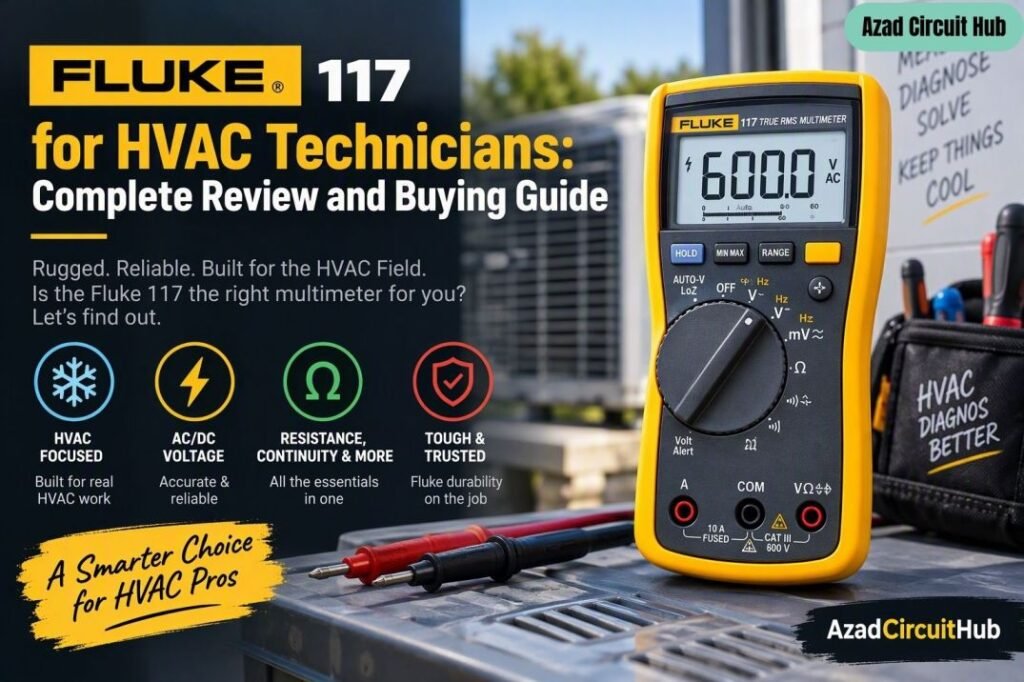
Table of Contents
Table of Contents
Why the Fluke 117 Works for HVAC Troubleshooting
The biggest advantage of the Fluke 117 for HVAC technicians is its combination of common electrical measurements in one compact meter.
An HVAC service call can involve checking a 24V control circuit, verifying line voltage, testing a contactor, checking a capacitor, or confirming continuity through a switch. Carrying a meter that can handle these jobs without complicated setup saves time.
The automatic voltage selection is particularly convenient. Instead of manually deciding between AC and DC voltage ranges for every test, the meter can automatically select the appropriate measurement mode.
Its low impedance voltage mode is also useful when troubleshooting electrical systems where ghost voltage can produce misleading readings.
Looking for a reliable clamp meter for electrical testing and troubleshooting? Explore our Best Fluke Clamp Meters Amazon Idea List to compare popular Fluke models and find the right option for your work.
Testing HVAC Control Voltage
Many residential HVAC control systems use low-voltage control circuits. Thermostats, contactors, relays, pressure switches, and control boards can all involve low-voltage measurements.
The Fluke 117 can be used to verify AC voltage across appropriate control terminals and help identify an open control circuit.
For example, if a contactor is not pulling in, a technician can check whether the expected control voltage is reaching the coil. If voltage is present but the contactor does not operate, the fault may be with the coil or contactor itself.
Always follow the equipment manufacturer's service procedure and use appropriate PPE and test methods when working around energized equipment.
Checking HVAC Line Voltage
HVAC equipment commonly operates from residential or commercial AC supplies. Depending on the equipment, a technician may encounter 120V, 208V, 230V, 240V, or other system voltages.
The Fluke 117 is designed for electrical voltage measurements and provides an easy-to-read digital display. The automatic AC/DC selection can make routine testing faster.
Before testing, verify the expected system voltage and meter configuration. Test the meter on a known source before and after live measurements when the application requires that procedure.
Capacitance Testing for HVAC Service
Capacitor testing is one of the most relevant features for HVAC technicians. Motors and compressors may use run or start capacitors, and a technician may need to determine whether a capacitor remains within its expected capacitance range.
The Fluke 117 includes capacitance measurement, allowing technicians to compare measured capacitance with the component's marked rating and the manufacturer's specifications.
A capacitance reading should not be treated as the only diagnostic test. A capacitor can sometimes show a reasonable capacitance value while still having other problems under operating conditions.
Always de-energize the equipment and safely discharge capacitors before making resistance or capacitance measurements.
Low Impedance Mode and Ghost Voltage
Ghost voltage can cause confusion during electrical troubleshooting. A high-impedance digital multimeter may detect voltage that has little ability to supply current because of capacitive coupling from nearby energized conductors.
The Fluke 117's Auto-V/LoZ function helps address this situation by providing a low-impedance measurement mode.
This can be useful when diagnosing HVAC disconnects, control wiring, contactors, and other electrical circuits where induced voltage may appear during testing.
It is still important to understand what the circuit is doing rather than relying on a single meter reading.
Need accurate current measurements without breaking the circuit? Check out Best Fluke Clamp Meters on our Amazon Idea List and compare Fluke clamp meters suited for electrical maintenance, field service, and industrial applications.
Continuity and Resistance Testing
Continuity testing is useful when checking switches, fuses, wiring, relays, and other de-energized components.
The Fluke 117 also measures resistance, which can help when troubleshooting coils, sensors, wiring, and components where a resistance specification is available.
For example, a technician may compare the resistance of a relay coil with the manufacturer's expected value. A significantly different reading can indicate an open or damaged component.
Continuity and resistance tests should normally be performed on de-energized circuits. Disconnect components where necessary to avoid parallel paths affecting the measurement.
Fluke 117 for HVAC Technicians: Practical Strengths and Limitations
The Fluke 117 for HVAC technicians makes sense when the priority is a general-purpose professional multimeter that covers common electrical troubleshooting tasks.
Strengths
- Automatic AC/DC voltage selection
- Low impedance voltage mode
- Non-contact voltage detection
- Capacitance measurement
- Resistance and continuity testing
- Frequency measurement
- Min/Max/Average functions
- Compact professional design
- Useful for general electrical troubleshooting
Things to Consider
The Fluke 117 is not specifically an HVAC-only meter. Technicians who frequently work with higher currents, temperature sensors, specialized HVAC probes, or advanced three-phase equipment may need additional instruments.
A clamp meter can also be useful for measuring current without placing the meter directly in series with a circuit.
If you are building a complete electrical service kit, compare the 117 with other options in my guide to the best multimeter for electricians.
Is the Fluke 117 Good for HVAC Technicians?
For general HVAC electrical troubleshooting, the Fluke 117 provides a useful set of measurements in one meter.
Its combination of voltage, resistance, continuity, capacitance, frequency, non-contact voltage detection, and low impedance mode covers many routine diagnostic tasks.
It is particularly useful for technicians who also perform general electrical work rather than limiting their work exclusively to HVAC systems.
However, the right meter depends on the equipment being serviced. Commercial HVAC technicians working on larger systems may need a clamp meter, insulation tester, temperature instrument, or other specialized equipment alongside a standard DMM.
Choosing a Fluke clamp meter can depend on current range, accuracy, functions, and application. Visit our Best Fluke Clamp Meters Amazon Idea List to see selected models and check the latest availability and pricing.
What HVAC Measurements Can You Make?
| HVAC Task | Fluke 117 Function |
|---|---|
| Check control voltage | AC voltage |
| Verify supply voltage | AC voltage |
| Test wiring continuity | Continuity |
| Check component resistance | Resistance |
| Test capacitor value | Capacitance |
| Check frequency | Frequency |
| Identify suspected ghost voltage | LoZ mode |
| Quick live-wire screening | VoltAlert |
| Track changing measurements | Min/Max/Average |
The key is matching the meter function to the diagnostic task. A multimeter provides measurements, but the technician still needs the equipment schematic and manufacturer specifications to interpret them correctly.
Buying the Fluke 117 for HVAC Work
The Fluke 117 is worth considering if you want a professional DMM that can cover everyday HVAC electrical troubleshooting without being overloaded with functions you may rarely use.
Before ordering, check the exact package contents and current Amazon listing because included accessories and pricing can change.
For technicians comparing alternatives before buying, the best multimeter for electricians guide is a useful place to compare features, measurement functions, and different Fluke models.
Frequently Asked Questions
Can the Fluke 117 test HVAC capacitors?
Yes. The Fluke 117 includes capacitance measurement, which can be used to check capacitor values against the component's rated specification.
Can the Fluke 117 measure 24V HVAC control voltage?
Yes. It can measure AC voltage in HVAC control circuits. Always confirm the expected voltage from the equipment documentation before testing.
Does the Fluke 117 have a low impedance mode?
Yes. Its Auto-V/LoZ function provides low impedance voltage measurement, which can help distinguish usable voltage from some forms of ghost or induced voltage.
Is the Fluke 117 suitable for HVAC technicians?
It is suitable for many general HVAC electrical troubleshooting tasks, including voltage, resistance, continuity, capacitance, and frequency measurements. Specialized HVAC work may still require additional instruments.
Does the Fluke 117 measure current?
Yes, the Fluke 117 includes current measurement capability. However, technicians who frequently measure operating current may find a clamp meter more convenient because it can measure current without opening the circuit.
Final Verdict
The Fluke 117 is a practical professional multimeter for HVAC technicians who need one instrument for common electrical troubleshooting tasks. Its automatic voltage selection, LoZ mode, capacitance measurement, continuity testing, and non-contact voltage detection make it useful on a wide range of service calls.
From an electrical engineering and field-troubleshooting perspective, I would consider it a strong general-purpose DMM rather than a complete HVAC test kit. For many technicians, pairing it with a quality clamp meter and appropriate HVAC-specific test accessories provides broader coverage.
If you want a reliable meter for daily electrical and HVAC troubleshooting, check the current Fluke 117 on Amazon listing and compare its price and included accessories before purchasing.
Get new guides in your feed. Follow Electrical Insights on LinkedIn for new electrical standards guides, calculators and design tips from Azad Circuit Hub.
#Fluke117, #Fluke117ForHVAC, #HVACTechnicians, #HVACTools, #FlukeMultimeter, #DigitalMultimeter, #ElectricalTesting, #HVACMaintenance, #ElectricalTools, #MultimeterReview