How to Test a Capacitor with a Multimeter (3 Easy Methods)
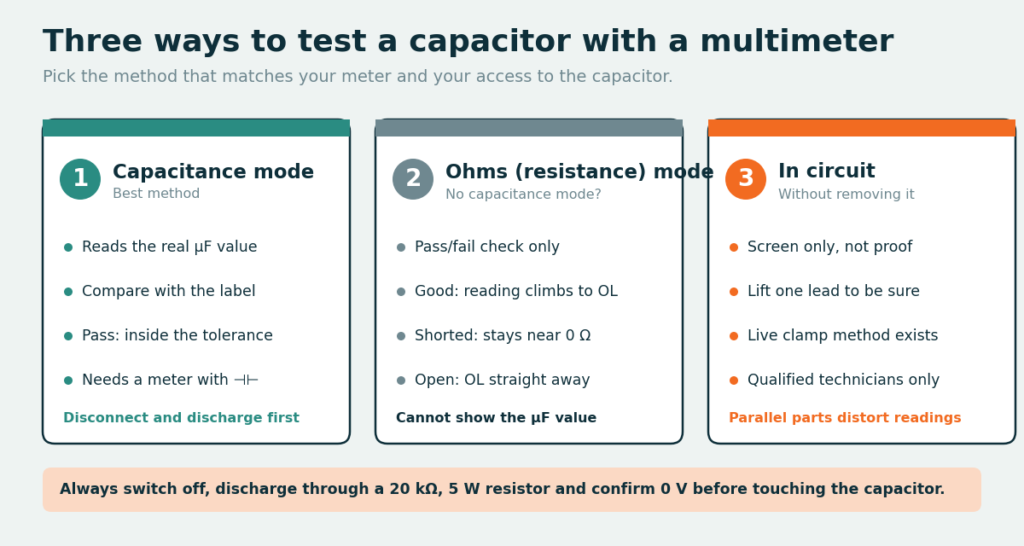
How to test a capacitor with a multimeter comes down to one question: does your meter have a capacitance mode? If it does, you read microfarads (µF) directly and compare them with the label. If it does not, you can still spot a shorted or open capacitor with the ohms range. This guide covers both methods, plus fan capacitors, AC dual run capacitors, in-circuit checks and the best multimeters for the job. It is a spoke of our Electrical Test Equipment Guide, which compares every tool in a technician’s kit.
Quick answer: how to test a capacitor with a multimeter in five steps
- Switch off the power and confirm it is off.
- Discharge the capacitor through a 20 kΩ, 5 W resistor for five seconds.
- Disconnect the capacitor, or at least lift one lead.
- Set the meter to capacitance (the ⊣⊢ symbol) and touch the probes to the terminals.
- Compare the reading with the µF value and tolerance printed on the label.
How to test a capacitor with a multimeter safely: discharge first
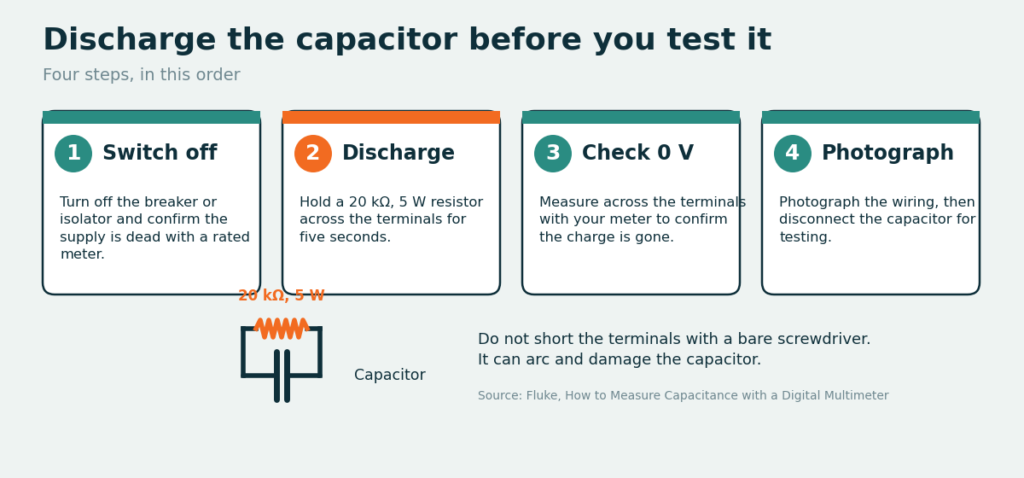
Capacitors keep their charge after the power is removed. An AC run capacitor rated 370 or 440 VAC can still deliver a painful shock. Fluke recommends connecting a 20,000 Ω, 5 W resistor across the terminals for five seconds and then confirming with your meter that the charge is gone. Avoid shorting terminals with a bare screwdriver, because it can arc and damage the capacitor.
Confirm the supply is dead with a rated meter. A non-contact voltage tester is a useful first screen, but it does not prove a conductor is de-energized. Photograph the wiring before you disconnect anything.
Tools you need
- A multimeter with a capacitance function (picks are below)
- A 20 kΩ, 5 W discharge resistor or a capacitor discharge tool
- An insulated screwdriver or needle-nose pliers
- Your phone, for a photo of the wiring
These tools cover every method of how to test a capacitor with a multimeter in this guide.

- Discharge capacitors safely, without the risk of electrical shock | For professional use only
- LED indicator to let you know if capacitor is charged | Standard magnetic connector or alligator clip adapter
- Maximum voltage: 440 VAC
How to test a capacitor with a multimeter in capacitance mode
Capacitance mode is the best way to test a capacitor with a multimeter, because it gives you a number you can compare with the label. Fluke explains that the meter charges the capacitor with a known current, measures the voltage and calculates the capacitance.
- Switch off the power, discharge the capacitor and confirm 0 V.
- Photograph the wiring, then disconnect the capacitor from the circuit.
- Turn the dial to the capacitance symbol. On many meters it shares a position with another function, so press the function button to select it.
- Touch the probes to the terminals. Polarity does not matter on a non-polarized capacitor. On an electrolytic, red goes to the positive lead.
- Wait for the reading to settle. For very small values, use relative mode to cancel the lead capacitance.
- Compare the reading with the printed µF rating and tolerance.
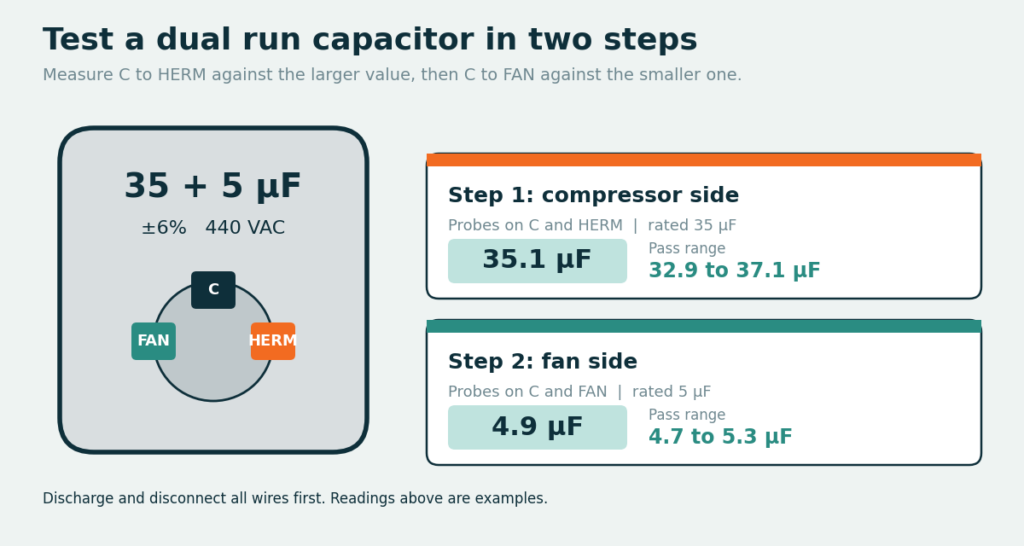
The pass range is the rating plus or minus the tolerance. For a 35 µF capacitor marked ±6%, the range is 35 × 0.94 = 32.9 µF to 35 × 1.06 = 37.1 µF.
| Capacitor | Rating and tolerance | Pass range |
|---|---|---|
| Dual run, compressor (HERM) | 35 µF ±6% | 32.9–37.1 µF |
| Dual run, fan (FAN) | 5 µF ±6% | 4.7–5.3 µF |
| Single run capacitor | 45 µF ±5% | 42.75–47.25 µF |
The tolerance printed on the capacitor is the controlling figure. Many HVAC run capacitors are marked ±5% or ±6%.
Multimeter capacitor test symbol: what to look for
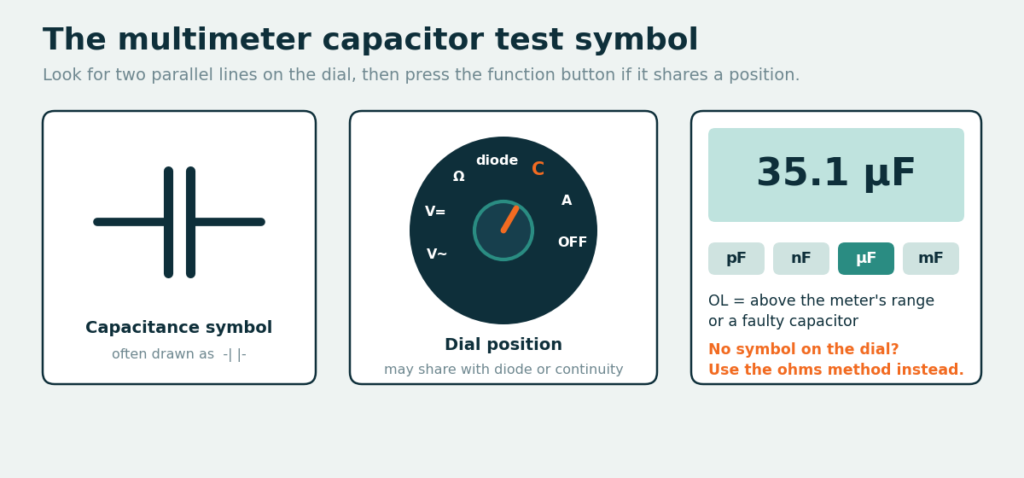
Every method of how to test a capacitor with a multimeter starts by finding the right dial position. The multimeter capacitor test symbol is two short parallel lines, one straight and one curved (⊣⊢ or -||-).
It often shares a dial position with diode or continuity, so press the SELECT or FUNC button until the display shows nF, µF or mF. If the meter shows OL in this mode, the capacitor is either above the meter’s range or faulty. If your dial has no capacitor symbol, your meter has no capacitance mode, and the ohms method below is your option.
How to test a capacitor with a multimeter without capacitance mode
Without capacitance mode, you can still learn whether the capacitor charges, is shorted or is open. The resistance range cannot tell you the µF value, so treat it as a pass/fail screen.
How to test a capacitor with a multimeter using ohms
The ohms version of how to test a capacitor with a multimeter takes under a minute.
- Switch off the power, discharge the capacitor and confirm 0 V.
- Disconnect the capacitor from the circuit.
- Set the meter to its highest resistance range (MΩ), or to auto-range.
- Touch the probes to the terminals, red to positive on a polarized capacitor.
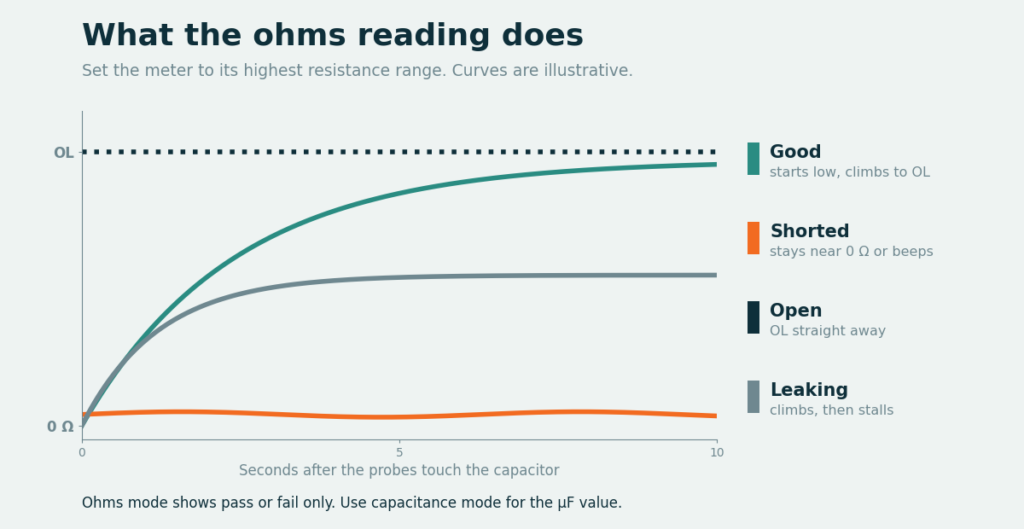
- Watch the display. The meter’s internal battery charges the capacitor, so the reading should start low and climb toward OL.
- Reverse the probes. A good capacitor repeats the same climb.
| What the meter does | What it means |
|---|---|
| Starts low, climbs to OL | Charging normally, likely good |
| Stays near 0 Ω or beeps | Shorted, replace it |
| Shows OL immediately and never moves | Open, replace it (tiny capacitors charge too fast to see) |
| Climbs but stops at a finite value | Leaking, replace it |
| Settles at a few kΩ | Some start capacitors have a built-in bleed resistor, so check the datasheet |
How to test an AC capacitor with a multimeter using ohms
An AC run capacitor behaves the same way, but its large value charges slowly, so give the reading several seconds. Test each section separately: C to HERM, then C to FAN. Then measure from each terminal to the metal case, which should read OL. Any low reading to the case means the capacitor has shorted to ground.
An ohms test can pass a capacitor that has lost much of its capacity. If the motor still struggles, measure the µF value.
How to test a capacitor with a multimeter without removing it
How to test a capacitor with a multimeter without removing it has a short, honest answer: you can screen it, but you cannot prove it is good. Other components in parallel distort the reading. Fluke advises detaching the capacitor, and the minimum is to lift one lead.
- Lift one lead. With power off and the capacitor discharged, disconnect one terminal and measure as usual. This is the reliable option.
- Screen in circuit. With power off and the capacitor discharged, measure across the terminals. A reading far below the rating or 0.0 µF is a warning. A normal-looking reading is not proof.
- Measure live (qualified technicians only). For a motor-run capacitor, clamp the current in the capacitor lead and measure the voltage across it. Then µF ≈ 2,652 × amps ÷ volts at 60 Hz, which follows from I = 2πfCV. For example, 5.2 A at 370 V gives 2,652 × 5.2 ÷ 370 ≈ 37.3 µF. This involves live voltage, so do not attempt it without training.
A clamp meter that also reads capacitance makes this easier, since one tool covers current and µF.
How to test a capacitor with a multimeter: fan and AC units
How to test a fan capacitor with a multimeter
This is how to test a capacitor with a multimeter on a fan. A weak fan capacitor is a common reason a ceiling fan hums, spins slowly or needs a push to start. The same fault stops an AC condenser fan from turning.
- Turn off the fan at the breaker and confirm it is dead.
- Remove the cover, photograph the wiring and note which wire goes where.
- Disconnect the capacitor and discharge it.
- Set the meter to capacitance and measure across the two terminals.
- Compare the reading with the printed µF rating and tolerance.
For this fan capacitor test, a reading below the tolerance range, 0.0 µF or OL means replace the capacitor with one of the same µF and voltage rating.
Dual run capacitor on an AC unit
The steps for how to test a capacitor with a multimeter on an AC unit differ slightly. An AC condenser uses one dual run capacitor with three terminals: C (common), HERM (compressor) and FAN. As the HVAC Training Shop explains, measure C to HERM against the larger µF value and C to FAN against the smaller value. A reading outside the tolerance on either side means the capacitor is weak.
What your readings mean
Use this table when you finish how to test a capacitor with a multimeter.
| Reading | Verdict |
|---|---|
| Within the label tolerance | Good |
| Below the range | Weak, replace it |
| 0.0 µF or OL | Open or failed, replace it |
| Very low resistance in ohms mode | Shorted, replace it |
| Swollen top, oil leak or burn marks | Replace it, whatever the meter says |
Best multimeter for capacitor testing
Every meter below can run how to test a capacitor with a multimeter in capacitance mode. The best multimeter for capacitor testing has a capacitance range large enough for the job. A dual run capacitor such as 45+5 µF needs at least 100 µF, and start capacitors can go higher. Also look for relative mode, a CAT III rating and a stable display.
As an Amazon Associate I earn from qualifying purchases. See our affiliate disclosure.
- Fluke 117, best for HVAC technicians. It measures up to 9,999 µF and has Auto-V/LoZ. Read our Fluke 117 for HVAC technicians review.
- KAIWEETS KM601S, best budget smart meter. It has capacitance, True RMS and auto-ranging. See our KAIWEETS KM601S review.
- AstroAI digital multimeter, best starter. A low-cost option for hobby and fan work. Read the AstroAI digital multimeter review.
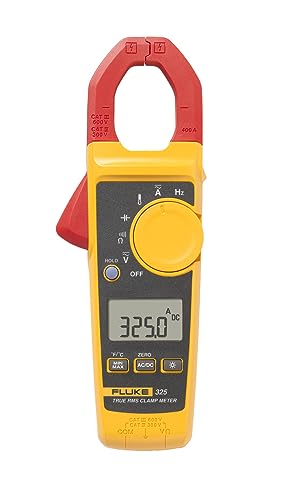
- Fluke 325 clamp meter, best for clamp plus capacitance. It measures current and capacitance up to 1,000 µF. See Fluke 324 vs 325.


Still deciding? Compare more options in our best multimeter for homeowners and best multimeter for automotive electrical guides.
Frequently asked questions
Can you test a capacitor with a regular meter?
Yes. How to test a capacitor with a multimeter that lacks capacitance mode comes down to the ohms range, which shows whether a capacitor charges, is shorted or is open. It cannot show the µF value.
What are signs of a bad capacitor?
Signs include a motor that hums but will not start, a fan that spins slowly, an AC fan that needs a push, a clicking or tripping compressor, and a swollen case or leaking oil.
Should you get continuity through a capacitor?
No. A good capacitor may beep for a split second while it charges, then goes open. Steady continuity or a constant beep means it is shorted.
How to test a capacitor in a circuit without removing it?
Lift one lead for a reliable result when you follow how to test a capacitor with a multimeter in circuit. An in-circuit reading is only a screen, because parallel components distort the measurement.
How to tell if a capacitor is bad with a multimeter?
Follow how to test a capacitor with a multimeter in capacitance mode. If the reading falls outside the label tolerance, or shows 0.0 µF or OL, the capacitor is bad. The ohms method catches shorts and opens only.
Will the AC still run if the capacitor is bad?
Sometimes, but badly. The fan may not spin and the compressor may hum, overheat and trip its overload. Running the unit like that can damage the compressor, so switch it off.
Conclusion
Now you know how to test a capacitor with a multimeter in three ways: capacitance mode for the µF value, the ohms method when your meter has no capacitance mode, and an in-circuit screen when you cannot remove the part right away. Keep this how to test a capacitor with a multimeter checklist handy: always discharge first and replace any capacitor that fails the label tolerance. For the rest of the toolkit, return to our Electrical Test Equipment Guide.
Get new guides in your feed. Follow Electrical Insights on LinkedIn for new electrical standards guides, calculators and design tips from Azad Circuit Hub.