
Fluke 324 vs 325: What Actually Changed?
If you are comparing the Fluke 324 vs 325, the two clamp meters can look almost identical at first glance. Both belong to Fluke’s compact 320 Series, both are designed for electrical troubleshooting, and both offer AC/DC current measurement in a portable clamp-meter format.
The real question is whether the Fluke 325 gives you enough extra functionality to justify choosing it over the 324.
For electricians, HVAC technicians, maintenance professionals, and electrical engineers, the answer usually comes down to measurement range, frequency measurement, temperature testing, and how often you work with motors and control circuits.
Fluke 324 vs 325: Quick Comparison
| Feature | Fluke 324 | Fluke 325 |
|---|---|---|
| AC current | Up to 400 A | Up to 400 A |
| DC current | Up to 400 A | Up to 400 A |
| AC voltage | Up to 600 V | Up to 600 V |
| DC voltage | Up to 600 V | Up to 600 V |
| Resistance | Up to 40 kΩ | Up to 40 kΩ |
| Capacitance | Yes | Yes |
| Frequency | Limited/No dedicated frequency function | Yes |
| Temperature measurement | Yes | Yes |
| Jaw opening | 30 mm | 30 mm |
| True RMS | Yes | Yes |
| Continuity | Yes | Yes |
| Min/Max | Yes | Yes |
| Display backlight | Yes | Yes |
| Best suited for | General electrical troubleshooting | More advanced electrical and HVAC work |
Which One Should You Buy?
Our Verdict: Fluke 325 Wins for Professionals
Choose the Fluke 324 if your main jobs involve measuring AC/DC current, voltage, resistance, continuity, and capacitance and you want to keep the purchase cost lower.
Choose the Fluke 325 if you regularly troubleshoot motors, HVAC systems, generators, control equipment, or industrial machinery and will use frequency and temperature measurements.
Our pick: The Fluke 325 is the better long-term choice for most professional electricians because its additional measurement functions make it more versatile. The 324 is the better value when you only need the core clamp-meter functions.
Buy Fluke 325 →Get Discount using This Link
Which Fluke Clamp Meter Should You Buy?
Fluke 324
Best for: Electricians who need reliable everyday electrical measurements without paying for features they may rarely use.
Why choose it:
- 400 A AC/DC current measurement
- True RMS measurements
- Voltage, resistance, capacitance, and continuity testing
- Compact design for field work
- Good choice for general electrical troubleshooting
- Lower-cost option within this comparison
This Product has been discontinued by Fluke.
Fluke 325
Best for: Professional electricians, HVAC technicians, and maintenance professionals who need broader troubleshooting capabilities.
Why choose it:
- 400 A AC/DC current measurement
- True RMS technology
- Voltage, resistance, and capacitance testing
- Frequency measurement
- Temperature measurement
- Better suited to motors, HVAC equipment, generators, and industrial troubleshooting
- More versatile as an all-around professional clamp meter
Check Fluke 325 Price on Amazon → Check the latest Amazon price, availability, and seller options before ordering.
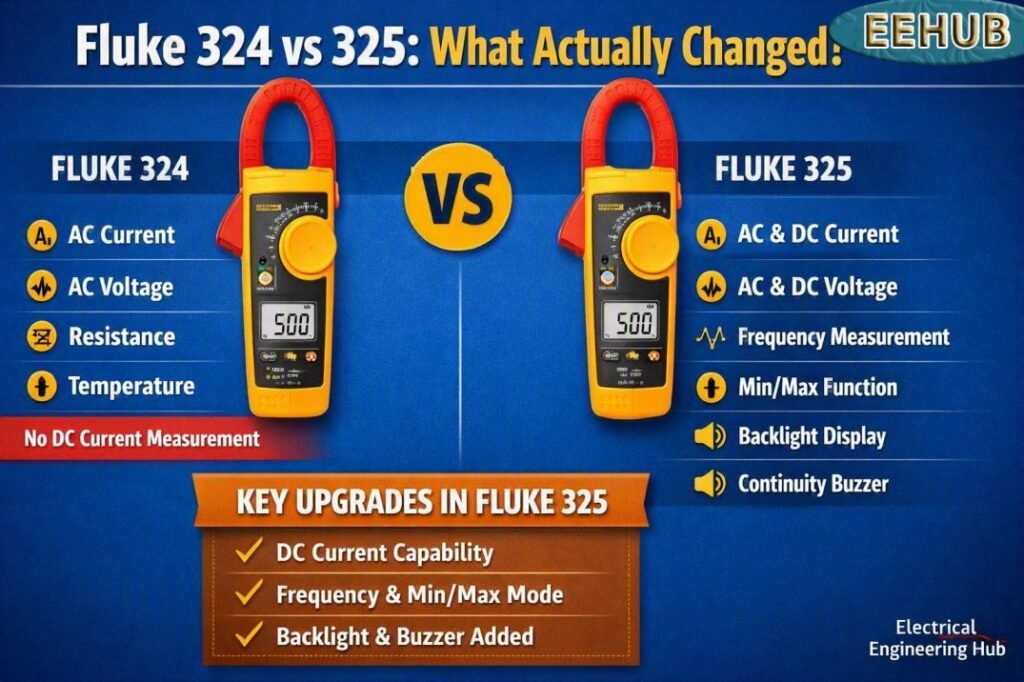
Table of Contents
Table of Contents
What Is the Main Difference Between Fluke 324 and 325?
The main difference is the additional functionality available on the Fluke 325, particularly frequency measurement and its broader usefulness for troubleshooting electrical and HVAC equipment.
Both meters can measure AC and DC current, which is important when working with conventional electrical circuits, control systems, batteries, and many industrial applications. Both also measure voltage and resistance.
Where the 325 becomes more attractive is when you need more than basic current and voltage readings.
Frequency measurement can be useful when checking generators, variable-frequency equipment, motor systems, and other electrical equipment where the operating frequency needs to be verified.
The 325 is therefore better suited to technicians who regularly troubleshoot equipment rather than simply checking current and voltage.
If you are still comparing several models, our guide to the Best Clamp Meter for Electricians can help you choose a meter based on your type of electrical work.
Fluke 324 vs 325: Current Measurement
Both models are designed to measure current without disconnecting the conductor. This is one of the biggest advantages of using a clamp meter.
The 400 A AC/DC current capability makes the meters useful for many residential, commercial, and light industrial applications.
You can clamp around a conductor and obtain a current reading without opening the circuit. This is especially useful when testing motors, distribution panels, air-conditioning equipment, pumps, and other loads.
For most users, there is no major reason to choose the 325 solely because of current capacity. Both models provide a similar 400 A maximum measurement capability.
The difference becomes more noticeable when you start using the meter for additional diagnostic measurements.
Fluke 325 Adds More Troubleshooting Capability
The 325 is aimed at users who need a more versatile electrical test instrument.
Its frequency measurement function is particularly useful when troubleshooting equipment where frequency matters. For example, technicians working around motors, generators, HVAC equipment, and electronic control systems may find this function valuable.
Temperature measurement is also useful for maintenance work. A technician can use a suitable thermocouple to investigate overheating components, connections, motors, bearings, and HVAC equipment.
This makes the 325 more of a multipurpose troubleshooting instrument.
If your work involves panels, motors, HVAC systems, control circuits, and maintenance testing, check our Best Clamp Meter for Electricians guide before making your final purchase.
Fluke 324 vs 325 for Electricians
For a general electrician, both models can handle many everyday jobs.
The Fluke 324 can be a practical choice when the primary requirements are:
- AC and DC current measurement
- AC and DC voltage testing
- Resistance measurement
- Continuity checks
- Capacitance testing
- Basic troubleshooting
The 325 makes more sense when your work regularly includes:
- Motor troubleshooting
- HVAC service
- Generator testing
- Frequency checks
- Temperature measurement
- Industrial maintenance
- More detailed electrical diagnostics
This is why the 325 often makes more sense as a long-term professional investment.
Fluke 325: Why It Is Still a Strong Choice
The Fluke 325 remains popular because it combines a compact design with several functions that technicians commonly need.
Its True RMS measurement is important when working with loads that produce non-linear or distorted waveforms. A basic average-responding meter can sometimes produce inaccurate readings on these types of circuits.
The 325 also has a clamp design that allows current measurement without physically disconnecting the conductor. That can save time during troubleshooting and reduce the need to disturb an energized circuit.
Another advantage is portability. A large industrial clamp meter may provide more capacity, but it can be inconvenient for everyday service work. The 325 is compact enough to carry as part of a standard electrical test kit.
Fluke 324 vs 325: Which One Is Better for HVAC?
For HVAC technicians, the 325 is generally the more useful option.
HVAC troubleshooting can involve current, voltage, resistance, capacitance, temperature, and frequency. Being able to use one instrument for several of these measurements reduces the number of tools needed in the service bag.
Temperature measurement can also be valuable when investigating equipment performance and overheating.
The 325 is therefore a better fit for technicians who work on compressors, motors, control systems, fans, and other HVAC equipment.
However, if you only need basic electrical measurements and already own separate temperature or frequency instruments, the additional features may not justify spending more.
Fluke 324 vs 325: Build Quality and Ease of Use
Both meters follow Fluke’s familiar approach to handheld electrical test equipment.
The compact clamp design is useful when working inside crowded panels where space is limited. The jaw can be placed around a conductor without requiring the conductor to be removed.
The display and controls are designed for field use, while the backlight helps when working in darker electrical rooms or equipment cabinets.
For professionals, build quality matters because a clamp meter is often carried from one job to another and exposed to demanding working conditions.
This is one area where choosing a reputable professional meter can be worthwhile even if a cheaper clamp meter offers similar basic specifications.
Fluke 325 vs Fluke 323: What About the Other Model?
People often search for the difference between fluke 323 and 325 because the two models are also closely related.
The Fluke 323 is more focused on basic AC/DC voltage, AC current, resistance, and continuity measurements. The 325 offers a wider set of diagnostic functions, making it better suited to users who need frequency, temperature, and additional measurement capability.
So, if you are deciding between the 323 and 325, think about how often you perform advanced troubleshooting rather than looking only at the maximum current rating.
For a professional electrician who wants one compact clamp meter for a wider range of jobs, the 325 is usually the more capable choice.
Is the Fluke 325 Worth Buying?
The Fluke 325 is worth considering if you want a professional clamp meter that can do more than measure current.
Its biggest advantage is versatility. Instead of carrying separate instruments for every basic troubleshooting task, you can use one clamp meter for current, voltage, resistance, capacitance, frequency, and temperature measurements.
That does not mean everyone needs the 325.
A homeowner or technician who only checks current and voltage may be perfectly satisfied with a simpler clamp meter. The extra features have the most value when they are actually used.
If you want the additional troubleshooting functions, the price difference can be easier to justify.
Check the Current Amazon Price
If the 325 fits your work requirements, you can Check the Fluke 325 price on Amazon to compare the current price, availability, and seller options before buying.
Fluke 324 vs 325: Pros and Cons
| Model | Pros | Cons |
|---|---|---|
| Fluke 324 | Compact, True RMS, AC/DC current, voltage, resistance, capacitance, temperature | Fewer advanced troubleshooting features |
| Fluke 325 | More versatile, frequency measurement, temperature function, True RMS, AC/DC current | Costs more than basic clamp meters |
| Best for | General electrical work | Professional troubleshooting and HVAC |
If you are building a professional electrical test kit, our Best Clamp Meter for Electricians comparison is also worth checking for alternatives at different price points.
Frequently Asked Questions
1. What is the main difference between Fluke 324 and 325?
The 325 provides additional troubleshooting functionality, including frequency measurement, while retaining the core clamp-meter functions found on the 324. This makes it better suited to professional electrical and HVAC diagnostics.
2. Is the Fluke 325 better than the Fluke 324?
For advanced troubleshooting, yes. The 325 offers more useful measurement functions and is a better choice for technicians who work with motors, HVAC systems, generators, and industrial equipment. For basic electrical testing, the 324 may be sufficient.
3. Can the Fluke 325 measure DC current?
Yes. The Fluke 325 supports DC current measurement up to 400 A, making it useful for many electrical, automotive, battery, and solar-related troubleshooting applications.
4. Is the Fluke 325 good for HVAC?
Yes. The 325 is a strong option for HVAC technicians because it combines clamp current measurement with voltage, resistance, capacitance, frequency, and temperature measurement capabilities.
5. Is Fluke 325 worth the extra money?
It can be, especially if you regularly use frequency and temperature measurements or need a versatile professional troubleshooting meter. If you only need basic current and voltage testing, a less expensive model may provide better value.
Related Guides
- Fluke 323 vs 325
- Fluke 325 Review
- Fluke 325 vs Fluke 902 FC
- Fluke 325 vs 375 vs 376
- Fluke 302 vs Fluke 323
Get new guides in your feed. Follow Electrical Insights on LinkedIn for new electrical standards guides, calculators and design tips from Azad Circuit Hub.
Fluke324, #Fluke325, #Fluke324vs325, #FlukeClampMeter, #FlukeClampMeters, #ElectricalTesting, #ElectricianTools, #DigitalClampMeter, #FlukeTools, #ElectricalTools
