
Fluke 302 vs Fluke 323: Budget Clamp Meter Face-Off
Choosing a reliable clamp meter does not always mean spending a lot. Fluke has two compact options that appeal to electricians, maintenance technicians, and DIY users: the Fluke 302 and Fluke 323. Both are designed for everyday electrical testing, but they target slightly different needs.
The Fluke 302 is the simpler entry-level option, while the Fluke 323 adds AC/DC voltage measurement, resistance testing, and temperature measurement. For many electricians, that broader feature set makes the 323 a more practical long-term purchase.
This fluke 302 vs 323 comparison looks at their features, accuracy, safety ratings, usability, and overall value to help you choose the right clamp meter.
Fluke 302 vs Fluke 323: Quick Comparison
| Feature | Fluke 302 | Fluke 323 |
|---|---|---|
| Clamp jaw opening | About 30 mm | About 30 mm |
| AC current | Up to 400 A | Up to 400 A |
| AC voltage | Yes | Yes |
| DC voltage | Limited/basic | Yes |
| Resistance | Yes | Yes |
| Continuity | Yes | Yes |
| Capacitance | No | No |
| Temperature | No | Yes |
| True RMS | No | Yes |
| Safety rating | CAT III 600 V | CAT III 600 V |
| Best for | Basic electrical checks | Electricians and maintenance |
| Overall value | Entry-level | Better value |
Where to Buy Fluke 302
Best for: Basic electrical testing and occasional troubleshooting.
Amazon prices and availability can change. Check the current listing before purchasing.
Where to Buy Fluke 323
Best for: Electricians, HVAC technicians, maintenance professionals, and serious DIY users.
Amazon prices and availability can change. Check the current listing before purchasing.
If you are comparing the fluke 302 vs 323 primarily on versatility, the Fluke 323 has the clear advantage. It provides more measurement capability without moving into the much higher price range of advanced professional clamp meters.
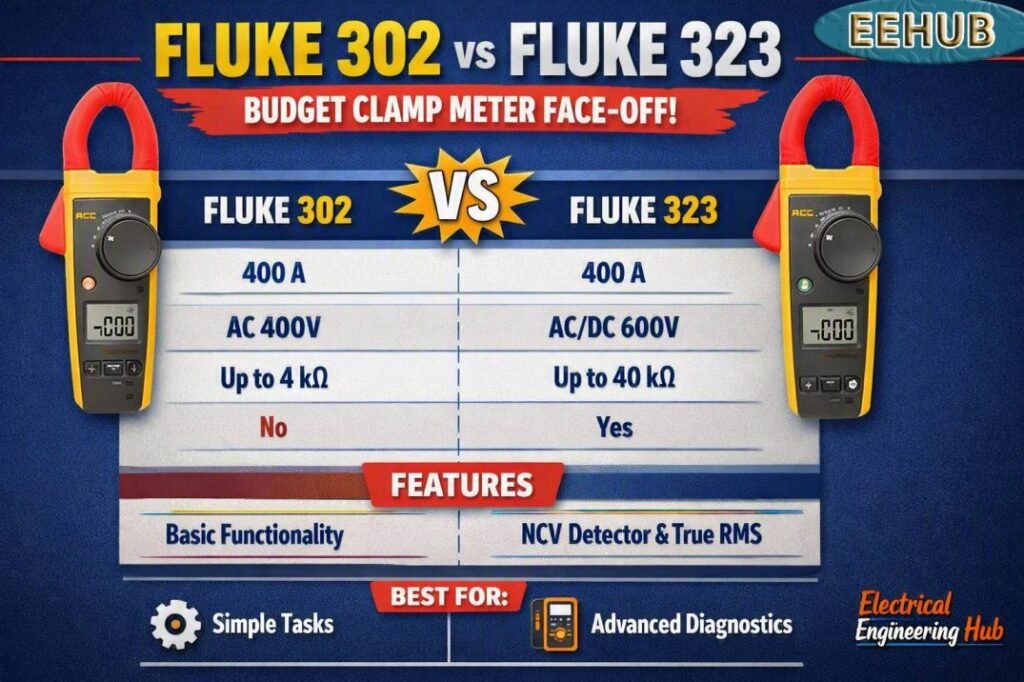
Table of Contents
Table of Contents
Fluke 302: What Do You Get?
The Fluke 302 is built for users who need a straightforward clamp meter for routine electrical work. Its compact design makes it easy to carry in a tool bag, while the clamp allows current measurements without disconnecting conductors.
The meter can measure AC current up to 400 A, along with voltage and resistance. That makes it suitable for basic troubleshooting, electrical maintenance, and household electrical checks.
One advantage of the 302 is simplicity. There are fewer advanced functions to work through, which can be useful for technicians who mainly need current, voltage, resistance, and continuity measurements.
However, the Fluke 302 is an entry-level model. It lacks some of the features that make the Fluke 323 more useful for broader electrical troubleshooting.
Fluke 302 Pros and Cons
Pros
- Compact and lightweight design
- 400 A AC current measurement
- Simple controls
- Fluke build quality
- CAT III 600 V safety rating
- Good choice for basic electrical testing
Cons
- Fewer measurement functions
- No True RMS capability
- Less versatile for troubleshooting
- No temperature measurement
- Not as suitable for users who need DC current measurements
Looking for more electrician-focused options? Check our best clamp meters for electricians for additional models, features, and buying recommendations.
Fluke 323: The Better Value Pick
The Fluke 323 takes the basic concept further. It is still compact and relatively easy to use, but it adds features that can matter during real-world electrical troubleshooting.
A major advantage is True RMS measurement. True RMS helps provide more accurate readings when dealing with non-linear loads such as variable-speed drives, electronic power supplies, and modern electrical equipment.
The 323 can measure AC/DC voltage, AC current, resistance, continuity, and temperature. This makes it more useful for electricians who work across residential, commercial, HVAC, and industrial applications.
When comparing fluke 302 vs 323, this wider measurement capability is one of the strongest reasons to choose the 323.
Fluke 323 Pros and Cons
Pros
- True RMS AC measurements
- Measures AC current up to 400 A
- AC and DC voltage measurement
- Resistance and continuity testing
- Temperature measurement
- CAT III 600 V safety rating
- Compact design
- Better suited to professional electrical troubleshooting
Cons
- Higher price than the 302
- Does not measure AC/DC current like larger advanced clamp meters
- Limited compared with high-end Fluke models
Fluke 302 vs Fluke 323: Features That Matter
The biggest difference is not simply the maximum current rating. Both meters can handle up to 400 A AC, so the decision comes down to how much measurement capability you need.
| Measurement or Feature | Fluke 302 | Fluke 323 |
|---|---|---|
| AC current | Up to 400 A | Up to 400 A |
| AC voltage | Yes | Yes |
| DC voltage | Basic | Yes |
| Resistance | Yes | Yes |
| Continuity | Yes | Yes |
| Temperature | No | Yes |
| True RMS | No | Yes |
| Compact design | Yes | Yes |
| Professional troubleshooting | Good | Better |
For simple electrical checks, the 302 can get the job done. If you regularly troubleshoot equipment where waveform quality matters, the 323 is the smarter choice.
True RMS: Why Does It Matter?
True RMS is one of the most important differences in this comparison.
A basic meter can provide reliable readings on clean sinusoidal AC waveforms. Modern electrical equipment, however, often produces distorted waveforms. Variable-frequency drives, switching power supplies, LED drivers, and electronic controls are common examples.
A True RMS clamp meter is designed to calculate the effective value of these more complex AC signals more accurately.
That does not mean every electrician needs True RMS for every measurement. For simple mains testing, a basic meter may be sufficient. But if one meter will be used for several years across different jobs, True RMS adds useful flexibility.
This is another reason the 323 stands out in the fluke 302 vs 323 face-off.
Safety: Fluke 302 vs Fluke 323
Electrical safety should be considered before price or extra features.
Both models carry a CAT III 600 V safety rating. CAT ratings indicate the type of electrical environment where test equipment can be safely used when operated within its specified limits.
CAT III equipment is intended for measurements on distribution-level installations, including building wiring, distribution panels, feeders, and fixed equipment.
Always inspect test leads before use and follow the meter’s operating instructions. The correct CAT rating does not make unsafe working practices safe.
For professional electrical work, also make sure the meter is appropriate for the specific installation and measurement being performed.
Which Clamp Meter Is Better for Electricians?
For an electrician who only needs basic current and voltage checks, the Fluke 302 offers a practical entry point.
But if the price difference is reasonable, the Fluke 323 is usually the better investment. True RMS, temperature measurement, and broader voltage functionality give it more room to handle different troubleshooting jobs.
The 323 is especially attractive for electricians who work with HVAC systems, motors, control panels, commercial equipment, and electronic loads.
Want to compare more professional options? Explore our guide to the best clamp meters for electricians before making your final choice.
Fluke 302 vs Fluke 323: Which One Should You Buy?
The right choice depends on your workload.
Choose the Fluke 302 if:
- You need an affordable Fluke clamp meter.
- Most jobs involve basic AC current measurements.
- You want simple controls.
- You do not need True RMS.
- You use a multimeter separately for advanced testing.
Choose the Fluke 323 if:
- You are an electrician or maintenance technician.
- You work with variable or non-linear loads.
- You want True RMS measurement.
- You need temperature measurement.
- You want one compact meter for a wider range of jobs.
- You want better long-term value.
For most professional users, the Fluke 323 earns the value-pick position. The 302 makes sense when keeping the initial purchase price low is the priority.
Final Verdict
The Fluke 302 is a capable entry-level clamp meter for straightforward electrical testing. It offers the trusted Fluke name, a compact design, and 400 A AC current measurement without the cost of a feature-heavy professional meter.
The Fluke 323, however, is the stronger all-around choice. True RMS measurement, temperature testing, AC/DC voltage capability, and a broader troubleshooting feature set make it more useful for electricians.
In the fluke 302 vs 323 comparison, the 302 wins on simplicity and entry-level pricing, while the 323 wins on versatility and overall value.
If you expect to use your clamp meter regularly, spending a little more on the 323 can make more sense than upgrading later. For occasional household testing, the 302 remains a reasonable budget option.
Ready to compare your options before buying? See our best clamp meters for electricians guide for more professional recommendations.
FAQs
Is the Fluke 323 better than the Fluke 302?
For most electricians, yes. The Fluke 323 offers True RMS measurement, temperature measurement, and broader testing capabilities. The 302 is better suited to users who mainly need basic AC current and voltage testing.
What is the main difference between Fluke 302 and 323?
The Fluke 323 provides more advanced measurement capability, including True RMS and temperature measurement. The 302 is a simpler entry-level clamp meter designed for basic electrical testing.
Does the Fluke 323 measure DC current?
No. The Fluke 323 is designed for AC current measurement through its clamp. It does provide DC voltage measurement, which is different from measuring DC current with the clamp.
Is Fluke 323 True RMS?
Yes. True RMS is one of the key advantages of the Fluke 323 over the more basic Fluke 302. It can provide more reliable AC measurements on distorted or non-linear waveforms.
Which is better for electricians, Fluke 302 or 323?
The Fluke 323 is generally the better choice for electricians because it offers more measurement functions and True RMS capability while maintaining a compact design. The Fluke 302 is a better fit for basic or occasional electrical testing.
Related Guides
Get new guides in your feed. Follow Electrical Insights on LinkedIn for new electrical standards guides, calculators and design tips from Azad Circuit Hub.
#Fluke302, #Fluke323, #Fluke302vsFluke323, #ClampMeter, #FlukeClampMeter, #BudgetClampMeter, #ElectricalTesting, #ElectricianTools, #DigitalClampMeter, #FlukeMeters
