
Fluke 325 vs Fluke 902 FC: Which Clamp Meter Wins for HVAC?
Choosing the right clamp meter for HVAC work can make electrical troubleshooting faster and safer. Both meters are built by Fluke, a trusted name in electrical test equipment, but they serve slightly different needs. The Fluke 325 is a versatile clamp meter for general electrical and HVAC tasks, while the Fluke 902 FC is designed specifically with HVAC professionals in mind.
In this Fluke 325 vs Fluke 902 FC comparison, we will look at AC/DC current, voltage, temperature, frequency, capacitance, jaw capacity, safety ratings, HVAC features, and overall value. The goal is simple: help you choose the better clamp meter for your daily service work.
Fluke 325 vs Fluke 902 FC: Quick Comparison
| Feature | Fluke 325 | Fluke 902 FC |
|---|---|---|
| Best for | General electrical and HVAC work | HVAC/R professionals |
| AC current | Up to 400 A | Up to 600 A |
| DC current | Up to 400 A | Up to 600 A |
| AC/DC voltage | Up to 600 V | Up to 600 V |
| Resistance | Up to 40 kΩ | Up to 60 kΩ |
| Capacitance | Yes | Yes |
| Frequency | Yes | Yes |
| Temperature | Yes | Yes |
| Jaw opening | Approx. 30 mm | Approx. 30 mm |
| True RMS | Yes | Yes |
| HVAC-focused functions | Good | Excellent |
| Wireless connectivity | No | Fluke Connect |
| Safety rating | CAT III 600 V | CAT III 600 V / CAT IV 300 V |
| Best overall use | Electrical + HVAC | Professional HVAC troubleshooting |
The specifications can vary slightly by market and product revision, so check the manufacturer’s current documentation before purchasing.
Where to Buy Fluke 325
Where to Buy Fluke 902 FC
Fluke 325 vs Fluke 902 FC: Key Difference
The biggest difference is their intended use.
The Fluke 325 is a compact True RMS clamp meter that handles a wide range of electrical measurements. It can measure AC and DC current, AC/DC voltage, resistance, capacitance, frequency, and temperature. That makes it a strong choice for electricians who also perform HVAC service.
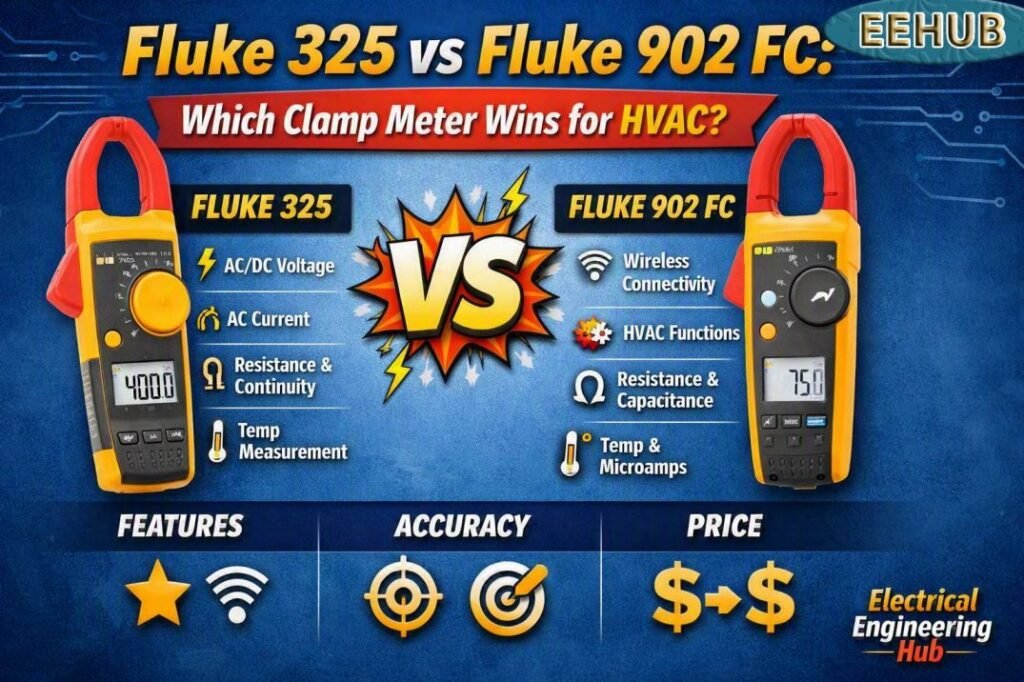
Table of Contents
Table of Contents
The Fluke 902 FC takes a more specialized approach. It was designed for heating, ventilation, air conditioning, and refrigeration technicians. In addition to standard electrical measurements, it includes features that are particularly useful when diagnosing motors, compressors, control circuits, and HVAC equipment.
For a technician who works on HVAC systems every day, the 902 FC has a more focused feature set.
If you are also comparing other professional meters, see our Best Clamp Meter for Electricians guide for more top-rated options.
Fluke 325: A Versatile Clamp Meter for Electrical and HVAC Work
The Fluke 325 is one of the more practical choices for technicians who want one meter for several applications.
Its True RMS capability helps provide accurate readings on non-linear electrical loads. This is useful when testing equipment with electronic controls, variable-speed drives, power supplies, and other modern electrical systems.
The meter measures both AC and DC current, making it suitable for many residential, commercial, industrial, and solar applications. Its temperature measurement function is also useful for HVAC troubleshooting.
Another advantage is its relatively compact design. HVAC technicians often work in crowded mechanical rooms, electrical panels, rooftop units, and service compartments. A smaller meter can be easier to handle in these situations.
Fluke 902 FC: Built Around HVAC Troubleshooting
The Fluke 902 FC is the more HVAC-oriented instrument in this comparison.
It is designed for technicians who regularly troubleshoot air conditioners, heat pumps, refrigeration equipment, compressors, motors, and HVAC control systems. Its AC/DC current capability and electrical measurement functions cover many of the tests performed during service calls.
One of its major advantages is Fluke Connect wireless connectivity. When supported with compatible devices and workflows, readings can be monitored remotely. This can be helpful when working around energized equipment or when a technician needs to keep the display visible from another position.
The 902 FC also has a strong safety specification for professional field work. That matters when troubleshooting equipment in commercial or industrial environments.
fluke 325 vs 902 fc: HVAC Features Compared
When comparing fluke 325 vs 902 fc, the important question is not simply which meter has more features. It is whether those features match your work.
| HVAC Task | Fluke 325 | Fluke 902 FC |
|---|---|---|
| Compressor current testing | Excellent | Excellent |
| Condenser fan motor testing | Excellent | Excellent |
| Blower motor testing | Excellent | Excellent |
| Capacitor testing | Yes | Yes |
| Temperature checks | Yes | Yes |
| Control voltage testing | Excellent | Excellent |
| AC/DC current measurement | Yes | Yes |
| Frequency testing | Yes | Yes |
| Troubleshooting variable loads | Excellent | Excellent |
| Remote measurement workflow | No | Yes |
| Dedicated HVAC design | Moderate | Strong |
For occasional HVAC work, the Fluke 325 provides plenty of capability. For full-time HVAC service, the 902 FC has the stronger professional focus.
Fluke 325 vs Fluke 902 FC for Compressor Testing
Compressor troubleshooting is one of the most important jobs for an HVAC technician. A clamp meter can help measure operating current without disconnecting the conductor.
The Fluke 325 is capable of measuring compressor current and checking voltage, resistance, capacitance, and temperature. This makes it useful when diagnosing common electrical problems.
The Fluke 902 FC offers similar core measurements but adds features aimed at professional HVAC technicians. If compressor diagnostics are a daily part of your work, the additional HVAC-oriented functionality can justify the higher investment.
Before testing, always follow the equipment manufacturer’s service procedure and use appropriate PPE and electrical safety practices.
Fluke 902 vs 325 for Capacitors and Motors
Capacitor and motor testing are common HVAC service tasks.
Both meters can measure capacitance, which can help identify capacitors that are outside their expected value. A technician can also use voltage and resistance measurements as part of a broader troubleshooting process.
For motor diagnostics, True RMS current measurement is valuable because HVAC motors and electronic controls may produce waveforms that are not simple sine waves.
The fluke 902 vs 325 decision therefore comes down to how much HVAC-specific functionality you need rather than basic measurement capability alone.
For a wider comparison of professional electrical test equipment, check our Best Clamp Meter for Electricians guide before choosing your final model.
Which One Is Better for HVAC Technicians?
If HVAC is your primary trade, I would choose the Fluke 902 FC.
Its HVAC-focused design, higher current measurement capability, wireless connectivity, and professional safety features make it better suited to technicians who spend most of their time diagnosing heating and cooling equipment.
The Fluke 325 is the better value for a technician who wants one compact clamp meter that can handle HVAC alongside general electrical work.
In simple terms:
- Choose the Fluke 325 for versatility and general electrical work.
- Choose the Fluke 902 FC for dedicated HVAC service.
- Choose the 902 FC if Fluke Connect is important to your workflow.
- Choose the 325 if you want strong HVAC capability without paying for specialized features you may rarely use.
For more options before making your purchase, explore our Best Clamp Meter for HVAC Work roundup.
Fluke 325 vs Fluke 902 FC: Which Offers Better Value?
Value depends on how you use the meter.
For an electrician who occasionally services air conditioners, motors, pumps, and control panels, the Fluke 325 can provide an excellent balance between price and capability.
For a full-time HVAC technician, the 902 FC can offer better long-term value because its design is more closely matched to HVAC troubleshooting.
A professional technician may use a clamp meter hundreds of times each year. In that situation, features that save time or make measurements easier can be worth more than the initial price difference.
Pros and Cons
Fluke 325 Pros
- True RMS AC measurement
- Measures AC and DC current
- Temperature measurement
- Capacitance and frequency functions
- Compact and practical design
- Useful for electrical and HVAC applications
- Strong choice for technicians who need one general-purpose meter
Fluke 325 Cons
- No Fluke Connect wireless functionality
- Less HVAC-specific than the 902 FC
- Lower current measurement range than the 902 FC
Fluke 902 FC Pros
- Designed specifically for HVAC professionals
- AC/DC current measurement up to 600 A
- True RMS technology
- Temperature measurement
- Capacitance and frequency functions
- Fluke Connect wireless capability
- Strong safety specifications for professional work
Fluke 902 FC Cons
- More expensive than a general-purpose clamp meter
- May offer features that occasional HVAC users do not need
- Less compelling if your work is mainly general electrical maintenance
Final Verdict: Fluke 325 vs Fluke 902 FC
The winner depends on your type of work.
The Fluke 325 is the better all-around choice for electricians, maintenance technicians, and occasional HVAC users. It provides the core measurements needed for motors, electrical panels, compressors, capacitors, and control circuits in a compact package.
The Fluke 902 FC is the better choice for dedicated HVAC professionals. Its HVAC-focused design, higher current range, wireless connectivity, and professional features give it an edge for demanding service work.
Overall, if you are buying one clamp meter mainly for HVAC, the Fluke 902 FC wins. If you need a versatile meter that covers HVAC plus broader electrical applications, the Fluke 325 offers excellent value.
For more electrician-focused buying recommendations, visit our Best Clamp Meter for Electricians guide.
Frequently Asked Questions
Is the Fluke 902 FC better than the Fluke 325 for HVAC?
Yes. The Fluke 902 FC is generally the better choice for dedicated HVAC work because it was designed specifically around HVAC troubleshooting needs and includes Fluke Connect wireless functionality.
Can the Fluke 325 test HVAC capacitors?
Yes. The Fluke 325 includes capacitance measurement, which can be useful when checking HVAC motor-run and start capacitors. Always compare the measured value with the capacitor’s rated specification.
Does the Fluke 902 FC measure DC current?
Yes. The 902 FC can measure both AC and DC current, making it useful for a range of HVAC and electrical troubleshooting applications.
Is Fluke 325 good enough for HVAC technicians?
For many HVAC applications, yes. The Fluke 325 can measure current, voltage, resistance, capacitance, frequency, and temperature. It is particularly suitable for technicians who perform both electrical and HVAC work.
Which should I buy, Fluke 325 or Fluke 902 FC?
Choose the Fluke 325 if you want a versatile clamp meter for electrical and occasional HVAC work. Choose the Fluke 902 FC if HVAC service is your primary job and you want its additional professional HVAC features and wireless connectivity.
Related Guides
Get new guides in your feed. Follow Electrical Insights on LinkedIn for new electrical standards guides, calculators and design tips from Azad Circuit Hub.
Fluke325, #Fluke902FC, #ClampMeter, #HVACTools, #FlukeClampMeter, #HVACTechnician, #ElectricalTesting, #ClampMeterComparison, #HVACTesting, #ElectricalTools
