
Fluke 323 vs Fluke 325 Review
Choosing the right clamp meter can save time, improve safety, and increase testing accuracy. In this Fluke 323 vs Fluke 325 Review, we will compare two of the most popular clamp meters used by electricians, maintenance engineers, and technicians.
Fluke is known for making reliable test tools. Both the Fluke 323 and Fluke 325 are part of the Fluke 320 series. They look similar, but they have some key differences. If you are planning to buy one, this detailed comparison will help you make the right choice.
Fluke 323 vs Fluke 325 Review: Quick Comparison Table
| Feature | Fluke 323 | Fluke 325 |
|---|---|---|
| AC Current | 400A | 400A |
| AC/DC Voltage | 600V | 600V |
| Resistance | 4kΩ | 40kΩ |
| Continuity | Yes | Yes |
| Temperature Measurement | No | Yes |
| Frequency Measurement | No | Yes |
| DC Current | No | Yes |
| True RMS | Yes | Yes |
| Backlight | No | Yes |
| CAT Rating | CAT III 600V / CAT IV 300V | CAT III 600V / CAT IV 300V |
Where to Buy Fluke 323
Where to Buy Fluke 325
Table of Contents
Table of Contents
Whether you work in residential wiring, industrial maintenance, HVAC troubleshooting, or solar panel systems, understanding these two meters is important.
Looking for a reliable clamp meter for professional electrical work? Check out our guide to the best Fluke clamp meter for electricians to compare top options and find the right fit.
Overview of Fluke 323
The Fluke 323 is a basic True RMS clamp meter designed for electricians who mainly work with AC measurements. It is simple, durable, and easy to use.
This model is ideal for checking load current, voltage testing, continuity testing, and resistance checks. If your work does not require advanced features, the Fluke 323 is often enough. Read complete review of Fluke 323 here.
Main Features of Fluke 323
- True RMS for accurate AC readings
- Measures up to 400A AC current
- Measures 600V AC/DC voltage
- Resistance up to 4kΩ
- Slim jaw design for tight spaces
- Rugged body for field use
If you need a simple and budget-friendly clamp meter, check the latest price of Fluke 323 here.
Overview of Fluke 325
The Fluke 325 is a more advanced version in the same series. It includes additional functions like DC current measurement, temperature testing, and frequency measurement.
This makes it a better choice for professionals who deal with motor drives, solar inverters, battery systems, and HVAC troubleshooting.
Main Features of Fluke 325
- True RMS technology
- 400A AC/DC current measurement
- 600V AC/DC voltage
- Temperature measurement
- Frequency testing
- Backlit display
- Resistance up to 40kΩ
- Compact and rugged design
For users who need more features, check today’s best deal on Fluke 325 here.
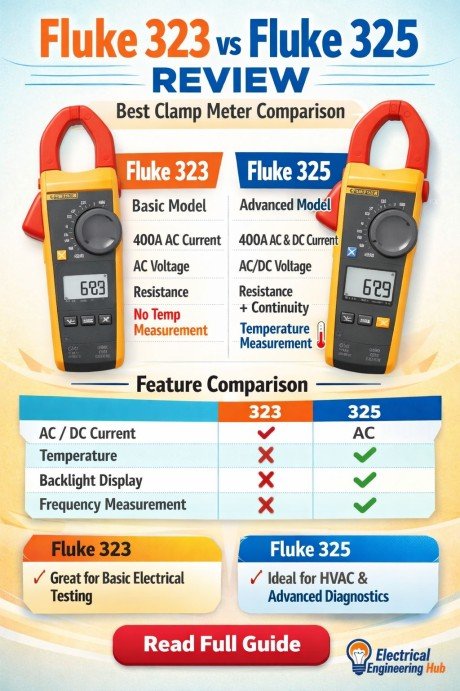
Fluke 323 vs Fluke 325 Review: Detailed Comparison
This Fluke 323 vs Fluke 325 Review becomes clearer when we compare each important function.
Accuracy and True RMS Performance
Both models offer True RMS measurement. This is important when testing non-linear loads like variable frequency drives and modern electronic circuits.
True RMS gives better accuracy than average responding meters.
In terms of AC accuracy, both perform very well. But the Fluke 325 has an edge because it can also measure DC current.
Winner: Fluke 325
Current Measurement
Clamp meters are mainly used for current testing.
The Fluke 323 can measure:
- 400A AC current only
The Fluke 325 can measure:
- 400A AC current
- 400A DC current
This makes the Fluke 325 much better for solar systems, battery banks, and DC equipment.
If you work with DC circuits often, grab the Fluke 325 from this recommended link.
Winner: Fluke 325
Looking for more options before choosing a meter? Explore our guide to the best current clamp meter for accurate electrical testing and everyday troubleshooting.
Voltage Testing
Both meters measure up to 600V AC and DC.
This makes them suitable for:
- Home electrical systems
- Commercial distribution panels
- Motor control circuits
- HVAC units
In voltage testing, both perform equally.
Winner: Tie
Resistance and Continuity
Resistance testing is useful for checking winding resistance, cable continuity, and circuit paths.
The Fluke 325 offers a wider resistance range, which is better for detailed diagnostics.
Winner: Fluke 325
Temperature Measurement
This is one of the biggest differences in this Fluke 323 vs Fluke 325 Review.
The Fluke 323 does not support temperature testing.
The Fluke 325 includes a thermocouple for temperature readings.
This is useful for:
- Checking overheating motors
- HVAC systems
- Electrical panels
- Transformer temperature
Winner: Fluke 325
Frequency Measurement
Frequency testing is important in generators, VFD systems, and industrial equipment.
The Fluke 323 does not have this feature.
The Fluke 325 does.
Winner: Fluke 325
Display and Ease of Use
The Fluke 323 has a simple LCD display.
The Fluke 325 includes a backlight, which helps in low-light working conditions.
If you work inside panels or dark electrical rooms, the backlight is very helpful.
Winner: Fluke 325
Build Quality
Fluke meters are known for durability.
Both models have:
- Strong plastic body
- Good drop protection
- Reliable clamp jaws
- Industrial safety ratings
There is no major difference in build quality.
Winner: Tie
Pros and Cons
Fluke 323 Pros
- Affordable price
- Reliable True RMS readings
- Easy to use
- Good for beginners
- Compact design
Fluke 323 Cons
- No DC current
- No temperature function
- No frequency measurement
- No backlight
Fluke 325 Pros
- Measures AC and DC current
- Includes temperature function
- Frequency testing available
- Backlit screen
- Wider resistance range
Fluke 325 Cons
- Higher price
- Slightly more complex for beginners
Need more options before choosing a clamp meter? Check our guide to the best electrical clamp meter for electricians and electrical testing.
Who Should Buy Fluke 323?
The Fluke 323 is best for:
- Residential electricians
- Basic AC troubleshooting
- Home wiring inspection
- Beginners in electrical work
If your work is focused on standard AC systems, Fluke 323 is a solid and cost-effective choice.
Who Should Buy Fluke 325?
The Fluke 325 is best for:
- Industrial electricians
- Solar technicians
- HVAC professionals
- Battery system installers
- Motor maintenance engineers
If you need advanced features and better flexibility, the Fluke 325 is worth the extra money.
See the best Fluke 325 offer here before the price changes.
Final Verdict
After completing this Fluke 323 vs Fluke 325 Review, the decision depends on your work type.
If you need a simple, affordable, and dependable clamp meter for AC-only testing, the Fluke 323 is a great option.
If you need DC current, temperature, frequency, and a backlight, the Fluke 325 is the better investment.
For most professional electricians, the Fluke 325 gives more value in the long term. For beginners and homeowners, the Fluke 323 is enough.
In short:
- Choose Fluke 323 for basic electrical work
- Choose Fluke 325 for advanced diagnostics
Frequently Asked Questions
Is Fluke 323 good for home use?
Yes, the Fluke 323 is excellent for home electrical testing, basic troubleshooting, and breaker load checking.
Can Fluke 325 measure DC amps?
Yes, the Fluke 325 can measure both AC and DC current up to 400A.
Does Fluke 323 have temperature measurement?
No, temperature testing is not available in Fluke 323.
Which clamp meter is better for solar panels?
The Fluke 325 is better because it supports DC current measurement, which is important in solar systems.
Is Fluke 325 worth the extra price?
Yes, if you need extra features like frequency, temperature, and DC current, it offers better value for professional use.
Related Guides
Get new guides in your feed. Follow Electrical Insights on LinkedIn for new electrical standards guides, calculators and design tips from Azad Circuit Hub.
#fluke323vsfluke325,#fluke323review,#fluke325review,#clampmetertest,#multimetercomparison,#electricaltools,#flukemultimeter,#electriciantools,#voltagetesting,#bestclampmeter
