
Best Clamp Meter for HVAC
Choosing the best clamp meter for HVAC troubleshooting faster, safer, and far more accurate. Whether you are working on residential air conditioners, commercial chillers, or heat pumps, a reliable meter helps you measure current, voltage, capacitance, and temperature without breaking circuits. In 2026, modern HVAC work demands compact tools with high accuracy, true RMS measurement, and strong safety ratings.
Below are two of the most trusted clamp meters used by HVAC technicians worldwide, along with a complete buying guide to help you make the right decision.
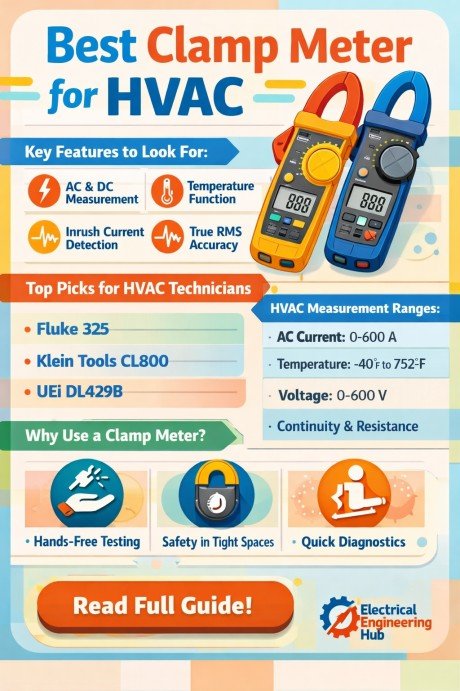
Table of Contents
Table of Contents
Why HVAC Technicians Need a Specialized Clamp Meter
HVAC systems are not simple electrical loads. They involve compressors, motors, capacitors, and variable speed drives. A standard multimeter often falls short when dealing with inrush current or fluctuating loads.
To simplify electrical troubleshooting, consider one of the options featured in our Best Multimeter Under $50 buying guide.
A proper HVAC clamp meter offers:
- True RMS measurement for accurate readings
- Inrush current detection for compressor startup
- Temperature measurement for ducts and refrigerant lines
- Non-contact current testing for safety
- High CAT safety rating for industrial environments
These features help reduce diagnostic time and improve system reliability.
Best Clamp Meters for HVAC Work
1. Fluke 325 True RMS Clamp Meter
The Fluke 325 is widely trusted by HVAC professionals due to its accuracy and durability. It is designed for both residential and light commercial systems, making it a balanced choice for everyday fieldwork.
Key Features:
- True RMS AC/DC current and voltage measurement
- Temperature measurement capability
- Slim jaw design for tight panels
- Resistance and continuity testing
- Backlit display for low-light conditions
Looking for a dependable meter for photovoltaic maintenance? Explore our review of the Best Multimeter for Solar Panels before making a purchase.
Technical Overview:
| Feature | Specification |
|---|---|
| AC Current Range | Up to 400 A |
| Voltage Range | Up to 600 V |
| Temperature Range | -10°C to 400°C |
| Safety Rating | CAT III 600V |
| Display | Digital backlit |
The Fluke 325 is known for long-term reliability and stable readings even in noisy electrical environments.
👉 Check Price on Amazon – Fluke 325 Clamp Meter
It is especially useful for technicians who want a single tool for both electrical and HVAC diagnostics without carrying multiple instruments.
2. Klein Tools CL800 Digital Clamp Meter
The Klein CL800 is another strong option built with HVAC technicians in mind. It is feature-rich and slightly more advanced in diagnostics compared to entry-level meters.
Key Features:
- Inrush current measurement for compressors
- Low impedance mode (LoZ) for ghost voltage elimination
- Dual temperature measurement with included probes
- Auto-ranging for quick testing
- High visibility display with backlight
Read our detailed Kaiweets Multimeter Review
Technical Overview:
| Feature | Specification |
|---|---|
| AC Current Range | Up to 600 A |
| Voltage Range | Up to 1000 V |
| Temperature Range | -40°C to 1000°C |
| Safety Rating | CAT IV 600V / CAT III 1000V |
| Special Function | Inrush & LoZ |
This model is particularly useful for troubleshooting HVAC systems with variable frequency drives or unstable voltage readings.
👉 Buy Now – Klein CL800 HVAC Clamp Meter on Amazon
It is a solid choice for professionals who want advanced diagnostic features without moving into premium industrial pricing.
Comparison Table for Quick Decision
| Feature | Fluke 325 | Klein CL800 |
|---|---|---|
| Accuracy | High | Very High |
| Inrush Current | No | Yes |
| Temperature Probes | Basic | Advanced Dual |
| Voltage Range | 600V | 1000V |
| Ideal For | General HVAC work | Advanced troubleshooting |
| Build Quality | Excellent | Excellent |
Both meters perform well, but the choice depends on whether you need advanced diagnostics or a simple, reliable daily-use tool.
Explore more about Best Multimeter for Electricians
How to Choose the Right HVAC Clamp Meter
Before buying, consider the following points:
- If you work mostly on residential AC units, a mid-range meter is sufficient
- For commercial HVAC systems, choose a model with inrush current detection
- Always check CAT safety ratings for your work environment
- Look for temperature probes if you handle refrigerant diagnostics
- A backlit display is essential for outdoor or basement work
A good clamp meter should reduce guesswork and improve fault detection speed.
👉 Get Your HVAC Clamp Meter Today – View Best Deals
Common Mistakes to Avoid When Buying
Many technicians choose based only on price, which often leads to poor performance in real field conditions. Avoid these mistakes:
- Ignoring true RMS capability
- Choosing low CAT-rated meters for industrial work
- Overlooking temperature measurement features
- Buying oversized clamp jaws that don’t fit control panels
Find the the Best Clamp Meter for Electricians
Investing in a reliable tool reduces long-term replacement costs and improves accuracy.
FAQs
1. What is the purpose of a clamp meter in HVAC work?
A clamp meter allows technicians to measure current without disconnecting wires, making troubleshooting faster and safer.
2. Do HVAC technicians need True RMS clamp meters?
Yes, because HVAC systems often produce non-linear loads, and True RMS ensures accurate readings.
3. Can a clamp meter measure refrigerant temperature?
Some advanced models come with temperature probes that help measure pipe and air temperatures.
4. What safety rating should I look for?
For HVAC work, CAT III or CAT IV ratings are recommended depending on the environment. Find the Best Clamp Meter Under $100
5. Is it worth buying a premium clamp meter?
Yes, especially for professionals, as premium meters provide better accuracy, durability, and diagnostic features.
Final Thoughts
Selecting the Best Clamp Meter for HVAC can significantly improve HVAC troubleshooting efficiency and safety. Both Fluke and Klein offer dependable solutions, with each serving slightly different needs depending on job complexity. Whether you prefer simplicity or advanced diagnostics, investing in a high-quality tool ensures better performance and fewer errors in the field.
Read our detailed Fluke 323 vs Fluke 325 Review
Follow Us on Social:
Subscribe our Newsletter on Electrical Insights for latest updates from Electrical Engineering Hub
#bestclampmeterforHVAC,#clampmeter,#HVACtools,#HVACtechnician,#electricaltesting,#digitalmultimeter,#amperageclamp,#HVACmaintenance,#toolsreview,#electrician
