
Best EV Charger for Tesla Model 3 & Model Y
Choosing the right home charger can make owning a Tesla Model 3 or Model Y much easier. A good Level 2 charger can provide faster overnight charging, reduce dependence on public charging stations, and make daily EV driving more convenient.
The best ev charger for tesla owners depends on several factors, including charging speed, electrical circuit capacity, connector type, installation method, cable length, and whether you want smart charging features. For Model 3 and Model Y owners, Tesla and ChargePoint offer practical options for different home setups.
Quick Comparison: Tesla NEMA vs ChargePoint
| Charger | Best For | Max Charging Current | Tesla Model 3/Y | Main Advantage |
|---|---|---|---|---|
| Tesla NEMA 14-50 | Simple Tesla home charging | Up to 32A | Yes | Straightforward plug-in setup |
| ChargePoint Home Flex | Flexible, smart charging | Up to 50A* | Yes | Adjustable charging |
| JuiceBox 40 | Smart 40A home charging | 40A | Yes | App controls and balanced charging |
For most homeowners, the best ev charger for tesla is one that matches the home’s electrical capacity rather than simply offering the highest advertised amperage.
Where to Buy Tesla NEMA 14-50
Where to Buy ChargePoint Home Flex
Where to Buy JuiceBox 40
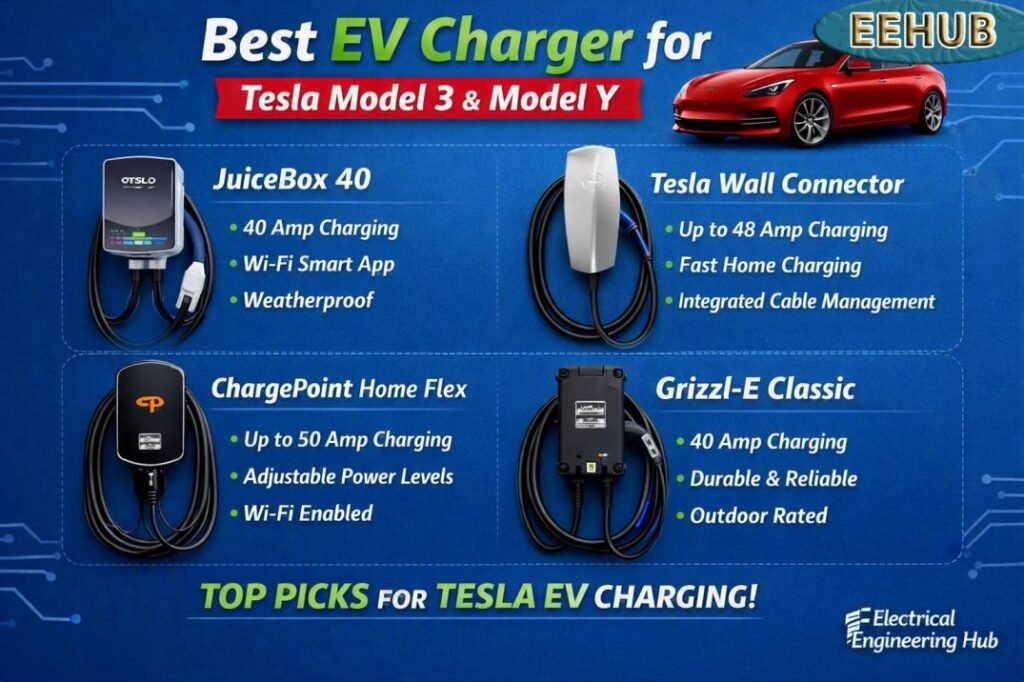
Table of Contents
Table of Contents
1. Tesla NEMA 14-50: Best for Simple Tesla Charging
The Tesla NEMA 14-50 setup is a popular choice for owners who already have, or can install, a properly rated NEMA 14-50 outlet. It is particularly useful for drivers who want a straightforward charging solution without installing a dedicated hardwired EV charger.
A NEMA 14-50 receptacle uses a 240-volt circuit and can support Level 2 charging. Tesla vehicles can automatically manage the charging current based on the connected equipment and vehicle settings.
If you are comparing several home EV charging solutions, check our guide to best level 2 chargers for home for more options and installation tips.
Why consider Tesla NEMA 14-50?
- Convenient 240V home charging
- Familiar option for Tesla owners
- Suitable for overnight charging
- Useful for homes with an existing compatible outlet
- Simple connection compared with a hardwired charger
- Can be a practical solution for Model 3 and Model Y owners
However, the outlet itself is not the charger. The EV charging equipment and properly installed circuit are both important. A qualified electrician should verify the receptacle, wiring, breaker, grounding, and continuous-load requirements before installation.
Best for
The Tesla NEMA option makes the most sense for homeowners who want reliable Level 2 charging and prefer a plug-in arrangement.
2. ChargePoint Home Flex: Best Flexible Option
ChargePoint Home Flex is one of the most versatile home EV chargers for Tesla owners. It can be installed as a plug-in or hardwired unit depending on the model and installation configuration.
Its adjustable charging current is a major advantage. This allows the charger to work with different electrical service capacities instead of forcing every homeowner into the same circuit size.
For example, a homeowner with a suitable 50-amp circuit may configure the charger differently from someone using a lower-rated circuit. The electrician should determine the correct configuration based on the electrical installation.
ChargePoint also provides smart charging functionality through its app. Depending on the setup and vehicle compatibility, owners can monitor charging, schedule sessions, and review charging information.
ChargePoint Home Flex advantages
| Feature | ChargePoint Home Flex |
|---|---|
| Charger type | Level 2 |
| Adjustable charging | Yes |
| App connectivity | Yes |
| Tesla compatibility | Yes, with appropriate connector/adapter |
| Installation | Plug-in or hardwired configuration |
| Best use | Flexible home charging |
| Suitable vehicles | Tesla and other EVs |
For households that may own another EV in the future, ChargePoint can be especially attractive because it is not limited to Tesla vehicles.
3. JuiceBox 40: Best Smart 40A Charger for Tesla
The JuiceBox 40 is a solid option for Tesla Model 3 and Model Y owners who want a smart Level 2 home charger with a 40-amp charging capability. It offers a good balance between charging speed, smart features, and everyday convenience without requiring the maximum electrical capacity of some higher-powered chargers.
With a suitable 240V circuit and professional installation, JuiceBox 40 can provide significantly faster charging than a standard 120V household outlet. This makes it practical for drivers who return home each evening and want to add a useful amount of range overnight.
Why choose JuiceBox 40?
- Up to 40A charging capability
- Level 2, 240V home charging
- Smart charging features
- Mobile app control on supported versions
- Charging schedules and monitoring
- Suitable for Tesla Model 3 and Model Y with the appropriate connection
- Good choice for daily home charging
- Available in plug-in and/or hardwired configurations depending on the specific model
One of the biggest advantages of JuiceBox 40 is its smart charging capability. Instead of simply plugging in and charging, owners can use compatible app features to monitor charging activity and manage charging schedules. This can be useful for households that want to charge during lower electricity-rate periods.
For Tesla owners, compatibility should be checked carefully before purchasing because connector and adapter requirements can vary by JuiceBox model and Tesla configuration. Always verify the exact product listing and included cable before ordering.
JuiceBox 40 vs ChargePoint Home Flex
| Feature | JuiceBox 40 | ChargePoint Home Flex |
|---|---|---|
| Charger type | Level 2 | Level 2 |
| Maximum current | 40A | Up to 50A* |
| Smart features | Yes | Yes |
| App controls | Yes, supported models | Yes |
| Tesla compatibility | Yes, with appropriate connection | Yes, with appropriate connection |
| Best for | 40A smart charging | Adjustable high-power charging |
| Installation | Depends on model | Plug-in/hardwired depending on configuration |
*Maximum output depends on the installation and electrical circuit.
JuiceBox 40 can be particularly attractive if your home’s electrical system is better suited to a 40-amp charging load or if you prefer a charger that combines smart controls with a moderate charging capacity.
For Tesla owners comparing several home charging solutions, it is worth looking at the charger’s electrical requirements rather than choosing based only on maximum amperage. Your daily driving distance, available parking time, panel capacity, and local electricity rates can all affect which charger makes the most sense.
If you are comparing JuiceBox with other Level 2 options, our guide to best level 2 chargers for home covers additional chargers, features, and installation considerations.
Tesla Model 3 vs Model Y Home Charging Needs
Both the Tesla Model 3 and Model Y are well suited to Level 2 home charging. The exact charging rate depends on the vehicle configuration, charger, circuit, and available electrical capacity.
| Factor | Model 3 | Model Y |
|---|---|---|
| Level 2 home charging | Yes | Yes |
| 240V charging | Yes | Yes |
| Overnight charging | Excellent | Excellent |
| Dedicated circuit recommended | Yes | Yes |
| Smart charger useful | Yes | Yes |
| NEMA 14-50 option | Yes | Yes |
| ChargePoint compatibility | Yes | Yes |
A home charger does not need to operate at its maximum possible amperage to be useful. Many Tesla owners charge overnight, so even a moderate Level 2 charging rate can restore a substantial amount of driving range while the car is parked.
What Size Breaker Does a Tesla Home Charger Need?
The required breaker depends on the charger’s maximum current and whether the unit is hardwired or connected through a receptacle. EV charging is generally treated as a continuous load, so the circuit must be sized appropriately under the applicable electrical code.
For example, a 32-amp charging load typically requires a larger circuit rating than the charging current itself. The exact breaker and conductor size must be selected according to the charger manufacturer’s instructions, installation method, conductor type, ambient conditions, and local electrical requirements.
Do not select a breaker based only on the vehicle’s maximum charging capability.
A licensed electrician can verify whether your existing electrical panel can support the charger without an unsafe overload.
Plug-In vs Hardwired EV Charger
The installation method is another important consideration when choosing the best ev charger for tesla.
Plug-in charging
A plug-in charger can be convenient because it can potentially be removed or relocated. The NEMA 14-50 approach is a good example of this type of installation.
However, the receptacle must be properly rated for EV charging. A standard household outlet should not be substituted for a suitable 240V EV charging circuit.
Hardwired charging
Hardwired chargers are permanently connected to the electrical circuit. This can provide a clean installation and is often preferred for higher-amperage home charging.
ChargePoint Home Flex and dedicated Tesla charging equipment can be used in hardwired configurations depending on the specific product and installation requirements.
If you want to compare more Level 2 options before buying, our best level 2 chargers for home guide covers additional choices for different budgets and electrical setups.
How to Choose the Best EV Charger for Your Tesla
Before buying, consider these factors:
1. Electrical panel capacity
Check how much spare capacity your service panel has. A high-powered EV charger may require a dedicated circuit and, in some homes, an electrical service upgrade.
2. Charging speed
Do not automatically choose the charger with the highest amperage. Your daily mileage and parking time are more important. If the vehicle sits at home for eight to twelve hours overnight, moderate Level 2 charging may be more than enough.
3. Cable length
A longer charging cable can make parking easier, especially when the electrical outlet or hardwired charger is not positioned directly beside the vehicle’s charging port.
4. Smart charging
Wi-Fi connectivity, charging schedules, energy monitoring, and mobile-app controls can be useful if you want to manage charging around electricity rates or your daily driving routine.
5. Future EV compatibility
If you may buy a non-Tesla EV later, a versatile charger such as ChargePoint Home Flex can offer more flexibility.
Which Charger Should Tesla Owners Buy?
The Tesla NEMA 14-50 option is a sensible choice for owners who want simple Level 2 charging and have a suitable 240V outlet installed by a qualified professional.
ChargePoint Home Flex is the better choice for buyers who want adjustable charging, app-based controls, and compatibility with a wider range of EVs.
For a Tesla-only household that wants a dedicated installation, Tesla’s hardwired charging equipment can also be worth considering.
Overall, the best ev charger for tesla is the one that fits your vehicle, electrical panel, driving habits, and installation budget. Faster charging is useful, but compatibility and safe installation should come first.
Compare Tesla NEMA and ChargePoint charging options on Amazon
Frequently Asked Questions
1. Can I use ChargePoint with a Tesla Model 3 or Model Y?
Yes. ChargePoint Level 2 chargers can be used with Tesla vehicles when the correct connector or adapter is used for the particular charger and vehicle configuration.
2. Is a NEMA 14-50 outlet good for Tesla charging?
Yes. A properly installed 240V NEMA 14-50 outlet can provide Level 2 charging for compatible Tesla charging equipment. The receptacle, wiring, breaker, and circuit must be correctly rated for the EV charging load.
3. Is Level 2 charging better than a regular outlet?
For most Tesla owners, yes. Level 2 charging uses 240V and can deliver substantially more power than a typical 120V household outlet, making it much more practical for regular overnight charging.
4. Does a Tesla need a dedicated circuit for home charging?
A dedicated circuit is normally required for EV charging equipment. The exact circuit rating depends on the charger and its configured charging current. Installation should follow the manufacturer’s instructions and applicable electrical codes.
5. What is the best home charger for a Tesla Model Y?
The right choice depends on your electrical service and charging requirements. Tesla’s NEMA 14-50 approach works well for simple plug-in charging, while ChargePoint Home Flex is a strong choice for adjustable current and smart charging features.
Final Verdict
For simple Tesla home charging, the Tesla NEMA 14-50 option is a practical choice when a suitable 240V outlet is available. For homeowners who want more flexibility and smart controls, ChargePoint Home Flex is a stronger all-around option.
Before purchasing, confirm the charger’s connector, maximum current, cable length, circuit requirements, and installation method. A qualified electrician should inspect the electrical panel and install the EV charging circuit correctly.
If you are still comparing products, visit our best level 2 chargers for home guide to see additional home charging options and find a charger that fits your Tesla, budget, and electrical setup.
Related Guides
- EVIQO Level 2 EV Charger Review
- Grizzl E Level 2 EV Charger Review
- Emporia EV Charger Review
- Grizzl-E vs ChargePoint
- Hardwired vs Plug In EV Charger
- How to Install a Level 2 EV Charger
Get new guides in your feed. Follow Electrical Insights on LinkedIn for new electrical standards guides, calculators and design tips from Azad Circuit Hub.
