Best 48 Amp EV Charger for Fast Home Charging
Choosing the right home EV charger is about more than finding the highest amperage. A 48-amp charger can deliver up to 11.5 kW on a 240V circuit, making it a strong option for drivers who want faster overnight charging without moving to a commercial DC fast charger.
As an electrical engineer with 15 years of experience working with electrical systems, automation, and renewable-energy installations, I pay close attention to circuit capacity, continuous-load requirements, safety certifications, installation method, cable management, and real-world charging convenience.
For this guide, I compared the IYILO 48A Level 2 EV Charger, Emporia 48A WiFi EV Charger, and EVIQO 48A NACS Level 2 charger. These models target different users, so the right choice depends on your vehicle, electrical panel, connectivity requirements, and whether you prefer a plug-in or hardwired installation.
Best 48 Amp EV Charger: Quick Comparison
| EV Charger | Output | Connection | Smart Features | Best For |
|---|---|---|---|---|
| IYILO Level 2 EV Charger | 48A / 11.5 kW | Tesla/NACS | Model-dependent | Tesla owners seeking high-power home charging |
| Emporia Level 2 EV Charger | 48A / 11.5 kW | J1772 | WiFi enabled | Smart charging and energy monitoring |
| EVIQO Level 2 EV Charger | 48A / 11.5 kW | NACS | Smart features | NACS-equipped EVs and hardwired installations |
At a glance, the IYILO is attractive for Tesla drivers, Emporia stands out for connected charging and energy management, while EVIQO is worth considering when a hardwired NACS setup is preferred.
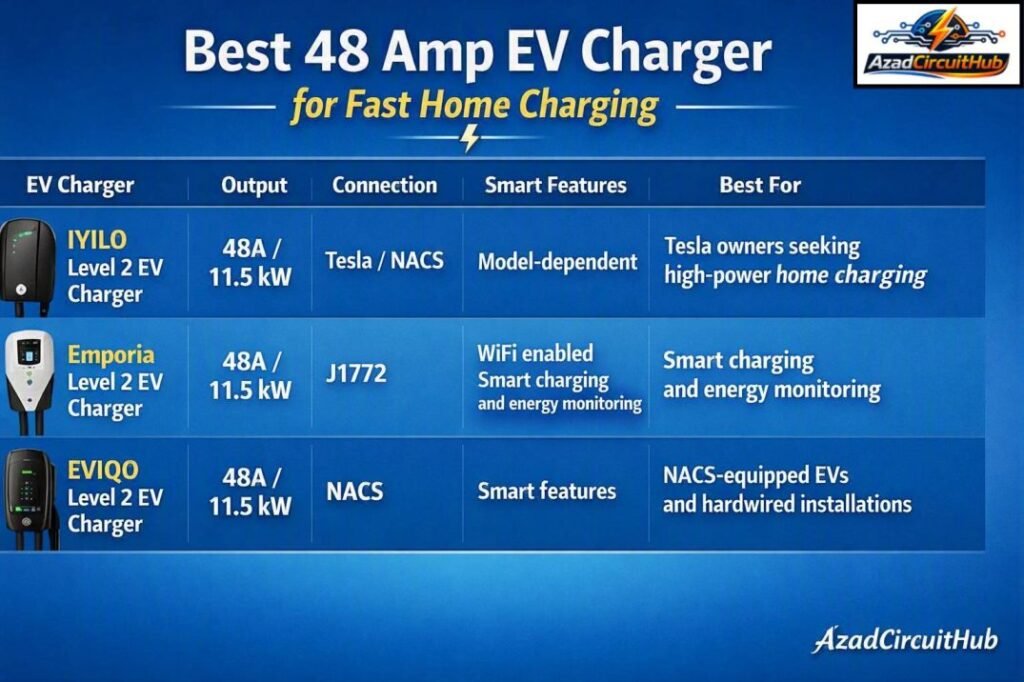
Table of Contents
Table of Contents
Best 48 Amp EV Charger for Fast Home Charging
1. IYILO Level 2 EV Charger for Tesla
The IYILO 48-amp Level 2 EV Charger is designed for drivers who want high charging power at home. Its advertised 48A output and 11.5 kW charging capacity make it suitable for a properly sized 240V installation.
One of its notable advantages is its certification positioning, with UL 2594, ETL, and ENERGY STAR listed for the model. These certifications and listings are important considerations when evaluating an EV charging station because a home charger becomes part of a high-current electrical installation.
The Tesla-oriented connector also makes this model particularly interesting for compatible Tesla and NACS vehicles.
Key IYILO features
- Up to 48A charging output
- Approximately 11.5 kW at 240V
- Tesla/NACS-oriented connection
- UL 2594/ETL/ENERGY STAR listed according to the product information
- Designed for Level 2 home charging
- High-power charging for overnight use
Want to compare the current price and availability? Check the IYILO 48A EV Charger on Amazon
For homeowners with a suitable electrical service and a compatible vehicle, this can be a practical way to get high-speed AC charging without installing a DC fast charger.
2. Emporia Level 2 EV Charger 48 Amp
Emporia has built a strong reputation around smart energy management, and its 48A EV charger takes that approach into home EV charging.
The Emporia Level 2 EV Charger uses a J1772 connector and supports 48A charging at 240V. Its WiFi connectivity is one of its biggest selling points. Connected charging can be useful for homeowners who want to monitor charging activity and integrate EV charging into a broader home energy strategy.
This becomes particularly useful if you have solar panels, time-of-use electricity rates, or other energy monitoring equipment.
Why consider Emporia?
| Feature | Emporia 48A |
|---|---|
| Maximum current | 48A |
| Voltage | 240V |
| Maximum power | About 11.5 kW |
| Connector | J1772 |
| WiFi | Yes |
| Best use | Smart home charging |
| Solar-energy users | Particularly useful |
A J1772 connector also makes this charger suitable for many non-Tesla EVs and plug-in vehicles. Vehicles using a different inlet may require the appropriate adapter.
3. EVIQO Level 2 EV Charger NACS 48A
EVIQO is another compelling option for homeowners who want a powerful NACS home charging station. The 48A model is designed around a 240V hardwired installation and can provide up to approximately 11.5 kW under suitable electrical conditions.
The hardwired configuration is important. Instead of connecting through a conventional receptacle, the charger is permanently connected to the electrical circuit. This can provide a clean installation and is often preferred for higher-amperage EV charging.
EVIQO highlights
- 48A maximum charging current
- 240V operation
- Up to approximately 11.5 kW
- NACS connector
- Hardwired installation
- Designed for residential Level 2 charging
If you are ready to upgrade your home charging setup, check the EVIQO 48A EV Charger on Amazon for current pricing and availability.
Because this is a high-current continuous load, the electrical installation should be evaluated before purchasing. A qualified electrician can confirm whether the existing service, panel, breaker, wiring, and installation location are suitable.
How Fast Does a 48A EV Charger Charge?
Charging speed depends on the vehicle's onboard AC charger as well as the EV charging station. Installing a 48A unit does not automatically mean every EV will accept 48A.
At 240V, the basic power calculation is:
240V × 48A = 11,520 watts
That equals approximately 11.5 kW.
| Charger Current | Voltage | Approx. Maximum Power |
|---|---|---|
| 32A | 240V | 7.68 kW |
| 40A | 240V | 9.6 kW |
| 48A | 240V | 11.52 kW |
| 50A | 240V | 12.0 kW |
| 60A | 240V | 14.4 kW |
Actual charging time varies with battery size, state of charge, vehicle charging limits, temperature, and charging efficiency.
For example, an EV with a 75 kWh battery theoretically needs around 6.5 hours to receive 75 kWh at 11.5 kW. Real-world charging takes longer because charging power is not perfectly constant throughout the entire cycle.
What Breaker Do You Need for a 48A EV Charger?
This is one of the most important installation questions.
EV charging is generally treated as a continuous load under NEC requirements. For a 48A continuous load, the circuit capacity is commonly calculated using 125% of the continuous current:
48A × 125% = 60A
Therefore, a 48A EV charger typically requires a 60A branch circuit, subject to the manufacturer's installation instructions and applicable electrical codes.
| EV Charger Setting | Typical Circuit Calculation | Common Circuit Rating |
|---|---|---|
| 32A | 32 × 125% = 40A | 40A |
| 40A | 40 × 125% = 50A | 50A |
| 48A | 48 × 125% = 60A | 60A |
The conductor size cannot be selected from amperage alone. Wire material, insulation temperature rating, terminal ratings, installation method, ambient temperature, conduit fill, distance, and local code requirements can all affect conductor sizing. Read complete guide on what size breaker for 48 amp ev charger here.
Never increase the breaker size simply to prevent nuisance trips. The entire circuit must be designed for the load.
Plug-In vs Hardwired 48A EV Charging
A plug-in charger can provide installation flexibility, but the receptacle and circuit must be appropriately rated for the continuous EV load. Hardwired chargers eliminate the receptacle connection and can provide a neat permanent installation.
| Installation | Advantages | Considerations |
|---|---|---|
| Plug-in | Easier to disconnect or relocate | Receptacle and plug must be correctly rated |
| Hardwired | Clean permanent installation | Requires electrical installation work |
| Indoor | Better weather protection | Garage ventilation and cable routing matter |
| Outdoor | Convenient driveway charging | Weather-rated equipment and installation required |
For a permanently installed high-amperage home charger, hardwiring can be an excellent option when supported by the manufacturer's instructions.
For drivers who prioritize charging speed above all else, our guide to the fastest level 2 charger can help you compare higher-output home charging solutions.
How to Choose the Best 48 Amp EV Charger
Before buying, check these five factors.
Vehicle compatibility
Confirm whether your EV uses NACS, J1772, or another charging connection. Connector compatibility should be checked before comparing features.
Electrical service capacity
A 48A charger can place a substantial load on a residential electrical system. Your electrician should check the service rating, main panel capacity, existing loads, and available breaker space.
Smart charging
WiFi connectivity can be useful when you want charging schedules, energy monitoring, notifications, or integration with a smart-home energy system.
Certification and safety
Look for appropriate safety certification or listing information and verify that the exact model you purchase has the claimed certification.
Installation requirements
Read the manufacturer's installation manual before purchasing. Some 48A chargers can be configured for lower current, while others have specific hardwired installation requirements.
Best 48 Amp EV Charger for Different Buyers
| Buyer Type | Recommended Option | Reason |
|---|---|---|
| Tesla/NACS owner | IYILO | High-power NACS-oriented charging |
| Smart-energy homeowner | Emporia | WiFi connectivity and energy-management focus |
| Hardwired NACS installation | EVIQO | Designed around permanent 240V installation |
| Solar-energy homeowner | Emporia | Useful connected energy features |
| Maximum overnight AC charging | Any suitable 48A model | Up to about 11.5 kW when vehicle and circuit support it |
If you are still comparing home charging options, see our best level 2 ev charger guide for a broader comparison of Level 2 charging stations.
Is 48 Amp Charging Worth It?
For many EV owners, yes. A 48A charger offers a useful balance between charging speed and residential electrical requirements.
The biggest benefit is the ability to add a significant amount of driving range during overnight charging. If your daily driving needs are modest, a lower-current charger may already be sufficient. But drivers with larger battery packs, longer commutes, or limited charging windows can benefit from the higher output.
There is also a practical future-proofing advantage. If you plan to keep the charger for several years or purchase another EV later, installing a properly designed higher-capacity circuit can provide more flexibility.
Final Verdict
The best choice depends on your vehicle and installation requirements rather than amperage alone. The IYILO is a strong option for compatible Tesla and NACS owners, while Emporia is especially appealing to homeowners who value WiFi connectivity and energy monitoring. EVIQO is worth considering for drivers looking for a hardwired NACS charging station.
Before installation, verify your vehicle's maximum AC charging rate and have the electrical circuit assessed by a qualified electrician. A properly sized 240V circuit, suitable overcurrent protection, correct conductor sizing, and an appropriately installed EVSE are just as important as the charger itself.
For shoppers who want to compare pricing before making a decision, check the latest 48A EV charger deals on Amazon and compare the current specifications, warranty, connector type, and installation requirements.
FAQs
1. How many kW is a 48 amp EV charger?
At 240V, a 48A EV charger can deliver approximately 11.52 kW. Actual charging power depends on the EV's onboard charger and other operating conditions.
2. What size breaker is needed for a 48 amp EV charger?
A 48A continuous EV load is commonly calculated at 125%, giving 60A. Therefore, a 60A circuit is typically required, subject to the manufacturer's instructions and applicable electrical code.
3. Is a 48A EV charger faster than a 40A charger?
Yes, when the vehicle can accept the additional current. A 48A charger can provide about 11.5 kW at 240V compared with approximately 9.6 kW from a 40A charger.
4. Can I install a 48A EV charger myself?
High-current EV charging circuits should be installed according to the manufacturer's instructions and applicable electrical codes. In many locations, professional electrical installation is the safest approach, especially for a new 240V circuit or hardwired charger.
5. Is an 11.5 kW EV charger good for home use?
Yes. An 11.5 kW Level 2 charger is a powerful residential charging option and can substantially reduce charging time compared with a standard 120V outlet or lower-power Level 2 charger.
Get new guides in your feed. Follow Electrical Insights on LinkedIn for new electrical standards guides, calculators and design tips from Azad Circuit Hub.
#Best48AmpEVCharger, #EVCharger, #Level2EVCharger, #HomeEVCharger, #48AmpEVCharger, #EVCharging, #ElectricVehicle, #EVChargingStation, #FastEVCharging, #EVChargerForHome