Best Commercial Level 2 EV Charger: Autel MaxiCharger AC Pro 80A Review
If you are installing EV charging at an office, apartment complex, dealership, fleet facility, workplace, or other commercial property, choosing the right charger matters more than simply looking at charging speed. A commercial charger needs dependable daily operation, strong electrical performance, smart charging controls, and features that make it practical for multiple drivers.
The Autel MaxiCharger AC Pro (80A) is a strong option for businesses that want high-power AC charging without moving to expensive DC fast-charging equipment. With up to 80 amps of output and 19.2 kW of charging power, it can deliver significantly faster charging than typical 32A or 40A Level 2 EV chargers.
This guide looks at the Autel MaxiCharger AC Pro 80A as a potential best commercial level 2 ev charger and explains its features, installation requirements, advantages, limitations, and ideal use cases.
Best Commercial Level 2 EV Charger: Autel MaxiCharger AC Pro
| Feature | Autel MaxiCharger AC Pro (80A) |
|---|---|
| Charger type | Level 2 AC EV charger |
| Maximum output | Up to 80A |
| Maximum charging power | Up to 19.2 kW |
| Connector | SAE J1772 |
| Input | 240V AC |
| Connectivity | Wi-Fi and Bluetooth |
| Charging management | Smart charging features |
| Display | LCD touchscreen |
| Vehicle compatibility | Most J1772-compatible EVs and PHEVs |
| Best suited for | Commercial sites, workplaces, fleets, apartments |
| Installation | Dedicated high-amperage circuit |
| Smart features | App-based monitoring and control |
| Cable | Integrated charging cable |
| Typical use | Workplace and destination charging |
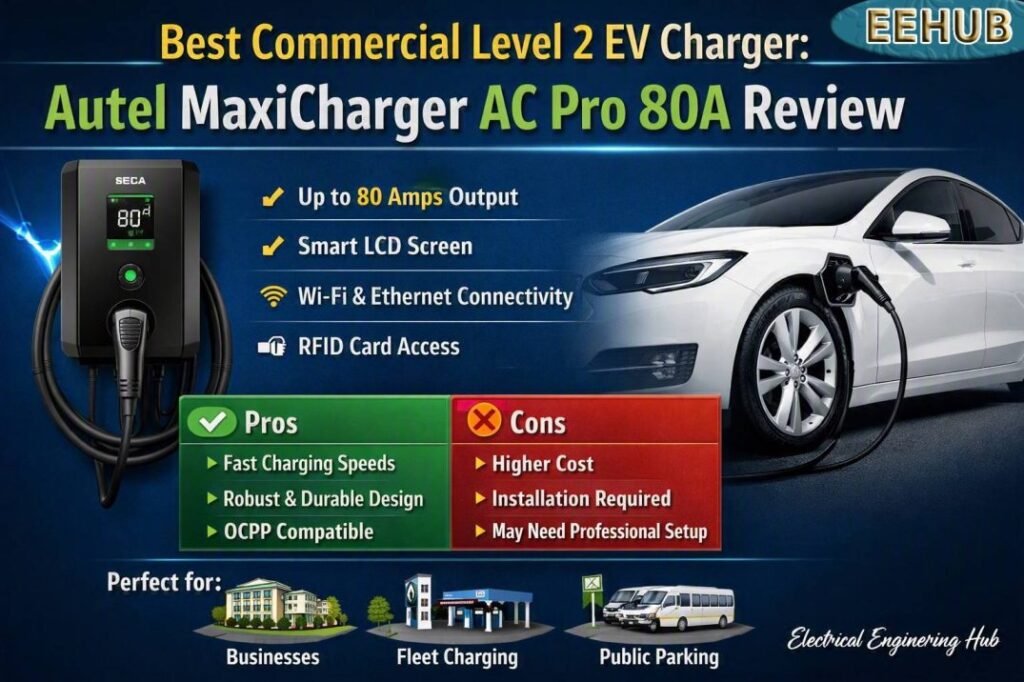
Table of Contents
Table of Contents
Why the Autel MaxiCharger AC Pro Is a Strong Commercial Choice
The biggest advantage of the Autel MaxiCharger AC Pro is its 80A output. At 240V, an 80A EV charging circuit can provide up to 19.2 kW of charging power when the vehicle supports the full rate.
That is considerably faster than many residential Level 2 chargers limited to 7.2, 9.6, or 11.5 kW.
For a business, faster charging can improve charger utilization. A vehicle that needs several hours on a lower-powered charger may require less time when connected to a 19.2 kW-capable system.
The Autel unit also brings smart charging functionality, connectivity, and a user-friendly interface. These features are useful when a charger is installed somewhere other than a private home garage.
For businesses comparing the best commercial level 2 ev charger options, the combination of high output and connected features makes this model worth considering.
Charging Speed and 80A Performance
Charging speed depends on both the EV and the charger. Installing an 80A EVSE does not mean every vehicle will charge at 19.2 kW.
The vehicle's onboard AC charger determines the maximum AC charging rate it can accept.
For example, an EV limited to 11.5 kW will continue charging at approximately that rate even when connected to a higher-powered 19.2 kW charger.
| EV onboard charger | Approx. maximum AC power | Approx. 50 kWh charging time* |
|---|---|---|
| 7.2 kW | 7.2 kW | 6.9 hours |
| 9.6 kW | 9.6 kW | 5.2 hours |
| 11.5 kW | 11.5 kW | 4.3 hours |
| 19.2 kW | 19.2 kW | 2.6 hours |
*Approximate charging time based on 50 kWh of usable energy and does not account for charging losses or the vehicle's charging curve.
This high-power capability makes the Autel particularly attractive for commercial locations where vehicles need to return to service quickly.
Electrical Requirements for Commercial Installation
An 80A Level 2 EV charger requires careful electrical planning. A continuous EV charging load is generally sized at 125% under NEC requirements.
For an 80A continuous load:
80A × 125% = 100A
This means an installation may require a 100A dedicated branch circuit, subject to the applicable electrical code, equipment instructions, conductor sizing, and local requirements.
A commercial electrician should verify the panel capacity, feeder rating, conductor ampacity, overcurrent protection, voltage drop, disconnect requirements, grounding, and available service capacity before installation.
If the existing electrical service cannot support the charger, a service upgrade or load-management strategy may be necessary.
Never select a breaker or wire size based only on the charger's nameplate without checking the complete installation requirements.
If your project has a smaller electrical budget, our best affordable level 2 ev charger comparison can help you evaluate practical alternatives without paying for features you may not need.
Smart Features for Businesses
Commercial charging becomes more useful when the operator can monitor and manage charging remotely.
The Autel MaxiCharger AC Pro includes connected functionality that can help users interact with the charger through its smart platform. Depending on the configuration and software features available, users can monitor charging activity, manage charging sessions, and access charger information.
For workplaces and commercial properties, these capabilities can be more valuable than simply having a high charging rate.
Smart EV charging can also help businesses understand usage patterns. For example, an operator may discover that charging demand peaks during employee arrival times and drops later in the day.
That information can support better charging policies and energy-management decisions.
Commercial Applications
The Autel MaxiCharger AC Pro can fit several commercial charging environments.
Workplaces
Employees can use Level 2 charging during a normal workday. The higher power output is particularly useful when employees have limited time to charge.
Apartment and Multifamily Properties
Property managers can offer EV charging as an amenity. Depending on the site design, additional chargers can be installed as EV adoption increases.
Fleet Operations
Small commercial fleets can benefit from faster AC charging when vehicles return to a facility for several hours between shifts.
Dealerships
Automotive dealerships can use Level 2 charging for customer vehicles, demonstration cars, service vehicles, and employee parking.
Hotels and Destination Properties
Hotels, offices, and other destination businesses can provide charging while customers or employees are on-site.
If you are comparing the best commercial level 2 ev charger for a workplace or destination location, consider expected daily sessions, parking duration, available electrical capacity, and future expansion rather than focusing only on maximum amperage.
Pros and Cons
| Pros | Cons |
|---|---|
| Up to 80A output | Requires substantial electrical capacity |
| Up to 19.2 kW charging power | Not every EV can use the full output |
| Wi-Fi and Bluetooth connectivity | Higher installation cost than basic chargers |
| Touchscreen interface | 80A operation requires careful circuit planning |
| Suitable for commercial applications | J1772 connector may require an adapter for some newer vehicles |
| Smart charging capabilities | Professional installation is recommended |
| Strong option for high-use locations | May be excessive for low-use residential applications |
What to Consider Before Buying
Before choosing a commercial EVSE, evaluate the following factors.
Electrical Capacity
Start with the electrical service. A high-power charger is only useful if the property can safely support it.
Vehicle Compatibility
Check the connector and maximum AC charging rate of the vehicles using the station. The charger should match the needs of the fleet or customer vehicles.
Daily Utilization
A workplace with five vehicles charging occasionally has different requirements from a fleet facility with dozens of daily charging sessions.
Installation Cost
The equipment is only part of the project. Conduit, conductors, breakers, disconnects, trenching, permits, labor, and panel upgrades can significantly affect the total cost.
Networking Requirements
If you need remote monitoring, user management, or charging data, confirm that the charger and software platform provide the required functions.
Future Expansion
If EV adoption is expected to grow, consider installing infrastructure that can support additional charging stations later.
For a broader comparison before making a purchase, see our best affordable level 2 ev charger guide to compare lower-cost options for different charging needs.
Is 80A Better Than a 48A or 40A Charger?
Not necessarily.
An 80A charger is advantageous when the vehicle can accept high AC power and the site has sufficient electrical capacity. However, a 40A or 48A charger can be a better choice when installation costs and electrical demand are priorities.
| Charger output | Approx. power at 240V | Typical application |
|---|---|---|
| 32A | 7.7 kW | Light residential use |
| 40A | 9.6 kW | Residential and workplace |
| 48A | 11.5 kW | Home and commercial |
| 64A | 15.4 kW | High-demand locations |
| 80A | 19.2 kW | High-power commercial charging |
The best commercial level 2 ev charger is therefore not automatically the one with the highest amperage. The right choice depends on the vehicles, site capacity, parking duration, and operating requirements.
Autel MaxiCharger AC Pro 80A: Who Should Buy It?
This charger makes the most sense for businesses that need high-power AC charging and have the electrical infrastructure to support it.
It is especially worth considering for:
- Commercial parking facilities
- Workplaces with EV-driving employees
- Apartment and multifamily properties
- Small and medium-sized EV fleets
- Automotive dealerships
- Hotels and destination businesses
- High-use private charging facilities
It may be unnecessary for a small property where only one vehicle charges overnight. In that situation, a lower-amperage charger can provide adequate charging while reducing installation requirements.
Check the Current Amazon Price
If you want a high-output connected charger for a commercial or workplace installation, check the Autel MaxiCharger AC Pro 80A on Amazon for current pricing, availability, and customer reviews before purchasing.
Amazon pricing and availability can change, so review the current product listing and verify the exact model and included equipment.
How to Choose the Best Commercial Level 2 EV Charger
When comparing commercial EV charging stations, use a simple checklist:
- Confirm the available electrical service.
- Determine the maximum charging rate supported by your EVs.
- Calculate expected daily charging demand.
- Decide whether networking and remote management are required.
- Compare installation costs, not just equipment prices.
- Check connector compatibility.
- Consider future charger expansion.
- Review warranty and manufacturer support.
- Have the installation evaluated by a qualified electrician.
Final Verdict
The Autel MaxiCharger AC Pro 80A is a compelling choice for businesses that need fast AC charging, connected functionality, and a professional charging experience. Its 80A capability can deliver up to 19.2 kW when the vehicle and installation support the full output.
However, high power comes with higher electrical requirements. Businesses should verify service capacity and installation costs before selecting an 80A EVSE.
For commercial properties where charging speed, smart functionality, and high utilization matter, the Autel is a strong contender for the best commercial level 2 ev charger category.
If you are still comparing equipment for a budget-conscious project, explore our best affordable level 2 ev charger guide for additional options and buying considerations.
Frequently Asked Questions
1. What is the best commercial Level 2 EV charger?
The best commercial level 2 ev charger depends on charging demand, vehicle compatibility, electrical capacity, and management requirements. The Autel MaxiCharger AC Pro 80A is a strong option for sites that can support its high-power 19.2 kW capability.
2. How fast is an 80A Level 2 EV charger?
An 80A charger operating at 240V can provide up to 19.2 kW. Actual charging speed depends on the EV's onboard AC charger, battery state, temperature, and other vehicle limitations.
3. What breaker is needed for an 80A EV charger?
An 80A continuous EV charging load is commonly calculated at 125%, resulting in a 100A circuit requirement under NEC load calculations. The final breaker, conductor, and installation method must be confirmed by a qualified electrician and the manufacturer's instructions.
4. Can the Autel MaxiCharger AC Pro charge every EV?
The J1772 version is compatible with vehicles using the SAE J1772 AC charging standard. Some vehicles with different inlet standards may require an appropriate manufacturer-approved adapter.
5. Is an 80A EV charger worth it for a business?
It can be worthwhile when vehicles need rapid AC charging and the property has adequate electrical capacity. For low-use sites, a 40A or 48A charger may offer better value with lower electrical infrastructure requirements.
Related Guides
- EVIQO Level 2 EV Charger Review
- Grizzl E Level 2 EV Charger Review
- Hardwired vs Plug In EV Charger
- Level 1 vs Level 2 EV Charger
- Best EV Charger Under $300
- Best Ford Level 2 EV Charger
Get new guides in your feed. Follow Electrical Insights on LinkedIn for new electrical standards guides, calculators and design tips from Azad Circuit Hub.
#AutelMaxiCharger, #Level2EVCharger, #CommercialEVCharger, #EVChargingStation, #80AmpEVCharger, #AutelCharger, #EVChargerReview, #ElectricVehicleCharging, #CommercialEVCharging, #EVChargingSolutions