Canadian Electrical Code vs NEC Differences for Homeowners
If you are searching for Canadian Electrical Code vs NEC differences for homeowners, the short version is this: Canada does not use the NEC. Canadian houses are wired to the Canadian Electrical Code (CSA C22.1), while US houses follow the National Electrical Code (NFPA 70). The two look similar, but they are separate documents with different rules, different product approvals and different legal authority. This guide, written by an electrical engineer, explains what changes for a homeowner, which edition applies, and when you can legally do the work yourself.
This post is a spoke of our Home Wiring as per CEC / CSA C22.1 guide, which covers Canadian residential wiring in depth. For the American side, see our Home Electrical Wiring & NEC Code Guide (USA).
Safety note: this is general information, not a substitute for the code book or your provincial authority. Turn the power off at the breaker and verify it is dead before touching any wiring.
Table of Contents
Table of Contents
Does Canada Use the NEC Code?
No. Canada does not use the NEC as its residential wiring code. Every province and territory adopts the Canadian Electrical Code, Part I (CSA C22.1), sometimes with its own amendments, and enforces it through a provincial electrical safety authority. The NEC has no legal force for a house in Toronto, Calgary or Vancouver.
That does not mean the NEC is irrelevant. Both countries use 120/240 V split-phase service at 60 Hz, the same AWG conductor sizes and similar breaker panels, so much of the NEC reads familiar to a Canadian electrician. Understanding the Canadian Electrical Code vs NEC differences for homeowners matters because those similarities hide real rule differences, especially when you buy equipment or follow a US video tutorial.
Is There a Canadian Electrical Code?
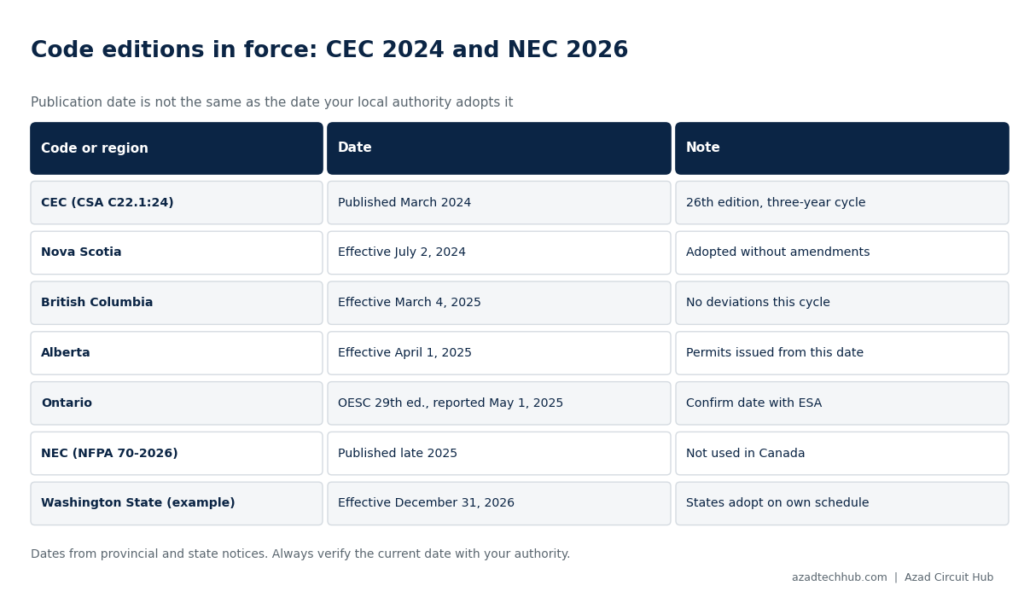
Yes, and it is the starting point for every one of the Canadian Electrical Code vs NEC differences for homeowners. The Canadian Electrical Code, Part I, is published by the CSA Group as CSA C22.1. The current edition is the 26th edition, CSA C22.1:24, published in March 2024. CSA updates it on a three-year cycle.
Publishing a new edition does not make it law. Each province decides when to adopt it. British Columbia adopted the 2024 edition effective March 4, 2025, and Alberta brought it into force on April 1, 2025. Nova Scotia adopted it earlier, effective July 2, 2024. Ontario publishes its own Ontario Electrical Safety Code, based on the CEC, and one industry source reports the 2024-based edition took effect May 1, 2025, so confirm the date with the Electrical Safety Authority.
What Electrical Standards Are Used in Canada?
Canadian electrical work involves a small family of standards, not just one book:
- CSA C22.1: the Canadian Electrical Code, Part I, covering installation rules for buildings and homes.
- CSA C22.2: Part II, the product safety standards that equipment must meet.
- CSA C22.3: Part III, for overhead and underground utility systems.
- Provincial codes: such as the Ontario Electrical Safety Code and the BC Electrical Code, which adopt the CEC with local changes.
- Building code: the National Building Code and provincial building codes cover the non-electrical parts of your renovation.
Your provincial authority, for example the Electrical Safety Authority in Ontario or Technical Safety BC, is the final word on what applies at your address, and that is why the Canadian Electrical Code vs NEC differences for homeowners always start with where you live.
Canadian Electrical Code vs NEC Differences for Homeowners: Quick Comparison
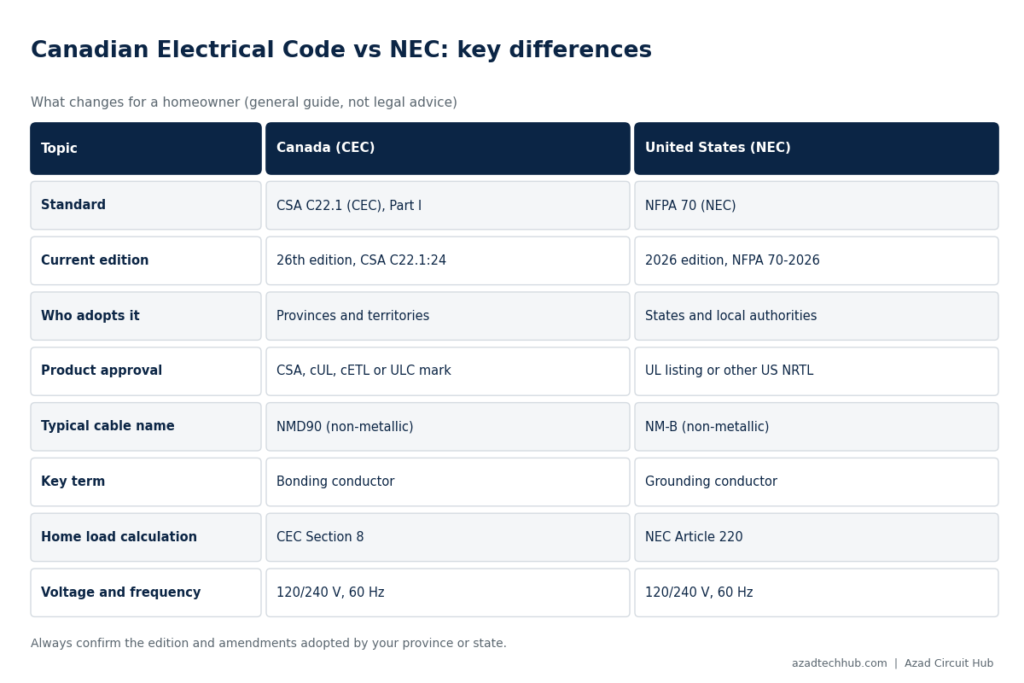
Here is the quick comparison for anyone who wants the Canadian Electrical Code vs NEC differences for homeowners on one screen. The NEC is the US document; the CEC is the Canadian one.
The Biggest Canadian Electrical Code vs NEC Differences for Homeowners Explained
Who Writes and Enforces the Code
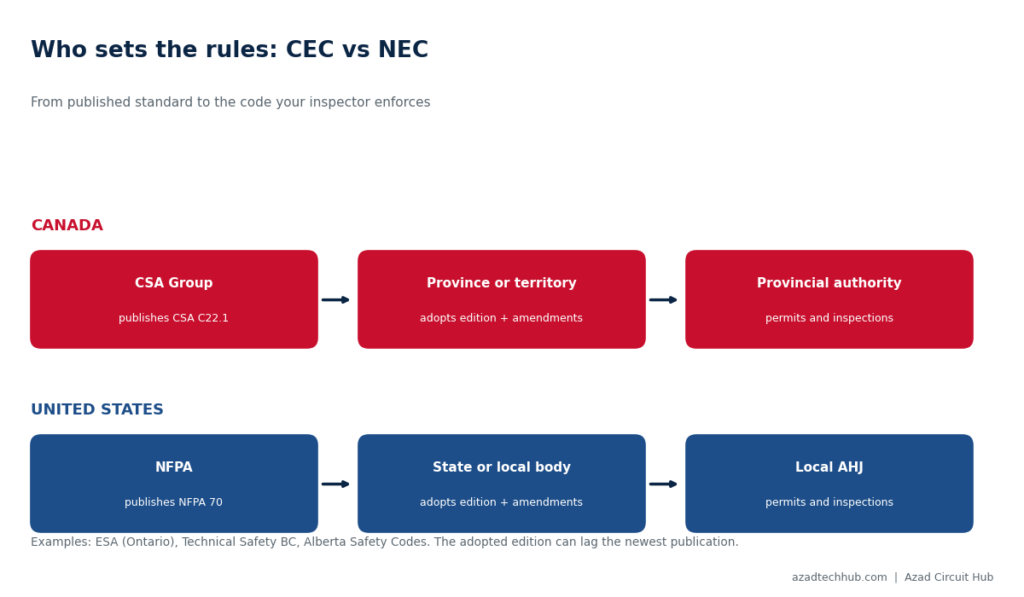
The first of the Canadian Electrical Code vs NEC differences for homeowners is authority. The CEC is written by CSA Group with input from provincial regulators and industry, then adopted by each province or territory. The NEC is written by NFPA and adopted state by state, often with local amendments. In both countries the code you must follow is the edition your local authority adopted, which can lag the newest publication.
Product Certification and Approval Marks
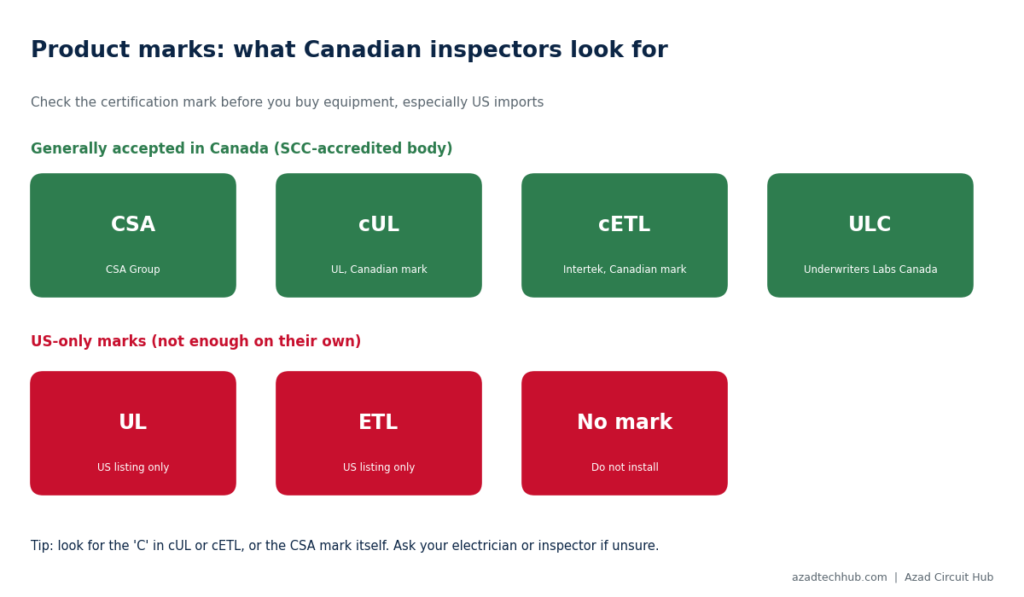
Of all the Canadian Electrical Code vs NEC differences for homeowners, this is the one that catches people most often. Equipment installed in a Canadian home must carry a mark from a certification body accredited by the Standards Council of Canada, such as CSA, cUL, cETL or ULC. A plain US UL listing is not enough on its own. If you import a panel, EV charger or light fixture from the US, check the mark before you buy, because an inspector can reject it.
Terminology and Cable Names
Vocabulary is another of the Canadian Electrical Code vs NEC differences for homeowners. Canadians say “bonding” where Americans often say “grounding”, and the cable names differ. Canadian non-metallic cable is sold as NMD90, while the US equivalent is NM-B. Armoured cable and conduit sizes also follow Canadian naming, and metric conduit sizes appear on Canadian products.
Ampacity tables and termination-temperature rules are not identical, so never size wire from a US chart without checking the CEC. Our cable size calculator is a good starting point, but the final check is the code.
Load Calculations and Service Sizing
Service sizing shows the Canadian Electrical Code vs NEC differences for homeowners in action. Canadian dwelling load calculations follow Section 8 of the CEC, while US homes use Article 220 of the NEC. Both start from floor area and add appliance loads with demand factors, but the numbers are not interchangeable. Use our home electricity load calculator and electrical service size calculator for planning, then let your electrician confirm the 100 A or 200 A decision against the CEC.
GFCI, AFCI and Receptacle Rules
Protective devices are the last of the Canadian Electrical Code vs NEC differences for homeowners worth knowing. Both codes require ground-fault and arc-fault protection, and both now call for tamper-resistant receptacles in dwellings.
The locations and exceptions differ, and each CEC edition changes them, so confirm the rule for your adopted edition rather than copying a US checklist. Our ground fault circuit interrupter tester guide shows how to check GFCI devices after installing them.
Is the 2026 NEC Out?
Yes. NFPA published the 2026 edition of the NEC (NFPA 70-2026) in late 2025. It is already in use as a reference book, but states adopt it on their own schedules. Washington State, for example, adopted it with an effective date of December 31, 2026.
For a Canadian homeowner the 2026 NEC changes nothing legally, because Canada never adopted the NEC. Your current rulebook is the Canadian Electrical Code edition adopted in your province, which for most provinces is the 2024 edition. That is the single most useful point when comparing the Canadian Electrical Code vs NEC differences for homeowners: each country updates on its own cycle.
Tools Every Canadian Homeowner Should Own
Before you open a wall, buy test gear that is rated for the job; the Canadian Electrical Code vs NEC differences for homeowners affect what you may install, but safe testing is the same everywhere. Whichever code you follow, the Canadian Electrical Code vs NEC differences for homeowners do not change the need for safe testing. Buy tools with a CAT III 600 V rating or better and a recognised certification mark.
- Two-pole voltage tester: confirms a circuit is dead. See our voltage tester reviews.
- Digital multimeter: for voltage, continuity and resistance. Browse the multimeter reviews.
- Receptacle and GFCI tester: a cheap way to catch reversed polarity and open grounds. Start with the panel testers and circuit analyzers reviews.
- Clamp meter: for checking load current on a circuit before adding an appliance. See the clamp meter reviews.
- Whole-home energy monitor: useful when planning a service upgrade. Read our best energy monitor for whole house review.
- Level 2 EV charger: a common reason Canadians upgrade panels. Compare picks in our best Level 2 EV charger guide and the EV charger reviews.
Can I Do Electrical Work on My Own House in Canada?
Sometimes, and this is where the Canadian Electrical Code vs NEC differences for homeowners matter most in daily life. The rules depend on the province, and a homeowner exemption is never automatic. In most provinces the homeowner may do some work in their own home, but must pull a permit and pass inspection. Friends and relatives usually cannot do the work for you.
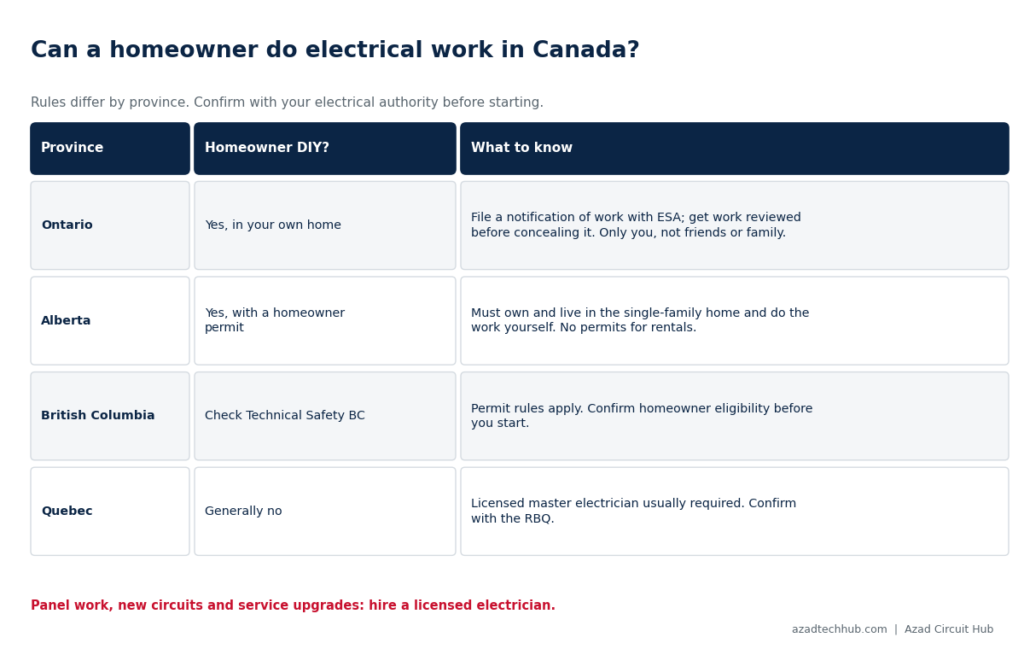
- Ontario: the Electrical Safety Authority says homeowners may do electrical work in their own home, but must file a notification of work before starting and have ESA review it before the work is concealed. Only the homeowner may do it, not a friend or family member.
- Alberta: a homeowner can get an electrical permit for their own home if they own and live in a single-family dwelling and do the work themselves. Permits are not issued for rental properties, and some hazardous work is excluded.
- British Columbia and Quebec: rules differ again, and Quebec is generally stricter. Confirm with Technical Safety BC or the Régie du bâtiment du Québec before you start.
Replacing like for like, such as a switch or receptacle, may not need a permit in some provinces, but check first. Anything involving the panel, new circuits, aluminum wiring or a service upgrade should go to a licensed electrician. Our hub covers many of these jobs in the Home Wiring as per CEC / CSA C22.1 guide.
FAQs
These quick answers sum up the Canadian Electrical Code vs NEC differences for homeowners and the questions Canadians search most.
Does Canada use the NEC code?
No. Canada uses the Canadian Electrical Code, Part I (CSA C22.1), adopted by each province or territory. The NEC is a US standard.
What is the difference between NEC and CEC?
The NEC is NFPA 70 and applies in the United States. The CEC is CSA C22.1 and applies in Canada. They share voltages and many principles but differ in product certification, terminology, load calculation rules, and which provinces or states adopt which edition. That is the core of the Canadian Electrical Code vs NEC differences for homeowners.
Is there a Canadian Electrical Code?
Yes. The 26th edition, CSA C22.1:24, was published in March 2024, and provinces adopt it on their own dates.
Is the 2026 NEC out?
Yes, NFPA 70-2026 has been published, but it does not apply in Canada. Canadian homes follow the CEC edition adopted by their province.
What electrical standards are used in Canada?
CSA C22.1 for installations, CSA C22.2 for equipment, CSA C22.3 for utility systems, and the provincial electrical codes that adopt them.
Can I do electrical work on my own house in Canada?
In some provinces, yes, with a permit and inspection. Ontario and Alberta allow qualifying homeowners to do their own work, and each requires you to do it yourself. Always confirm with your provincial authority first.
Conclusion
Now you know the Canadian Electrical Code vs NEC differences for homeowners: Canada uses CSA C22.1, the US uses NFPA 70, and the rules, product marks and adoption dates are separate. Check your province’s adopted edition, buy equipment with a Canadian certification mark, and file the right permit before you start.
For test gear, start with our voltage tester reviews and multimeter reviews, and return to the Home Wiring as per CEC / CSA C22.1 guide for the full installation picture. If you are comparing standards worldwide, our UK BS 7671 home wiring guide shows a third approach.
Get new guides in your feed. Follow Electrical Insights on LinkedIn for new electrical standards guides, calculators and design tips from Azad Circuit Hub.