NEC Code for How Many Receptacles on One Circuit: The Real Answer (2026)
The NEC code for how many receptacles on one circuit surprises many people: for a home, the National Electrical Code sets no limit at all. Where a limit exists, in offices, shops and other non-dwelling spaces, it comes from a calculation that counts 180 VA for each receptacle.
This guide gives the real numbers for 15 amp and 20 amp circuits, explains where the “10 outlets” and “12 outlets” rules of thumb come from, and covers 240 volt outlets, lighting outlets and amps per outlet.
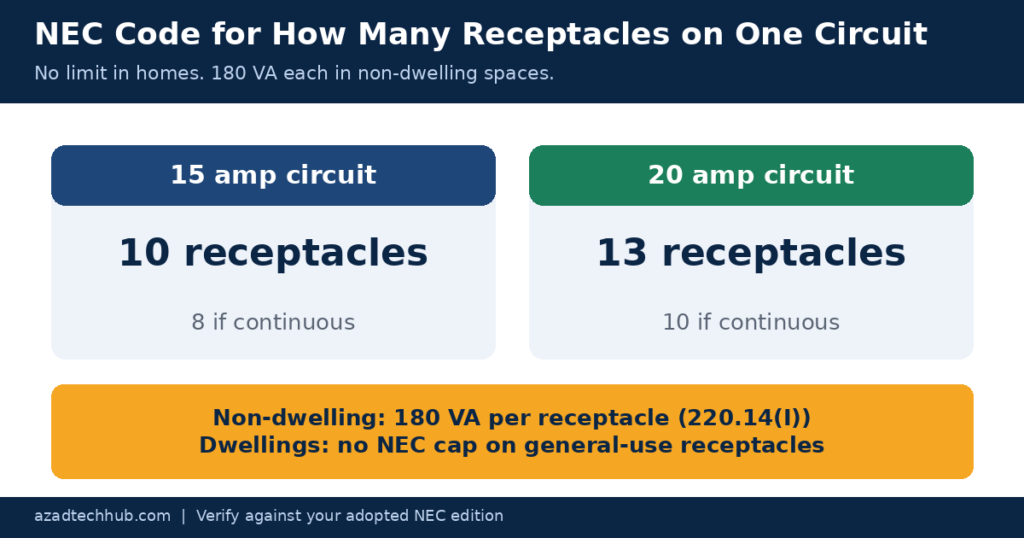
Quick answer: Under the NEC code for how many receptacles on one circuit, a dwelling has no cap. The NEC does not limit general-use receptacles per circuit in a home. In non-dwelling spaces, each receptacle counts as 180 VA (220.14(I)), which gives about 10 receptacles on a 15 amp circuit and 13 on a 20 amp circuit, or 8 and 10 if the load is continuous.
Is There an NEC Code for How Many Receptacles on One Circuit?
For homes, no. The load from general-use receptacles in a dwelling is already included in the 3 VA per square foot general lighting load, so the NEC does not count them one by one. The NEC code for how many receptacles on one circuit simply does not give a dwelling limit. That is true in the 2020, 2023 and 2026 editions. There is no 2021 NEC, so a search for the 2021 rule is usually about the 2020 edition.
The numbers you see on forums come from two sources. One is the 180 VA calculation for non-dwelling spaces. The other is plain good practice: the more outlets on a circuit, the more likely it trips. Inspectors and local codes can set their own limits, so check with your authority having jurisdiction. California uses the California Electrical Code, which is built on the NEC, and the same logic applies unless a local amendment says otherwise.
How Many Receptacles on a 15 Amp Circuit?
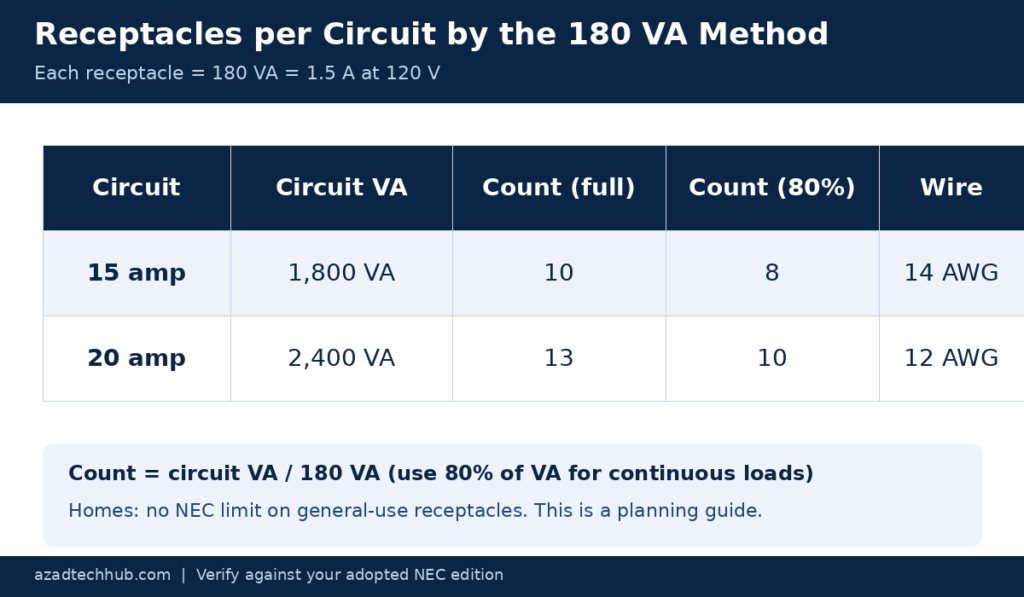
Under the NEC code for how many receptacles on one circuit, use the 180 VA rule. Each receptacle counts as 180 VA, which is 1.5 amps at 120 volts. A 15 amp circuit carries 1,800 VA, so you can count 10 receptacles. If the load will be continuous, you can only load the circuit to 80%, which is 1,440 VA, so the count is 8.
A 15 amp circuit uses 14 AWG copper and 15 amp receptacles. Our AWG to mm² conversion chart helps with metric sizes.
How Many Receptacles on a 20 Amp Circuit (Per NEC, Residential)?
The NEC code for how many receptacles on one circuit uses the same method for 20 amps. A 20 amp circuit carries 2,400 VA, so the count is 13 receptacles.
At 80% for continuous use it is 1,920 VA, which gives 10. A 20 amp circuit uses 12 AWG copper and may have 15 or 20 amp receptacles (Table 210.21(B)(3)). In a residence there is still no NEC limit, so the numbers are guidance for planning how many receptacles on a 20 amp circuit residential designs can comfortably handle.
| Circuit | Circuit VA | Non-continuous count (÷ 180 VA) | Continuous count (80%) | Wire |
|---|---|---|---|---|
| 15 amp | 1,800 VA | 10 | 8 | 14 AWG |
| 20 amp | 2,400 VA | 13 | 10 | 12 AWG |
The 180 VA Rule in 220.14(I)
The NEC code for how many receptacles on one circuit rests on 220.14(I), which counts each single or multiple receptacle on one yoke at 180 VA for load calculations in non-dwelling occupancies. A retail store with 30 receptacles has 5,400 VA of receptacle load.
The rule does not apply to the small-appliance and laundry circuits in dwelling units. Feeder demand factors for these loads are in our NEC article for demand factors, and the full load method is in our NEC Article 220 guide.
How Many Amps per Outlet?
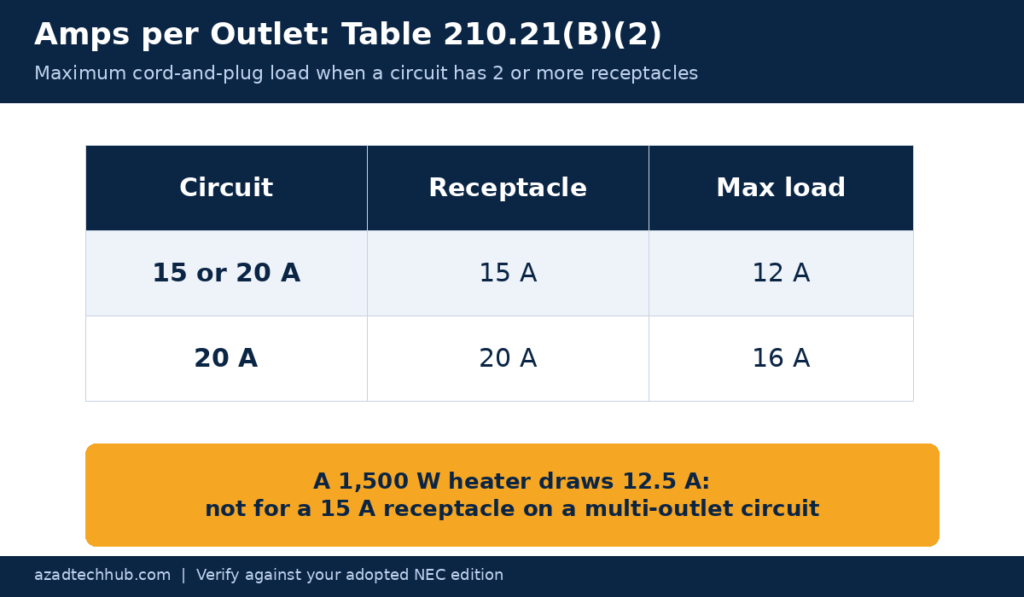
The NEC code for how many receptacles on one circuit also limits load per receptacle. A receptacle has a rating (15 or 20 amps), not a fixed draw. The circuit’s current is shared among everything plugged in. Table 210.21(B)(2) limits the cord-and-plug load on a receptacle when the circuit has two or more receptacles:
| Circuit | Receptacle | Maximum cord-and-plug load |
|---|---|---|
| 15 or 20 A | 15 A | 12 A |
| 20 A | 20 A | 16 A |
So a 1,500 W space heater (12.5 A) should not go on a 15 amp receptacle, and 210.23(A) similarly limits one portable load to 80% of the circuit rating.
Can I Put 12 Outlets on a 20 Amp Circuit?
Under the NEC code for how many receptacles on one circuit, in a home the answer is yes: the NEC does not forbid it. In a non-dwelling space, 12 × 180 VA = 2,160 VA, which is under 2,400 VA for non-continuous loads but over the 1,920 VA continuous limit.
The honest answer is that it depends on what you plug in. A bedroom with a lamp and a phone charger is fine. A garage workbench with a compressor and a heater is not.
Can I Run Two 220 Outlets on One Circuit?
Usually avoid it. The NEC code for how many receptacles on one circuit applies to 240 volt outlets too, and a 240 volt receptacle is normally on a dedicated circuit for the appliance. The NEC allows two or more receptacles on a 30, 40 or 50 amp circuit only if the receptacle ratings match Table 210.21(B)(3) and the total cord-and-plug load stays within Table 210.21(B)(2).
Some loads also need their own circuit: an EV charger requires an individual branch circuit (see our NEC code for EV chargers), and a hot tub has its own rules (see the NEC code for hot tub disconnect).
Maximum Lighting Outlets per Circuit
There is also no NEC limit on lighting outlets per circuit. Calculate it instead: circuit VA × 80% for continuous loads ÷ VA per fixture. A 15 amp circuit has 1,440 VA of continuous capacity, so twenty 12 W LED fixtures use 240 VA. Use our electrical load calculator to total mixed loads.
Circuits the NEC Does Limit
Some dwelling circuits are required and restricted:
- Kitchen small-appliance circuits: at least two 20 amp circuits for countertop receptacles, with few other outlets (210.11(C)(1)).
- Laundry: one 20 amp circuit for the laundry receptacle (210.11(C)(2)).
- Bathroom: a 20 amp circuit for bathroom receptacles (210.11(C)(3)).
- Garage: a 20 amp circuit for garage receptacles (210.11(C)(4)).
For where those receptacles go, see the 2-6-12 rule in our guide to the NEC code for outlet orientation. The 2-6-12 rule says: receptacles every 12 ft along a wall, so no point is more than 6 ft from one, and any wall space 2 ft or wider needs one. It sets how many outlets a room needs, not how many a circuit can carry.
Checks Before You Add Receptacles
Before you apply the NEC code for how many receptacles on one circuit, run these checks:
- Wire size: 14 AWG for 15 amps and 12 AWG for 20 amps. Use our cable size calculator for long runs and voltage drop.
- Box fill: a crowded box fails inspection. See the NEC article for box fill.
- GFCI: see NEC article 210.8 A.
- Panel capacity: check the load with the full load amperage calculator.
Tools for Adding Circuits
Once the NEC code for how many receptacles on one circuit is settled, the right tools help. As an Amazon Associate I earn from qualifying purchases, at no extra cost to you. See our affiliate disclosure.
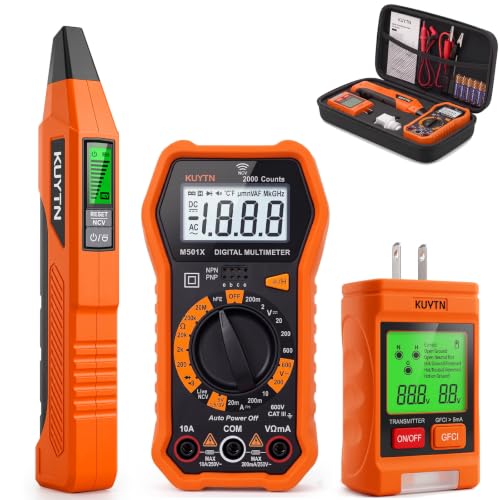
- Receptacle tester: checks wiring and the GFCI trip.
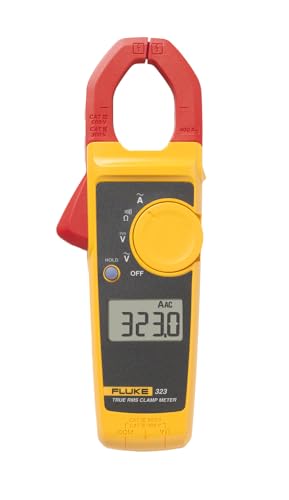
- Clamp meter: measure real circuit load. See our best clamp meter for electricians.
- Wire strippers: see our best wire strippers.
- Voltage tester: confirm the circuit is dead with our best non-contact voltage tester guide.
- Cable: 12/2 NM cable for 20 amp circuits.


Frequently Asked Questions
What is the NEC code for how many receptacles on one circuit?
There is no limit in dwellings. Non-dwelling spaces use 180 VA per receptacle.
How many outlets can I run on a single circuit?
About 10 on 15 amps and 13 on 20 amps by the 180 VA method, or 8 and 10 for continuous loads.
Conclusion
The NEC code for how many receptacles on one circuit has a short answer: no limit in homes, 180 VA each elsewhere. Count the real load, keep continuous loads at 80%, and use dedicated circuits where the code requires them. For the wider picture, read our home electrical wiring NEC guide, and see the Electrical Standards library.
Sources: NFPA 70, National Electrical Code (210.11, 210.21, 210.23, 220.12, 220.14), viewable free on the NFPA 70 page.
Get new guides in your feed. Follow Electrical Insights on LinkedIn for new electrical standards guides, calculators and design tips from Azad Circuit Hub.