
AWG to mm² Conversion Chart: Complete Reference
An AWG to mm² Conversion Chart helps electricians, engineers, technicians, and electrical contractors compare American Wire Gauge sizes with metric conductor cross-sectional areas. This is especially useful when selecting cables for equipment designed to IEC, NEC, or other international standards.
AWG and mm² do not use the same sizing system. AWG is based on a standardized gauge number, while mm² describes the actual cross-sectional area of a conductor. Therefore, the metric value shown in an AWG to mm² Conversion Chart is normally the nearest equivalent rather than a direct change of units.
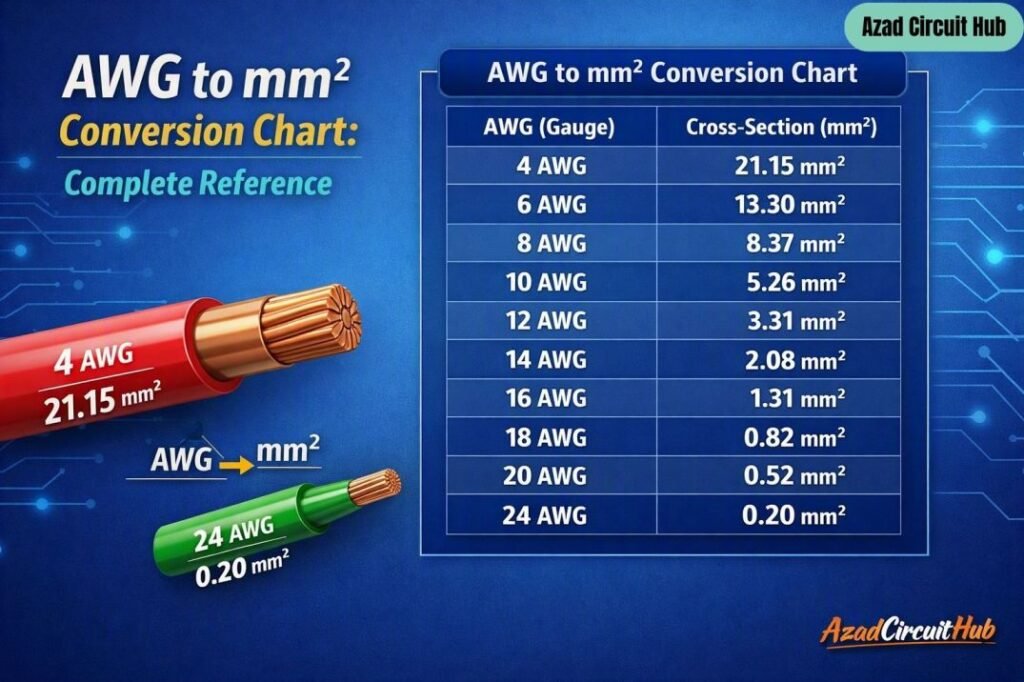
Table of Contents
Table of Contents
AWG to mm² Conversion Chart
The following AWG to mm² Conversion Chart covers common conductor sizes used in residential wiring, industrial control panels, automation, power distribution, and electronic equipment.
| AWG Size | Diameter (mm) | Cross-Sectional Area (mm²) | Approx. Metric Size |
|---|---|---|---|
| 30 | 0.255 | 0.051 | 0.05 mm² |
| 28 | 0.321 | 0.081 | 0.08 mm² |
| 26 | 0.405 | 0.129 | 0.13 mm² |
| 24 | 0.511 | 0.205 | 0.20 mm² |
| 22 | 0.644 | 0.326 | 0.35 mm² |
| 20 | 0.812 | 0.519 | 0.50 mm² |
| 18 | 1.024 | 0.823 | 0.75 mm² |
| 16 | 1.291 | 1.31 | 1.5 mm² |
| 14 | 1.628 | 2.08 | 2.5 mm² |
| 12 | 2.053 | 3.31 | 4 mm² |
| 10 | 2.588 | 5.26 | 6 mm² |
| 8 | 3.264 | 8.37 | 10 mm² |
| 6 | 4.115 | 13.3 | 16 mm² |
| 4 | 5.189 | 21.2 | 25 mm² |
| 2 | 6.544 | 33.6 | 35 mm² |
| 1 | 7.348 | 42.4 | 50 mm² |
| 1/0 | 8.251 | 53.5 | 50 mm² |
| 2/0 | 9.266 | 67.4 | 70 mm² |
| 3/0 | 10.40 | 85.0 | 95 mm² |
| 4/0 | 11.68 | 107 | 120 mm² |
The metric equivalent should not be treated as an exact interchangeable cable size. For example, 10 AWG has an area of about 5.26 mm², while a common metric cable size is 6 mm². The conductor areas are different even though they are often used as practical equivalents.
Common AWG to Metric Wire Sizes
For everyday electrical work, a smaller reference table is often easier to use.
| AWG | Area (mm²) | Common Metric Cable Size |
|---|---|---|
| 18 AWG | 0.823 | 0.75 mm² |
| 16 AWG | 1.31 | 1.5 mm² |
| 14 AWG | 2.08 | 2.5 mm² |
| 12 AWG | 3.31 | 4 mm² |
| 10 AWG | 5.26 | 6 mm² |
| 8 AWG | 8.37 | 10 mm² |
| 6 AWG | 13.3 | 16 mm² |
| 4 AWG | 21.2 | 25 mm² |
| 2 AWG | 33.6 | 35 mm² |
| 1/0 AWG | 53.5 | 50 mm² |
| 2/0 AWG | 67.4 | 70 mm² |
| 4/0 AWG | 107 | 120 mm² |
If you regularly work between American and metric cable specifications, our mm to awg converter can make individual conversions faster when checking drawings, equipment manuals, and cable schedules.
How AWG Wire Size Relates to mm²
American Wire Gauge uses a numerical system in which the gauge number becomes smaller as the conductor becomes larger. For example, 18 AWG is smaller than 12 AWG, while 4 AWG is considerably larger than 12 AWG.
Metric cable sizing works differently. A conductor marked 2.5 mm² has a nominal cross-sectional area of 2.5 square millimeters.
The conductor area can be calculated from its diameter using:
A = πd² / 4
Where:
- A = conductor cross-sectional area in mm²
- d = conductor diameter in mm
- π ≈ 3.1416
AWG itself follows a logarithmic gauge system. The diameter of an AWG conductor can be calculated from its gauge number using the standard AWG relationship.
This difference is important because an AWG number should not simply be treated as another unit for mm². The two systems need a reference conversion.
AWG to mm² Conversion for Electrical Applications
The appropriate cable size depends on more than conductor area. Current capacity, insulation temperature rating, installation method, ambient temperature, grouping, voltage drop, and applicable electrical code can all affect the final selection.
For example, 12 AWG copper is approximately 3.31 mm², but selecting a 12 AWG cable for a particular circuit requires checking the applicable ampacity requirements rather than relying only on its metric equivalent.
| Typical Application | Common AWG Range | Approx. Metric Range |
|---|---|---|
| Control and signal wiring | 18–24 AWG | 0.2–0.75 mm² |
| Small control circuits | 16–18 AWG | 0.75–1.5 mm² |
| General branch circuits | 12–14 AWG | 2.5–4 mm² |
| Higher-current circuits | 8–10 AWG | 6–10 mm² |
| Battery and inverter wiring | 2–8 AWG | 10–35 mm² |
| Larger power feeders | 1/0–4/0 AWG | 50–120 mm² |
These are broad application ranges, not cable-sizing rules. The actual conductor should be selected according to the equipment rating, installation conditions, protection, and governing standard.
How to Convert mm² to AWG
Converting in the opposite direction is also common when working with imported equipment or North American electrical documentation.
For example:
| Metric Area | Closest AWG | AWG Area |
|---|---|---|
| 0.5 mm² | 20 AWG | 0.519 mm² |
| 0.75 mm² | 18 AWG | 0.823 mm² |
| 1.5 mm² | 16 AWG | 1.31 mm² |
| 2.5 mm² | 14 AWG | 2.08 mm² |
| 4 mm² | 12 AWG | 3.31 mm² |
| 6 mm² | 10 AWG | 5.26 mm² |
| 10 mm² | 8 AWG | 8.37 mm² |
| 16 mm² | 6 AWG | 13.3 mm² |
| 25 mm² | 4 AWG | 21.2 mm² |
| 35 mm² | 2 AWG | 33.6 mm² |
| 50 mm² | 1/0 AWG | 53.5 mm² |
| 70 mm² | 2/0 AWG | 67.4 mm² |
Because standard metric cable sizes and AWG sizes do not always match exactly, always check the actual conductor area specified by the manufacturer.
For a quick reverse lookup, use our convert mm to gauge wire tool when you need to identify the closest AWG size from a metric conductor specification.
Why the Closest Size Is Not Always the Correct Size
A common mistake is assuming that the closest number in a conversion table is automatically suitable for an electrical installation.
For example, 6 mm² is commonly compared with 10 AWG, but 6 mm² has a larger cross-sectional area than 10 AWG. Similarly, 16 mm² is larger than 6 AWG.
Cable selection should therefore consider:
- Conductor material
- Continuous and peak current
- Installation method
- Ambient temperature
- Number of loaded conductors
- Insulation temperature rating
- Voltage drop
- Short-circuit withstand capability
- Overcurrent protection
- Applicable electrical standard
For detailed conversion work involving several conductor sizes, our mm to wire gauge conversion reference can be useful when comparing international cable schedules.
AWG Diameter and Area Reference
Diameter is another useful parameter when checking terminals, ferrules, lugs, conduit fill, and cable-entry requirements.
| AWG | Diameter (mm) | Area (mm²) |
|---|---|---|
| 24 | 0.511 | 0.205 |
| 22 | 0.644 | 0.326 |
| 20 | 0.812 | 0.519 |
| 18 | 1.024 | 0.823 |
| 16 | 1.291 | 1.31 |
| 14 | 1.628 | 2.08 |
| 12 | 2.053 | 3.31 |
| 10 | 2.588 | 5.26 |
| 8 | 3.264 | 8.37 |
| 6 | 4.115 | 13.3 |
| 4 | 5.189 | 21.2 |
| 2 | 6.544 | 33.6 |
The figures refer to the conductor itself. Finished cable diameter will be larger because of insulation, shielding, fillers, armor, or other construction layers.
Frequently Asked Questions
Is 2.5 mm² the same as 14 AWG?
No. 14 AWG has a conductor area of approximately 2.08 mm², while 2.5 mm² is larger. They are often compared as practical cable sizes, but they are not identical.
What AWG is equivalent to 4 mm²?
4 mm² is closest to 12 AWG, which has a conductor area of approximately 3.31 mm². The actual cable choice should be based on the required current capacity and applicable electrical standard.
What is 10 AWG in mm²?
10 AWG has a conductor cross-sectional area of approximately 5.26 mm². A commonly available metric cable size near it is 6 mm², but the two are not exactly the same.
What is 6 mm² wire in AWG?
6 mm² falls between 10 AWG and 9 AWG in conductor area. Since 9 AWG is not commonly used in many standard cable ranges, 10 AWG is often the nearest commonly encountered AWG reference.
Is AWG the same as wire diameter?
No. AWG is a standardized gauge designation. Each AWG size corresponds to a specific conductor diameter and cross-sectional area. Wire diameter is one physical measurement, while AWG is the size designation derived from the AWG system.
Final Reference
An AWG to mm² Conversion Chart is useful when comparing American and metric electrical drawings, cables, terminals, equipment specifications, and installation documents. The most important point is that an equivalent size is not necessarily an identical conductor.
For final cable selection, compare the actual conductor cross-sectional area and then verify ampacity, voltage drop, installation conditions, protection, and the relevant electrical code. This approach avoids choosing a cable simply because its AWG and metric labels appear close on a conversion table.
Get new guides in your feed. Follow Electrical Insights on LinkedIn for new electrical standards guides, calculators and design tips from Azad Circuit Hub.
#AWGtoMM2, #AWGConversionChart, #WireSizeChart, #AWGWireSize, #CableSizing, #ElectricalWire, #WireGauge, #ElectricalEngineering, #CableSize, #WireConversion
