
Best Non Contact Voltage Tester (2026 Reviews)
Working around electricity always comes with risk. Whether you are a professional electrician, a maintenance engineer, or a homeowner handling small repairs, safety should always come first. This is where the Best Non Contact Voltage Tester becomes an essential tool.
A non contact voltage tester helps you detect live wires without touching exposed conductors. It is one of the safest and fastest ways to check electrical circuits before doing any work. From checking outlets to tracing live wires in walls, this tool saves time and prevents dangerous shocks.
Best Top Rated Non Contact Voltage Tester Comparison
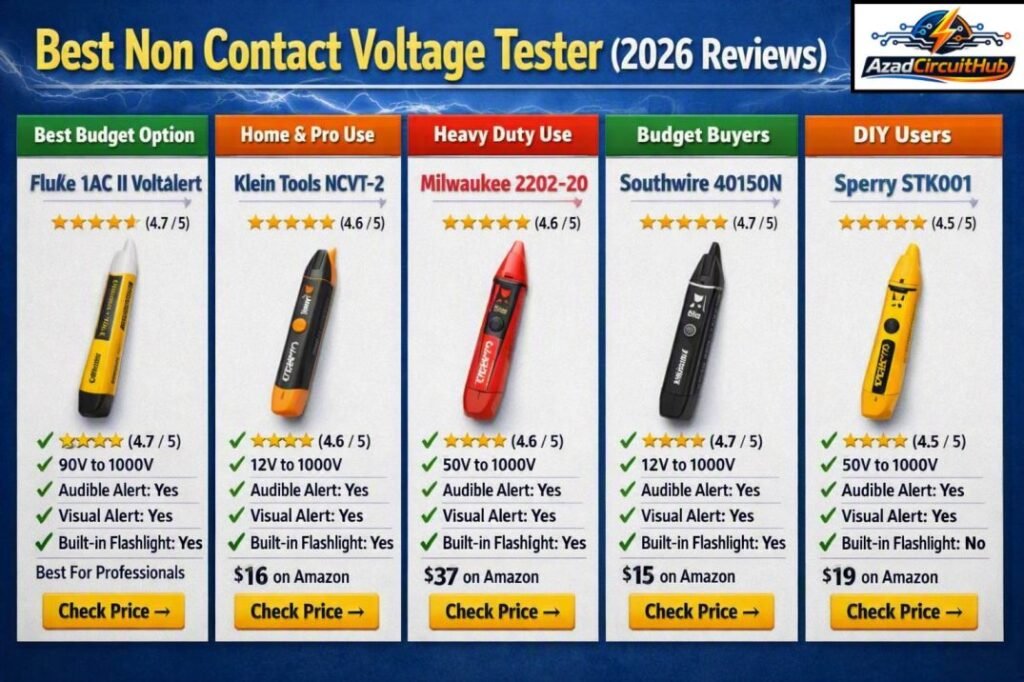
Table of Contents
Table of Contents
In this guide, you will find the Best top rated Non Contact Voltage Tester options available today, along with their features, pros, cons, and buying tips. If you want reliable and safe testing, this article will help you choose the right one.
Why You Need the Best Non Contact Voltage Tester
Electrical troubleshooting often starts with identifying whether a wire or outlet is energized. Traditional multimeters require direct contact, but non contact voltage detectors simplify this task.
Here are the main benefits:
- Detects AC voltage without touching wires
- Reduces the risk of electric shock
- Quick and easy to use
- Portable and lightweight
- Suitable for residential and industrial work
- Helps in breaker identification
If safety is your priority, investing in the Best Non Contact Voltage Tester is a smart decision.
Best Non Contact Voltage Tester Reviews
1. Fluke 1AC II VoltAlert
Fluke is one of the most trusted brands in electrical testing equipment. The Fluke 1AC II is widely known for accuracy and durability.
Key Features
- Voltage detection from 90V to 1000V AC
- VoltBeat technology for self-test
- Continuous visual indicator
- CAT IV 1000V safety rating
Pros
- Highly reliable
- Strong build quality
- Easy single-button operation
- Excellent sensitivity
Want to know whether the Fluke 1AC-II is worth buying? Read our in-depth Fluke 1AC-II Review to explore its accuracy, durability, real-world performance, and see if it's the right voltage pen for your toolkit.
Cons
- Limited low-voltage detection
- No flashlight
This model is often considered the Best Non Contact Voltage Tester for industrial electricians.
Check the latest price here: Buy Fluke 1AC II on Amazon
2. Klein Tools NCVT-2
Klein Tools has built a strong reputation among electricians. This tester offers dual voltage range detection, making it versatile.
Key Features
- Detects 12V to 1000V AC
- Dual-range operation
- Bright LED flashlight
- Auto power-off feature
Pros
- Great for low-voltage systems
- Compact design
- Strong battery life
- Loud audible alarms
Cons
- Slightly sensitive in crowded panels
For home wiring and industrial use, this is one of the Best Non Contact Voltage Tester choices.
Grab your Klein Tools NCVT-2 today for safer testing
3. Milwaukee 2202-20 Voltage Detector
Milwaukee is known for rugged tools. This voltage detector is ideal for field technicians.
Key Features
- Wide detection range
- LED work light
- Green power-on indicator
- High durability
Pros
- Tough construction
- Fast voltage sensing
- Bright flashlight
- Comfortable grip
Cons
- Higher price point
It performs well in industrial environments where reliability matters.
4. Southwire 40150N
Southwire offers a budget-friendly solution without sacrificing performance.
Key Features
- 12V to 1000V range
- Water-resistant design
- Built-in flashlight
- Vibration alert
Pros
- Affordable
- Good sensitivity
- Suitable for beginners
Cons
- Plastic feels less premium
This is a great option if you want the Best Non Contact Voltage Tester at a lower price.
See today’s deal on Southwire 40150N before it sells out
5. Sperry STK001
Sperry provides a practical choice for DIY homeowners.
Key Features
- Detects 50V to 1000V
- Includes GFCI outlet tester
- LED visual alerts
- Durable design
Pros
- Value for money
- Easy operation
- Good for household testing
Cons
- Basic features only
It is suitable for people who need occasional electrical checks.
Fluke 1AC-II vs Fluke 2AC Alert
The Fluke 1AC-II and 2AC Alert are popular non-contact voltage detectors for electricians and DIY electrical checks. Both provide visual and audible alerts when AC voltage is detected, but their detection features and practical use differ. The Fluke 1AC-II vs Fluke 2AC Alert comparison can help you choose the right tester for routine troubleshooting and safety checks.
| Feature | Fluke 1AC-II | Fluke 2AC Alert |
|---|---|---|
| Voltage detection | AC voltage | AC voltage |
| Alert | LED + audible | LED + audible |
| Best use | General electrical checks | Quick voltage presence checks |
| Form factor | Pen-style | Compact pen-style |
For more detailed differences, see our Fluke 1AC-II vs Fluke 2AC Alert comparison before choosing the Best Non Contact Voltage Tester for your toolbox.
Best GFCI Outlet Tester for Home Inspectors
Home inspectors need more than a non-contact voltage tester when checking receptacles. A GFCI tester can quickly identify common wiring issues and verify whether GFCI protection is working properly.
| Feature | Why It Matters |
|---|---|
| GFCI test button | Checks trip function |
| Wiring indicators | Helps spot common faults |
| Compact design | Easy to carry during inspections |
For detailed recommendations, see our guide to the Best GFCI Outlet Tester for Home Inspectors, which compares practical testers for fast and reliable outlet checks. Pairing one with a quality non-contact voltage detector gives inspectors a more complete electrical testing toolkit.
Best Fluke Non Contact Voltage Tester: Fluke 1AC II vs 2AC Alert
If you want a reliable best fluke non contact voltage tester, Fluke’s VoltAlert series is a strong choice for electricians and DIY electrical work. Both testers provide quick, non-contact AC voltage detection without requiring direct contact with an energized conductor.
The Fluke 1AC II is an excellent everyday option for checking outlets, switches, cables, and panels. The Fluke 2AC offers similar high-voltage detection in a compact pen-style design, making it convenient for electricians who carry a tester throughout the day.
Buying tip: Choose the 1AC II for dependable general-purpose testing, while the 2AC is ideal when compact size and portability are priorities. Always verify an absence of voltage with an appropriate contact-type meter before starting electrical work.
Best Non Contact Voltage Tester for Christmas Lights
The top rated non contact voltage tester for Christmas lights should help you quickly identify live wires, sockets, and faulty light strings without direct electrical contact. For seasonal lighting, dedicated Christmas light testers can also check bulbs and fuses.
For homeowners, the allsun Christmas Light Tester with Bulb Remover is useful when troubleshooting individual bulbs, while the ALLOSUN Christmas Light Tester Bulb & Fuse Checker is a practical choice for checking both bulbs and fuses. Use a non-contact tester first to verify whether a circuit or socket is energized, then use the Christmas light tester according to its instructions. Follow our guide on Best Non Contact Voltage Tester for Christmas Lights for detailed specifications and full comparison of both testers.
Non Contact Voltage Testers Working
If you are wondering about the Non Contact Voltage Testers Working principle before buying one, understanding the technology can help you choose the right model. These testers detect the electric field surrounding an energized conductor through capacitive coupling instead of making direct electrical contact. When the sensor tip comes close to a live wire, the internal circuit identifies the alternating electric field and triggers an LED light, buzzer, or vibration alert.
| Component | Function |
|---|---|
| Sensor Tip | Detects the AC electric field |
| Internal Circuit | Processes the detected signal |
| LED/Buzzer | Indicates the presence of voltage |
Want a detailed explanation with diagrams, limitations, and safety tips? Read our complete guide on How Non Contact Voltage Testers Work to understand the technology before choosing the best tester.
Non Contact Voltage Tester Blinking Blue: What Does It Mean?
A non contact voltage tester blinking blue can indicate different conditions depending on the brand and model. Blue blinking may mean the tester is powered on, detecting a low-voltage signal, or operating in a specific sensitivity mode. Always check the manufacturer’s manual before assuming the circuit is energized.
| Blue Blinking Behavior | Possible Meaning | Recommended Action |
|---|---|---|
| Slow blue blink | Power-on/standby indicator | Test on a known live circuit |
| Fast blue blink | Possible voltage detection | Verify with a second tester |
| Blue + audible beep | Voltage detected | Treat conductor as energized |
| Blue with no detection | Low battery or mode indicator | Check battery and settings |
| Blue/red alternating | Warning or voltage detection | Stop and verify safely |
If your non-contact voltage tester flashes blue around an outlet, wire, or Christmas light string, do not rely on the color alone. Confirm operation on a known energized source and use an appropriately rated meter when making electrical repairs. A blinking light is an indication, not proof that a circuit is safe or de-energized. Read full troubleshooting guide on Non Contact Voltage Tester Blinking Blue here.
Non Contact Voltage Tester Beeps Once: What Does It Mean?
If a non contact voltage tester beeps once and then stops, it usually means the tester briefly detected an AC electric field but the signal was too weak, intermittent, or moved away from the detection range. Check the circuit and retest from several positions before assuming it is de-energized.
| Tester behavior | Likely indication | What to do |
|---|---|---|
| One beep, then silent | Weak/intermittent voltage | Retest closer to the conductor |
| Continuous beeping | Strong AC field detected | Treat circuit as energized |
| No beep | No detectable voltage | Verify with a proper meter |
| Flashing LED + beep | Voltage detected | Maintain safe clearance |
For typical residential circuits, nominal voltages are 120V and 240V AC in the U.S. A non-contact tester should only be used as a preliminary indication; always verify de-energization with an appropriate test instrument before electrical work. Read complete troubleshooting guide on beeping of non contact voltage tester here.
Non Contact Voltage Tester Battery Replacement
A non-contact voltage tester is only reliable when its batteries are fresh. For non contact voltage tester battery replacement, check the manufacturer’s recommended battery type before opening the tester. Most compact models use 2 AAA or 2 AA batteries, while some use button cells.
| Tester Type | Common Battery | Typical Runtime* | Replacement Tip | Buy Now |
|---|---|---|---|---|
| Pen-style NCVT | 2 AAA | 50–100 hours | Replace as a pair | Buy Now on Amazon |
| Heavy-duty NCVT | 2 AA | 100–200 hours | Use alkaline cells | Buy Now on Amazon |
| Compact tester | 1–2 AAA | 40–80 hours | Check polarity | Buy Now on Amazon |
*Runtime varies by model and usage. Turn the tester off after each check and test it on a known live circuit after replacing batteries. Read complete Non Contact Voltage Tester Battery Replacement guide here. Do not rely on battery replacement alone to confirm electrical safety.
Best Non Contact Voltage Tester for Electric Fence
Finding the best non contact voltage tester for electric fence work requires a tester with a suitable voltage range and clear visual/audio alerts. The Klein Tools NCVT-2 Voltage Tester is a practical choice for checking energized fence wires without direct electrical contact.
Electric fence applications require a tester that can reliably detect voltage through fencing systems. For specialized recommendations, see our guide to the Best Non-Contact Voltage Tester for Electric Fence.
The NCVT-2 can help identify whether an electric fence conductor is energized before maintenance. However, electric fences use high-voltage pulses, so always follow the fence energizer manufacturer's safety instructions and never rely on a non-contact tester as the sole method of confirming a circuit is de-energized.
Best Non Contact Voltage Tester for Ignition Coils
If you need the best non contact voltage tester for ignition coils, a dedicated spark tester is safer and more practical than a standard electrical voltage detector. The OTC 6589 Electronic Ignition Spark Tester provides a quick way to check whether an ignition system is producing a visible spark.
For ignition-coil testing, connect the tester according to the vehicle manufacturer's procedure and observe the spark indication. Always keep hands, clothing, and tools away from moving engine components and follow proper ignition-system safety precautions.
Affiliate Pick: OTC 6589 Electronic Ignition Spark Tester
Best Voltage Tester for 240V Circuits
When testing higher-voltage residential and commercial circuits, choosing the right tester is important for both accuracy and safety. The best voltage tester for 240V applications should have an appropriate voltage range, clear visual or audible alerts, and a design suitable for electrical panels, outlets, and wiring checks.
Non-contact testers are convenient for quick detection, while two-pole voltage testers can provide more reliable confirmation of circuit voltage.
| Feature | Recommended for 240V Testing |
|---|---|
| Voltage range | Up to 240V or higher |
| Detection | Visual + audible indication |
| Safety rating | CAT III or CAT IV |
| Best use | Panels, circuits, outlets |
For detailed product comparisons and buying advice, see this guide to the best voltage tester for 240V, including options suited to different electrical testing needs.
Outlet Tester vs Voltage Tester: Key Differences
If you're comparing an outlet tester with a non-contact voltage tester, understanding the differences helps you choose the right tool for the job. The detailed guide on Outlet Tester vs Voltage Tester explains each tool in depth, but the quick comparison below covers the basics.
| Feature | Outlet Tester | Voltage Tester |
|---|---|---|
| Primary Use | Checks outlet wiring | Detects live voltage |
| Contact Required | Yes | No (non-contact models) |
| Wiring Fault Detection | Yes | No |
| Safety Check | Basic | Fast live-wire detection |
An outlet tester verifies wiring issues such as reversed polarity or open grounds, while a non-contact voltage tester simply indicates whether voltage is present without touching exposed conductors.
For a complete comparison, applications, and buying recommendations, read our comprehensive Outlet Tester vs Voltage Tester guide. It explains when each tester is the better choice for homeowners and electricians.
Where to Buy a Non Contact Voltage Tester
Need a reliable tester for home electrical work? You can find non-contact voltage testers at major retailers and online marketplaces, making it easy to compare brands, features, and prices.
| Store | What to Look For | Best For |
|---|---|---|
| Home Depot | Klein, Milwaukee, Southwire | Electricians |
| Lowe’s | Klein, Kobalt | DIY users |
| Amazon | Wide brand selection | Price comparison |
| Walmart | Basic testers | Budget buyers |
Before purchasing, check the voltage range, sensitivity settings, audible/visual alerts, and safety rating. For more buying guidance, see our detailed guide on Where to Buy a Non Contact Voltage Tester for current options and retailer comparisons.
Fluke T6-1000 Pro vs 325: Which Tester Fits Your Work?
Choosing between these two Fluke tools depends on whether you want fast voltage checks or deeper electrical measurements. The T6-1000 Pro uses FieldSense technology to measure voltage without test leads, while the Fluke 325 adds clamp-meter functions for current, resistance, capacitance, and temperature.
| Feature | T6-1000 Pro | Fluke 325 |
|---|---|---|
| Voltage | Up to 1000V | Up to 600V |
| Current | FieldSense | Clamp measurement |
| Best for | Quick testing | Detailed troubleshooting |
For a closer comparison of features, accuracy, and applications, see our guide on Fluke T6-1000 Pro vs 325 before choosing your next electrical tester.
Fluke T6-1000 PRO vs Fluke T5-1000
Choosing between these two Fluke testers depends on whether you need quick voltage checks or current measurement without opening the circuit.
| Feature | Fluke T6-1000 PRO | Fluke T5-1000 |
|---|---|---|
| Voltage | Up to 1000V | Up to 1000V |
| Current | Up to 200A AC | Up to 100A AC |
| Open-jaw measurement | Yes | No |
| Best for | Electricians & troubleshooting | General electrical testing |
The T6-1000 PRO stands out for its FieldSense technology, allowing current measurements without test leads. You can read complete Fluke T6-1000 Pro Review here. The T5-1000 is simpler and practical for routine voltage and continuity checks.
See our detailed Fluke T6-1000 PRO vs Fluke T5-1000 comparison for a closer look at features, usability, and which model offers better value.
How to Choose the Best Non Contact Voltage Tester
Not every tester is the same. Here are important factors to consider.
Voltage Range
Choose a tester with a wide voltage range. Some models start at 12V, which is useful for low-voltage systems.
Sensitivity
High sensitivity allows detection through insulation or behind walls.
Safety Rating
Look for CAT III or CAT IV safety certification for better protection.
Audible and Visual Alerts
A tester should have both sound and LED indicators for clear alerts.
Flashlight Feature
This is useful in dark electrical panels and ceiling spaces.
Build Quality
Durable tools last longer and perform better in rough environments.
Best Non Contact Voltage Tester for Different Needs
| User Type | Recommended Model |
|---|---|
| Professional Electricians | Fluke 1AC II |
| Homeowners | Klein Tools NCVT-2 |
| Budget Buyers | Southwire 40150N |
| DIY Users | Sperry STK001 |
| Industrial Technicians | Milwaukee 2202-20 |
This makes it easier to choose based on your exact needs.
Best Voltage Tester for Homeowners
Homeowners need a voltage tester that is simple, safe, and reliable for everyday electrical checks. The Best Voltage Tester for Homeowners should offer non-contact detection, audible and visual alerts, and CAT III safety certification for household circuits. If you want a detailed comparison of beginner-friendly models, read our complete guide on the Best Voltage Tester for Homeowners.
| Feature | Why It Matters for Homeowners |
|---|---|
| Non-contact sensing | Checks live wires without touching conductors |
| Audible & LED alerts | Easy indication of live voltage |
| CAT III Safety Rating | Suitable for residential electrical systems |
| Built-in Flashlight | Helpful for dark electrical panels and outlets |
Best Voltage Pen Tester
If you need a compact tool for quick live-wire checks, choosing the Best Voltage Pen Tester is often the smartest option. Voltage pen testers are lightweight, fit easily in a pocket, and provide fast non-contact voltage detection for electricians, DIY users, and maintenance technicians.
While this guide compares all types of non-contact testers, our dedicated buying guide covers the top-rated pen-style models, their sensitivity, safety certifications, and value for money.
| Feature | Voltage Pen Tester |
|---|---|
| Best For | Quick voltage detection |
| Contact Required | No |
| Portability | Excellent |
| Read Full Guide | Best Voltage Pen Tester → |
Klein NCT-2 vs Fluke 1AC ii
When comparing the Klein NCT-2 vs Fluke 1AC ii, both are reliable non-contact voltage testers designed for quick electrical checks. The Klein NCT-2 offers dual-range voltage detection and a built-in flashlight, while the Fluke 1AC ii is known for its compact design, trusted accuracy, and professional-grade reliability.
| Feature | Klein NCT-2 | Fluke 1AC ii |
|---|---|---|
| Voltage Range | 12–1000V AC | 200–1000V AC |
| Best For | Electricians, maintenance work | Professional troubleshooting |
| Extra Feature | Flashlight | Compact pocket design |
| Safety Rating | CAT IV 1000V | CAT IV 1000V |
For a detailed comparison, check our guide on Klein NCT-2 vs Fluke 1AC ii to choose the right tester for your electrical applications.
Best Non-Contact Voltage Tester Under $30
If you need an affordable tester for basic electrical checks, our detailed guide on the Best Non-Contact Voltage Tester Under $30 covers reliable models that balance safety, accuracy, and price. These budget-friendly voltage detectors are suitable for homeowners, DIY users, and electricians who need quick AC voltage detection.
| Feature | What to Look For |
|---|---|
| Voltage Range | Wide AC detection range |
| Safety Rating | CAT III/CAT IV protection |
| Indicator | Bright LED and audible alert |
| Price | Under $30 |
Explore our complete recommendations for the Best Non-Contact Voltage Tester Under $30 to find the right tool for your electrical testing needs.
Best Solenoid Voltage Tester for Reliable Electrical Testing
While non-contact voltage testers are convenient for quickly detecting live voltage, a solenoid tester provides a more practical way to verify whether a circuit can actually deliver voltage under load. The best solenoid voltage tester is useful for electricians troubleshooting questionable readings, identifying energized circuits, and checking for phantom voltage.
| Feature | Solenoid Tester | Non-Contact Tester |
|---|---|---|
| Voltage indication | Under load | Without contact |
| Phantom voltage detection | Excellent | Limited |
| Contact required | Yes | No |
| Best use | Troubleshooting | Quick screening |
If you need more dependable contact-based testing, see our detailed guide to the Best Solenoid Voltage Tester, including top models, important safety features, and buying considerations. Use a properly rated tester and follow safe electrical testing procedures whenever working on energized circuits.
Best Voltage Tester for Ignition Coils
Testing an ignition coil requires a tool suited to automotive high-voltage pulses rather than a standard household voltage detector. A suitable tester can help identify weak or missing spark output without unnecessarily exposing the technician to high voltage.
| Tester Type | Best Use | Key Benefit |
|---|---|---|
| Ignition spark tester | Coil and plug testing | Direct spark verification |
| Inductive tester | Coil-wire diagnosis | Non-contact detection |
| Multimeter | Coil resistance checks | Measures primary/secondary resistance |
For automotive troubleshooting, choosing the Best Voltage Tester for Ignition Coils means matching the tester to the ignition system and manufacturer specifications. A Best Non Contact Voltage Tester is useful for general electrical checks, but it should not automatically be substituted for a dedicated ignition tester.
For detailed product comparisons, features, and buying recommendations, see our guide to the Best Voltage Tester for Ignition Coils.
How to Use a Non Contact Voltage Tester Safely
Even the Best Non Contact Voltage Tester should be used properly.
Follow these steps:
- Turn on the tester.
- Verify it on a known live source.
- Bring the tip close to the wire or outlet.
- Watch for light or sound alerts.
- Confirm the circuit is dead before touching.
Important safety tips:
- Always test before and after use
- Replace weak batteries
- Never rely on one tool alone
- Wear insulated gloves
Using proper electrical safety tools can greatly reduce accidents.
Common Applications of Non Contact Voltage Testers
A non contact voltage detector is useful in many situations.
Common uses include:
- Checking live outlets
- Identifying energized wires
- Testing breaker panels
- Locating wire breaks
- Troubleshooting light fixtures
- Confirming power isolation
This makes the Best Non Contact Voltage Tester a must-have tool for electrical maintenance.
Are Non Contact Voltage Testers Accurate?
Yes, they are accurate for detecting the presence of AC voltage. However, they do not measure exact voltage values.
For exact readings, use:
- Digital multimeter
- Clamp meter
- Insulation resistance tester
Think of them as the first line of defense before using contact-based electrical test equipment.
Final Verdict
Choosing the Best Non Contact Voltage Tester depends on your work type and budget.
If you want premium quality and professional-grade reliability, Fluke 1AC II is the top choice. For versatile use and lower voltage detection, Klein Tools NCVT-2 offers excellent value. If you need a budget-friendly model, Southwire 40150N is a strong pick.
A voltage tester is a small investment, but it can protect you from serious electrical hazards. Always choose a trusted brand and use it correctly for safe testing.
Frequently Asked Questions
What is the Best Non Contact Voltage Tester for home use?
Klein Tools NCVT-2 is one of the best for home use because it detects both low and high voltage.
Can a non contact voltage tester detect DC voltage?
DC non-contact voltage testers do exist, but they are less common than AC non-contact testers. Most standard NCVTs are designed primarily for detecting AC voltage and may not reliably detect low-voltage DC circuits.
For DC applications such as batteries, solar wiring, and automotive systems, use a tester specifically rated for DC voltage or a suitable multimeter. Always check the manufacturer's voltage and DC detection specifications before testing.
Are non contact voltage testers safe?
Yes, they are safer than direct-contact testers because they detect voltage without touching conductors.
How often should I test my voltage tester?
Test it before and after every use on a known live source.
Which brand makes the Best Non Contact Voltage Tester?
Fluke, Klein Tools, Milwaukee, and Southwire are among the most trusted brands in the market.
Follow Us on Social:
Subscribe our Newsletter on Electrical Insights for latest updates from Azad Circuit Hub
#BestNonContactVoltageTester,#VoltageTester,#ElectricalTools,#NonContactTester,#BestVoltageDetector,#ElectricianTools,#VoltageDetection,#SafetyTester,#ElectricalSafety,#ToolReview
