
Fluke 1AC-II Review: Best Voltage Pen?
A reliable non-contact voltage tester is one of the first tools every electrician should carry. Whether you work on residential wiring, industrial panels, or simple home repairs, a quick voltage check improves safety and saves time. This Fluke 1AC-II Review explains its features, performance, advantages, drawbacks, and whether it deserves a place in your toolbox.
If you need a dependable voltage pen from a trusted brand, the Fluke 1AC-II remains one of the most recommended choices for professionals and DIY users alike.
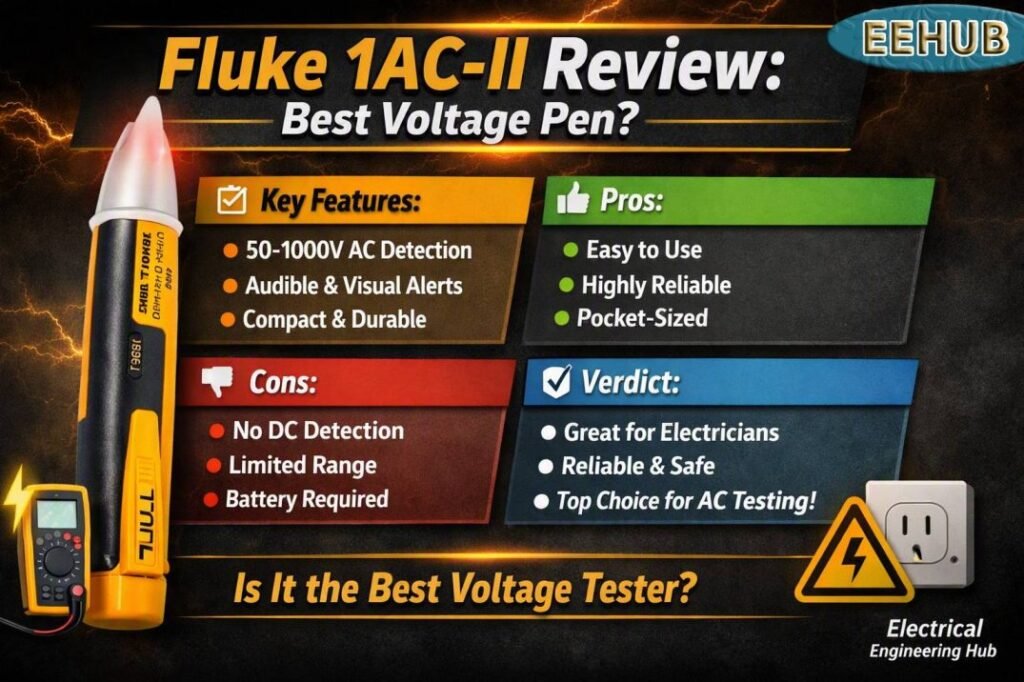
Table of Contents
Table of Contents
Fluke 1AC-II Review at a Glance
| Feature | Fluke 1AC-II |
|---|---|
| Detection Type | Non-contact AC voltage detection |
| Voltage Range | 90V–1000V AC |
| Safety Rating | CAT IV 1000V |
| Alert Type | Red LED + Audible Beeper |
| Battery | 2 × AAA |
| Flashlight | Yes |
| Auto Self-Test | Yes |
| Pocket Clip | Yes |
| Best For | Electricians, homeowners, maintenance technicians |
| Overall Rating | ⭐⭐⭐⭐⭐ (4.8/5) |
Looking for more models before buying? Check our complete guide to the best non contact voltage detector to compare the top-rated voltage pens for every budget and application.
Fluke 1AC-II Review
The Fluke 1AC-II is one of the most trusted non-contact voltage testers available today. Instead of touching exposed conductors, it detects the electric field around energized AC wiring.
Simply place the tip near an outlet, cable, breaker, or switch. When AC voltage is present, the tester flashes a bright red light and produces an audible beep.
Its compact size, rugged construction, and CAT IV safety rating make it suitable for electricians, HVAC technicians, maintenance professionals, and homeowners.
Unlike many low-cost voltage pens, the Fluke 1AC-II includes an automatic self-test that continuously checks whether the tester is working correctly before each measurement.
Key Specifications
| Specification | Details |
|---|---|
| Model | Fluke 1AC-II VoltAlert |
| Voltage Detection | 90–1000 VAC |
| Frequency | 45–405 Hz |
| Safety Category | CAT IV 1000V |
| Indicator | LED + Beeper |
| Flashlight | Integrated LED |
| Batteries | Two AAA |
| Weight | Approximately 67 g |
| Warranty | Limited manufacturer warranty |
Key Features
Wide Voltage Detection
The Fluke 1AC-II detects AC voltage from 90V to 1000V, making it suitable for residential, commercial, and industrial electrical systems.
VoltAlert Technology
Fluke's VoltAlert technology allows quick voltage detection without direct electrical contact, reducing the risk of accidental shock.
Built-In Self-Test
One of the biggest advantages is continuous self-testing. Every time the tester is used, it automatically verifies that it is functioning correctly.
Bright Flashlight
The integrated LED flashlight helps when working inside electrical panels, ceilings, basements, or poorly lit work areas.
Audible and Visual Alerts
The tester provides two warning methods:
- Bright red LED
- Loud audible beep
This combination makes energized conductors easy to identify.
CAT IV 1000V Safety Rating
This high safety rating makes the tester suitable for service entrances and distribution circuits where higher transient voltages may occur.
Performance in Real-World Use
This Fluke 1AC-II Review would not be complete without discussing actual field performance.
The tester responds quickly when approaching energized outlets, switches, junction boxes, extension cords, and breaker panels.
Response time is nearly instant, allowing electricians to verify live circuits before beginning work.
The plastic housing feels durable, while the pocket clip keeps the tester accessible throughout the day.
Battery life is also impressive because the tester consumes very little power during normal operation.
Pros and Cons
| Pros | Cons |
|---|---|
| Excellent build quality | Detects AC only |
| Trusted Fluke reliability | Cannot measure exact voltage |
| CAT IV 1000V safety | No adjustable sensitivity |
| Built-in flashlight | Slightly higher price |
| Continuous self-test | Not suitable for DC systems |
| Loud audible alert | None for professional users |
Who Should Buy the Fluke 1AC-II?
The Fluke 1AC-II is ideal for:
- Licensed electricians
- Electrical contractors
- Maintenance technicians
- HVAC professionals
- Building inspectors
- Homeowners performing electrical repairs
- DIY enthusiasts
If your work involves checking outlets, switches, breaker panels, or lighting circuits, this voltage pen is a practical investment.
Who Should Skip It?
Although the Fluke 1AC-II is excellent, it may not be the right choice if you need:
- DC voltage detection
- Adjustable sensitivity
- Exact voltage measurement
- Multimeter functions
In those situations, a digital multimeter or specialized tester will be a better option.
Accuracy and Reliability
One reason professionals continue buying Fluke products is reliability.
The Fluke 1AC-II consistently detects live AC conductors while reducing false readings compared to many inexpensive alternatives.
Its automatic self-check feature adds another layer of confidence before testing electrical equipment.
Remember that all non-contact voltage testers should first be verified on a known live source before and after testing.
Safety Tips
Always follow these best practices:
| Safety Tip | Why It Matters |
|---|---|
| Test on a known live outlet first | Confirms tester is working |
| Wear insulated PPE | Improves personal safety |
| Never rely on one tester alone | Verify with additional testing if needed |
| Replace weak batteries | Maintains reliable detection |
| Keep the tip clean | Improves sensitivity |
Fluke 1AC vs 2AC: Which Voltage Pen Is Better?
The Fluke 1AC vs 2AC comparison mainly comes down to sensitivity and application. Both are non-contact voltage detectors designed for quick AC voltage checks, while the Fluke 2AC is generally positioned as the more compact, straightforward option. For electricians who want a simple pen-style tester, either can complement a multimeter.
| Feature | Fluke 1AC-II | Fluke 2AC |
|---|---|---|
| Type | Non-contact AC voltage detector | Non-contact AC voltage detector |
| Voltage detection | 90–1000 V AC | 200–1000 V AC |
| Form factor | Pen-style | Compact pen-style |
| Visual indication | Red LED | Red LED |
| Audible alert | Yes | Yes |
| Best for | General electrical troubleshooting | Quick higher-voltage checks |
| Low-voltage sensitivity | Higher | Lower |
Which Should You Choose?
If you need broader detection capability, the 1AC-II is usually the better choice. This Fluke 1AC-II Review shows why it remains a popular voltage pen for electricians and DIY users. Choose the 2AC when you prefer a compact tester primarily for standard higher-voltage circuits. Always verify a circuit with an appropriate meter before performing electrical work.
Fluke 1AC-II vs Klein NCVT-1
| Feature | Fluke 1AC-II | Klein NCVT-1 |
|---|---|---|
| Voltage Range | 90–1000V | 50–1000V |
| Flashlight | Yes | Yes |
| Self-Test | Yes | Limited |
| Safety Rating | CAT IV 1000V | CAT IV 1000V |
| Brand Reputation | Excellent | Excellent |
| Overall Reliability | Outstanding | Very Good |
Both are excellent testers, but the Fluke 1AC-II earns higher marks for its automatic self-testing and long-term reliability.
Is the Fluke 1AC-II Worth the Money?
For most electricians, the answer is yes.
Although it costs more than generic voltage pens, the added safety, durability, dependable detection, and Fluke's reputation justify the price.
Many professionals continue using the same tester for years without issues.
If electrical safety matters, spending a little more on a quality tester is a wise decision.
Buy Fluke 1AC-II on Amazon
Ready to upgrade your electrical safety kit? Check today's price for the Fluke 1AC-II on Amazon and see why thousands of electricians trust this voltage pen every day. It is a smart addition to any professional or home toolbox.
If you are still comparing models, explore our complete guide to the best non contact voltage detector to find the right tester for your needs before making a purchase.
Final Verdict
This Fluke 1AC-II Review shows why it remains one of the best non-contact voltage testers available. It combines dependable performance, strong safety features, rugged construction, and easy operation in a compact design.
Whether you are troubleshooting household wiring or working on commercial electrical systems, the Fluke 1AC-II delivers the confidence professionals expect.
For buyers who value reliability over unnecessary features, this voltage pen is an excellent investment.
Related Guides
- Best Non-Contact Voltage Tester Under $30
- Klein NCT-2 vs Fluke 1AC ii
- Best Voltage Pen Tester
- Best Voltage Tester for Homeowners
Frequently Asked Questions
1. Is the Fluke 1AC-II good for professional electricians?
Yes. It is one of the most trusted non-contact voltage testers used by electricians because of its reliability, CAT IV safety rating, and automatic self-test.
2. Can the Fluke 1AC-II detect DC voltage?
No. It only detects AC voltage between 90V and 1000V.
3. Does the Fluke 1AC-II require direct contact with the wire?
No. It detects the electric field around energized conductors without touching exposed metal.
4. How long do the batteries last?
With normal use, the two AAA batteries typically provide several months of operation, depending on usage frequency.
5. Is the Fluke 1AC-II worth buying over cheaper voltage pens?
Yes. The Fluke 1AC-II offers better build quality, dependable voltage detection, continuous self-testing, and higher long-term reliability, making it a worthwhile investment for anyone who regularly works around electrical systems.
Get new guides in your feed. Follow Electrical Insights on LinkedIn for new electrical standards guides, calculators and design tips from Azad Circuit Hub.
#Fluke1ACIIReview, #VoltageTester, #NonContactVoltageTester, #FlukeTools, #ElectricalTools, #ElectricianGear, #VoltagePen, #ElectricalSafety, #ToolReview, #DIYElectrical
