
Best Voltage Tester for Homeowners
Working with electricity at home is never something to take lightly. Whether you are replacing a light switch, installing a ceiling fan, checking a faulty outlet, or troubleshooting a breaker, the first step is always verifying that power is off. That is why choosing the best voltage tester for homeowners is one of the smartest investments for DIY electrical safety.
Unlike professional electricians who often carry multiple testing instruments, homeowners need a reliable, easy-to-use, and affordable tester that provides accurate results without unnecessary complexity.
This guide compares the top voltage testers available today based on safety, ease of use, durability, accuracy, battery life, and overall value. By the end of this article, you’ll know exactly which model fits your needs.
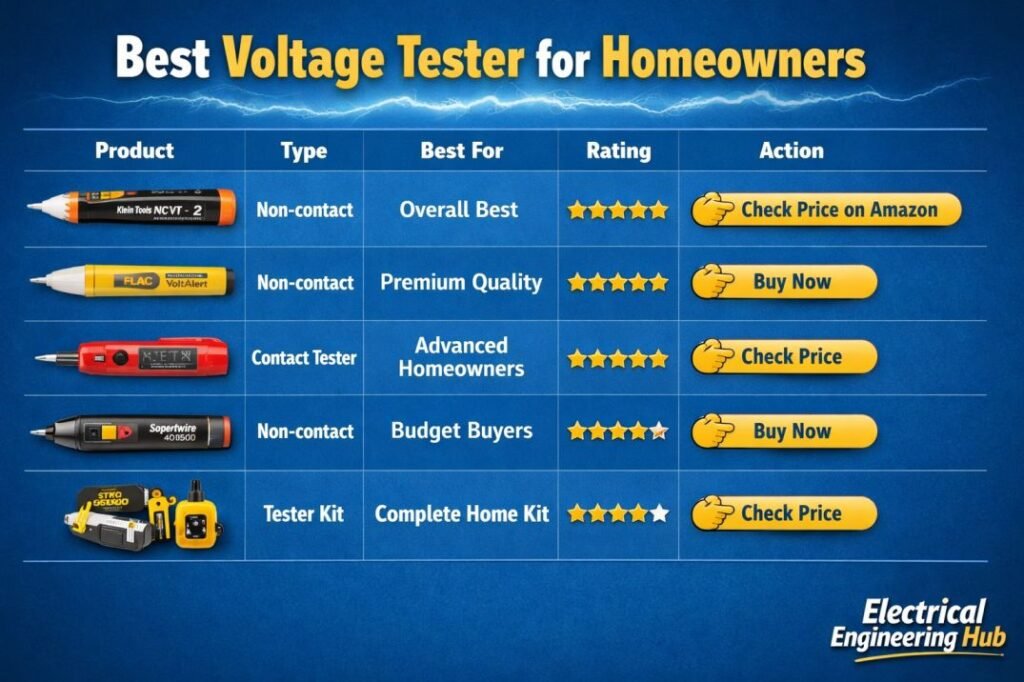
Table of Contents
Table of Contents
Quick Comparison Table
| Product | Type | Best For | Check Price |
|---|---|---|---|
| Klein Tools NCVT-2 | Non-contact | Overall Best | 👉 Check Price on Amazon |
| Fluke 1AC II VoltAlert | Non-contact | Premium Quality | 👉 Buy Now on Amazon |
| Klein ET45 | Contact Tester | Advanced Homeowners | 👉 Check Price on Amazon |
| Southwire 40150N | Non-contact | Budget Buyers | 👉 Buy Now on Amazon |
| Sperry STK001 | Tester Kit | Complete Home Kit | 👉 Check Price on Amazon |
Why Every Homeowner Needs a Voltage Tester
Electricity cannot be seen, smelled, or heard. Assuming a wire is de-energized can lead to serious injury.
The best voltage tester for homeowners helps you:
- Verify power before touching wires
- Check outlets safely
- Identify live circuits
- Test switches and light fixtures
- Troubleshoot extension cords
- Confirm breaker operation
- Perform DIY electrical repairs safely
Even if you only perform occasional repairs, a voltage tester is an essential safety tool.
How We Selected the Best Voltage Tester for Homeowners
Our recommendations are based on several important factors.
| Evaluation Factor | Importance |
|---|---|
| Safety Certifications | Very High |
| Ease of Use | Very High |
| Accuracy | High |
| Durability | High |
| Battery Life | Medium |
| Price | Medium |
| Customer Reviews | High |
Best Overall: Klein Tools NCVT-2
| Specification | Details |
|---|---|
| Voltage Range | 12–1000V AC |
| Detection | Non-contact |
| Flashlight | Yes |
| Audible Alarm | Yes |
| CAT Rating | CAT IV 1000V |
The Klein NCVT-2 remains one of the most trusted voltage testers for residential electrical work. It offers dual voltage detection, allowing users to test both low-voltage doorbells and standard household wiring.
The built-in flashlight is especially useful when working inside breaker panels, attics, basements, and crawl spaces.
Pros
- Extremely reliable
- Bright LED flashlight
- Dual sensitivity modes
- Excellent build quality
- Easy to carry
Cons
- Slightly more expensive than budget models
Best For
Homeowners wanting the best combination of safety, durability, and performance.
Buyer’s Recommendation
👉 Buy the Klein Tools NCVT-2 on Amazon if you want professional-level reliability for everyday home electrical work.
If you want a deeper comparison before purchasing, read our detailed guide on best non contact voltage tester.
Best Premium Choice: Fluke 1AC II VoltAlert
| Specification | Details |
|---|---|
| Voltage Range | 90–1000V AC |
| Detection | Non-contact |
| Audible Alert | Yes |
| Visual Indicator | Red Glow |
Fluke has earned its reputation by manufacturing some of the most dependable electrical testing equipment available.
The Fluke 1AC II is simple to operate. Just place the tip near the conductor, outlet, or switch. If voltage is present, the tester glows red and emits an audible beep.
It is ideal for homeowners who value premium quality and long-term reliability.
Pros
- Excellent accuracy
- Rugged construction
- Trusted brand
- Long battery life
Cons
- Does not detect low-voltage circuits
For a detailed comparison between the two leading models, read our complete article on klein ncvt-2 vs fluke 1ac ii.
Best Contact Voltage Tester: Klein ET45
Sometimes homeowners need more than a non-contact tester.
The Klein ET45 can verify:
- AC voltage
- DC voltage
- Continuity
- Polarity
- Ground faults
This makes it suitable for homeowners who frequently perform electrical maintenance and want more detailed measurements.
Pros
- Multiple testing functions
- LCD display
- CAT III safety rating
- Durable construction
Cons
- Requires direct contact with conductors
Best Budget Option: Southwire 40150N
Not everyone wants to spend premium money on occasional electrical work.
The Southwire 40150N offers dependable voltage detection at a very affordable price.
Features include:
- LED indication
- Audible alarm
- Pocket clip
- Compact design
- Lightweight body
It performs well for routine household testing without increasing your tool budget.
Buyer’s Recommendation
👉 Check today’s price on the Southwire 40150N if you need an affordable voltage tester for occasional DIY repairs.
Best Voltage Tester Kit: Sperry STK001
Instead of purchasing individual electrical testing tools, many homeowners prefer a complete kit.
The Sperry STK001 includes:
- Non-contact voltage tester
- GFCI outlet tester
- Batteries
- User instructions
This kit is ideal for first-time homeowners who want multiple testing tools in one package.
Pros
- Excellent value
- Beginner friendly
- Trusted brand
- Easy operation
Cons
- Basic features compared to premium testers
Non-Contact vs Contact Voltage Testers
| Feature | Non-Contact Tester | Contact Tester |
|---|---|---|
| Touch Wire Required | No | Yes |
| Safer for Beginners | Yes | No |
| Measures Exact Voltage | No | Yes |
| Quick Testing | Excellent | Good |
| Best for Homeowners | Excellent | Very Good |
For most people, the best voltage tester for homeowners is a quality non-contact voltage tester because it offers the highest level of convenience and safety.
Features to Look for Before Buying
Safety Rating
Always choose testers with CAT III or CAT IV safety ratings.
Audible Alert
A loud beep makes it easier to detect energized circuits.
LED Indicator
Bright visual indicators improve visibility during daylight.
Built-in Flashlight
Working inside breaker panels often requires additional lighting.
Auto Power Off
This feature extends battery life.
Pocket Clip
Easy carrying encourages homeowners to keep the tester nearby whenever working around electricity.
Common Home Projects That Require a Voltage Tester
| Project | Voltage Tester Needed |
|---|---|
| Replacing outlets | Yes |
| Installing ceiling fans | Yes |
| Changing switches | Yes |
| Replacing light fixtures | Yes |
| Checking breakers | Yes |
| Troubleshooting dead outlets | Yes |
| Installing smart switches | Yes |
Safety Tips When Using a Voltage Tester
- Always test the tester on a known live circuit first.
- Replace weak batteries immediately.
- Never rely on a damaged tester.
- Follow manufacturer instructions.
- Turn off the breaker whenever possible.
- Wear insulated gloves during electrical work.
- Keep the tester clean and dry.
Which Voltage Tester Is Best for Most Homeowners?
| User Type | Recommended Product |
|---|---|
| First-Time Homeowner | Sperry STK001 |
| Best Overall | Klein NCVT-2 |
| Premium Choice | Fluke 1AC II |
| Budget Buyer | Southwire 40150N |
| Advanced DIY User | Klein ET45 |
Overall, the Klein Tools NCVT-2 remains the best voltage tester for homeowners because it balances safety, accuracy, ease of use, and long-term durability.
Buyer’s Recommendation
👉 Buy the Klein NCVT-2 today if you want a dependable tester that will serve you for years and help make every electrical project safer.
If you’re specifically looking for compact pen-style testers, don’t miss our in-depth review of the best voltage pen tester to compare more top-rated options.
Related Guides
Frequently Asked Questions
What is the best voltage tester for homeowners?
The Klein Tools NCVT-2 is widely considered the best voltage tester for homeowners because it offers dual voltage detection, a built-in flashlight, reliable performance, and excellent safety features.
Are non-contact voltage testers accurate?
Yes. High-quality non-contact voltage testers accurately detect the presence of AC voltage. However, they do not measure the exact voltage level.
Can a voltage tester detect DC voltage?
Most non-contact voltage testers only detect AC voltage. If you need to test DC circuits, choose a contact voltage tester or a digital multimeter.
Is a voltage tester better than a multimeter?
For basic home electrical safety, a voltage tester is faster and easier to use. A multimeter provides more detailed electrical measurements but requires greater knowledge.
How often should I replace a voltage tester?
Replace the tester immediately if it becomes damaged, fails a known live test, or shows inconsistent operation. With proper care, a quality tester can last for many years.
Final Verdict
Choosing the best voltage tester for homeowners is not just about convenience—it is about protecting yourself before every electrical project. A dependable tester can help prevent electrical shock, confirm circuits are de-energized, and make DIY repairs much safer.
For most homeowners, the Klein Tools NCVT-2 is the top recommendation because of its dependable performance, dual-voltage detection, rugged construction, and user-friendly design. Those looking for premium quality can confidently choose the Fluke 1AC II, while budget-conscious buyers will find excellent value in the Southwire 40150N. If you want a complete starter package, the Sperry STK001 offers everything needed for common household electrical tasks.
Get new guides in your feed. Follow Electrical Insights on LinkedIn for new electrical standards guides, calculators and design tips from Azad Circuit Hub.
#BestVoltageTesterForHomeowners, #VoltageTester, #ElectricalSafety, #DIYElectrical, #NonContactVoltageTester, #HomeMaintenance, #ElectricianTools, #HomeImprovement, #ElectricalTesting, #SafetyFirst
