
Fluke 1AC-II vs Fluke 2AC Alert: Full Comparison
Choosing between two Fluke non-contact voltage testers can be confusing because the Fluke 1AC-II and Fluke 2AC Alert look similar and serve the same basic purpose. Both are compact voltage detectors designed to help electricians identify the presence of AC voltage without making direct contact with a conductor.
This Fluke 1AC-II vs Fluke 2AC Alert comparison looks at voltage detection range, safety features, sensitivity, operation, size, applications, and overall value. The goal is to help you choose the right tester for residential, commercial, industrial, and maintenance work.
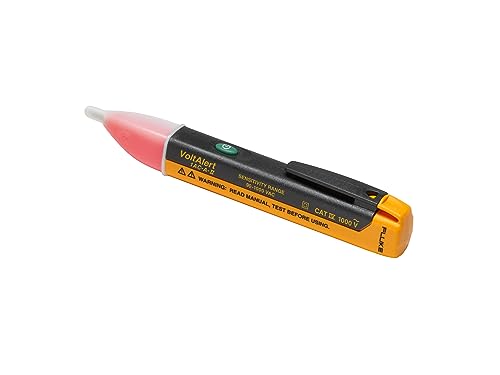

Fluke 1AC-II vs Fluke 2AC Alert: Quick Comparison
| Feature | Fluke 1AC-II | Fluke 2AC Alert |
|---|---|---|
| Product type | Non-contact AC voltage detector | Non-contact AC voltage detector |
| Detection range | 90–1,000 V AC | 200–1,000 V AC |
| Voltage detection | AC voltage | AC voltage |
| Contact with conductor | Not required | Not required |
| Visual indication | LED indication | LED indication |
| Audible alert | Yes | Yes |
| Self-test | Yes | Yes |
| Compact design | Yes | Yes |
| Pocket clip | Yes | Yes |
| Typical use | Residential and general electrical work | Higher-voltage electrical applications |
| Best feature | Lower detection threshold | Simple, rugged voltage detection |
| Battery powered | Yes | Yes |
The biggest difference is the lower voltage detection threshold. The Fluke 1AC-II can detect AC voltage from around 90 V, while the Fluke 2AC Alert is generally intended for higher-voltage circuits starting around 200 V.
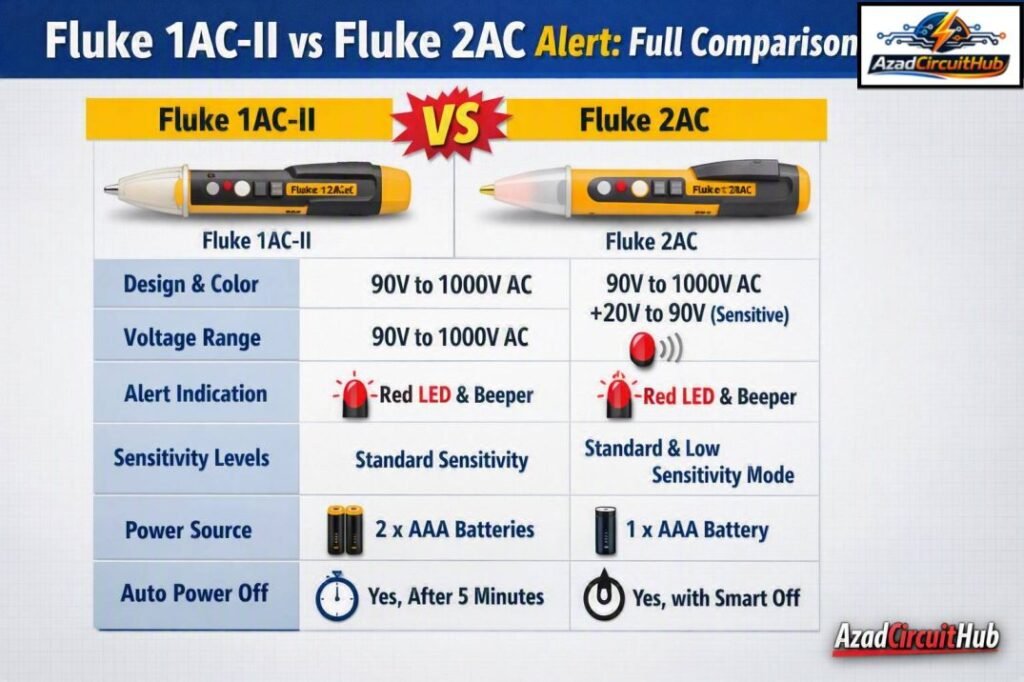
Table of Contents
Table of Contents
What Is the Fluke 1AC-II?
The Fluke 1AC-II VoltAlert is a compact non-contact voltage detector designed for quick checks around electrical wiring, outlets, switches, panels, and other AC circuits.
It is particularly useful when an electrician wants to determine whether voltage may be present before making contact with a conductor. The tester can be placed near an insulated wire, terminal, outlet, or other electrical point. When an appropriate AC electric field is detected, the tester provides an indication.
One advantage of the 1AC-II is its relatively low detection threshold. This makes it more useful for applications where the circuit voltage may be below typical 200 V systems.
The Fluke 1AC-II vs Fluke 2AC Alert decision therefore starts with a simple question: do you need to detect lower-voltage AC circuits?
Key Fluke 1AC-II Features
- Non-contact AC voltage detection
- Detection range starting at approximately 90 V AC
- Audible and visual indication
- Compact pen-style design
- Built-in battery operation
- Useful pocket clip
- Suitable for electrical troubleshooting and preliminary voltage checks
- Designed for quick go/no-go testing
The 1AC-II is not a replacement for a properly rated multimeter or two-pole voltage tester when an electrician needs to prove a circuit is de-energized.
What Is the Fluke 2AC Alert?
The Fluke 2AC Alert is another pen-style non-contact voltage detector from Fluke. It is designed for quick identification of AC voltage without requiring the test probe to touch the energized conductor.
Its higher voltage threshold makes it particularly suited to common 230 V and 240 V electrical systems, as well as many higher-voltage applications within its rated range.
The 2AC Alert is simple to operate. The user brings the detector near the suspected energized source and watches for the visual and audible alert.
Key Fluke 2AC Alert Features
| Feature | Benefit |
|---|---|
| Non-contact detection | Allows quick preliminary voltage checks |
| 200–1,000 V AC range | Well suited to higher-voltage AC systems |
| Audible indication | Useful when visual indication is difficult |
| LED indication | Provides a clear visual warning |
| Compact pen shape | Easy to carry in a tool pouch |
| Automatic operation | Requires minimal user interaction |
| Pocket clip | Keeps the tester accessible |
For electricians who mainly work on 230 V or 240 V circuits, the 2AC Alert can be a practical choice when its detection range matches the application.
Fluke 1AC-II vs Fluke 2AC Alert: Voltage Range
Voltage range is the most important difference between these two testers.
The 1AC-II has a lower nominal detection threshold of about 90 V AC. The 2AC Alert is designed for approximately 200–1,000 V AC detection.
| Application | 1AC-II | 2AC Alert |
|---|---|---|
| 120 V AC circuit | Suitable | Not the intended range |
| 208 V AC system | Suitable | Suitable |
| 230 V AC circuit | Suitable | Suitable |
| 240 V AC circuit | Suitable | Suitable |
| 480 V AC system | Suitable | Suitable |
| 600 V AC system | Suitable | Suitable |
| Up to 1,000 V AC | Suitable within rating | Suitable within rating |
This gives the 1AC-II an advantage for electricians who work across both lower and higher AC voltage systems.
However, detection depends on factors such as distance, insulation, conductor arrangement, grounding, electromagnetic interference, and the strength of the electric field. A non-contact voltage tester should therefore be treated as a screening tool rather than absolute proof of circuit status.
Sensitivity and Detection Performance
A non-contact voltage detector does not directly measure voltage in the same way as a multimeter. Instead, it senses the electric field associated with an energized AC conductor.
This means a tester can sometimes behave differently depending on the installation.
For example, thick insulation, shielded cables, tightly grouped conductors, or unusual wiring arrangements can affect detection. Low-voltage signals may also be more difficult to detect with a tester designed for a higher threshold.
The Fluke 1AC-II vs Fluke 2AC Alert comparison favors the 1AC-II when broader AC voltage detection is important.
Which One Is Better for 120 V Circuits?
The Fluke 1AC-II is the better choice between the two for typical 120 V AC circuits because its detection range begins around 90 V.
The 2AC Alert, with its higher nominal detection threshold, is not the preferred option for routine 120 V circuit checks.
For residential electricians working primarily with North American 120 V branch circuits, receptacles, lighting circuits, and similar wiring, the 1AC-II provides a more suitable detection range.
If your work includes both 120 V and 240 V systems, the 1AC-II also provides greater flexibility.
For readers who want to compare additional options, a non touch voltage tester with the appropriate detection range can be a useful addition to an electrician’s everyday tool kit.
Which One Is Better for 230 V and 240 V Systems?
Both testers can be useful on 230 V and 240 V systems when operated within their specifications.
The 2AC Alert’s higher detection threshold is well matched to these systems, while the 1AC-II provides additional range below and above these common voltages.
For an electrician working mainly with 230 V industrial, commercial, or residential circuits, either can serve as a convenient preliminary voltage detector.
A multimeter or properly rated voltage tester should still be used when an exact voltage measurement is required.
Safety Considerations
A non-contact voltage detector is an important convenience tool, but it should never be treated as the only method for establishing that a circuit is safe to work on.
Follow these practices:
- Inspect the tester before use.
- Confirm that the battery is working.
- Test the detector on a known energized source.
- Check the suspected circuit.
- Recheck the tester on the known energized source.
- Use an appropriately rated contact voltage tester or multimeter when required.
- Follow applicable electrical safety procedures and lockout/tagout requirements.
This known-live → test → known-live approach helps confirm that the detector was functioning before and after the check.
Fluke 1AC-II vs Fluke 2AC Alert: Ease of Use
Both models are designed around simplicity. There are no complicated measurement settings to configure, which makes them useful for quick field checks.
| Usability factor | 1AC-II | 2AC Alert |
|---|---|---|
| One-handed operation | Yes | Yes |
| Compact pen design | Yes | Yes |
| Audible warning | Yes | Yes |
| Visual warning | Yes | Yes |
| Quick circuit screening | Excellent | Excellent |
| Lower-voltage detection | Better | Limited by higher threshold |
The main usability difference is therefore not the operating procedure but the voltage range each tester is designed to detect.
Which Tester Should Electricians Buy?
Choose the Fluke 1AC-II if you:
- Work on 120 V circuits.
- Need a wider AC detection range.
- Work on both residential and commercial systems.
- Want one compact tester for a variety of AC voltage applications.
- Frequently troubleshoot outlets, switches, lighting, and panels.
Choose the Fluke 2AC Alert if you:
- Primarily work with 200 V and higher AC systems.
- Work frequently on 230 V, 240 V, or higher circuits.
- Want a simple higher-voltage non-contact detector.
- Already have another instrument for lower-voltage testing.
For many electricians, the broader detection capability makes the 1AC-II the more versatile option.
Need a Better Non-Contact Voltage Tester?
If you are comparing more than these two Fluke models, our guide to the best non contact voltage tester can help you compare detection ranges, safety ratings, sensitivity, features, and use cases before buying.
Fluke 1AC-II vs Fluke 2AC Alert: Final Verdict
The Fluke 1AC-II and Fluke 2AC Alert are both useful tools for quickly checking for the presence of AC voltage. Their compact designs make them convenient for electricians, maintenance technicians, HVAC professionals, and DIY users.
The key difference is their voltage detection range. The 1AC-II starts at a lower nominal voltage and therefore offers greater versatility, especially for 120 V systems. The 2AC Alert is better suited to applications where the expected voltage is 200 V or higher.
For general electrical work across different voltage systems, the Fluke 1AC-II is the stronger all-around choice. For focused work on higher-voltage AC systems, the 2AC Alert remains a practical option.
Remember that neither device measures voltage like a multimeter. Always follow the manufacturer’s instructions and applicable electrical safety procedures when testing or working around energized equipment.
Frequently Asked Questions
Is the Fluke 1AC-II better than the Fluke 2AC Alert?
The 1AC-II is generally more versatile because its nominal detection range starts lower, making it suitable for both 120 V and higher-voltage AC applications. The 2AC Alert is more focused on higher-voltage AC detection.
Can the Fluke 1AC-II detect 120 V?
Yes. The 1AC-II is designed to detect AC voltage beginning at approximately 90 V, so it is suitable for preliminary checks on typical 120 V circuits.
Can the Fluke 2AC detect 120 V?
The 2AC Alert is designed for a higher nominal detection range, around 200–1,000 V AC. Therefore, it should not be selected when reliable detection of typical 120 V circuits is a primary requirement.
Is a Fluke non-contact voltage tester safe for electricians?
A properly rated Fluke voltage detector is a useful safety tool for preliminary voltage detection. However, it should not be the sole method used to establish that a circuit is de-energized. Follow electrical safety procedures and use an appropriate contact voltage tester or multimeter when required.
What is the best non-touch voltage tester for electricians?
The best choice depends on the voltage range, environment, sensitivity, safety requirements, and intended application. The Fluke 1AC-II is a versatile option when both lower and higher AC voltage detection are needed, while the 2AC Alert is suited to higher-voltage applications.
Final Buying Tip
Before purchasing, check the actual voltage range printed on the tester and the latest manufacturer’s specifications for the exact model. If your work involves several voltage levels, choosing a detector with a broader operating range can reduce the need to carry multiple preliminary voltage-testing tools.
For specialized applications where detecting lower AC voltage is important, a low voltage non contact tester may be more appropriate than a detector designed primarily for higher-voltage circuits.
Get new guides in your feed. Follow Electrical Insights on LinkedIn for new electrical standards guides, calculators and design tips from Azad Circuit Hub.
#Fluke1ACII, #Fluke2ACAlert, #FlukeVoltageTester, #VoltageDetector, #NonContactVoltageTester, #FlukeTester, #ElectricalTesting, #ElectricianTools, #VoltageTesterComparison, #ElectricalSafety
