
Best Non-Contact Voltage Tester for Electric Fence: Top 4
Finding the right Voltage Tester for Electric Fence work is important because electric fences use short, high-voltage pulses rather than the steady voltage found on a typical household circuit. A suitable fence tester helps confirm whether the energizer is producing a pulse and gives a quick indication of fence performance.
As an electrical engineer with hands-on experience in electrical systems, troubleshooting, and power equipment, I recommend using a tester designed specifically for electric-fence pulses rather than assuming a standard household non-contact voltage detector will work reliably. The tester should match the fence voltage range and be easy to read in outdoor conditions.
For this guide, I compared four electric-fence testers based on voltage range, display method, portability, ease of use, and practical value.
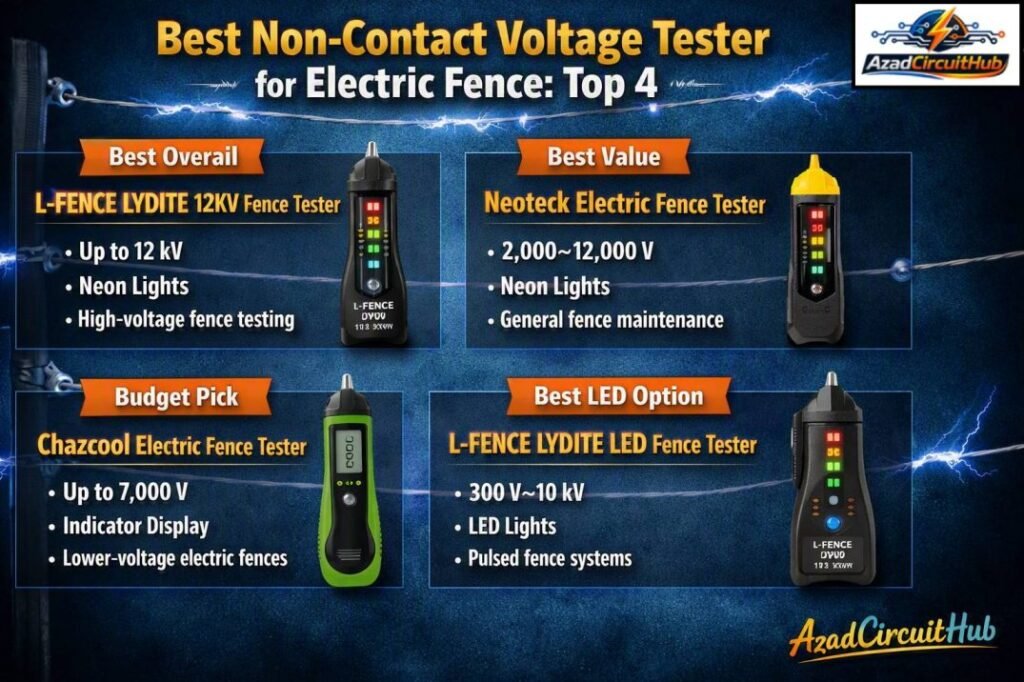
Table of Contents
Table of Contents
1. L-FENCE LYDITE Fence Electric Fence Voltage Tester, 12KV
The L-FENCE LYDITE 12KV model is my top choice for users who want a wide testing range and a simple visual indication. It is rated for electric-fence voltages up to 12 kV and uses eight neon indicator lights to provide a quick voltage-level indication.
The broad range makes it useful for many agricultural, livestock, perimeter-security, and farm fence applications. Instead of carrying a general-purpose electrical meter into a field, a dedicated fence tester is much easier to use for a quick go/no-go inspection.
The eight-light indicator system is also useful when checking different fence sections. If the indication becomes noticeably weaker farther along the fence, it can help point you toward a possible fault, poor connection, vegetation contact, or grounding problem.
Key features:
- Up to 12,000 V testing range
- Eight neon indicator lights
- Designed for electric-fence voltage checking
- Compact and portable design
- Simple visual indication
- Useful for routine fence troubleshooting
Affiliate pick: Check the L-FENCE LYDITE 12KV Electric Fence Tester on Amazon
2. Neoteck 2000–12000V Electric Fence Voltage Tester
The Neoteck electric fence tester covers a 2,000 to 12,000 V range and uses eight neon lights for voltage indication. It is a strong option for users who want a dedicated fence voltage checker without needing a more complicated digital instrument.
One advantage of an indicator-based tester is speed. For routine maintenance, you often need to know whether the energizer is producing an appropriate pulse rather than record a highly precise laboratory measurement.
The Neoteck is particularly suitable for farmers, fence installers, property owners, and maintenance technicians who regularly inspect long electric-fence runs.
Neoteck Specifications
| Feature | Details |
|---|---|
| Voltage range | 2,000–12,000 V |
| Indicator | 8 neon lights |
| Application | Electric fences |
| Measurement approach | Visual voltage indication |
| Best use | Routine inspection and troubleshooting |
Buyer's tip: If your fence system normally operates below 2,000 V, this model may not be the best match because its stated range begins at 2 kV.
See the Neoteck 2000–12000V Fence Tester on Amazon
3. Chazcool 7000V Electric Fence Tester
The Chazcool 7000V Electric Fence Tester is a simpler choice for electric-fence systems within its stated 7 kV maximum range. It can be a practical budget option for basic inspection where a very wide voltage range is not required.
A dedicated fence tester is especially useful when troubleshooting intermittent fence performance. A low indication may lead you to inspect the energizer, fence joints, insulators, grounding system, vegetation contact, or damaged wire.
Before purchasing, check the output specification of your fence energizer. Selecting a tester based only on price can result in a device that does not adequately cover the operating voltage of the fence.
Recommended for: Basic electric-fence maintenance, smaller installations, and users who do not need a tester rated to 10 or 12 kV.
Check the Chazcool 7000V Electric Fence Tester on Amazon
4. L-FENCE LYDITE Electric Fence Tester with LED Indicators
The second L-FENCE LYDITE model is different from the 12 kV version because its stated testing range starts at 300 V and extends to 10 kV. It uses LED indicator lights and is designed for pulsed electric-fence systems.
The lower stated starting voltage can make this model attractive where the fence voltage may be below the operating range of testers that start at 2 kV.
LED indicators are also easy to see during routine inspection. However, users should always compare the tester's published range with the energizer's output and follow the manufacturer's instructions before testing.
L-FENCE LED Model at a Glance
| Feature | Details |
|---|---|
| Stated range | 300 V–10 kV |
| Indicator | LED lights |
| Application | Pulsed electric fences |
| Main advantage | Wider low-to-high range |
| Suitable users | Farmers, installers, maintenance technicians |
View the L-FENCE LYDITE LED Electric Fence Tester on Amazon
Which Voltage Tester for Electric Fence Should You Buy?
My recommendation is the L-FENCE LYDITE 12KV Fence Electric Fence Voltage Tester.
The main reason is its 12 kV maximum rating combined with eight neon indicators. That gives it a useful operating range for many high-voltage electric-fence applications while keeping the interface simple.
If your fence operates at a lower voltage, however, the L-FENCE LED model with its stated 300 V–10 kV range may be more appropriate. The Neoteck is another good choice for systems in the 2–12 kV range, while the Chazcool is worth considering for installations up to 7 kV.
| Your Requirement | Recommended Model |
|---|---|
| Best overall | L-FENCE LYDITE 12KV |
| 2–12 kV range | Neoteck |
| Up to 7 kV | Chazcool |
| 300 V–10 kV | L-FENCE LYDITE LED |
| Eight visual indicators | L-FENCE 12KV or Neoteck |
Can a Non-Contact Voltage Tester Detect an Electric Fence?
This is an important distinction. A conventional non-contact AC voltage detector is normally designed to sense an alternating electric field around energized wiring. An electric fence produces high-voltage pulses, and the pulse characteristics can vary significantly between energizers.
For that reason, you should not assume that an ordinary household NCVT will provide a reliable indication of fence voltage. A dedicated electric-fence tester is designed specifically for this application.
Some products marketed for electric-fence testing are also described as voltage detectors, but their operating method and intended application should be checked carefully. Always follow the product instructions and maintain a safe distance from the conductor.
For broader electrical applications, see our best non contact voltage tester guide to compare general-purpose voltage detection tools.
How to Test an Electric Fence Safely
Electric fences are designed to deliver brief pulses rather than continuous current, but the voltage can be several thousand volts. The high voltage means careless testing can still cause injury, particularly to people with certain medical conditions.
Use these basic precautions:
- Read the tester and energizer manufacturer's instructions before testing.
- Never touch the fence conductor with your bare hand to determine whether it is energized.
- Use a tester specifically rated for the fence voltage.
- Keep children and unauthorized people away from the fence during troubleshooting.
- Avoid testing during wet conditions when your footing or insulation may be compromised.
- Check the fence grounding system if the voltage indication is unexpectedly low.
- Inspect insulators and fence wires for contact with vegetation.
- Disconnect the energizer before making physical repairs to the fence.
For general electrical inspection, our guide to the non contact voltage tester range can help you choose a suitable tool for conventional electrical work.
What to Look for in an Electric Fence Tester
The first consideration should be voltage range. A tester must be suitable for the output produced by the energizer. A 7 kV tester, for example, is not the same choice as a unit rated to 12 kV.
The display is another consideration. Neon indicators are simple and can provide quick visual feedback, while LED indicators may be easier for some users to read.
Portability also matters. Electric-fence troubleshooting often involves walking along hundreds of metres of fence, so a compact tester is more practical than a large bench-style instrument.
If you work across residential and industrial electrical systems as well as fencing, our best voltage detector guide provides additional options for everyday voltage checks.
Electric Fence Troubleshooting With a Voltage Tester
A fence tester is most useful as part of a systematic troubleshooting process. If the voltage is good near the energizer but becomes weaker farther along the fence, inspect the fence for leakage points.
Common causes include:
- Broken or loose fence connections
- Vegetation touching the conductor
- Damaged insulators
- Poor grounding
- Corroded joints
- Damaged underground connections
- Faulty energizer components
- Excessive fence length for the energizer
Testing several points along the fence can help narrow down the location of a problem. However, an indicator tester should not be treated as a substitute for proper electrical diagnostics when an energizer or fence system requires detailed repair.
If you also work with Klein tools for conventional electrical inspection, see our guide to the klein non contact voltage tester range for additional voltage-detection options.
Final Verdict
For most users, the L-FENCE LYDITE 12KV is the best overall choice from these four products because of its 12 kV rating and eight neon indicators. It offers a straightforward approach to checking high-voltage electric-fence pulses without the complexity of a general-purpose electrical meter.
The Neoteck is a close alternative for 2–12 kV systems, while the Chazcool makes sense when the fence voltage is within its 7 kV rating. The L-FENCE LED model is especially interesting when a tester with a stated 300 V starting range is preferred.
Always confirm the fence energizer's specifications before purchasing, and never use an electrical tester outside its rated range.
Frequently Asked Questions
Is a non-contact voltage tester safe for an electric fence?
A conventional non-contact voltage detector should not automatically be assumed suitable for electric fences. Electric fences generate short high-voltage pulses, so a tester specifically designed and rated for fence systems is the safer and more reliable choice.
What voltage does an electric fence normally have?
Electric-fence energizers commonly produce pulses in the several-thousand-volt range, although the actual output depends on the energizer and fence design. Always check the manufacturer's specifications rather than assuming a standard voltage.
Can I use a multimeter to test an electric fence?
A standard multimeter should not be connected directly to a high-voltage electric fence unless it is specifically designed and rated for that application. A dedicated fence tester is generally more appropriate for routine pulse-voltage checks.
Why does my electric fence tester show low voltage?
Low indication can result from vegetation touching the wire, poor grounding, damaged insulators, loose connections, corrosion, excessive fence loading, or an issue with the energizer. Test at multiple points to help locate where the voltage begins to drop.
What is the best Voltage Tester for Electric Fence?
For the products compared here, I recommend the L-FENCE LYDITE 12KV model because it combines a high 12 kV rating with eight neon indicator lights. However, the correct choice depends on your energizer's actual voltage and the tester's specified operating range.
Get new guides in your feed. Follow Electrical Insights on LinkedIn for new electrical standards guides, calculators and design tips from Azad Circuit Hub.
#NonContactVoltageTester, #ElectricFenceTester, #VoltageDetector, #ElectricFenceSafety, #ElectricalTesting, #VoltageTester, #ElectricianTools, #FenceVoltage, #ElectricalSafety, #ElectricalTools
