
Klein Tools NCVT1P Voltage Tester Review: Detailed Overview
If you work around electrical panels, outlets, switches, lighting circuits, or general wiring, a dependable voltage detector is one of the most useful tools you can keep in your pocket. The Klein Tools NCVT1P is designed for exactly this type of quick voltage check.
In this Klein Tools NCVT1P Voltage Tester Review, I look at its detection capability, usability, safety features, construction, limitations, and overall value. As an electrical engineer with extensive experience working with electrical systems and automation equipment, I prefer a voltage tester that is simple enough for everyday checks but predictable enough to trust as part of a proper testing procedure.
The NCVT1P is not intended to replace a multimeter or two-pole voltage tester. Instead, it provides a fast, non-contact way to identify the presence of AC voltage before you begin more detailed electrical testing.
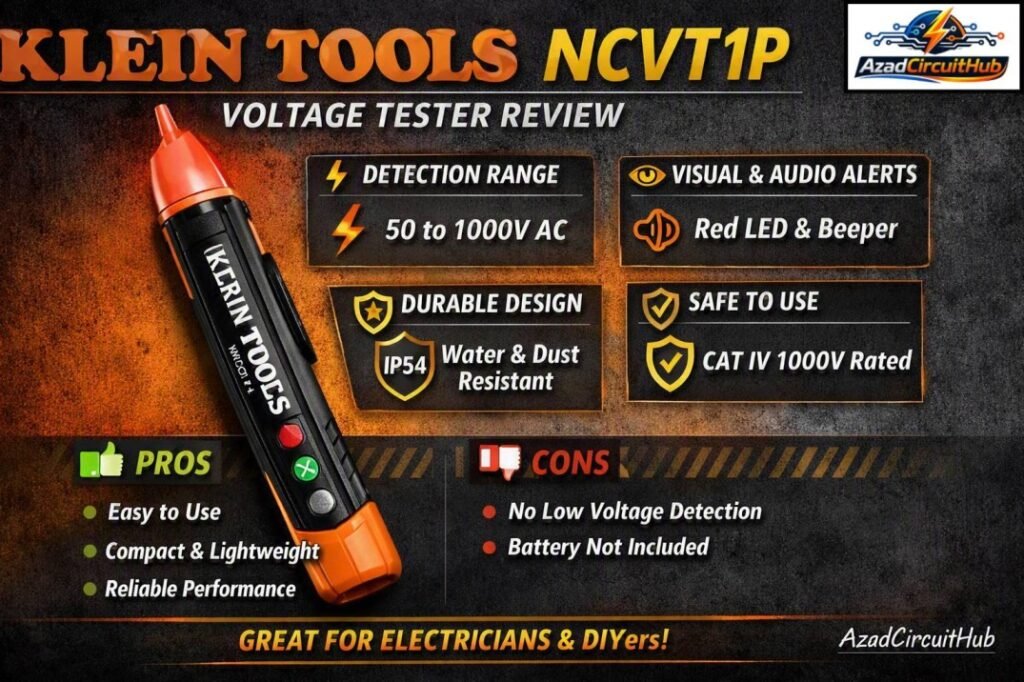
Table of Contents
Table of Contents
Klein Tools NCVT1P Voltage Tester Review at a Glance
| Feature | Klein Tools NCVT1P |
|---|---|
| Tool type | Non-contact voltage tester |
| Voltage detection | AC voltage detection |
| Detection method | Non-contact |
| Indicator | Visual and audible indication |
| Operation | One-button design |
| Power | Replaceable batteries |
| Tip design | Integrated probe tip |
| Pocket friendly | Yes |
| Typical use | Outlets, wires, switches, panels and fixtures |
| Best for | Electricians, technicians and DIY users |
| Brand | Klein Tools |
| Safety role | Preliminary voltage detection |
The biggest advantage is its simplicity. There is no complicated range selection, test lead connection, or display menu. Turn the tester on, bring the tip close to the suspected energized conductor, and watch for the voltage indication.
What Is the Klein Tools NCVT1P?
The Klein Tools NCVT1P is a pen-style non-contact voltage tester designed to detect AC voltage without making direct electrical contact with the conductor.
That makes it particularly useful when you need a quick preliminary check. For example, before opening an outlet box, working around a switch, tracing a wire, or inspecting a circuit, a non-contact detector can provide an additional indication of whether voltage may be present.
In this Klein Tools NCVT1P Voltage Tester Review, one point is especially important: a non-contact tester should be treated as a screening tool, not the final proof that a circuit is de-energized.
A proper electrical safety procedure still requires an appropriately rated test instrument and verification method when working on circuits.
Key Features and Design
The NCVT1P follows the familiar pen-style design used by many professional electricians. Its compact shape makes it easy to carry in a shirt pocket, tool pouch, or electrical tool bag.
Non-Contact Voltage Detection
The main feature is its ability to detect AC voltage without touching the bare conductor.
This is useful when checking:
- Electrical outlets
- Switch boxes
- Exposed conductors
- Extension cords
- Lighting circuits
- Circuit breakers
- Junction boxes
- Electrical panels
The non-contact approach also reduces the need to place a probe directly against a potentially energized conductor during an initial inspection.
Visual and Audible Indication
The tester provides an indication when AC voltage is detected. The combination of visual and audible feedback is useful in busy electrical environments where you may not always be looking directly at the tool.
For an electrician, this is a practical feature rather than a gimmick. When troubleshooting several conductors, a clear indication can make the first-pass inspection faster.
Compact Pen-Style Construction
The small body is another strong point. A voltage detector is most useful when you actually have it with you, and the NCVT1P does not take much room.
Its pen-style format also makes it easier to reach into areas where a larger electrical tester would be inconvenient.
NCVT1P Performance in Everyday Electrical Work
One reason the NCVT1P stands out in this class is that it focuses on one basic task instead of trying to become a multimeter.
During routine electrical work, there are many situations where you simply want to know whether an AC source may be energized. Pulling out a full multimeter for every preliminary check can be unnecessary.
This is where the NCVT1P makes sense.
For example, if I am preparing to inspect an outlet, I would first perform a quick visual inspection and then use a non-contact tester as an initial screening step. If the situation requires confirmation of voltage or verification that a circuit is de-energized, I would move to an appropriately rated contact tester or multimeter.
That distinction is important for safe electrical work.
If you are building a complete electrical testing kit, our non-contact voltage detector guide can help you compare different detector types and choose the right option for your work.
Klein Tools NCVT1P Pros and Cons
| Pros | Cons |
|---|---|
| Compact pen-style design | Does not provide an exact voltage reading |
| Easy one-button operation | Not a substitute for a multimeter |
| Non-contact AC detection | Detection can be affected by installation conditions |
| Audible and visual indication | Primarily intended for preliminary checks |
| Easy to carry | Limited compared with multifunction testers |
| Useful for quick troubleshooting | Requires batteries |
The NCVT1P's limitations are mostly related to what it is designed to do. It is a voltage detector, not a digital multimeter.
Is the Klein Tools NCVT1P Accurate?
Accuracy is a slightly different concept with a non-contact voltage detector.
A multimeter can display a measured voltage value, while a non-contact tester indicates the presence of an electric field associated with AC voltage. Therefore, you should not use the NCVT1P when you need to know whether a circuit measures 120 V, 208 V, 240 V, or another specific value.
In this Klein Tools NCVT1P Voltage Tester Review, I would rate its usefulness based on detection rather than numerical measurement.
The tester is best viewed as an initial warning and screening device.
If a circuit needs to be proven dead before electrical work, follow the appropriate lockout/tagout and electrical safety procedures and use a properly rated test instrument.
NCVT1P vs Multimeter
| Factor | NCVT1P | Digital Multimeter |
|---|---|---|
| Contact required | No | Usually yes |
| Voltage value | No | Yes |
| Quick screening | Excellent | Good |
| Resistance testing | No | Yes |
| Continuity testing | No | Yes |
| Current measurement | No | Some models |
| Portability | Excellent | Good |
| Detailed troubleshooting | Limited | Excellent |
| Ease of use | Very simple | Requires more knowledge |
This comparison explains why electricians often carry both tools. A non-contact tester provides speed, while a multimeter provides measurement and diagnostic information.
Who Should Buy the NCVT1P?
The NCVT1P is a good choice for anyone who frequently performs basic AC electrical checks and wants a compact tester that can stay in a tool pouch.
It is particularly suitable for:
- Electricians
- Electrical technicians
- Maintenance personnel
- HVAC technicians
- Solar and building-service technicians
- Facilities teams
- Experienced DIY users
It is also useful as a secondary tool for professionals who already own a multimeter or clamp meter.
Ready to Add One to Your Tool Bag?
If you want a compact Klein Tools voltage detector for quick AC checks, you can check the current Amazon price and availability here:
Prices and availability can change, so check the current Amazon listing before purchasing.
Safety Tips When Using a Non-Contact Voltage Tester
A voltage detector should always be used as part of a safe testing procedure.
Keep these points in mind:
- Test the tester on a known energized source before relying on it.
- Check the tester again after the measurement when appropriate.
- Do not assume a negative indication automatically means a circuit is safe.
- Follow your electrical safety procedures and applicable codes.
- Use a properly rated contact tester or multimeter when voltage confirmation is required.
- Replace weak or depleted batteries.
- Inspect the tool for physical damage before use.
- Consider environmental and installation conditions that can affect non-contact detection.
This is especially important because non-contact voltage detection can be influenced by conductor position, insulation, grounding, circuit configuration, and other conditions.
For more options, see our non-contact voltage detector recommendations before choosing a tester for professional or home use.
Final Verdict
After considering its design, intended application, and limitations, the NCVT1P is a practical choice for quick AC voltage screening.
The main strength is simplicity. You do not buy this tester because you need advanced electrical measurements. You buy it because you want a compact tool that can quickly indicate potential AC voltage without direct contact.
For professional electrical work, I would use the NCVT1P alongside a properly rated multimeter or two-pole tester rather than treating it as the only instrument in the toolbox.
My experience as an electrical engineer has taught me that the best test equipment is not always the most complicated. A simple tool that performs its intended job well can be extremely useful, particularly when it is carried and used consistently.
If that matches your needs, the NCVT1P deserves consideration.
See the latest Klein Tools NCVT1P price on Amazon and check the current listing for availability, package details, and customer feedback.
Frequently Asked Questions
Is the Klein Tools NCVT1P a good voltage tester?
Yes. The NCVT1P is a useful non-contact AC voltage detector for preliminary electrical checks. Its compact design and simple operation make it convenient for electricians, maintenance workers, and experienced DIY users.
Can the NCVT1P test DC voltage?
The NCVT1P is intended for detecting AC voltage. It should not be treated as a DC voltage measurement instrument. Use a properly rated multimeter when you need to test batteries, solar circuits, control wiring, or other DC systems.
Can I use the NCVT1P to prove a circuit is dead?
No. A non-contact voltage detector should not be the sole method for proving a circuit is de-energized. Follow the appropriate electrical safety procedure and use a suitable contact-type voltage tester or multimeter for confirmation.
Does the Klein NCVT1P replace a multimeter?
No. It performs a different job. The NCVT1P provides quick non-contact AC voltage detection, while a multimeter can measure voltage and perform additional tests such as continuity, resistance, and other electrical measurements depending on the model.
Is the Klein Tools NCVT1P worth buying?
For users who need a compact tool for quick AC voltage screening, it can be a worthwhile addition to a toolbox. Its value is highest when used as a preliminary tester alongside properly rated electrical test equipment rather than as a replacement for a multimeter.
Get new guides in your feed. Follow Electrical Insights on LinkedIn for new electrical standards guides, calculators and design tips from Azad Circuit Hub.
#KleinTools, #NCVT1P, #VoltageTester, #VoltageDetector, #NonContactVoltageTester, #ElectricalTesting, #ElectricianTools, #ElectricalSafety, #KleinToolsReview, #ElectricalTools
