
Best Voltage Tester for Ignition Coils & Automotive Spark Testing
Choosing the right tester for an ignition system can save time when an engine cranks but will not start. A good spark tester helps determine whether the ignition coil, coil pack, spark plug wire, or related circuit is producing a usable spark. For home mechanics, technicians, and maintenance professionals, an inline tester is often safer and easier to use than testing spark directly at the plug.
As an electrical engineer with practical experience in electrical troubleshooting and equipment diagnostics, I look for three things in an automotive tester: a clear indication, secure connections, and construction that can tolerate repeated workshop use. The products below are selected for different levels of automotive and small-engine troubleshooting.
For most users who want a simple visual check, the SINGARO Inline Spark Plug Tester is a practical starting point. Those who want adjustable testing should consider the ecocstm model, while the Lisle 20610 is worth considering for routine automotive diagnostic work.
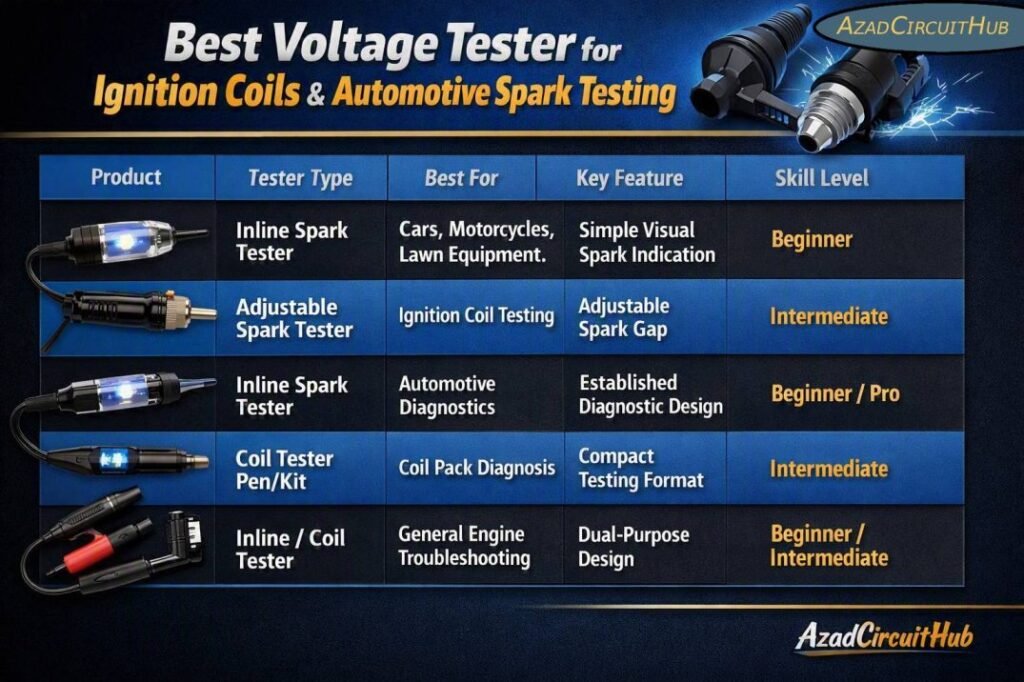
Table of Contents
Table of Contents
What Is an Ignition Coil Voltage Tester?
An ignition coil tester is a diagnostic tool used to check whether an ignition system is generating a spark. It is commonly connected between the ignition coil or spark plug wire and the spark plug.
When the engine is cranked, the tester provides a visible indication when the ignition system produces a high-voltage pulse.
The important point is that most inexpensive automotive spark testers do not measure ignition voltage in the same way as a digital multimeter. Instead, they provide a practical spark/no-spark indication.
This makes them useful for troubleshooting:
- Failed ignition coils
- Weak ignition systems
- Damaged spark plug wires
- Starting problems
- Intermittent ignition faults
- Lawn mower ignition systems
- Small gasoline engines
- Motorcycle ignition systems
- Coil pack problems
For technicians, this simple test can quickly establish whether the problem is likely on the ignition side before spending time checking fuel or mechanical components.
How to Choose the Best Voltage Tester for Ignition Coils
The best voltage tester for ignition coils depends on the type of engine and the diagnostic task. A basic inline tester is usually enough for checking whether a spark is reaching the plug.
For more detailed diagnosis, an adjustable spark tester can provide additional information about the ignition system's ability to jump a controlled gap.
1. Inline or Adjustable Design
An inline spark tester sits between the ignition lead and spark plug. It is convenient because you can observe the spark while the engine is cranked.
An adjustable tester allows the spark gap to be changed. This can help identify a weak ignition coil because a marginal system may produce a spark across a small gap but fail across a larger controlled gap.
2. Clear Spark Visibility
A bright, easy-to-see spark indication is important. Some automotive ignition systems operate in difficult locations, so a tester with a clear viewing section can make diagnosis much easier.
3. Secure Connections
The tester should remain securely connected during cranking. A loose connection can produce misleading results and may expose the user to ignition-system voltage.
4. Application Range
Check whether the tester is intended for conventional ignition systems, modern coil-on-plug systems, motorcycles, or small engines. A tool marketed for lawn equipment may not be suitable for every automotive ignition configuration.
5 Best Spark Testers for Ignition Coils
SINGARO Inline Spark Plug Tester
The SINGARO inline spark plug tester is designed for a straightforward ignition check. Its inline configuration allows the technician to place the tester between the ignition lead and spark plug and observe the spark while cranking.
It can be useful for cars, motorcycles, lawn mowers, and other gasoline-powered equipment where an accessible ignition lead is available.
The main advantage is simplicity. You do not need advanced diagnostic equipment to determine whether an ignition spark is present.
Best for: Home mechanics and basic engine troubleshooting.
Check the SINGARO Spark Plug Tester on Amazon
ecocstm Spark Plug Tester
The ecocstm spark tester is designed around an adjustable ignition-testing concept. Adjustable spark testers can be useful when you want to perform a more controlled ignition-system check rather than simply looking for any visible spark.
A controlled gap can place more demand on the ignition system. However, the test should always be performed according to the engine manufacturer's specifications.
Best for: Users who want adjustable spark-gap testing.
Check the ecocstm Adjustable Spark Tester on Amazon
Lisle 20610 Inline Spark Tester
The Lisle 20610 Inline Spark Tester is a well-known style of diagnostic tool for checking spark delivery. Its inline arrangement makes it suitable for quick troubleshooting when access to the ignition lead permits installation.
The tool is particularly useful when an engine cranks normally but does not start and you need to establish whether ignition spark is reaching the plug.
Best for: Automotive maintenance and workshop diagnostics.
Check the Lisle 20610 Inline Spark Tester on Amazon
APOWFIX Ignition Coil Tester Tool
The APOWFIX ignition coil tester is aimed at automotive ignition diagnostics and is supplied as a compact coil-pack testing tool. Its pen-style format can be convenient for technicians who need a portable diagnostic accessory.
It can be useful when investigating suspected coil problems, although the exact testing procedure depends on the ignition system fitted to the vehicle.
Best for: Portable automotive ignition troubleshooting.
Check the APOWFIX Ignition Coil Tester on Amazon
Zunvix Ignition Coil Tester
The Zunvix ignition coil tester combines ignition-coil and inline spark-testing functions in a compact tool. This makes it attractive for users who work on different gasoline engines.
A tester like this can help narrow down a no-start condition by establishing whether an ignition pulse is producing a visible spark.
Best for: General automotive and small-engine diagnosis.
Check the Zunvix Ignition Coil Tester on Amazon
Spark Tester Comparison Chart
| Feature | SINGARO | ecocstm | Lisle 20610 | APOWFIX | Zunvix |
|---|---|---|---|---|---|
| Inline testing | Yes | Yes/depending on configuration | Yes | Designed for coil testing | Yes |
| Visual spark check | Yes | Yes | Yes | Yes | Yes |
| Adjustable gap | No | Yes | No | Model-dependent | Model-dependent |
| Automotive use | Yes | Yes | Yes | Yes | Yes |
| Small-engine use | Yes | Yes | Possible | Possible | Yes |
| Best use | Basic diagnosis | Controlled testing | Workshop use | Coil diagnosis | General testing |
Always verify the current product specifications and vehicle compatibility on the Amazon listing before purchasing.
How to Test an Ignition Coil With a Spark Tester
Testing is generally straightforward, but ignition systems generate high voltage and should be treated with caution.
- Turn the engine off before connecting the tester.
- Locate the ignition coil output or spark plug lead.
- Install the inline tester according to its instructions.
- Make sure the connection is secure.
- Keep hands, clothing, and tools away from moving engine components.
- Crank the engine.
- Observe the tester for a consistent spark.
- Compare the result with the manufacturer's diagnostic procedure.
A consistent visible spark indicates that the ignition system is producing a high-voltage pulse at the test point. No spark suggests that further testing is needed.
A weak or intermittent spark can point toward an ignition coil, wiring, power supply, control module, crankshaft position sensor, or related ignition problem.
What Does a Weak Spark Mean?
A weak spark does not automatically prove that the ignition coil is defective. Several components can affect ignition performance.
| Symptom | Possible Cause |
|---|---|
| No spark | Failed coil, wiring, fuse, control circuit |
| Intermittent spark | Coil, connector, sensor, wiring |
| Weak spark | Coil, low supply voltage, excessive resistance |
| Spark at coil but not plug | Plug wire or distributor issue |
| Spark at plug but engine won't start | Fuel, timing, compression, or control issue |
This is why a spark tester should be considered one part of a complete diagnostic process.
Safety Tips for Automotive Spark Testing
Ignition systems can generate potentially dangerous high-voltage pulses. Never hold an ignition wire or spark plug while the engine is being cranked.
Keep the tester away from fuel vapors and other flammable materials. Do not perform ignition testing near an open fuel container. Follow the tester manufacturer's instructions and the vehicle service manual.
For coil-on-plug systems, use a tester specifically compatible with the ignition arrangement rather than improvising a connection.
If you regularly troubleshoot electrical and automotive systems, you can also compare this tool with a best non contact voltage tester for general low-voltage electrical checks. Remember that a non-contact tester is not a replacement for an automotive ignition spark tester.
When Should You Buy an Adjustable Spark Tester?
An adjustable tester can be worthwhile if you diagnose engines frequently. The adjustable gap allows you to apply a controlled spark-gap test rather than relying only on a basic spark/no-spark observation.
However, bigger is not always better. Do not arbitrarily increase the gap beyond the ignition system's intended capability. Excessive gap requirements can place unnecessary stress on ignition components.
For occasional troubleshooting, an inline tester such as the Lisle 20610 or SINGARO can be more convenient.
Ignition Coil Tester vs Multimeter
A multimeter and spark tester serve different purposes.
A multimeter can measure coil resistance, supply voltage, continuity, and other electrical parameters. However, resistance readings alone do not prove that an ignition coil can generate a usable high-voltage spark under operating conditions.
A spark tester provides a functional indication of ignition output. For this reason, using both tools can provide a more complete diagnosis.
For general electrical troubleshooting around vehicles and equipment, see our guide to non contact voltage tester options for additional safety and voltage-detection applications.
Which Is the Best Voltage Tester for Ignition Coils?
For simple automotive and small-engine troubleshooting, the SINGARO is an attractive choice because of its straightforward inline design and easy visual indication. The Lisle 20610 is another strong option for users who prefer a dedicated inline automotive spark tester.
The ecocstm is more suitable when adjustable spark-gap testing is important. APOWFIX and Zunvix are useful alternatives for users looking for compact ignition-coil diagnostic tools.
My recommendation is to choose based on the ignition system you actually service rather than buying the most feature-heavy tester. A simple, correctly connected spark tester can often identify an ignition problem within minutes.
If you want to compare more products before purchasing, read our non contact voltage tester reviews for additional electrical testing tools.
Frequently Asked Questions
Can a spark tester check an ignition coil?
Yes. A spark tester can determine whether an ignition system is producing a spark at the test point. It is useful for identifying no-spark and some weak-spark conditions, but further testing may be required to identify the exact failed component.
How do I know if my ignition coil is bad?
A no-spark or intermittent-spark result can indicate a defective coil, but it does not prove the coil has failed. Check the coil's power supply, ground, control signal, wiring, connectors, and manufacturer's resistance specifications before replacing it.
Can I use a spark tester on a lawn mower?
Yes. Many inline spark testers are suitable for small gasoline engines such as lawn mowers, generators, and other outdoor equipment. Confirm that the tester and connection method are compatible with the engine's ignition system.
Is an ignition coil tester the same as a multimeter?
No. A multimeter measures electrical characteristics such as voltage and resistance, while a spark tester checks whether the ignition system produces a visible spark. Both tools can be useful during a complete ignition diagnosis.
Is it safe to test an ignition coil yourself?
It can be done safely if the correct tester and procedure are used. Never touch ignition components while the engine is cranking, keep the tester away from fuel vapors, and follow the vehicle and tester manufacturer's safety instructions.
Follow Us on Social:
Subscribe our Newsletter on Electrical Insights for latest updates from Azad Circuit Hub
#VoltageTester, #IgnitionCoilTester, #AutomotiveTesting, #SparkTesting, #CarDiagnosticTools, #AutomotiveElectrical, #ElectricalTester, #CarRepairTools, #IgnitionSystem, #MechanicTools
