
How Non Contact Voltage Testers Work: Complete Guide
Working around electricity always carries risk, even during simple maintenance tasks. Understanding How Non Contact Voltage Testers Work helps electricians, homeowners, maintenance technicians, and DIY users verify whether a conductor is energized without touching exposed metal. These compact safety tools use electric field sensing technology to detect AC voltage through wire insulation, making them one of the safest first-line electrical testing devices.
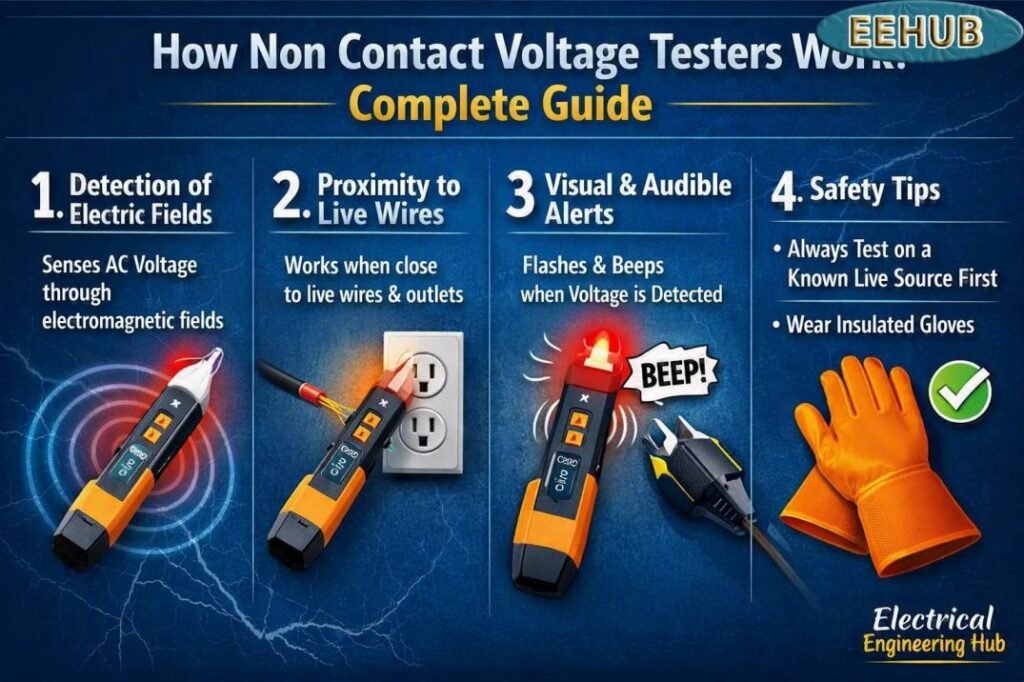
Table of Contents
Table of Contents
Before choosing a tester, compare the two most trusted Amazon models below.
Quick Comparison Table
| Feature | Fluke 1AC II VoltAlert | Klein Tools NCVT-2 |
|---|---|---|
| Detection Type | Non-contact AC Voltage | Non-contact AC Voltage |
| Voltage Range | 90V–1000V AC | 12V–1000V AC |
| Audible Alarm | Yes | Yes |
| Visual Indicator | Red LED | Bright Green/Red LEDs |
| Flashlight | No | Yes |
| CAT Rating | CAT IV 1000V | CAT IV 1000V |
| Best For | Professional electricians | Homeowners & professionals |
| Amazon Rating | Highly Rated | Highly Rated |
Both voltage testers use similar sensing technology, but each is designed for different applications. Continue reading to learn How Non Contact Voltage Testers Work and discover which model best matches your electrical work.
Looking for more product recommendations before buying? Visit our complete guide on best non contact voltage detector to compare additional top-rated models.
What Is a Non-Contact Voltage Tester?
A non-contact voltage tester (NCVT) is a handheld electrical safety device that detects the presence of alternating current (AC) voltage without physically touching the conductor.
Instead of measuring voltage like a multimeter, it senses the electric field surrounding an energized wire. When voltage is detected, the tester alerts the user using flashing LEDs, audible beeps, or vibration depending on the model.
This makes it ideal for:
- Checking live outlets
- Testing switches
- Identifying energized wires
- Troubleshooting electrical circuits
- Performing lockout/tagout verification
- Quick safety inspections
Because it never requires direct metal contact, it significantly reduces shock hazards during preliminary testing.
How Non Contact Voltage Testers Work
Understanding How Non Contact Voltage Testers Work starts with the electric field created around an energized AC conductor.
Whenever alternating current flows through a wire, it produces an alternating electric field around the insulation. The sensing tip inside a voltage tester contains a high-impedance capacitive sensor that reacts to this electric field.
The internal electronics amplify this tiny signal. Once the detected field exceeds a preset threshold, the tester activates:
| Detection Step | What Happens |
|---|---|
| Energized wire creates AC electric field | Electric field surrounds insulation |
| Capacitive sensor detects field | No direct contact required |
| Internal circuit amplifies signal | Filters electrical noise |
| Microprocessor verifies voltage | Reduces false alarms |
| LED and buzzer activate | User receives warning |
Because only the electric field is detected, the tester cannot determine exact voltage values.
The Science Behind Capacitive Coupling
The operating principle relies on capacitive coupling.
The tester tip and energized conductor form a very small capacitor through the insulation and surrounding air. Although only an extremely tiny current exists, it is enough for the tester’s high-sensitivity electronics to recognize the electric field.
The process involves:
- Electric field generation
- Capacitive coupling
- Signal amplification
- Noise filtering
- Alarm activation
This technology allows voltage detection without electrical contact.
Why Non-Contact Testers Only Detect AC Voltage
Many beginners wonder why these tools usually cannot detect DC voltage.
Alternating current constantly changes polarity, creating a continuously changing electric field that the tester can sense.
Direct current produces a stable electric field that standard NCVT sensors cannot reliably detect.
Therefore, most non-contact voltage testers are designed exclusively for:
- Household wiring
- Commercial electrical systems
- Industrial AC circuits
- Distribution panels
- Extension cords
For batteries or DC systems, a digital multimeter remains the better choice.
Where Non-Contact Voltage Testers Are Used
These testers have become standard equipment across many industries.
| Application | Purpose |
|---|---|
| Home electrical work | Verify power before repairs |
| Construction | Identify energized circuits |
| Industrial maintenance | Safety inspections |
| HVAC service | Check equipment voltage |
| Commercial buildings | Outlet testing |
| Electrical troubleshooting | Locate live conductors |
They are especially valuable during preventive maintenance because they provide immediate feedback without dismantling wiring.
Fluke 1AC II VoltAlert Review
Key Features
- Detects 90V–1000V AC
- CAT IV 1000V safety rating
- Bright red LED indicator
- Audible beeper
- Pocket-sized design
- Trusted Fluke reliability
Pros
- Extremely durable
- Reliable voltage detection
- Fast response time
- Professional-grade quality
- Simple one-button operation
Cons
- No built-in flashlight
- Higher price than budget models
- Minimum detection starts at 90V
Best For
Professional electricians who require dependable daily performance.
Buy the Fluke 1AC II VoltAlert on Amazon to improve electrical safety with a trusted tester used by professionals worldwide.
Klein Tools NCVT-2 Review
Key Features
- Detects 12V–1000V AC
- Dual voltage sensitivity
- Bright LED work light
- Audible and visual alerts
- CAT IV 1000V rating
- Lightweight construction
Pros
- Detects lower voltages
- Integrated flashlight
- Excellent value
- Easy to carry
- Ideal for residential troubleshooting
Cons
- Slightly less rugged than Fluke
- Battery compartment requires occasional maintenance
Best For
DIY users, maintenance technicians, and residential electricians.
Check the latest Amazon price for the Klein Tools NCVT-2 and upgrade your electrical toolbox with a versatile voltage detector.
How to Use a Non-Contact Voltage Tester Safely
Follow these steps before beginning electrical work.
| Step | Action |
|---|---|
| 1 | Test the tester on a known live outlet |
| 2 | Hold the insulated handle only |
| 3 | Place the sensing tip near the conductor |
| 4 | Watch for LEDs and listen for beeps |
| 5 | Verify on another live source after testing |
This “live-dead-live” method ensures the tester is functioning correctly before relying on the results.
Limitations You Should Know
Although highly useful, non-contact testers have limitations.
- They cannot measure exact voltage.
- They may not detect shielded cables.
- Wet environments can affect readings.
- Nearby energized wires may cause false indications.
- They should never replace proper lockout procedures.
For accurate voltage measurements, always use a calibrated digital multimeter after confirming circuit status.
If you are comparing more professional and homeowner-friendly models, explore our complete guide to the best non contact voltage detector for detailed reviews, buying advice, and performance comparisons.
Buying Guide
When purchasing a non-contact voltage tester, consider the following factors.
| Buying Factor | Recommendation |
|---|---|
| Voltage Range | Match your application |
| Safety Rating | CAT III or CAT IV |
| Audible Alert | Essential |
| LED Indicator | High visibility |
| Flashlight | Helpful in dark areas |
| Brand Reliability | Choose trusted manufacturers |
| Battery Life | Longer operating time |
Professionals generally prefer Fluke for rugged industrial use, while Klein Tools offers excellent value for residential and commercial applications.
Before making your final decision, read our in-depth best non contact voltage detector guide to compare top-rated testers side by side and choose the right model for your needs.
Conclusion
Learning How Non Contact Voltage Testers Work helps you use one of the most important electrical safety tools correctly. These testers rely on capacitive sensing technology to detect the electric field surrounding energized AC conductors without requiring direct contact. While they cannot replace a multimeter for measuring voltage, they provide a fast and reliable first safety check before beginning electrical work.
Whether you choose the Fluke 1AC II VoltAlert for professional reliability or the Klein Tools NCVT-2 for versatile home use, investing in a quality non-contact voltage tester is a smart step toward safer electrical maintenance.
Related Guides
- Best Non-Contact Voltage Tester Under $30
- Fluke 1AC-II Review
- Klein NCT-2 vs Fluke 1AC ii
- Best Voltage Pen Tester
- Best Voltage Tester for Homeowners
Frequently Asked Questions
How Non Contact Voltage Testers Work without touching the wire?
They detect the alternating electric field around an energized conductor using capacitive sensing technology. No direct metal contact is required.
Can a non-contact voltage tester detect DC voltage?
Most standard models cannot detect DC voltage. They are designed primarily for alternating current (AC) electrical systems.
Are non-contact voltage testers accurate?
They are reliable for detecting the presence of AC voltage but cannot measure the exact voltage level like a digital multimeter.
Which is better, Fluke 1AC II VoltAlert or Klein Tools NCVT-2?
Fluke offers excellent durability and professional-grade performance, while Klein Tools NCVT-2 provides dual-voltage sensitivity and added convenience with an integrated flashlight.
Should I trust a non-contact voltage tester alone?
No. Always use the tester as the first safety check, then confirm with a properly rated multimeter when precise voltage verification is required before working on electrical equipment.
Get new guides in your feed. Follow Electrical Insights on LinkedIn for new electrical standards guides, calculators and design tips from Azad Circuit Hub.
#HowNonContactVoltageTestersWork, #VoltageTester, #ElectricalSafety, #NonContactVoltageTester, #DIYElectrical, #ElectricianTools, #ElectricalTesting, #VoltageDetection, #HomeElectrical, #ElectricalEngineering
