
NEC 392.22(A)(2): Single-Layer Rule for 4/0 AWG+ Cables
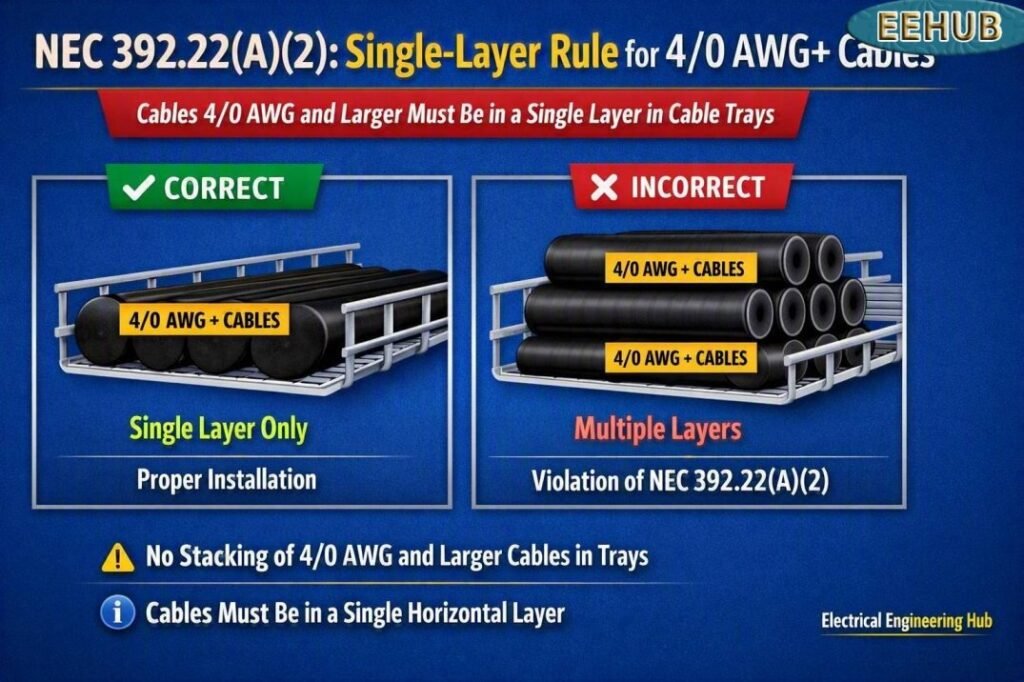
When designing or inspecting cable tray systems, one of the most important National Electrical Code (NEC) requirements is nec 392.22(a)(2). This rule explains how large single-conductor cables rated 4/0 AWG and larger must be installed inside cable trays. Following this requirement improves heat dissipation, simplifies maintenance, and reduces the risk of cable damage.
Whether you are an electrical engineer, contractor, designer, or inspector, understanding this code section helps ensure a safe and code-compliant installation.
NEC 392.22(A)(2) Quick Reference Table
| Item | Requirement |
|---|---|
| NEC Section | NEC 392.22(A)(2) |
| Cable Size | 4/0 AWG and Larger |
| Installation Method | Single Layer Only |
| Cable Type | Single-Conductor Cables |
| Purpose | Heat Dissipation and Safety |
| Typical Applications | Industrial Plants, Data Centers, Utility Facilities |
Quick Compliance Summary
| Requirement | Status |
|---|---|
| Multiple stacked layers allowed | No |
| Single-layer installation | Yes |
| Applies to 4/0 AWG and larger | Yes |
| Improves cable cooling | Yes |
| Helps meet NEC requirements | Yes |
What is NEC 392.22(A)(2)?
nec 392.22(a)(2) specifies that single-conductor cables sized 4/0 AWG and larger must be installed in a single layer within cable trays. Instead of stacking cables on top of one another, each cable should be placed side by side across the tray width.
This installation method allows proper airflow around each conductor. Better ventilation reduces operating temperature, improves cable life, and maintains the conductor’s current-carrying capability.
Large power cables generate considerable heat during operation. When stacked in multiple layers, the inner cables cannot release heat efficiently, increasing the chance of overheating.
Cable Sizes Covered by NEC 392.22(A)(2)
The following table shows common cable sizes covered by this NEC requirement.
| Cable Size |
|---|
| 4/0 AWG |
| 250 kcmil |
| 350 kcmil |
| 500 kcmil |
| 750 kcmil |
| 1000 kcmil |
These conductors are commonly installed for high-current feeders, switchgear connections, transformers, generators, and industrial distribution systems.
Why the Single-Layer Rule Matters
Installing cables in a single layer provides several technical advantages.
- Better natural air circulation
- Lower conductor operating temperature
- Reduced insulation aging
- Easier cable identification
- Improved inspection access
- Simplified maintenance
- Lower chance of cable damage
These benefits increase overall electrical system reliability while maintaining NEC compliance.
Looking for the correct tray width before installation? Use our Cable Tray Sizing Calculation tool to select the proper tray dimensions for your cable layout.
Heat Dissipation Explained
Large conductors carry substantial electrical current. Current flow creates heat due to conductor resistance.
When cables are stacked:
- Airflow becomes restricted.
- Heat becomes trapped.
- Cable insulation experiences higher temperatures.
- Ampacity may decrease.
- Long-term insulation degradation accelerates.
A single-layer arrangement allows each cable to release heat more effectively into the surrounding air.
Where NEC 392.22(A)(2) Applies
This NEC requirement is commonly used in many electrical installations.
| Application | Typical Use |
|---|---|
| Manufacturing Plants | Motor feeders |
| Data Centers | Main distribution feeders |
| Utility Substations | High-current circuits |
| Water Treatment Plants | Pump power cables |
| Commercial Buildings | Main electrical feeders |
| Renewable Energy Plants | Solar and battery systems |
| Oil and Gas Facilities | Process equipment power |
Most industrial facilities routinely install large conductors that fall under this requirement.
Cable Tray Types Used
The single-layer rule can be applied with several cable tray designs.
| Tray Type | Common Use |
|---|---|
| Ladder Cable Tray | Heavy power cables |
| Ventilated Trough Tray | Industrial feeders |
| Solid Bottom Tray | Special environmental conditions |
| Channel Tray | Small cable runs |
| Wire Mesh Tray | Mainly communication cables |
Ladder trays remain the preferred option for large power conductors because they provide excellent ventilation.
Example Installation
Consider a project requiring six parallel 500 kcmil copper conductors supplying a large switchboard.
Incorrect installation:
- Three cables on the bottom
- Three cables stacked above
Correct installation:
- All six conductors arranged side by side
- No overlapping
- Adequate spacing maintained according to project design
The second arrangement satisfies nec 392.22(a)(2) while providing better cooling performance.
How Engineers Select Tray Width
Before purchasing cable trays, engineers calculate the total cable width.
Typical design process:
- Count the number of conductors.
- Measure the outside diameter of each cable.
- Add required spacing if applicable.
- Select a tray wide enough for a single-layer arrangement.
- Verify cable tray load ratings.
- Check support spacing.
Proper planning avoids expensive field modifications.
Need to verify available tray space? Try our Cable Tray Fill Calculator to quickly determine whether your cable arrangement meets fill requirements before installation.
Common Design Mistakes
The following mistakes frequently lead to code violations.
| Mistake | Result |
|---|---|
| Stacking large cables | Excessive heat |
| Selecting a narrow tray | NEC non-compliance |
| Ignoring future expansion | Costly upgrades |
| Mixing power and control cables improperly | Maintenance difficulty |
| Overloading the tray | Structural concerns |
Avoiding these issues improves installation quality and inspection success.
Relationship with Cable Ampacity
Cable ampacity depends heavily on operating temperature.
When conductors operate cooler:
- Insulation lasts longer.
- Voltage drop remains predictable.
- Thermal stress decreases.
- Electrical efficiency improves.
- Maintenance costs decline.
This is one reason the NEC emphasizes proper cable arrangement rather than simply limiting cable tray fill.
Inspection Checklist
Use this quick checklist during installation.
| Inspection Item | Verify |
|---|---|
| Cable size is 4/0 AWG or larger | Yes |
| Cables installed in one layer | Yes |
| No overlapping conductors | Yes |
| Tray width is adequate | Yes |
| Tray supports installed correctly | Yes |
| Cable identification visible | Yes |
| Installation follows project drawings | Yes |
Inspectors often verify these items before approving electrical installations.
Best Practices for Compliance
Following a few practical guidelines makes compliance much easier.
- Select the cable tray after completing cable sizing.
- Leave room for future expansion.
- Keep large power cables organized.
- Label feeders clearly.
- Follow manufacturer installation instructions.
- Verify structural load capacity.
- Perform periodic inspections after commissioning.
These practices improve safety and reduce future maintenance.
NEC 392.22(A)(2) vs Cable Tray Fill Rules
Many electricians confuse the single-layer rule with cable tray fill requirements.
| NEC 392.22(A)(2) | Cable Tray Fill |
|---|---|
| Focuses on cable arrangement | Focuses on tray capacity |
| Applies to 4/0 AWG and larger | Applies to tray occupancy |
| Requires single-layer installation | Limits allowable fill |
| Improves cooling | Prevents overcrowding |
Both requirements should be evaluated together during tray design.
Planning a complete cable tray system? Use our Cable Tray Sizing Calculation and Cable Tray Fill Calculator together to ensure both tray dimensions and fill limits meet NEC requirements while avoiding costly redesigns.
Frequently Asked Questions
Does nec 392.22(a)(2) apply to all cable sizes?
No. It specifically applies to single-conductor cables that are 4/0 AWG and larger.
Why can’t large cables be stacked?
Stacking reduces airflow, traps heat, and may increase conductor operating temperature, affecting performance and service life.
Does this rule apply to ladder cable trays?
Yes. Ladder cable trays commonly use this installation method because they provide excellent ventilation.
Can multiple layers be used if tray space is limited?
No. The code requires a single-layer arrangement for the cable sizes covered by this section.
Why is tray width important?
The tray must be wide enough to accommodate all applicable conductors in one layer while maintaining a safe and organized installation.
Conclusion
Understanding nec 392.22(a)(2) is essential for anyone designing, installing, or inspecting cable tray systems. The single-layer rule for 4/0 AWG and larger single-conductor cables helps improve heat dissipation, supports long-term cable reliability, and promotes safe electrical installations.
By selecting the correct cable tray width, following proper cable arrangement practices, and verifying compliance during installation, engineers and electricians can avoid costly corrections and ensure their projects meet NEC requirements. Combining good cable tray design with accurate sizing and fill calculations results in safer, more efficient, and code-compliant electrical systems.
Related Guides & Tools
- Cable Tray Fill Calculator (NEC 392)
- NEC 392.22(A)(1)(a) Explained
- NEC 392.22(A) Multiconductor Cable
- NEC 392.22(B) Single Conductor Cable
- NEC 392.22(B)(1)(c) Mixed Single Conductor
- nEC 392.80 ampacity derating
Get new guides in your feed. Follow Electrical Insights on LinkedIn for new electrical standards guides, calculators and design tips from Azad Circuit Hub.
NEC39222A2, #CableTray, #NECCode, #ElectricalEngineering, #ElectricalInstallation, #PowerDistribution, #CableManagement, #NationalElectricalCode, #IndustrialElectrical, #ElectricalSafety
