NEC 392.22(B) Single Conductor Cable Tray Fill Rules: Complete NEC Guide
If you are designing or inspecting cable tray systems carrying single-conductor power cables, understanding NEC 392.22(B) is essential. This section of the National Electrical Code explains how single-conductor cables should be installed in different types of cable trays to ensure proper heat dissipation, ampacity, and electrical safety.
Before calculating tray capacity, you can use our Cable Tray Fill Calculator according to NEC to quickly determine allowable cable fill based on NEC requirements.
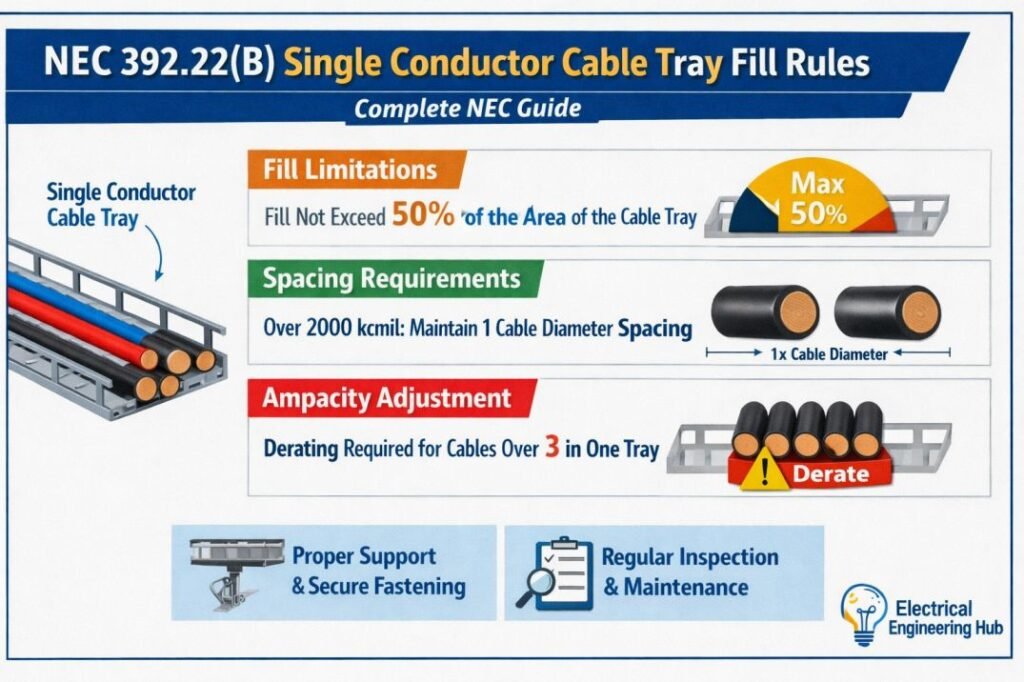
Table of Contents
Table of Contents
NEC 392.22(B) Single Conductor Rules at a Glance
| NEC Requirement | Summary |
|---|---|
| Applicable Cables | Single-conductor insulated cables |
| Governing Standard | NEC 392.22(B) |
| Main Concern | Heat dissipation and magnetic effects |
| Installation Method | Depends on cable size, voltage, and tray type |
| Grounding | Follow NEC grounding and bonding requirements |
| Typical Applications | Industrial plants, substations, utility systems |
Quick Decision Chart
| Installation Situation | NEC Requirement |
|---|---|
| Single conductor in ladder tray | Permitted when installed according to NEC 392.22(B) |
| Parallel conductors | Maintain proper grouping per phase |
| High-current feeders | Consider spacing for heat dissipation |
| Ferrous hardware | Avoid configurations causing excessive magnetic heating |
| Tray fill calculation | Verify using NEC tray fill limits |
What is NEC 392.22(B) Single Conductor?
NEC 392.22(B) Single Conductor provides installation requirements for insulated single-conductor cables installed in cable tray systems. Unlike multiconductor cables, single-conductor cables generate individual magnetic fields that affect cable heating and overall system performance.
Improper arrangement can increase conductor temperature, reduce ampacity, and create unnecessary magnetic losses in metallic components. For this reason, the NEC specifies installation practices that maintain safe operating temperatures while ensuring reliable electrical performance.
These rules are commonly applied in:
- Power distribution systems
- Industrial manufacturing plants
- Petrochemical facilities
- Solar power plants
- Data centers
- Utility substations
- Large commercial buildings
Why NEC Has Separate Rules for Single-Conductor Cables
Single-conductor cables behave differently from multiconductor cables because each conductor carries only one phase.
This creates stronger external magnetic fields. If conductors are separated incorrectly, magnetic fields increase losses in metallic cable trays, supports, clamps, and nearby steel structures.
Proper cable arrangement helps achieve:
| Benefit | Result |
|---|---|
| Better cooling | Lower conductor temperature |
| Balanced magnetic fields | Reduced induced currents |
| Higher cable life | Less insulation aging |
| Improved ampacity | Safe current carrying capacity |
| Reduced maintenance | Better long-term reliability |
Cable Arrangement Requirements Under NEC 392.22(B)
One of the most important aspects of NEC 392.22(B) Single Conductor is cable arrangement.
Instead of randomly placing conductors inside the tray, each phase should be positioned to minimize magnetic effects.
Typical arrangements include:
| Arrangement | Application |
|---|---|
| Trefoil formation | High-current installations |
| Flat formation | Common ladder tray installations |
| Grouped phase conductors | Parallel feeders |
| Even spacing | Heat dissipation improvement |
The selected arrangement depends on cable size, current level, tray construction, and engineering design.
Ladder Tray vs Solid Bottom Tray
Different cable tray designs influence cooling performance.
| Tray Type | Heat Dissipation | Typical Use |
|---|---|---|
| Ladder Tray | Excellent | Industrial power feeders |
| Ventilated Tray | Very Good | Commercial installations |
| Solid Bottom Tray | Limited | Sensitive control cables |
| Wire Mesh Tray | Moderate | Light-duty applications |
Ladder trays generally provide superior airflow, making them the preferred choice for large single-conductor power cables.
Ampacity Considerations
The purpose of NEC 392.22(B) is not simply filling the tray with cables. The real objective is maintaining conductor temperature within allowable limits.
Several factors influence cable ampacity.
| Factor | Effect on Current Rating |
|---|---|
| Cable spacing | Higher spacing improves cooling |
| Ambient temperature | High temperature lowers ampacity |
| Number of cables | More cables increase heating |
| Tray ventilation | Better airflow increases ampacity |
| Solar exposure | Outdoor installations may require derating |
Designers should always verify ampacity after completing tray fill calculations.
For accurate sizing, use the Cable Tray Fill Calculator according to NEC before finalizing tray dimensions.
Single-Conductor Cable Grouping
Proper phase grouping is essential for magnetic field cancellation.
Instead of routing all phase A conductors together, each circuit should remain grouped.
Example:
| Correct Grouping | Incorrect Grouping |
|---|---|
| A-B-C | A-A-A |
| A-B-C | B-B-B |
| A-B-C | C-C-C |
Proper grouping helps reduce:
- Eddy current losses
- Induced heating
- Electromagnetic interference
- Mechanical forces during faults
Parallel Single-Conductor Cables
Large feeders often require parallel conductors.
When parallel cables are installed, each phase conductor should have identical characteristics.
Requirements include:
- Equal conductor length
- Same insulation type
- Same conductor size
- Similar installation conditions
- Balanced spacing throughout the cable tray
Unequal routing can cause current imbalance, resulting in overheating.
Common Design Mistakes
Many cable tray problems occur because installation crews focus only on tray capacity instead of cable arrangement.
The following mistakes frequently violate good engineering practice.
| Common Mistake | Possible Result |
|---|---|
| Mixing different circuit phases | Uneven heating |
| Excessive tray fill | Reduced cooling |
| Poor cable spacing | Ampacity reduction |
| Incorrect grouping | Higher magnetic losses |
| Ignoring ambient temperature | Cable overheating |
These issues may shorten insulation life and increase maintenance costs.
Inspection Checklist for NEC 392.22(B)
During inspections, engineers typically verify several installation details.
| Inspection Item | Status |
|---|---|
| Correct tray type selected | ✓ |
| Proper phase grouping | ✓ |
| Adequate cable spacing | ✓ |
| Cable supports installed | ✓ |
| Grounding completed | ✓ |
| Fill requirements satisfied | ✓ |
| Ampacity verified | ✓ |
This checklist simplifies commissioning and code compliance.
Practical Example
Consider a manufacturing facility installing three 500 kcmil single-conductor copper cables for each feeder circuit in a ladder cable tray.
The engineer should verify:
- Proper phase grouping
- Adequate spacing between circuits
- Tray width
- Cable support intervals
- Ambient temperature correction
- Ampacity compliance
- Overall tray fill
Before approving the installation, engineers commonly verify the tray dimensions using the Cable Tray Fill Calculator according to NEC to ensure compliance with NEC cable tray fill requirements.
Best Practices for Engineers
Following NEC 392.22(B) Single Conductor becomes easier when these design practices are adopted.
| Best Practice | Benefit |
|---|---|
| Group conductors by circuit | Lower magnetic effects |
| Use ladder trays for power cables | Better ventilation |
| Verify ampacity after layout | Prevent overheating |
| Maintain consistent spacing | Improved cooling |
| Inspect installation before energization | Better reliability |
| Follow manufacturer recommendations | Long service life |
These practices improve both electrical performance and long-term maintenance.
Related Guides & Tools
- Cable Tray Fill Calculator (NEC 392)
- NEC 392.22(A)(1)(a) Explained
- NEC 392.22(A) Multiconductor Cable Tray Fill Rules
Frequently Asked Questions
Does NEC 392.22(B) apply to multiconductor cables?
No. This section specifically addresses insulated single-conductor cables installed in cable trays. Multiconductor cables are covered under different provisions of NEC Article 392.
Why are single-conductor cables installed differently?
Each conductor produces its own magnetic field. Proper grouping minimizes magnetic heating and improves overall cable performance.
Does tray fill alone determine compliance?
No. Engineers must evaluate cable arrangement, spacing, ampacity, ventilation, and installation method in addition to tray fill.
Which cable tray is generally preferred?
Ladder cable trays are commonly preferred for large power cables because they provide excellent ventilation and improve heat dissipation.
Conclusion
NEC 392.22(B) Single Conductor establishes important installation rules that go beyond simple cable tray capacity. Proper conductor grouping, adequate spacing, suitable tray selection, and ampacity verification all contribute to a safe and reliable electrical installation.
Engineers who understand these requirements can reduce overheating, improve cable life, and ensure NEC compliance across industrial, commercial, and utility power systems. Before completing any cable tray design, verify the installation using a reliable sizing method and confirm compliance with the applicable NEC cable tray fill requirements.
Get new guides in your feed. Follow Electrical Insights on LinkedIn for new electrical standards guides, calculators and design tips from Azad Circuit Hub.
#NEC39222B, #SingleConductorCableTray, #CableTrayFill, #NECCode, #ElectricalEngineering, #ElectricalDesign, #PowerDistribution, #IndustrialElectrical, #NECCompliance, #ElectricalSafety