How to Use a GFCI Outlet Tester: Step-by-Step Guide
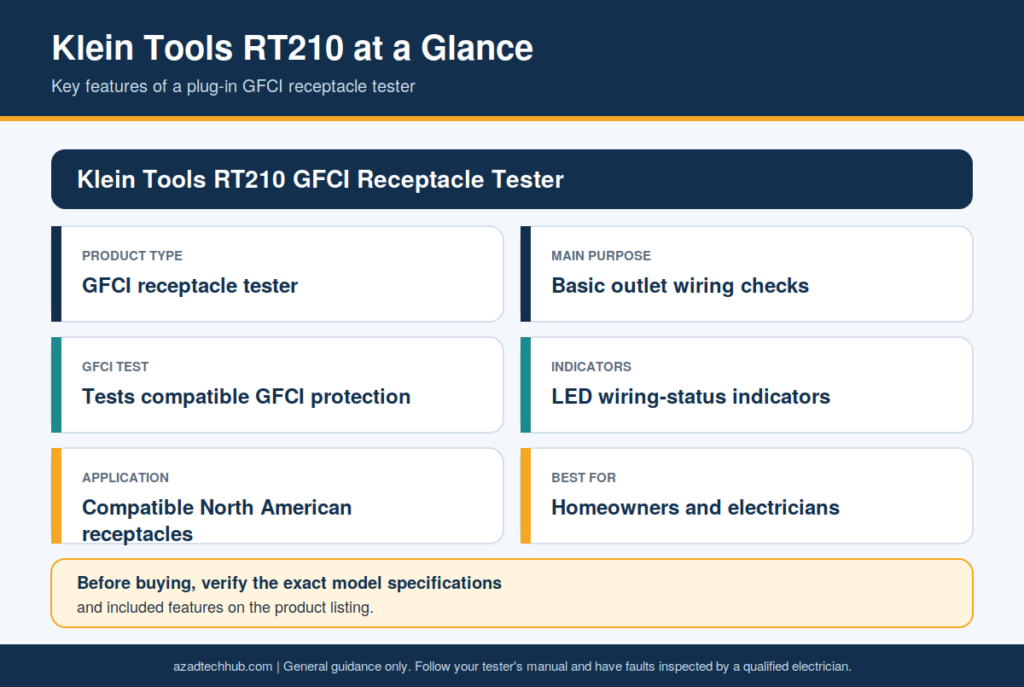
Learning how to use a gfci outlet tester helps you check common wiring problems and verify the basic operation of a ground-fault circuit interrupter (GFCI) receptacle. A tester such as the Klein Tools RT210 can indicate certain wiring faults and check whether a compatible GFCI trips when the test button is pressed.
As an electrical engineer with hands-on experience in electrical panels, field testing, and troubleshooting, I recommend using an outlet tester as a first-line diagnostic tool, not as proof that an entire circuit is safe. A plug-in tester cannot detect every wiring fault, and its GFCI test depends on a valid equipment grounding path.
GFCI Outlet Tester: Features at a Glance
| Feature | Klein Tools RT210 |
|---|---|
| Product type | GFCI receptacle tester |
| Main purpose | Basic outlet wiring checks |
| GFCI test | Tests compatible GFCI protection |
| Indicators | LED wiring-status indicators |
| Application | Compatible North American receptacles |
| Best for | Homeowners and electricians |
| Buying option | Amazon |
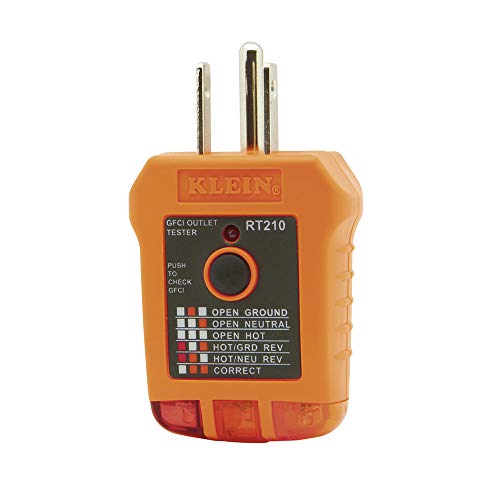
- EFFECTIVE GFCI WIRING PROBLEM DETECTION: GFCI Tester detects common wiring problems in standard and GFCI receptacles, en…
- COMPATIBLE WITH GFCI OUTLETS: Works on GFCI outlets and verifies the proper operation of the ground fault protective dev…
Before buying, verify the exact model specifications and included features on the product listing.
How to Use a GFCI Outlet Tester Step by Step
Follow these steps to check a standard compatible receptacle.
- Inspect the outlet. Look for cracks, burn marks, loose parts, or signs of overheating. Do not use a damaged receptacle.
- Check the tester. Read the manufacturer’s instructions and inspect the plug and housing for damage.
- Plug it into the outlet. Insert the tester fully into the receptacle.
- Read the indicator lights. Compare the light pattern with the chart printed on the tester or in its manual. The pattern may indicate correct wiring or a possible wiring fault.
- Press the GFCI test button. Use this function only on a compatible GFCI-protected circuit and follow the manufacturer’s instructions.
- Check the result. If the GFCI trips, power at the protected outlet should be interrupted. The tester’s lights should change or go out.
- Reset the GFCI. Press the receptacle’s RESET button, or reset the appropriate protective device if the instructions require it.
- Verify normal operation. Confirm that the receptacle has returned to normal operation.
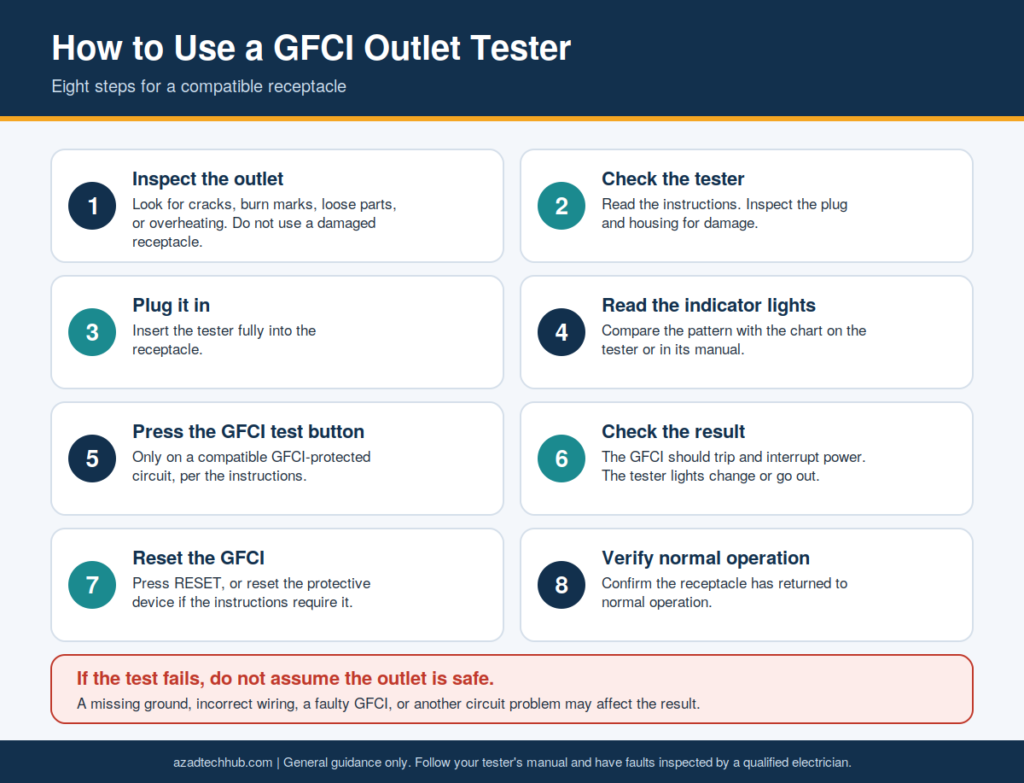
If the test fails, do not assume the outlet is safe. A missing ground, incorrect wiring, a faulty GFCI, or another circuit problem may affect the result.
How to Use a GFCI Outlet Tester YouTube
When looking for a demonstration, search YouTube for the exact tester model, such as “Klein Tools RT210 GFCI tester demonstration.” Choose a video that shows the indicator chart, test-button procedure, and reset process.
Check that the video matches your tester. Different models can use different light patterns and testing procedures. Always follow the manufacturer’s manual if a video conflicts with the instructions.
How to Use a GFCI Outlet Tester Without a Ground
A plug-in GFCI tester may fail to trip a GFCI when the receptacle has no effective equipment grounding path. This does not automatically mean the GFCI protection is defective.
Never create a makeshift ground or use a neutral-to-ground jumper to force the test to work. That can create a shock hazard.
Use the GFCI’s built-in TEST button as directed by its manufacturer. If the receptacle’s grounding or wiring status is uncertain, have a qualified electrician inspect it using suitable test equipment.
How to Test a GFCI Outlet With a Multimeter
A digital multimeter can help check voltage, but it cannot independently confirm that a GFCI will protect a person under fault conditions.
A qualified person can use an appropriately rated meter to check for expected voltage between hot and neutral and assess other measurements where the circuit design permits. However, voltage readings alone do not establish that the equipment ground is effective or that the GFCI trips within its required limits.
Do not insert meter probes into a live receptacle unless you are trained to do so and have the correct meter, leads, and safety procedures. For a functional GFCI test, use the built-in TEST button or a compatible GFCI tester according to the manufacturer’s instructions.
What Happens if You Use a GFCI Tester on a Regular Outlet?
On a standard, non-GFCI receptacle, the tester’s basic wiring indicators may still provide useful information. However, pressing its GFCI test button will not normally trip a regular circuit breaker.
The GFCI test function creates a small ground-fault condition intended to trigger compatible GFCI protection. A standard overcurrent breaker responds to overloads and short circuits, not the small imbalance used for GFCI testing.
Never assume that a regular outlet is GFCI-protected just because the tester lights up. Check whether the receptacle is protected by an upstream GFCI device.
Klein Tools RT250 GFCI Receptacle Tester Manual PDF
If you own the Klein Tools RT250, consult the official Klein Tools product page for its current manual and documentation. The RT250 is a different model from the RT210, so do not assume that their features or instructions are identical.
Read the model number on the tester before following a procedure. The manual explains the indicator patterns, operating limits, and any additional functions available on that specific device.
For another useful electrical diagnostic tool, see my guide to the best non contact voltage tester for checking for possible AC voltage before working near electrical equipment.
Klein Tools Voltage Tester: How to Use It
Klein Tools makes several types of electrical testers, including non-contact voltage detectors, digital multimeters, and plug-in receptacle testers. Before testing an outlet, identify the exact model because each tool has a different purpose and operating procedure.
Steps to Use a Klein Tools Voltage Tester
- Inspect the tester: Check the housing, probe insulation, leads, and battery condition. Do not use a damaged tool.
- Verify the tester: Test it on a known live source within its rated range. This confirms that the tester is responding before you rely on its reading.
- Select the correct test method: A non-contact voltage tester detects an electric field near an energized conductor. A contact tester or multimeter requires the procedure specified in its manual.
- Check the target circuit: Follow the manufacturer’s instructions and keep your hands away from exposed conductors. For a non-contact tester, bring the sensing tip near the appropriate conductor or receptacle location.
- Verify the tester again: After testing, check it on a known live source to confirm it still responds.
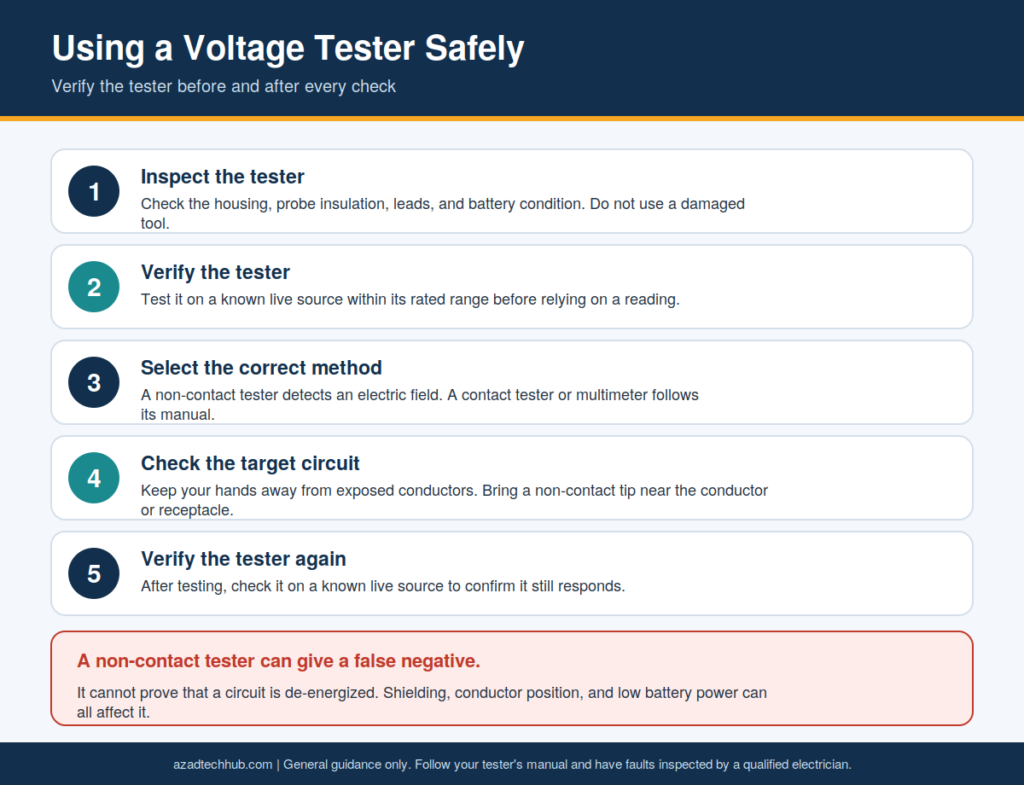
A non-contact voltage tester can give a false negative because of shielding, conductor position, low battery power, or other conditions. It cannot prove that a circuit is de-energized.
Klein Tools RT210 vs. a Voltage Detector
| Tool | Main purpose | Can test GFCI operation? |
|---|---|---|
| Klein Tools RT210 | Receptacle wiring indications and GFCI testing | Yes, under suitable conditions |
| Non-contact voltage tester | Detects possible AC voltage | No |
| Digital multimeter | Measures voltage and other electrical quantities | Not by itself |
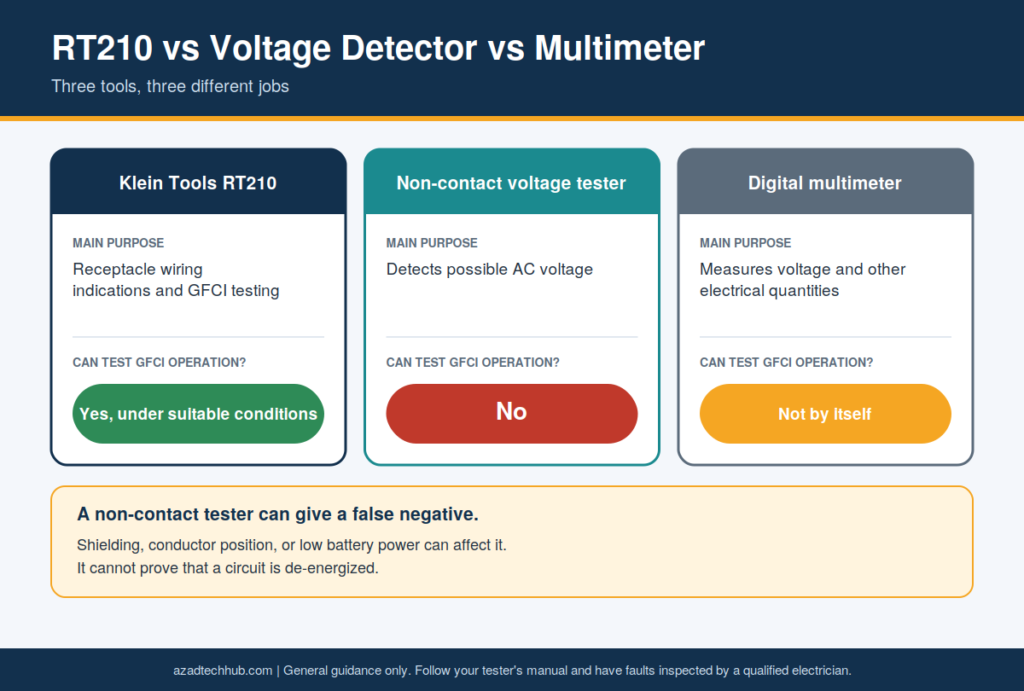
If you need a tool for quick voltage screening, compare options in my guide to the best non contact voltage tester. For outlet wiring and GFCI checks, use a compatible receptacle tester instead.
Sperry GFCI Tester Instructions
A Sperry GFCI tester can help identify certain receptacle wiring conditions and check the operation of compatible GFCI protection. The exact procedure depends on the model, so read the indicator chart and instructions supplied with your tester before using it.
How to Test an Outlet With a Sperry GFCI Tester
- Inspect the tester: Look for cracks, damaged plug blades, or other signs of wear.
- Confirm the outlet type: Make sure the tester is designed for the receptacle voltage and configuration.
- Insert the tester: Plug it fully into the outlet without forcing the connection.
- Read the LED pattern: Compare the illuminated indicators with the chart printed on the tester or provided in its manual.
- Perform the GFCI test: If the outlet is GFCI-protected and the tester instructions permit it, press the test button.
- Check the result: A successful test should cause the compatible GFCI protection to interrupt power to the protected receptacle.
- Restore power: Reset the GFCI receptacle or protective device according to its instructions, then confirm normal operation.
What If the Sperry Tester Does Not Trip the GFCI?
A failed plug-in test does not always mean the GFCI itself is defective. Some testers rely on an effective equipment grounding path to create the test current. An ungrounded receptacle or certain wiring arrangements may prevent the tester from tripping the device.
Check the following:
- Whether the tester is compatible with the receptacle.
- Whether the outlet has the expected wiring configuration.
- Whether an upstream GFCI device protects the outlet.
- Whether the GFCI’s built-in TEST button works correctly.
- Whether the tester’s instructions identify any operating limitations.
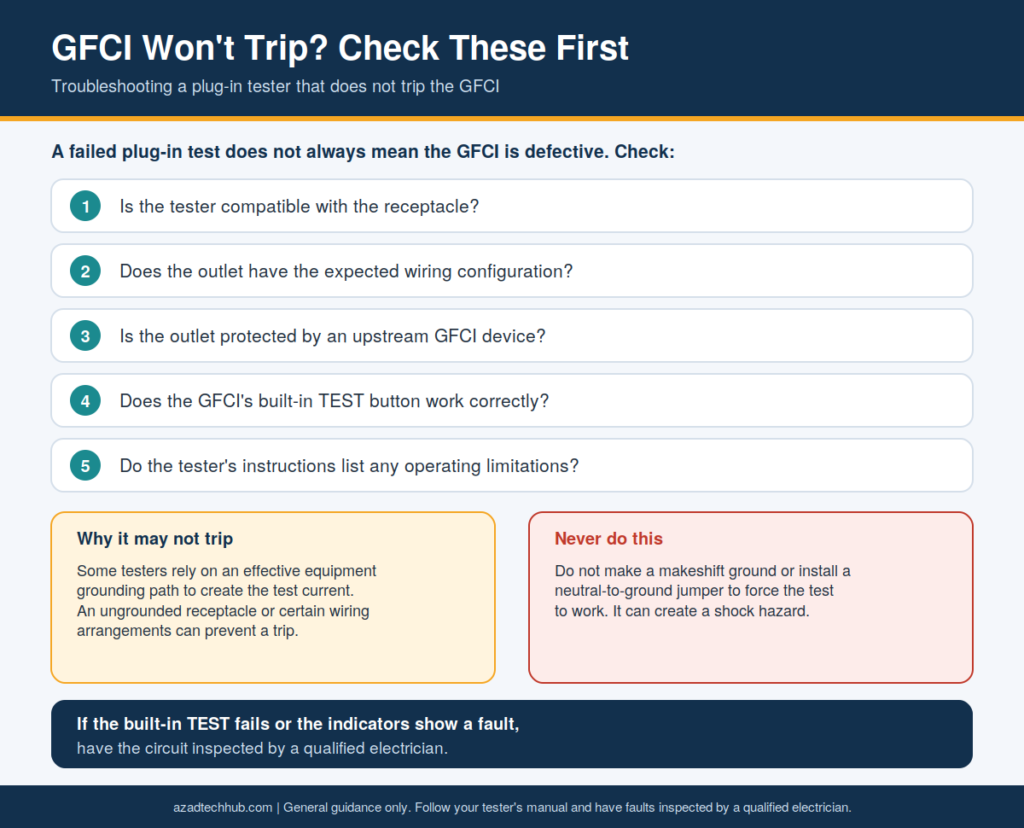
Never install a jumper between neutral and ground to make the tester trip. If the GFCI fails its built-in test, or the wiring indicators show a fault, have the circuit inspected by a qualified electrician.
For a broader understanding of electrical safety tools, read my guide to how does a non contact voltage detector work. Remember that a voltage detector and a GFCI receptacle tester serve different purposes.
How to Use a Milwaukee Outlet Tester
Milwaukee offers several electrical testing instruments, so first confirm whether your tool is a plug-in receptacle tester, a non-contact voltage detector, or a multimeter. The correct testing method depends on the model and its rated applications.
Step-by-Step Procedure for a Milwaukee Receptacle Tester
Step 1: Check the model and rating
Read the model number and manufacturer’s instructions. Confirm that the tester supports the receptacle type and voltage you intend to check.
Step 2: Inspect the outlet
Look for cracked faceplates, loose receptacles, discoloration, or signs of overheating. Do not insert a tester into a visibly damaged outlet.
Step 3: Insert the tester
Plug the tester into the receptacle fully. Do not force it into an incompatible outlet or use an adapter unless the manufacturer permits that arrangement.
Step 4: Read the indicators
Use the specific model’s LED chart to interpret the results. Depending on the tester, the indicators may identify conditions such as correct wiring, an open ground, an open neutral, or a possible wiring error. Not every model detects every condition.
Step 5: Test GFCI protection if supported
If the tool includes a GFCI test function, follow its instructions. On a compatible, correctly configured circuit, the test should activate the GFCI protection and interrupt power.
Step 6: Reset and verify
Reset the protective device according to its instructions. If the outlet does not return to normal operation, or the tester indicates a fault, stop using the outlet until the problem has been assessed.
Common Problems When Using an Outlet Tester
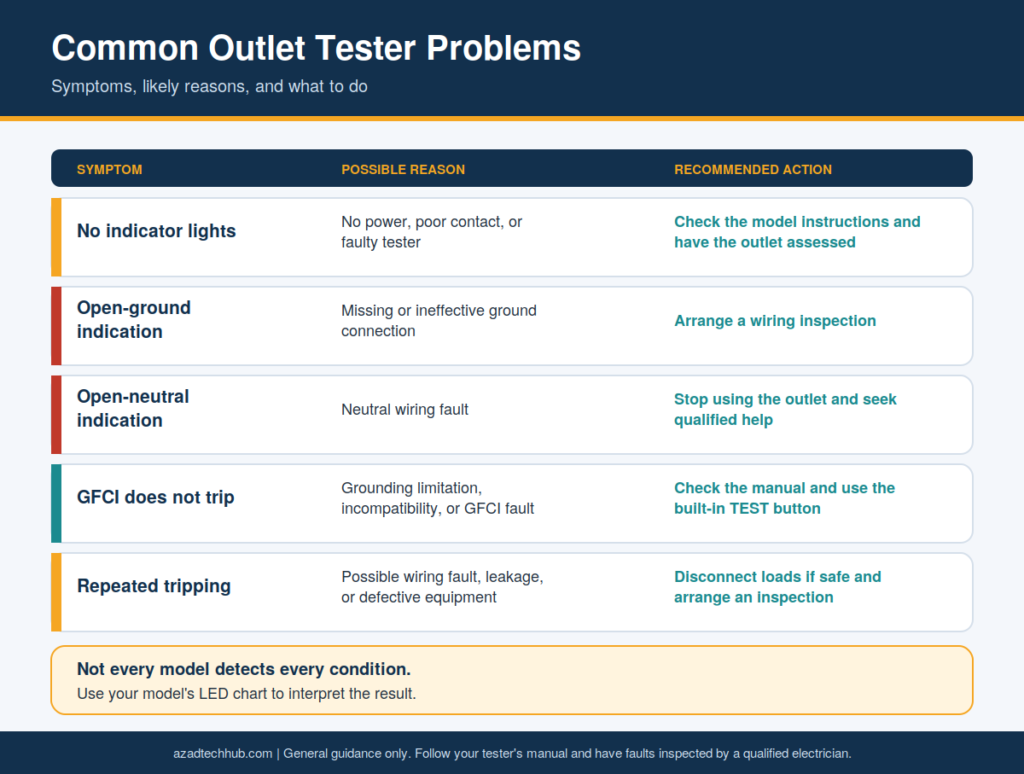
| Symptom | Possible reason | Recommended action |
|---|---|---|
| No indicator lights | No power, poor contact, or faulty tester | Check the model instructions and have the outlet assessed |
| Open-ground indication | Missing or ineffective ground connection | Arrange a wiring inspection |
| Open-neutral indication | Neutral wiring fault | Stop using the outlet and seek qualified help |
| GFCI does not trip | Grounding limitation, incompatibility, or GFCI fault | Check the manual and use the built-in TEST button |
| Repeated tripping | Possible wiring fault, leakage, or defective equipment | Disconnect loads if safe and arrange an inspection |
Can a Milwaukee Outlet Tester Confirm an Outlet Is Safe?
No plug-in outlet tester can confirm every aspect of electrical safety. It may identify common wiring errors, but it cannot reliably establish the quality of every connection, the effectiveness of all grounding paths, or the complete operation of every protective device.
For professional troubleshooting, use the appropriate rated instruments and follow the applicable electrical code and manufacturer procedures. Never touch exposed conductors or remove a receptacle cover while the circuit is energized unless you are qualified and following the required safety controls.
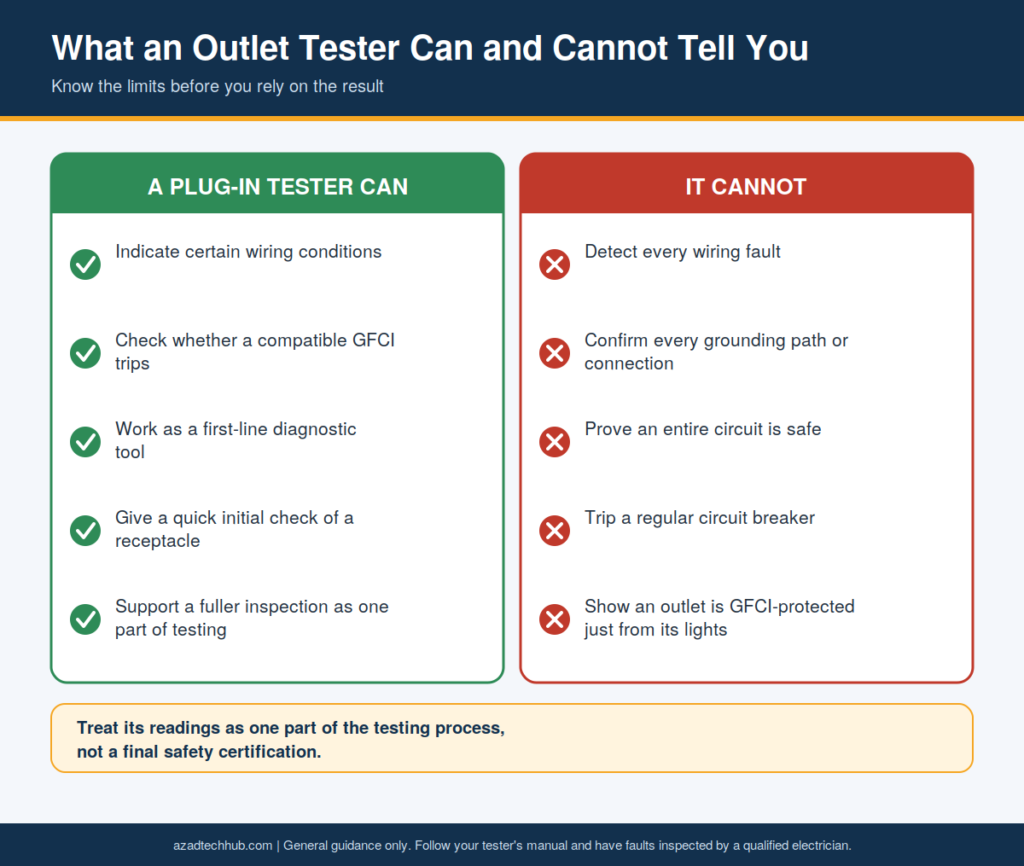
For a quick initial check, a compatible Milwaukee receptacle tester can be useful. For a full diagnosis, treat its readings as one part of the testing process rather than a final safety certification.
Frequently Asked Questions
Can I use a GFCI tester to test an outlet?
Yes. A compatible plug-in tester can indicate certain wiring conditions and test a GFCI’s operation. It does not detect every fault or replace a complete electrical inspection.
Why won’t my GFCI breaker trip when I press the test button?
Possible causes include an ineffective grounding path for the plug-in test, incorrect wiring, an incompatible tester, or a faulty protective device. Test the breaker using its built-in TEST button as directed by the manufacturer. If it fails that test, arrange an inspection.
How can I tell if a GFCI outlet is bad?
Warning signs include failure to reset, failure to trip during the built-in test, visible damage, burning smells, or repeated unexplained tripping. Stop using a damaged outlet and have it inspected.
Will a GFCI tester trip a normal breaker?
Normally, no. A standard circuit breaker is designed to respond to overcurrent, while a GFCI responds to a ground-fault current imbalance.
How do I use a GFCI outlet tester?
Plug it into a compatible receptacle, read the indicator chart, press the GFCI test button if appropriate, verify the trip, and reset the GFCI. Follow the model-specific instructions throughout.
Is there a difference between a GFI and a GFCI?
In common US electrical usage, GFI and GFCI generally refer to the same type of ground-fault protection. GFCI is the more common formal term.
Final Verdict
The Klein Tools RT210 is worth considering for basic receptacle wiring checks and GFCI testing. Its indicator lights make it useful for quick troubleshooting, provided you understand the limits of a plug-in tester.
Get new guides in your feed. Follow Electrical Insights on LinkedIn for new electrical standards guides, calculators and design tips from Azad Circuit Hub.