
Non-Contact Voltage Tester Blinking Blue: Full Troubleshooting Guide
A non-contact voltage tester should give a clear indication when it detects an energized conductor. But when the indicator starts flashing blue, the meaning is not always obvious. Depending on the tester design, a blue light can indicate normal operation, low battery, standby mode, weak voltage detection, or a fault.
If you are dealing with a Voltage Tester Blinking Blue, the first step is to identify the tester brand and model. Fluke, Klein Tools, Sperry, and other manufacturers use different LED colors and warning patterns. Never assume that blue means the same thing on every voltage detector.
This guide explains the most common causes, testing methods, brand-specific behavior, and signs that indicate it is time to replace the tester.
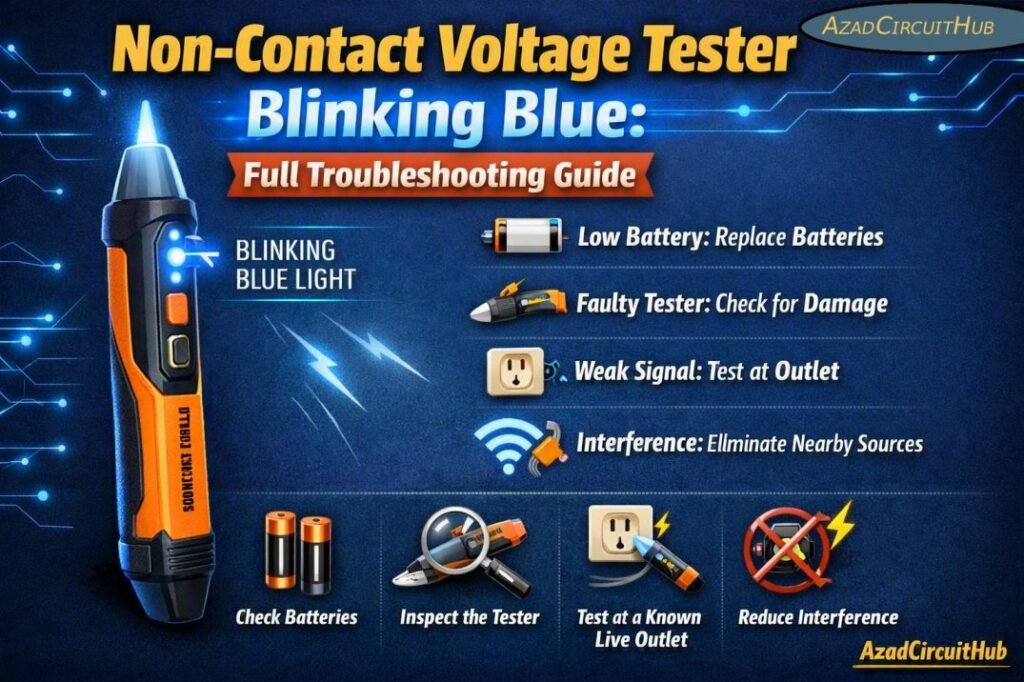
Table of Contents
Table of Contents
Quick Troubleshooting Table
| Tester behavior | Most likely cause | What to check | Recommended action |
|---|---|---|---|
| Blue light flashes during startup | Normal self-test | Manual and startup sequence | Continue testing |
| Blue light flashes continuously | Standby or operating indication | Model instructions | Check operating mode |
| Blue light with no voltage alarm | Weak battery or no detected voltage | Battery and live circuit | Test battery and known-live source |
| Blue light becomes weak | Low battery | Battery compartment | Replace battery |
| Blue light plus red warning | Voltage detected on some models | Known-live circuit | Follow tester instructions |
| Random blue flashing | Possible interference or fault | Nearby electronics and wiring | Retest in another location |
| Blue light but no response to live voltage | Sensor or circuit problem | Known-live AC source | Stop relying on tester |
| Flashing after dropping tester | Internal damage possible | Housing and tip | Replace if unreliable |
What Does a Blue Light Mean on a Voltage Tester?
A blue indicator does not have one universal meaning. Non-contact voltage testers use LEDs, audible alarms, vibration, or combinations of these signals to communicate operating status.
On some instruments, blue may simply show that the tester is powered on. On another model, it can indicate a low-sensitivity or standby condition. A change in flashing pattern can also occur when the battery is becoming weak.
The safest approach is to compare the light pattern with the manufacturer’s instructions rather than interpreting the color alone.
When troubleshooting a Voltage Tester Blinking Blue, always check whether the tester produces its normal voltage warning when placed near a verified energized conductor.
Common Causes of a Voltage Tester Blinking Blue
Several conditions can produce unusual LED behavior. The following table provides a quick starting point.
| Possible cause | Typical symptom | Severity |
|---|---|---|
| Normal startup sequence | Short flash after pressing power | Low |
| Low battery | Dim or irregular indicator | Medium |
| Standby mode | Periodic flashing without alarm | Low |
| Electrical interference | False or inconsistent indication | Medium |
| Very low detected voltage | Weak or intermittent response | Medium |
| Damaged sensor | No reliable response to live voltage | High |
| Moisture contamination | Erratic operation | High |
| Internal electronic fault | Unpredictable lights or alarms | High |
1. Low Battery
A weak battery is one of the easiest causes to overlook. As battery voltage falls, the tester may still power on but may not provide reliable sensing performance.
Replace the battery with the correct type recommended by the manufacturer. Avoid assuming that a tester is safe to use simply because its LED still illuminates.
After replacing the battery, perform a functional test on a known energized AC source.
2. Normal Power-Up Indication
Some voltage detectors briefly illuminate an LED during startup. This is part of their self-check routine and does not necessarily indicate a problem.
If the blue light appears only for a short period and the tester subsequently operates normally, there may be no fault at all.
3. Standby or Low-Sensitivity Mode
Some models have multiple sensitivity levels or operating modes. A periodic blue flash may indicate that the device is powered and waiting for a voltage signal.
Check the model number and operating instructions before assuming the tester has failed.
4. Electrical Interference
Non-contact voltage detectors can respond to electric fields from nearby conductors and electronic equipment. Fluorescent lighting, power supplies, extension cords, computers, and adjacent energized cables can sometimes create confusing indications.
Move away from the suspected interference source and repeat the test.
For a Voltage Tester Blinking Blue that behaves differently in different locations, interference should be considered before declaring the instrument defective.
How to Troubleshoot It Safely
Use this sequence rather than immediately opening the tester or replacing internal components.
| Step | Test | Expected result |
|---|---|---|
| 1 | Inspect housing and sensing tip | No cracks or damage |
| 2 | Check battery | Correct voltage and installation |
| 3 | Power tester on | Normal startup indication |
| 4 | Test known-live AC source | Expected visual/audio response |
| 5 | Test known-dead source | No voltage warning |
| 6 | Repeat at different distance | Stable response |
| 7 | Compare with another tester | Similar voltage indication |
| 8 | Check manufacturer instructions | Correct LED interpretation |
Never use an unknown or questionable circuit as your first test. A known-live source, such as a properly functioning receptacle, provides a much safer reference.
A non-contact tester is also not a substitute for proving a circuit dead with an appropriate test instrument when electrical work requires isolation and verification.
Fluke vs Klein vs Sperry: What Changes?
Brand behavior can vary considerably. The exact LED pattern depends on the model, so the following notes should be treated as general guidance rather than a replacement for the manual.
Fluke Voltage Testers
Fluke non-contact voltage detectors commonly use visual and audible indications to communicate voltage detection and operating status. Some models also incorporate different sensitivity settings.
If a Fluke tester shows an unusual flashing pattern but fails to respond consistently to a known-live circuit, check the battery first. Then verify the tester using the manufacturer’s specified functional test procedure.
Do not rely on a blue indicator alone to determine whether a conductor is energized.
Klein Tools Voltage Testers
Klein Tools produces several non-contact voltage testers with different LED colors, audible alarms, sensitivity ranges, and operating sequences.
Some models use colored LEDs as part of their normal status indication. Therefore, a blue or differently colored flash does not automatically mean the tester is defective.
If a Klein tester starts flashing unexpectedly, inspect the battery, sensing tip, power button, and housing. Test it against a known-live source before using it for electrical troubleshooting.
Sperry Voltage Testers
Sperry voltage detectors also vary by model. LED colors and alarm behavior can differ between product generations.
A Sperry tester that produces a blue flash but gives no expected voltage indication should be checked against a known energized AC source. If it fails the manufacturer’s functional test, replace the tester rather than trusting an uncertain reading.
| Brand | Behavior can vary by model? | Important check |
|---|---|---|
| Fluke | Yes | Sensitivity and startup sequence |
| Klein Tools | Yes | LED/alarm pattern and battery |
| Sperry | Yes | Model-specific indicator behavior |
| Other brands | Yes | Manufacturer instructions |
When Blue Flashing Indicates a Fault
A flashing indicator becomes more concerning when it is combined with other symptoms.
Watch for these warning signs:
- The tester fails on a known-live circuit.
- The audible alarm no longer works.
- The LED becomes unusually dim.
- The tester works only when held at a particular angle.
- The indication changes randomly.
- The tester was dropped or exposed to moisture.
- The sensing tip is cracked or contaminated.
- The tester gives voltage indications when it should not.
If a Voltage Tester Blinking Blue is accompanied by inconsistent voltage detection, treat the instrument as unreliable.
When Should You Replace the Tester?
If a voltage detector cannot consistently pass its functional test, replacement is usually the sensible option. These instruments are safety devices, and saving the cost of a new tester is not worth the risk of trusting a defective indication.
CTA: If you are replacing an unreliable detector, compare our guide to the best non contact voltage tester for electricians, maintenance technicians, and home electrical checks.
Fresh Tester Recommendation: Don’t Ignore These Symptoms
Consider buying a fresh voltage tester if the existing unit has been dropped, exposed to water, shows unpredictable LED behavior, or fails to detect a verified live source.
Choose a model with clear visual and audible warnings, an appropriate AC voltage range, durable construction, and a manufacturer’s stated functional test procedure.
Replace the tester rather than troubleshooting indefinitely if it fails a known-live test. A new, reputable non-contact voltage detector is inexpensive compared with the consequences of a missed energized conductor.
For professional electrical work, use the voltage detector as an initial screening tool and follow the applicable safe isolation and voltage verification procedure with properly rated test equipment.
Other Reasons a Voltage Tester May Behave Strangely
Not every unusual indication means an electronic failure.
| Situation | Possible effect |
|---|---|
| Shielded cable | Reduced detection |
| Deeply buried conductor | Weak response |
| Low-voltage AC | Little or no response |
| Multiple adjacent cables | False or stronger indication |
| Static electricity | Momentary indication |
| Variable-frequency equipment | Unusual response |
| Electronic power supplies | Intermittent indication |
| Wet or contaminated tip | Erratic operation |
This is why proximity voltage testing should be understood as an indication of an electric field, not as a direct measurement of conductor voltage.
If you need more information about selecting a reliable detector, see our detailed guide to the best non contact voltage tester and compare voltage range, sensitivity, alarm type, battery life, and professional features.
How to Test Whether the Tester Is Working
A simple three-point check is useful:
- Turn the tester on and observe its normal startup behavior.
- Test it against a known energized AC source.
- Test it away from energized conductors or on a verified de-energized condition.
The tester should respond consistently according to its manufacturer’s instructions.
If the device passes the first check but fails the known-live test, do not continue using it for electrical diagnosis.
For critical electrical work, use an appropriately rated two-pole voltage tester or multimeter according to the applicable safety procedure. Non-contact detectors should not be treated as the only method of proving absence of voltage.
Frequently Asked Questions
Why is my voltage tester blinking blue?
A blue flash may indicate normal operation, standby mode, battery condition, or another model-specific status. Check the tester’s manual and confirm operation on a known-live AC source before using it.
Why is my non-contact voltage tester flashing but not detecting voltage?
A weak battery, electrical interference, low voltage, excessive distance, shielding, or a damaged sensing circuit can cause this behavior. Replace the battery and perform a functional test on a known-live source.
Can a voltage tester give a false reading?
Yes. Non-contact voltage detectors sense electric fields and can sometimes respond to induced or nearby voltage. They can also fail to detect voltage under certain conditions, so they should not be the sole method of proving a circuit is de-energized.
How do I know if my voltage detector is bad?
Test it on a known energized source using the manufacturer’s recommended procedure. If it does not respond consistently, produces unpredictable indications, or has physical damage, replace it.
Do Fluke and Klein voltage testers use the same LED colors?
No. Indicator colors and flashing patterns vary between models and manufacturers. A blue light on one tester should not automatically be interpreted in the same way on another.
Final Takeaway
A Voltage Tester Blinking Blue is not automatically a sign of failure. The indicator may simply represent normal operation or a model-specific status condition. However, unusual flashing combined with weak, missing, or inconsistent voltage detection should never be ignored.
Start with the battery, inspect the tester, check for interference, and perform a functional test on a known-live source. Always follow the instructions for the exact Fluke, Klein, Sperry, or other tester you are using.
If the instrument fails its functional check, replace it. For electricians and maintenance professionals, choosing a dependable detector is an important part of safe electrical troubleshooting.
Before your next electrical inspection, check our guide to the best non contact voltage tester to compare reliable options and features.
Get new guides in your feed. Follow Electrical Insights on LinkedIn for new electrical standards guides, calculators and design tips from Azad Circuit Hub.
#NonContactVoltageTester, #VoltageTester, #VoltageTesterBlinkingBlue, #ElectricalTesting, #ElectricalSafety, #VoltageDetector, #ElectricianTools, #ElectricalTroubleshooting, #NCVTester, #ElectricalTools
