
Fluke T6-1000 Pro vs Fluke 325: Which Electrical Tester Is Better?
Choosing between two Fluke meters can be difficult because the Fluke T6-1000 Pro and Fluke 325 are designed for different types of electrical work. One focuses on fast voltage and current measurements without touching bare conductors, while the other is a more traditional clamp meter with broader troubleshooting functions.
In this fluke t6 1000 pro vs fluke 325 comparison, I will look at their measurement capabilities, safety ratings, clamp design, ease of use, accuracy, and practical applications. As an electrical engineer with 15 years of experience in electrical systems maintenance, I have found that the best meter is not always the one with the most functions. The right choice depends on how you work and what you troubleshoot most often.
Fluke T6-1000 Pro vs Fluke 325: Quick Comparison
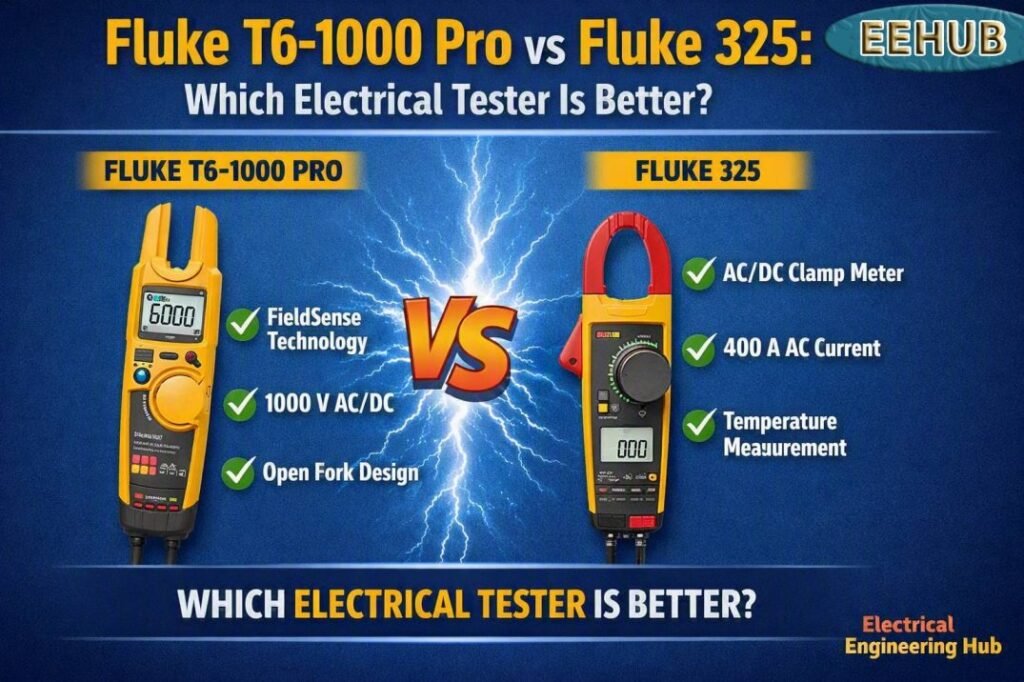
Table of Contents
Table of Contents
What Is the Fluke T6-1000 Pro?
The Fluke T6-1000 Pro is designed for electricians who want to measure voltage and current quickly without placing test probes directly across conductors in many situations.
Its biggest advantage is Fluke FieldSense technology. This allows the user to measure AC voltage through the open fork rather than making direct metallic contact with a live conductor. That can make everyday electrical testing faster and can reduce the need to position two test probes in a crowded panel.
The T6-1000 Pro is rated for measurements up to 1000 V and 200 A AC. Its narrow fork design is particularly useful when working around breakers, terminals, and individual conductors.
For electricians who regularly perform installation, maintenance, and service work, this design can be extremely convenient.
If you want a tester specifically for fast non-contact electrical measurements, see my detailed guide to the best non touch voltage tester before choosing a model.
T6-1000 Pro Key Features
- FieldSense technology for non-contact AC voltage measurement
- AC voltage measurement up to 1000 V
- AC current measurement up to 200 A
- Slim open-fork design
- True-RMS measurements
- Resistance measurement
- Frequency measurement
- Backlit display
- CAT III 1000 V and CAT IV 600 V safety rating
- Designed for electrical maintenance and troubleshooting
What Is the Fluke 325?
The Fluke 325 is a compact True-RMS clamp meter intended for general electrical troubleshooting. Unlike the T6-1000 Pro, it uses a conventional clamp jaw and test leads to provide a broader range of measurements.
It can measure AC and DC current up to 400 A, making it more suitable for applications where both current types matter. It also adds functions such as capacitance, temperature, diode testing, and frequency measurement.
The Fluke 325 is therefore more of a general-purpose troubleshooting instrument. It is useful for electricians, HVAC technicians, maintenance professionals, and technicians who need more than basic voltage and current measurements.
One limitation is its 600 V maximum voltage rating. That is still adequate for many commercial and residential applications, but the T6-1000 Pro has a higher voltage rating and a higher CAT IV rating at 600 V.
Fluke T6-1000 Pro vs Fluke 325: Measurement Capability
The biggest difference becomes clear when comparing their measurement philosophies.
The T6-1000 Pro is optimized for speed. Its FieldSense technology can simplify voltage measurements when working with individual conductors. This is particularly useful when checking circuits during maintenance.
The Fluke 325 prioritizes measurement versatility. Its conventional clamp and test leads allow you to perform several additional tests that are not available on the T6-1000 Pro.
For example, if you troubleshoot HVAC equipment and need temperature measurements, the 325 is the more practical choice. The same applies when capacitance or DC current measurements are part of your normal workflow.
Fluke T6-1000 Pro vs Fluke 325 for Electricians
For electricians working primarily on AC electrical systems, the T6-1000 Pro has a major ergonomic advantage.
You can position a single conductor inside the fork and obtain a current reading without wrapping a conventional clamp around the conductor. Its slim profile is convenient in crowded electrical panels.
The 325 takes a more traditional approach. Its larger jaw accommodates larger conductors, and the conventional design is familiar to most technicians.
If your work involves frequent panel inspections, breaker testing, and AC circuit checks, the T6-1000 Pro can save time. If you work across different equipment types and need several diagnostic functions, the 325 offers greater versatility.
Which One Is Safer?
Safety should be considered before price or convenience.
The T6-1000 Pro carries a CAT III 1000 V and CAT IV 600 V rating, which gives it a significant advantage for certain higher-energy electrical environments when used according to the manufacturer's instructions.
The Fluke 325 is rated CAT III 600 V. This makes it suitable for many building and industrial troubleshooting applications, but it is not equivalent to the T6-1000 Pro's higher voltage and CAT IV capability.
Remember that a meter's CAT rating does not make electrical work automatically safe. Proper PPE, isolation procedures, verification of the instrument, and safe work practices remain essential.
Fluke T6-1000 Pro vs Fluke 325: Ease of Use
The T6-1000 Pro wins for quick routine measurements.
Its fork-style design means you can often check a conductor without the two-handed probe positioning required by a conventional multimeter. This is especially useful when space is limited.
The Fluke 325 takes slightly more traditional steps, but that also makes it familiar. Its clamp jaw and test leads provide a conventional workflow for technicians who need multiple measurement modes.
Which Meter Has Better Features?
| Requirement | Better Choice |
|---|---|
| Fast AC voltage testing | T6-1000 Pro |
| Non-contact voltage measurement | T6-1000 Pro |
| Higher voltage rating | T6-1000 Pro |
| CAT IV 600 V protection | T6-1000 Pro |
| AC current measurement | Both |
| Higher current capacity | Fluke 325 |
| DC current | Fluke 325 |
| Temperature testing | Fluke 325 |
| Capacitance testing | Fluke 325 |
| Diode testing | Fluke 325 |
| HVAC troubleshooting | Fluke 325 |
| General-purpose diagnostics | Fluke 325 |
| Crowded electrical panels | T6-1000 Pro |
Buy the Fluke T6-1000 Pro if You Need Fast Electrical Testing
The T6-1000 Pro makes the most sense for electricians who value speed and convenient AC measurements.
It is especially attractive if your daily work includes electrical panels, branch circuits, motor circuits, commercial wiring, and maintenance inspections.
If the T6-1000 Pro fits your work, check the latest Fluke T6-1000 Pro price on Amazon. Amazon pricing and availability can change, so check the current listing before ordering.
Buy the Fluke 325 if You Need a Versatile Clamp Meter
The 325 is the better choice when you need one compact instrument for several troubleshooting tasks.
Its AC/DC current capability and additional functions make it more flexible for technicians who work with motors, HVAC equipment, control panels, machinery, and general electrical systems.
If those functions are more important than FieldSense technology, check the Fluke 325 on Amazon and compare the current price, seller, and included accessories before buying.
Fluke T6-1000 Pro vs Fluke 325: Pros and Cons
Fluke T6-1000 Pro Pros
- Fast AC voltage measurements
- FieldSense technology
- Excellent safety ratings
- Slim fork design
- 1000 V voltage capability
- Very convenient for electricians
- Excellent for routine AC maintenance
Fluke T6-1000 Pro Cons
- Less versatile than a full-featured clamp meter
- No DC current measurement
- No temperature function
- No capacitance measurement
- 200 A AC current limit
Fluke 325 Pros
- Measures AC and DC current
- 400 A current capacity
- True-RMS measurements
- Temperature function
- Capacitance measurement
- Frequency and diode testing
- Useful for HVAC and general troubleshooting
Fluke 325 Cons
- Lower 600 V voltage rating
- No FieldSense fork measurement
- Larger clamp design
- Not CAT IV rated like the T6-1000 Pro
Fluke T6-1000 Pro vs Fluke 325: Which Should You Buy?
The better option depends on your typical electrical tasks.
Choose the Fluke T6-1000 Pro if your priority is fast AC voltage and current testing, a compact form factor, and higher electrical safety ratings. Its FieldSense technology is the standout feature and is particularly valuable for electricians who frequently work inside electrical panels.
Choose the Fluke 325 if you want a broader troubleshooting tool. Its 400 A AC/DC current capability, temperature measurement, capacitance testing, and diode function give it a wider range of applications.
For pure electrician convenience, I would lean toward the T6-1000 Pro. For technicians who need a more versatile diagnostic clamp meter, the 325 is the stronger choice.
When deciding in this fluke t6 1000 pro vs fluke 325 comparison, do not simply choose the model with more functions. Consider the circuits you work on, voltage levels, current type, available space, and the measurements you perform most often.
If you are still comparing electrical testers, my guide to the best non touch voltage tester can help you find a suitable option for quick live-circuit checks.
Frequently Asked Questions
Is the Fluke T6-1000 Pro better than the Fluke 325?
Not for every user. The T6-1000 Pro is better for fast AC electrical testing and FieldSense measurements, while the 325 is better for technicians who need AC/DC current and additional diagnostic functions.
Can the Fluke T6-1000 Pro measure DC current?
No. The T6-1000 Pro is primarily designed around AC voltage and AC current measurements. If DC current measurement is important, the Fluke 325 is the better option.
Is the Fluke 325 a True-RMS meter?
Yes. The Fluke 325 uses True-RMS measurement technology, making it suitable for measuring many non-linear electrical loads more accurately than an average-responding meter.
Which is better for HVAC work, the T6-1000 Pro or Fluke 325?
The Fluke 325 is generally the better choice for HVAC troubleshooting because it provides AC/DC current measurement along with temperature and capacitance functions. Those additional measurements can be useful when diagnosing motors, compressors, capacitors, and related equipment.
Is the Fluke T6-1000 Pro worth buying?
For electricians who regularly need fast AC voltage and current measurements, the T6-1000 Pro can be worth the higher investment. FieldSense technology, its compact design, and its higher safety ratings make it particularly useful for electrical maintenance and service work.
Final Verdict
The Fluke T6-1000 Pro and Fluke 325 are both professional-grade instruments, but they solve different problems.
The T6-1000 Pro is the specialist for fast AC electrical measurements. Its FieldSense technology, 1000 V capability, slim design, and strong safety ratings make it an excellent option for electricians who spend much of their day testing energized AC circuits.
The Fluke 325 is the more versatile troubleshooting instrument. Its AC/DC current capability and additional measurement functions make it a better all-around choice for HVAC, industrial maintenance, and technicians who need several diagnostic tools in one meter.
My overall recommendation is simple: choose the T6-1000 Pro for electrician-focused AC testing and choose the 325 when measurement versatility matters more. That is the key takeaway from this fluke t6 1000 pro vs fluke 325 comparison.
Before purchasing, compare the current Amazon listing, included accessories, warranty, and seller reputation. For professional electrical work, buying a genuine Fluke meter from a reputable source is worth prioritizing over a small difference in price.
Related Guides
- Fluke T6-600 Electrical Tester Review
- Fluke T6-1000 PRO vs Fluke T5-1000
- Fluke T6-1000 Pro vs Fluke T6-1000
- Best Voltage Tester for 240V Circuits
- Fluke T6-600 Electrical Tester Review
Get new guides in your feed. Follow Electrical Insights on LinkedIn for new electrical standards guides, calculators and design tips from Azad Circuit Hub.
#FlukeT61000Pro, #Fluke325, #FlukeTester, #ClampMeter, #ElectricalTester, #FlukeComparison, #ElectricianTools, #ElectricalTesting, #DigitalMultimeter, #ElectricalTools
