Fluke T6-1000 Pro vs Fluke T6-1000: Which Electrical Tester Should You Buy?
Choosing between two closely related electrical testers can be difficult when both come from Fluke. The Fluke T6-1000 and T6-1000 Pro are designed for electricians who need to measure voltage and current without making direct contact with conductors. However, there are meaningful differences in features, included accessories, usability, and overall value.
In this fluke t6-1000 pro vs fluke t6-1000 comparison, I will break down the practical differences that matter when working on electrical panels, distribution boards, motors, disconnects, and branch circuits. My perspective comes from 15 years of experience in electrical systems maintenance, where safe testing, dependable readings, and quick troubleshooting are critical.
The basic measurement concept is similar, but the Pro version is positioned as the more complete professional option. Before purchasing, check the exact package offered by the retailer because included accessories can vary by market and seller.
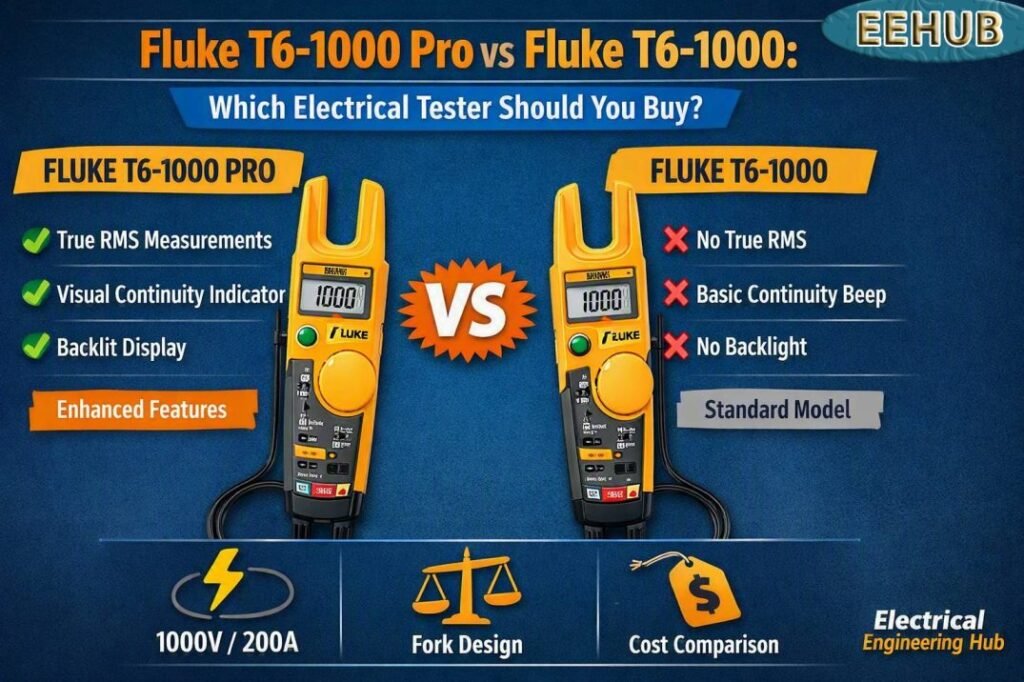
Table of Contents
Table of Contents
What Is the Fluke T6-1000?
The Fluke T6-1000 is a clamp-style electrical tester built around Fluke's FieldSense technology. Instead of requiring the electrician to place test leads directly across a circuit for many voltage measurements, FieldSense can detect electrical voltage through the tester's open fork.
That makes it particularly useful when working inside crowded electrical panels.
The tester can measure AC voltage, AC current, resistance, continuity, and other common electrical parameters. Its open-jaw design also allows current measurement without disconnecting the conductor.
For maintenance electricians, this can save time during routine troubleshooting.
One of the biggest advantages is the ability to measure voltage and current with a single compact instrument. It is not intended to replace every function of a full-featured digital multimeter, but it can be an excellent troubleshooting tool.
What Is the Fluke T6-1000 Pro?
The Fluke T6-1000 Pro builds on the T6 platform and is aimed more directly at professional electrical work. It retains the core FieldSense approach while providing a more complete professional solution.
For electricians who regularly troubleshoot 120V, 240V, 480V, and other AC systems, the combination of voltage detection and open-fork current measurement can be very convenient.
The Pro model is especially attractive when the purchase package includes accessories that make field work easier. Depending on the seller and region, packaging can differ, so compare the actual contents rather than relying only on the product name.
Fluke T6-1000 Pro vs Fluke T6-1000: Key Differences
The most important point in this fluke t6-1000 pro vs fluke t6-1000 comparison is that these are not completely different categories of instruments. Both belong to the same T6 family and use the same general measurement philosophy.
1. FieldSense Technology
Both models use FieldSense technology for non-contact voltage measurement through the open fork.
This is one of the main reasons to choose a T6 tester. An electrician can often check voltage without attaching conventional probes directly to the conductor.
However, FieldSense should not be confused with a basic non-contact voltage detector. The T6 is designed to provide a measured voltage value, while a simple voltage pen generally provides an indication that voltage may be present.
For broader testing options, see our best non touch voltage tester guide to compare other professional voltage detection tools.
2. Current Measurement
Both testers can measure AC current through the open fork, with a rated measurement capability of up to 200A AC.
This is useful for checking loads on individual conductors without opening the circuit.
For example, during motor maintenance, you can measure operating current and compare it with the motor nameplate rating. This can help identify overload conditions, phase imbalance issues, or unexpected load changes.
3. Safety Ratings
Safety is one of the most important considerations when selecting electrical test equipment.
Both T6-1000 models are designed for demanding electrical environments and carry high CAT safety ratings. Their specifications make them suitable for many industrial and commercial troubleshooting applications.
Nevertheless, the CAT rating of a meter does not make every electrical task safe. Proper PPE, isolation procedures, arc-flash practices, and test-before-touch procedures remain essential.
4. Size and Convenience
A traditional digital multimeter requires test leads for many measurements. The T6 design reduces the amount of equipment needed for common voltage and current checks.
This is particularly helpful when working in confined panels.
An electrician can place the conductor through the open fork and obtain a current reading without disconnecting the wire. For voltage measurements, FieldSense can reduce the need for direct probe contact.
Fluke T6-1000 Pro vs Fluke T6-1000: Which Is Better for Electricians?
For many users, the answer depends less on raw measurement capability and more on workflow.
The standard T6-1000 can be an excellent choice if you want a compact electrical tester for routine maintenance and troubleshooting.
The Pro version makes more sense when you work with electrical systems regularly and want the enhanced professional configuration or accessory package.
| User Type | Recommended Choice |
|---|---|
| Home electrical troubleshooting | T6-1000 |
| Maintenance electrician | T6-1000 or T6-1000 Pro |
| Industrial electrician | T6-1000 Pro |
| Commercial electrical contractor | T6-1000 Pro |
| Occasional voltage checks | T6-1000 |
| Frequent panel troubleshooting | T6-1000 Pro |
| Users who already own a good multimeter | T6-1000 |
| Users wanting an all-purpose field tester | T6-1000 Pro |
If you are ready to purchase, compare the current Amazon listing for the Fluke T6-1000 Pro electrical tester and check the included accessories, seller, warranty, and latest price before ordering.
Pros and Cons of the Fluke T6-1000
Pros
- FieldSense technology simplifies voltage testing.
- Open fork allows convenient current measurements.
- Measures up to 200A AC.
- Compact design for field work.
- High safety rating.
- Useful for electrical maintenance and troubleshooting.
Cons
- Not a complete replacement for a high-end multimeter.
- FieldSense measurements can require proper positioning.
- Limited compared with advanced meters used for detailed diagnostics.
- Price is higher than basic electrical testers.
Pros and Cons of the Fluke T6-1000 Pro
Pros
- Professional-grade construction.
- FieldSense voltage measurement.
- Open-fork current measurement.
- 1000V voltage capability.
- Suitable for demanding maintenance environments.
- Convenient for electricians who perform frequent measurements.
Cons
- Costs more than many basic testers.
- Some advanced diagnostic functions still require a multimeter.
- Package contents should be checked before purchase.
- Overkill for users who only need occasional voltage detection.
Is the T6-1000 Pro Worth the Extra Money?
The value question is central to the fluke t6-1000 pro vs fluke t6-1000 decision.
If you only need basic electrical checks, the standard T6-1000 may provide everything you need. Spending extra money on the Pro model may not produce a meaningful benefit for occasional users.
For a professional electrician, however, the calculation is different. A tester that saves time during repeated voltage and current measurements can justify its cost over years of field use.
I would prioritize the Pro model for technicians who spend a significant part of their working day troubleshooting electrical circuits. For occasional maintenance, the standard T6-1000 remains a sensible choice.
If your main requirement is simple voltage presence detection rather than current measurement, our best non touch voltage tester recommendations can help you find a more specialized option.
T6-1000 vs T6-1000 Pro: What About a Traditional Multimeter?
The T6 family is best viewed as a specialized electrical troubleshooting instrument rather than a universal replacement for every multimeter.
A conventional True RMS multimeter is still valuable when you need detailed measurements, test leads, capacitance testing, frequency measurements, diode tests, or more advanced troubleshooting functions.
The T6 is strongest when speed and convenience matter.
For example, checking several conductors in an electrical panel can be faster with an open-fork tester than repeatedly attaching and removing test leads.
Buying Tips Before You Order
Before purchasing either model, check these points:
- Confirm the exact model number.
- Check whether the listing is for the standard or Pro version.
- Compare included accessories.
- Verify the seller and warranty.
- Check the latest Amazon price because it can change frequently.
- Make sure the voltage and current ranges match your application.
- Use properly rated PPE and follow electrical safety procedures.
For professional users, buying from an authorized or reputable seller is especially important for expensive test instruments.
Final Verdict
The fluke t6-1000 pro vs fluke t6-1000 comparison shows that both testers are strong choices for electricians who value fast voltage and current measurements. The T6-1000 is the better value when you want the core T6 functionality without paying for additional professional-oriented features or packaging.
The T6-1000 Pro is the better choice for electricians who use their tester frequently and want a more complete professional setup.
From my experience working with electrical systems maintenance, I would choose based on working conditions rather than simply selecting the more expensive model. If your daily work involves panels, motors, disconnects, and commercial or industrial circuits, the Pro version is easier to justify. If your requirements are simpler, the T6-1000 can be a practical investment.
The best choice in the fluke t6-1000 pro vs fluke t6-1000 debate ultimately comes down to how often you test, what circuits you work on, and whether the additional Pro features and package justify the price difference.
Frequently Asked Questions
Is the Fluke T6-1000 Pro better than the T6-1000?
The T6-1000 Pro is generally the better option for frequent professional use. However, both models share the core T6 measurement concept, so the standard T6-1000 can offer better value for routine electrical troubleshooting.
Can the Fluke T6-1000 measure current without disconnecting the wire?
Yes. Its open-fork design allows AC current measurements around a suitable individual conductor. This is one of the main advantages of the T6 platform for electrical maintenance.
Is the Fluke T6-1000 Pro a multimeter?
It is an electrical tester with several multimeter-style measurement functions, but it should not be considered a replacement for every advanced digital multimeter. A conventional DMM may provide additional functions required for specialized diagnostics.
Can I use a T6-1000 for 480V electrical systems?
The T6-1000 is rated for high-voltage electrical applications, but the exact installation category and conditions must always be checked against the manufacturer's specifications. Follow the meter's CAT rating, PPE requirements, and applicable electrical safety procedures.
Should an electrician buy the T6-1000 or T6-1000 Pro?
For occasional maintenance, the T6-1000 can be sufficient. For electricians who frequently troubleshoot commercial or industrial electrical systems, the Pro model is generally the more attractive long-term choice. Compare current pricing and package contents before buying.
Related Guides
- Fluke T6-1000 Pro vs Fluke 325
- Fluke T6-1000 PRO vs Fluke T5-1000
- Best Voltage Tester for 240V Circuits
- Fluke T6-600 Electrical Tester Review
Get new guides in your feed. Follow Electrical Insights on LinkedIn for new electrical standards guides, calculators and design tips from Azad Circuit Hub.
FlukeT61000Pro, #FlukeT61000, #FlukeTester, #ElectricalTester, #VoltageTester, #ElectricianTools, #ElectricalTesting, #FlukeTools, #ElectricalSafety, #TestEquipment