
Fluke T6-600 Electrical Tester Review: Features, Accuracy & Buying Guide
The Fluke T6-600 Electrical Tester is designed for electricians who want to measure AC voltage and current without putting a test probe around a live conductor. Its FieldSense technology can detect electrical current through the cable jacket, which can make routine measurements faster and reduce the need to open a circuit.
As an electrical engineer who has worked around panels, industrial controls, and electrical troubleshooting, I look at testers like this from a practical point of view. A good tester should be simple to use, reliable in the field, and suitable for the type of measurements an electrician actually makes.
The T6-600 is particularly interesting for panel work, maintenance, HVAC service, and troubleshooting where access to conductors can be limited.
Fluke T6-600 Electrical Tester: Key Features
| Feature | Fluke T6-600 Specification |
|---|---|
| AC voltage | Up to 600 V |
| AC current | Up to 200 A |
| Measurement method | FieldSense |
| Test leads | Included |
| Display | Digital LCD |
| Jaw opening | Up to 17.8 mm |
| Voltage detection | Contact and FieldSense |
| Safety rating | CAT III 600 V |
| Battery | 2 AAA batteries |
| Suitable for | Electrical maintenance, panels, HVAC and troubleshooting |
One of the main attractions of the T6-600 is its combination of a voltage tester and current measurement function. Instead of reaching for a conventional clamp meter for every basic current check, an electrician can use the open fork around a suitable conductor.
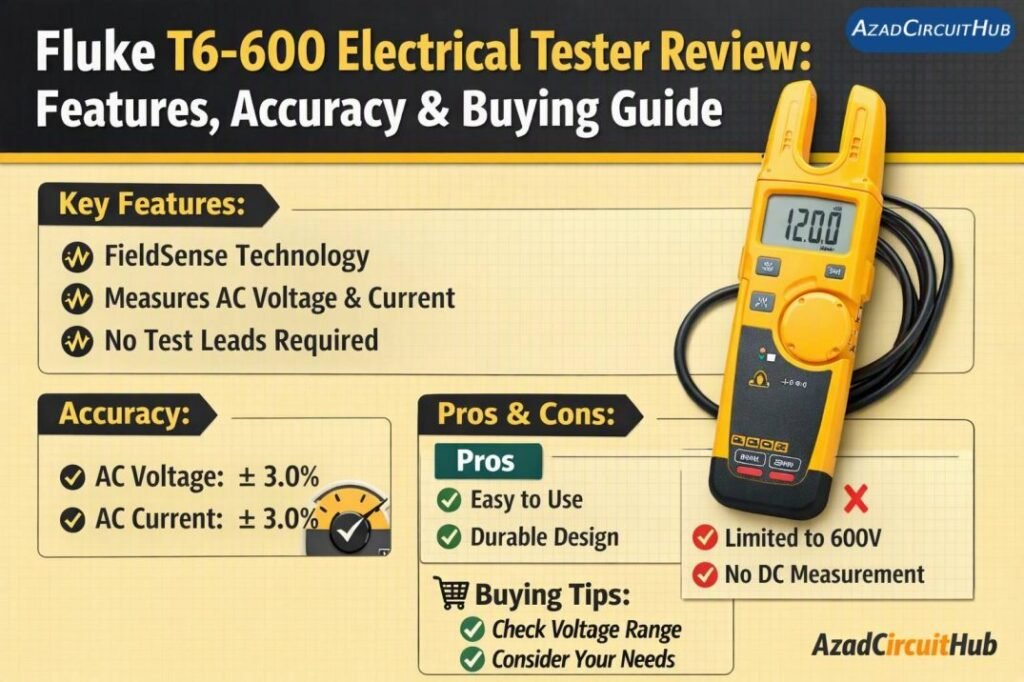
Table of Contents
Table of Contents
What Is the Fluke T6-600 Electrical Tester?
The Fluke T6-600 is a fork-style electrical tester that measures AC voltage and current. Its FieldSense system allows current measurement without making direct electrical contact with the conductor for the current reading.
That design is useful when working inside electrical panels. Traditional current measurement often requires separating or accessing a conductor so that a clamp meter can be placed around it. The T6-600 uses an open fork arrangement, allowing the conductor to be positioned inside the measurement area.
The tester also supports conventional test-lead measurements. This gives it more flexibility than a basic non-contact voltage detector.
For electricians who regularly perform voltage checks, load measurements, and troubleshooting, this combination can reduce the number of tools needed for quick jobs.
FieldSense Technology in Real Electrical Work
FieldSense is one of the most important features of this tester. It allows the instrument to sense voltage and current through the electrical field surrounding an energized conductor.
For example, when checking a branch circuit in a distribution panel, you may not need to expose the conductor just to obtain a current reading. You can position the appropriate conductor in the tester's open fork and take the measurement.
There are still important limitations. FieldSense is not a replacement for every type of electrical measurement. The conductor must be positioned correctly, and the tester should be used according to Fluke's instructions.
For higher-risk work, I would still verify the circuit with an appropriate contact measurement method and follow the required electrical safety procedures.
Fluke T6-600 Electrical Tester for Electricians
The T6-600 makes the most sense for electricians who frequently troubleshoot low- and medium-voltage AC circuits within its rated limits.
Typical applications include:
- Distribution panel checks
- Branch circuit troubleshooting
- Motor circuit checks
- HVAC electrical service
- Maintenance work
- Load current measurements
- General AC voltage testing
- Electrical commissioning
Its fork design can also be convenient when a conventional clamp meter is physically awkward to position.
Where the T6-600 Works Well
The biggest advantage is speed. An electrician can often perform a basic voltage or current check without changing instruments.
The instrument is also compact enough for everyday service work. That matters when a technician is already carrying screwdrivers, insulated tools, a voltage detector, a multimeter, and other test equipment.
If you are comparing this tester with other voltage-detection tools, our guide to the best non contact electrical tester can help you understand which features matter for different field applications.
Current and Voltage Measurement
The T6-600 is rated for AC measurements up to 600 V and current measurements up to 200 A. These ratings make it suitable for many residential, commercial, and light industrial troubleshooting tasks.
However, the maximum rating should never be treated as a target operating condition. The actual application, installation category, conductor arrangement, and safety procedure all matter.
| Measurement | T6-600 Capability | Practical Use |
|---|---|---|
| AC voltage | 600 V | Circuit and supply checks |
| AC current | 200 A | Load and branch circuit checks |
| Resistance | No | Use a multimeter |
| DC current | No | Use a suitable meter |
| DC voltage | No | Use a suitable meter |
This distinction is important when choosing the tester. The T6-600 is primarily an AC electrical troubleshooting instrument rather than a full-featured digital multimeter.
What I Like About the T6-600
From a field-use perspective, the fork-style design is its strongest point. It can make certain current measurements quicker than using a traditional clamp meter.
The combination of FieldSense and test leads also gives the instrument two different measurement approaches. The display is straightforward, and Fluke's reputation for professional electrical test equipment is another reason the model attracts electricians.
Another benefit is portability. For a service technician who needs a quick measurement tool rather than a complete laboratory-style multimeter, the T6-600 can fit well into a regular tool bag.
If you are specifically comparing non-contact voltage tools, you can also see our guide to the best ncv tester for a broader comparison of tester types.
Limitations to Consider
The T6-600 is not designed to replace a high-end digital multimeter or a full-featured clamp meter.
It does not provide the same measurement range as a professional multimeter, particularly when you need resistance, continuity, capacitance, frequency, DC measurements, or other advanced functions.
FieldSense measurements also require proper conductor placement and suitable conditions. Nearby conductors and installation configuration can affect how measurements are obtained.
For that reason, I would treat the T6-600 as a specialized everyday troubleshooting tool rather than the only meter in an electrician's toolbox.
Is the Fluke T6-600 Worth Buying?
If your work involves frequent AC voltage and current checks, the T6-600 can be a practical addition to your tool kit. Its main value comes from combining quick AC measurements with FieldSense technology in a compact instrument.
If you already own a quality multimeter and clamp meter, the T6-600 may be more of a convenience tool than a replacement. But for electricians who want faster routine measurements, its fork design can save time.
For current Amazon pricing and availability, check the Fluke T6-600 Electrical Tester on Amazon before buying because prices and seller availability can change.
If you regularly work with DC systems, remember that this model is not intended to be a universal DC tester. For those applications, our guide to the best non contact dc voltage tester covers other options and selection factors.
Fluke T6-600 vs Traditional Test Tools
| Tool | Main Strength | Best Use |
|---|---|---|
| Fluke T6-600 | Fast AC voltage/current checks | Electrical troubleshooting |
| Digital multimeter | Broad measurement functions | Detailed electrical testing |
| Clamp meter | AC/DC current options on suitable models | Load and equipment testing |
| Non-contact voltage tester | Quick voltage presence check | Initial screening |
| Two-pole tester | Direct voltage verification | Electrical safety checks |
This comparison shows why the T6-600 occupies a specific place in an electrician's toolkit. It is not necessarily intended to replace every other test instrument.
Frequently Asked Questions
Is the Fluke T6-600 a multimeter?
It performs some functions associated with a multimeter, including AC voltage measurement, but it is not a full-featured digital multimeter. It is better viewed as a specialized electrical tester with FieldSense current measurement.
Can the T6-600 measure DC voltage?
The T6-600 is designed primarily for AC voltage and current measurements. For DC voltage testing, use a suitable multimeter or tester specifically rated for the DC application.
How much current can the Fluke T6-600 measure?
The T6-600 is rated to measure AC current up to 200 A under the manufacturer's specified conditions. Always follow the instrument's operating instructions and safety ratings.
Can the Fluke T6-600 replace a clamp meter?
It can replace a conventional clamp meter for some AC current measurement tasks, but it should not be considered a universal replacement. A clamp meter offers different measurement capabilities depending on the model, including DC current on suitable versions.
Is the Fluke T6-600 suitable for electricians?
Yes. Its combination of AC voltage measurement, FieldSense current sensing, compact design, and test-lead capability makes it useful for many electrical maintenance and troubleshooting tasks. The right choice depends on the measurements required in your particular work.
Related Guides
- Fluke T6-1000 Pro vs Fluke 325
- Fluke T6-1000 PRO vs Fluke T5-1000
- Fluke T6-1000 Pro vs Fluke T6-1000
- Fluke T6-1000 Pro Review
Get new guides in your feed. Follow Electrical Insights on LinkedIn for new electrical standards guides, calculators and design tips from Azad Circuit Hub.
#FlukeT6600, #ElectricalTester, #FlukeTester, #ElectricalTesting, #ElectricianTools, #VoltageTester, #ElectricalTools, #FlukeTools, #ElectricalSafety, #TesterReview
