
Best Fluke Clamp Meter for Electrician: 2026 Buying Guide and Top Models
Finding the best Fluke clamp meter for electrician work depends on the type of electrical testing you perform. A residential electrician may need a compact meter for current and voltage checks, while an industrial technician may require higher current capacity, inrush measurement, flexible current sensing, or advanced power-quality features.
As an electrical engineer with hands-on experience in electrical systems, automation, solar installations, and industrial equipment, I look at clamp meters from a practical testing perspective. Accuracy matters, but so do safety ratings, jaw size, current range, display quality, inrush capability, and how easily the meter can be used in a crowded panel.
Fluke has one of the broadest selections of professional clamp meters. The models range from compact 323 and 324 meters to advanced wireless and power-quality instruments such as the 377 FC and 378 FC.
Quick Comparison of Best Fluke Clamp Meter for Electrician
| Fluke Clamp Meter | AC Current | DC Current | Inrush | True RMS | Best For |
|---|---|---|---|---|---|
| Fluke 323 | 400 A | No | No | Yes | Basic electrical work |
| Fluke 324 | 400 A | No | No | Yes | General electricians |
| Fluke 325 | 400 A | 400 A | Yes | Yes | HVAC and electrical work |
| Fluke 365 | 200 A | 200 A | Yes | Yes | Tight spaces |
| Fluke 373 | 600 A | 600 A | Yes | Yes | General industrial work |
| Fluke 374 | 600 A | 600 A | Yes | Yes | Industrial electricians |
| Fluke 375 | 600 A | 600 A | Yes | Yes | Advanced field testing |
| Fluke 376 FC | 1,000 A | 1,000 A | Yes | Yes | Industrial troubleshooting |
| Fluke 377 FC | 1,000 A | 1,000 A | Yes | Yes | Non-contact current testing |
| Fluke 378 FC | 1,000 A | 1,000 A | Yes | Yes | Advanced electrical diagnostics |
| Fluke 393 FC | 999.9 A | 999.9 A | Yes | Yes | CAT III 1500 V solar/industrial |
| Fluke 355 | 2,000 A | 1,400 A | Yes | Yes | High-current applications |
| Fluke 353 | 2,000 A | 1,400 A | Yes | Yes | High-current AC/DC testing |
| Fluke 381 | 600 A | 600 A | Yes | Yes | Remote display testing |
| Fluke 902 FC | 600 A | 600 A | Yes | Yes | HVAC/R electrical work |
Specifications can vary by measurement function and accessory. Always verify the current Fluke datasheet before purchasing.
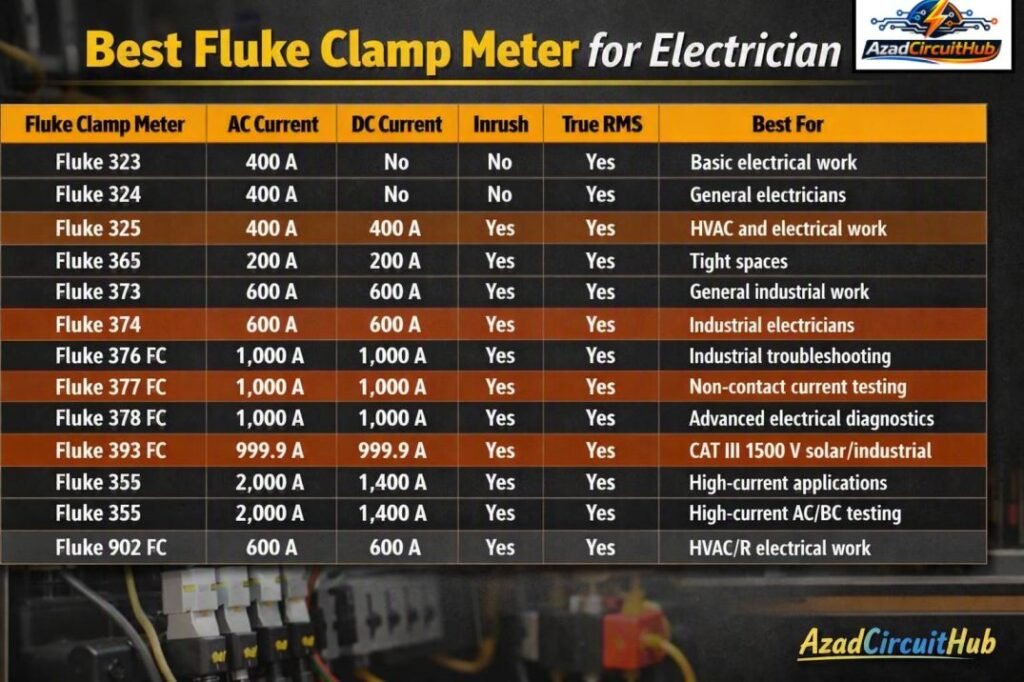
Table of Contents
Table of Contents
Best Fluke Clamp Meter for Electrician: Top Picks
Fluke 323 Clamp Meter – Best Basic Choice
The Fluke 323 is one of the simplest ways to enter the Fluke clamp meter range. It measures AC current up to 400 A and includes True RMS measurement for accurate readings on many modern electrical loads.
Its compact body works well in residential panels, distribution boards, motors, and general maintenance.
The 323 is particularly attractive when you already own a separate multimeter and mainly need current measurement. It does not offer DC current measurement, so it is not the right choice for technicians who frequently troubleshoot batteries, solar circuits, or DC equipment. Read complete fluke 323 review here.
For electricians who want a trusted brand without paying for advanced functions, the 323 remains a strong option.
Fluke 324 – Best Compact General-Purpose Model
The Fluke 324 adds useful functions over the basic 323, including capacitance and temperature measurement. It also provides AC current measurement and True RMS capability.
This makes it useful for electricians who troubleshoot electrical equipment rather than only checking current.
The compact design is helpful when working inside crowded electrical panels. Its CAT-rated construction also makes it suitable for professional electrical environments when used within its specified limits.
If you want a small Fluke meter for everyday electrical maintenance, the 324 deserves consideration.
Fluke 325 – Best Fluke Clamp Meter for Electrician and HVAC Work
The Fluke 325 is one of the most versatile choices for electricians. It measures both AC and DC current, along with voltage, resistance, frequency, capacitance, and temperature.
It also provides inrush current measurement, which is valuable when checking motors, compressors, transformers, and other equipment with high starting currents. Read complete review of fluke 325 here.
For an electrician who works across commercial, residential, industrial, and HVAC applications, the 325 offers a useful balance between price and capability.
See the Fluke 325 on Amazon for current pricing and availability
Fluke 365 – Best for Tight Electrical Panels
The Fluke 365 uses a removable jaw design that can make current measurement easier in confined spaces. This is a major advantage when conductors are difficult to reach.
It measures both AC and DC current and includes True RMS measurement. Its smaller form factor makes it especially useful for control panels, machinery, and crowded switchgear.
The 365 is worth considering when physical access is a bigger problem than maximum current capacity.
Fluke 373, 374 and 375 – Professional Industrial Options
The Fluke 373, 374, and 375 form a useful group for electricians who need higher current measurement and more advanced troubleshooting features.
Fluke 373
The 373 is designed for AC and DC current measurement with a higher current range than the compact 323 and 324. It is a practical option for industrial maintenance and motor testing.
Fluke 374
The Fluke 374 expands the capabilities of the 373 and is suited to technicians who need more comprehensive electrical measurements.
It is a good fit for industrial electricians who regularly troubleshoot motors, panels, feeders, and machinery.
Fluke 375
The Fluke 375 adds additional measurement capability and is aimed at more demanding electrical troubleshooting. It can measure AC/DC current and supports inrush measurements.
If your work involves motors and equipment with variable loads, this model provides more flexibility than entry-level clamp meters.
Fluke 376 FC – Best for Industrial Troubleshooting
The Fluke 376 FC is a step up for professional electrical troubleshooting. It can measure AC and DC current up to 1,000 A and works with the included flexible current probe for measuring larger conductors.
Its Fluke Connect compatibility is also useful for technicians who want to transfer measurements to compatible mobile devices. Read complete review of fluke 376 fc here.
The 376 FC makes sense for industrial electricians, maintenance teams, and technicians working around large conductors where a standard jaw may be restrictive.
Fluke 377 FC – Advanced Non-Contact Current Measurement
The Fluke 377 FC is designed for electricians who want to reduce the need for direct contact with energized conductors during current measurements.
Its FieldSense technology can measure electrical parameters without making direct metallic contact for supported measurements. This can be particularly useful in difficult panel environments.
The 377 FC also supports AC/DC current measurement, True RMS technology, inrush current, and Fluke Connect functionality. Read complete review of fluke 377 fc here
It is a premium option for technicians who regularly perform demanding electrical diagnostics.
Fluke 378 FC – Advanced Electrical Diagnostics
The Fluke 378 FC builds on the capabilities of the 377 FC and is aimed at more advanced electrical troubleshooting.
It includes FieldSense technology, True RMS measurement, AC/DC current capability, and features intended to help electricians identify electrical problems more efficiently. Read complete review of fluke 378 FC here.
For professional maintenance teams working with industrial equipment, motor systems, and complex electrical installations, the 378 FC is one of the more advanced choices in the Fluke clamp meter family.
Fluke 393 FC – Best for Solar and High-Voltage DC Applications
The Fluke 393 FC is especially interesting for solar technicians and electricians working with high-voltage DC systems.
It supports measurement applications up to 1,500 V DC in its specified CAT III rating and can measure high levels of AC/DC current. The slim jaw design is useful when working around solar combiner boxes and other crowded electrical equipment.
For photovoltaic installations, battery systems, and industrial DC applications, the 393 FC can be a better match than a conventional 600 V clamp meter. Read complete review here: Fluke 393 FC Solar Clamp Meter Review
When working on high-energy systems, always confirm the meter’s exact category rating and voltage limits for the installation.
Fluke 353 and 355 – High-Current Clamp Meters
Electricians working with large conductors, generators, industrial feeders, and heavy equipment may need considerably more current capacity.
The Fluke 353 and 355 are designed for high-current AC/DC measurement and can handle applications where smaller clamp meters are unsuitable.
The Fluke 355 is particularly useful for demanding high-current troubleshooting. Its large jaw and high measurement capacity make it more appropriate for industrial power systems than ordinary residential electrical work. Read complete Fluke 355 True RMS Clamp Meter Review here.
These models are specialized instruments, so buying one only makes sense if your typical work actually requires their high-current capability.
Fluke 381 – Clamp Meter with Remote Display
The Fluke 381 combines clamp measurement with a detachable remote display. This can be extremely useful when the electrical panel is difficult to observe while taking measurements.
A technician can position the clamp around a conductor and move away from the measurement point while monitoring the reading from the remote display. Read complete review of Fluke 381 here.
This design is useful for troubleshooting crowded panels, industrial machinery, and energized electrical equipment where keeping a safe working position is important.
Fluke 902 FC – HVAC and Electrical Applications
The Fluke 902 FC is designed with HVAC and electrical troubleshooting in mind. It provides AC/DC current measurement along with electrical measurement functions needed for service work.
For technicians who work on air-conditioning equipment, motors, compressors, and control systems, the 902 FC can be a practical alternative to more general-purpose Fluke clamp meters. Read the complete review on fluke 902 fc here.
How to Choose the Right Fluke Clamp Meter
The best Fluke clamp meter for electrician work should match the measurements you actually perform.
Consider these factors before buying:
AC and DC Current
If you only work with AC distribution systems, a 323 or 324 may be sufficient. For solar, batteries, automotive systems, and DC equipment, choose a model with DC current measurement.
Current Capacity
Do not automatically choose the highest-rated meter. A 400 A clamp meter is easier to carry and may be more practical for residential work. Industrial electricians may benefit from 600 A, 1,000 A, or high-current models.
Inrush Current
Inrush measurement is useful for motors, compressors, transformers, and other inductive loads. If motor troubleshooting is part of your regular work, this feature is worth having.
Jaw Size
A large jaw does not always mean a better meter. Smaller jaws can be easier to position around individual conductors, while larger jaws are useful for heavy cables.
Safety Rating
Look for the appropriate CAT rating for your working environment. Voltage rating alone is not enough. The meter must be suitable for the transient energy present in the electrical installation.
True RMS
True RMS is valuable when measuring modern nonlinear loads such as variable-frequency drives, electronic power supplies, LED drivers, and computer equipment.
If you are still comparing models and want to see alternatives from other brands, our best clamp meter for electricians guide compares professional clamp meters across different price ranges and applications.
Fluke Clamp Meter Features Worth Paying For
| Feature | Why It Matters |
|---|---|
| True RMS | Better AC measurement on nonlinear loads |
| AC/DC Current | Useful for electrical and solar troubleshooting |
| Inrush | Helps diagnose motors and compressors |
| Flexible Probe | Useful around large or awkward conductors |
| FieldSense | Supports non-contact electrical measurements |
| Fluke Connect | Remote measurement recording and sharing |
| Temperature | Helpful for HVAC and equipment diagnostics |
| CAT III/CAT IV Rating | Helps match the instrument to electrical environments |
| Large Display | Easier reading in poorly lit panels |
| Auto Range | Simplifies routine measurements |
Which Fluke Clamp Meter Should You Buy?
For basic residential electrical work, the Fluke 323 is a sensible starting point. The 324 is better when you want additional measurement functions.
For a versatile professional instrument, the Fluke 325 is one of the strongest choices. It provides AC/DC current, True RMS, inrush, temperature, and other useful functions without moving into the highest-priced Fluke models.
For industrial electricians, the 376 FC, 377 FC, and 378 FC provide more advanced capabilities. For solar and high-voltage DC work, the 393 FC deserves particular attention.
The 353 and 355 are better suited to high-current applications, while the 381 is useful when remote viewing is important.
Final Verdict
The best Fluke clamp meter for electrician work is not necessarily the most expensive model. The right choice depends on your current range, AC/DC requirements, safety category, jaw size, inrush testing, and the type of equipment you troubleshoot.
For most electricians, the Fluke 325 offers an excellent balance of functions and portability. The 323 is a better budget-oriented choice within the Fluke range, while the 376 FC and 377 FC are better suited to demanding industrial work. Solar professionals should look closely at the 393 FC, especially when higher-voltage DC measurements are part of the job.
Before purchasing, check the latest specifications, included accessories, safety category, and Amazon listing to make sure the model matches your application.
For a broader comparison of professional options, visit our best clamp meter for electricians guide before making your final purchase.
Frequently Asked Questions
Which Fluke clamp meter is best for electricians?
The Fluke 325 is one of the best all-around choices for electricians because it combines AC/DC current measurement, True RMS, inrush current, temperature, voltage, resistance, and other useful functions in a portable design.
Is the Fluke 323 good for electricians?
Yes. The Fluke 323 is a good choice for general AC electrical work, especially residential and commercial troubleshooting. However, it does not measure DC current, so technicians working with solar or battery systems may need a more capable model.
What is the difference between Fluke 323 and 325?
The Fluke 325 offers considerably more measurement capability. It measures both AC and DC current and adds functions such as temperature and inrush current measurement, while the 323 is a simpler AC clamp meter.
Which Fluke clamp meter is best for solar electricians?
The Fluke 393 FC is particularly suitable for many solar applications because it supports high-voltage DC measurement and high current measurement. Always verify the exact system voltage, CAT rating, and meter limitations before testing.
Are Fluke clamp meters worth the money?
For professional electricians, Fluke clamp meters can be worth the higher purchase price because of their measurement performance, safety features, rugged construction, and broad professional lineup. The best value comes from choosing a model with the functions you actually need rather than simply buying the most advanced instrument.
Get new guides in your feed. Follow Electrical Insights on LinkedIn for new electrical standards guides, calculators and design tips from Azad Circuit Hub.
#FlukeClampMeter, #BestClampMeter, #ElectricianTools, #FlukeTools, #ClampMeter, #ElectricalTesting, #ElectricalTools, #ElectricianGear, #TrueRMSClampMeter, #TestEquipment
