
Fluke 375 FC Clamp Meter Review: Features, Accuracy, Pros, Cons & Buying Guide
If you work around electrical panels, motors, HVAC equipment, or industrial control systems, a reliable clamp meter can save time and reduce the need to disconnect conductors during testing. In this fluke 375 fc clamp meter review, I’ll look closely at its measurement capabilities, accuracy, safety features, wireless functionality, and practical value for professional electricians.
As an electrical engineer with extensive field experience in electrical systems, automation, solar installations, and industrial equipment, I look at clamp meters from a practical testing perspective. A good meter needs more than impressive specifications. It should provide dependable readings, handle demanding environments, and make troubleshooting easier.
The Fluke 375 FC is positioned above basic clamp meters and is designed for professional electrical troubleshooting. It combines AC/DC current measurement, True-RMS readings, variable-frequency drive capability, and Fluke Connect wireless communication.
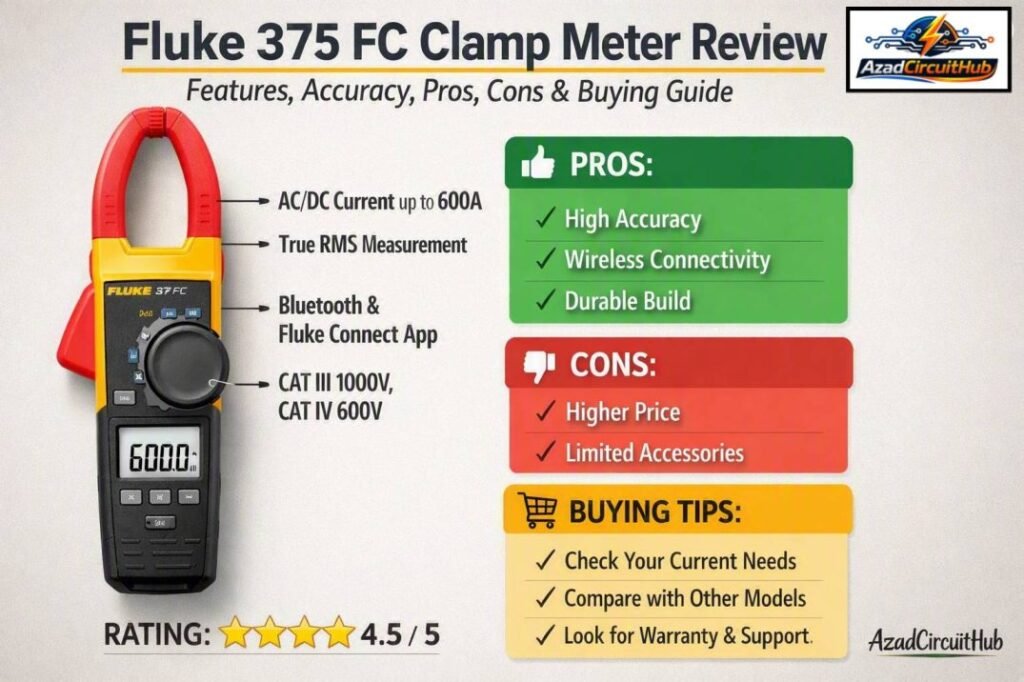
Table of Contents
Table of Contents
Fluke 375 FC Clamp Meter Specifications at a Glance
| Feature | Specification |
|---|---|
| Model | Fluke 375 FC |
| AC Current | Up to 600 A |
| DC Current | Up to 600 A |
| AC/DC Voltage | Up to 1,000 V |
| Frequency | Up to 500 Hz |
| Resistance | Up to 60 kΩ |
| Jaw Opening | 34 mm |
| Measurement Type | True-RMS |
| VFD Measurement | Yes |
| Wireless Connectivity | Fluke Connect |
| Safety Rating | CAT III 1000 V / CAT IV 600 V |
| Display | Backlit digital display |
| Warranty | Limited lifetime warranty* |
*Check the manufacturer's current warranty terms and regional conditions before purchase.
What Makes the Fluke 375 FC Different?
The main advantage of the Fluke 375 FC is that it is built for professional troubleshooting rather than occasional household electrical work. Its combination of a 600 A AC/DC current range, True-RMS technology, and VFD filtering gives electricians more flexibility when dealing with modern electrical equipment.
The meter can measure current without requiring the conductor to be disconnected. This is especially useful when troubleshooting motors, distribution panels, pumps, compressors, and other energized equipment.
Its 34 mm jaw opening is also large enough for many common conductors and cable arrangements. However, jaw size should always be checked against the conductor configuration you expect to encounter in the field.
For electricians who frequently work with variable-frequency drives, the VFD low-pass filter is another useful feature. Drive outputs can contain high-frequency components that may produce confusing readings on simpler meters.
If you are comparing several models for professional electrical work, see my detailed guide to Best Fluke Clamp Meter for Electrician for a broader comparison of Fluke clamp meters.
Measurement Performance and Accuracy
A major reason professionals choose Fluke meters is measurement consistency. The Fluke 375 FC uses True-RMS measurement, which is important when testing circuits with nonlinear loads.
Traditional average-responding meters can provide misleading results when measuring distorted AC waveforms. True-RMS technology is better suited to equipment such as:
- Variable-frequency drives
- Switching power supplies
- UPS systems
- Electronic motor controls
- LED drivers
- Industrial automation equipment
- Modern HVAC systems
For normal sinusoidal loads, both measurement approaches can often produce similar results. The advantage of True-RMS becomes more important when the waveform is distorted.
The 600 A current capacity also covers many residential, commercial, and industrial troubleshooting applications. For higher-current applications, however, electricians should verify the required measurement range before relying on any clamp meter.
AC and DC Current Measurement
One of the strongest points in this fluke 375 fc clamp meter review is its ability to measure both AC and DC current.
Many inexpensive clamp meters concentrate primarily on AC current. DC current measurement is valuable when working with battery systems, automotive circuits, solar equipment, control systems, and DC power supplies.
For renewable-energy technicians, this can be particularly useful. A clamp meter capable of measuring DC current allows troubleshooting without opening the circuit, provided the conductor arrangement and operating conditions are suitable.
The meter also supports voltage, resistance, continuity, and frequency measurements, making it more versatile than a current-only tester.
VFD Low-Pass Filter
Variable-frequency drives can make electrical measurements more complicated. Their output waveform is not the same as a clean utility sine wave, and high-frequency switching components can affect conventional measurements.
The VFD low-pass filter on the meter is designed to help electricians obtain more useful readings when troubleshooting drive-controlled motors.
This does not mean the meter should replace proper drive-specific test procedures. Instead, it is a valuable feature for technicians who regularly diagnose motor and VFD problems.
Why VFD Measurement Matters
| Application | Benefit |
|---|---|
| Motor troubleshooting | Helps evaluate drive output |
| HVAC equipment | Useful around variable-speed motors |
| Pumps | Supports current and voltage checks |
| Industrial machinery | Helps diagnose drive-related issues |
| Automation systems | Useful for electrical troubleshooting |
Fluke Connect Wireless Function
The wireless Fluke Connect feature is one of the biggest differences between this meter and conventional clamp meters.
When compatible with the Fluke Connect ecosystem, measurements can be transmitted to a compatible smartphone or other supported device. This can be useful when the technician cannot safely stand directly beside the equipment while monitoring readings.
For maintenance teams, remote measurement can also make documentation and troubleshooting more efficient.
The wireless function is not essential for every electrician. If you mainly work on simple residential circuits, you may rarely use it. For industrial maintenance and preventive maintenance work, however, it can provide a meaningful productivity advantage.
Build Quality and Field Use
Fluke has a strong reputation for producing professional test instruments, and the 375 FC follows that approach. The meter has a solid feel and is designed for demanding electrical environments.
The clamp mechanism is practical when accessing conductors inside crowded panels. The backlit display is helpful in equipment rooms, electrical cabinets, and other areas where lighting is poor.
Still, no clamp meter should be treated as indestructible. Proper inspection, lead testing, battery maintenance, and safe measurement practices remain essential.
Pros and Cons
| Pros | Cons |
|---|---|
| AC and DC current measurement | More expensive than basic clamp meters |
| True-RMS accuracy | May be excessive for simple home use |
| VFD low-pass filter | Wireless features may not suit everyone |
| Fluke Connect capability | Some advanced functions require compatible ecosystem |
| 1,000 V voltage capability | Premium price |
| Professional CAT safety rating | Larger investment than entry-level meters |
| Durable professional construction | Not intended to replace specialized instruments |
Is the Fluke 375 FC Worth Buying?
The value depends heavily on how you use a clamp meter. For a homeowner who only needs to check basic AC current occasionally, this is probably more capability than necessary.
For professional electricians, industrial technicians, maintenance engineers, HVAC technicians, and automation professionals, the situation is different.
The combination of True-RMS measurement, AC/DC current measurement, VFD filtering, high voltage capability, and wireless connectivity makes it a strong troubleshooting instrument.
Before purchasing, consider whether you actually need the advanced features. If you do, paying more for a professional instrument can be worthwhile because reliability and measurement confidence matter when diagnosing expensive electrical equipment.
If you are ready to compare the current deal, Check the Fluke 375 FC Clamp Meter price on Amazon and review the latest availability, seller information, and customer feedback before ordering.
Fluke 375 FC vs Basic Clamp Meters
A basic clamp meter may be sufficient for checking whether a motor is drawing current or measuring load current on a standard circuit. The 375 FC goes considerably further.
| Capability | Basic Clamp Meter | Fluke 375 FC |
|---|---|---|
| AC Current | Yes | Yes |
| DC Current | Sometimes | Yes |
| True-RMS | Sometimes | Yes |
| VFD Filtering | Rare | Yes |
| Wireless Connectivity | Rare | Yes |
| Professional Safety Rating | Varies | Yes |
| Industrial Troubleshooting | Limited | Excellent |
This difference is important when selecting test equipment. Buying a premium meter only makes sense when its additional capabilities match your work.
For a wider look at professional options, Best Fluke Clamp Meter for Electrician can help you compare this model with other Fluke meters before making a final choice.
Who Should Buy the Fluke 375 FC?
The meter is a particularly good fit for:
- Professional electricians
- Industrial maintenance technicians
- Electrical engineers
- HVAC technicians
- Automation technicians
- Solar and renewable-energy technicians
- Motor and VFD troubleshooting
- Commercial electrical contractors
It is less compelling for someone who only needs basic voltage testing around a home.
Safety Considerations
A high-quality meter does not eliminate electrical hazards. Always inspect the test leads, select the correct function and range, and confirm the meter's rating is appropriate for the installation.
When measuring current with the clamp, ensure that the jaws surround only the conductor being tested. Clamping around both the supply and return conductors can cause the magnetic fields to cancel and result in an incorrect current reading.
Follow the manufacturer's instructions and applicable electrical safety procedures, especially when working inside energized switchboards and distribution equipment.
Frequently Asked Questions
Is the Fluke 375 FC a True-RMS clamp meter?
Yes. The Fluke 375 FC uses True-RMS measurement, making it suitable for measuring AC signals from many nonlinear electrical loads where average-responding meters may be less reliable.
Can the Fluke 375 FC measure DC current?
Yes. DC current measurement is one of its useful features, particularly for battery systems, solar installations, control circuits, and other DC applications.
Is the Fluke 375 FC suitable for VFD testing?
Yes. It includes a low-pass filter designed to improve measurements when troubleshooting variable-frequency drive applications. However, technicians should still follow appropriate VFD testing procedures.
Does the Fluke 375 FC connect to a smartphone?
Yes. It supports Fluke Connect wireless functionality with compatible devices and the Fluke Connect ecosystem. This can help with remote monitoring and measurement documentation.
Is the Fluke 375 FC worth it for electricians?
For professional electricians who need AC/DC current measurement, True-RMS capability, VFD troubleshooting, and advanced connectivity, it can be a worthwhile investment. For occasional basic electrical testing, a less expensive model may provide better value.
Final Verdict
After examining its measurement capabilities and practical applications, the Fluke 375 FC stands out as a professional-grade clamp meter rather than a basic electrical tester. Its AC/DC current capability, True-RMS technology, VFD filtering, high-voltage rating, and Fluke Connect functionality give it a strong position for demanding troubleshooting work.
The biggest drawback is price. If you only perform simple electrical checks, spending extra on advanced functions may not be necessary. But for technicians who regularly work with motors, drives, commercial panels, industrial equipment, HVAC systems, or DC power systems, the additional capability can justify the investment.
If these features match your work, Check the Fluke 375 FC Clamp Meter on Amazon for the latest price and availability before choosing your next professional clamp meter.
For electricians who are still deciding between different Fluke models, my Best Fluke Clamp Meter for Electrician guide provides a useful starting point for comparing features, applications, and overall value.
Get new guides in your feed. Follow Electrical Insights on LinkedIn for new electrical standards guides, calculators and design tips from Azad Circuit Hub.
#Fluke375FC, #FlukeClampMeter, #ClampMeterReview, #Fluke375, #ElectricalTesting, #TrueRMSClampMeter, #ElectricianTools, #DigitalClampMeter, #FlukeTools, #ElectricalTools
