Fluke 381 Clamp Meter Review: Best Remote Display Clamp Meter for Electricians
The Fluke 381 is not a typical clamp meter. Its standout feature is the detachable magnetic display, which lets you take measurements while viewing the readings from a safer and more convenient position. For electricians working inside crowded panels, motor control cabinets, and industrial equipment, this can be a major advantage.
In this fluke 381 clamp meter review, I will look at its measurement capabilities, remote display, accuracy, safety rating, practical applications, limitations, and overall value.
As an electrical engineer with extensive field experience in electrical systems, automation, and power equipment, I look at clamp meters from a practical testing perspective. A good meter should not only have impressive specifications; it should also make troubleshooting safer and easier.
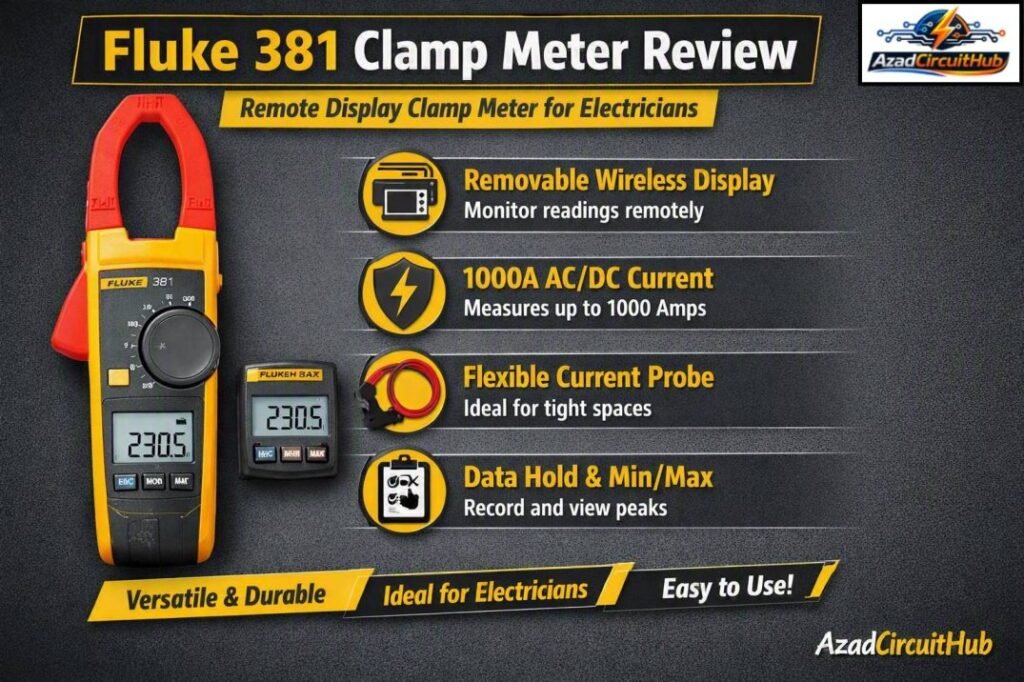
Table of Contents
Table of Contents
Fluke 381 Quick Specifications
The table below provides a quick overview before we examine the meter in detail.
| Feature | Fluke 381 Specification |
|---|---|
| Product type | AC/DC Clamp Meter |
| AC current | Up to 600 A |
| DC current | Up to 600 A |
| AC/DC voltage | Up to 1,000 V |
| Resistance | Up to 60 kΩ |
| Frequency | Up to 500 Hz |
| Jaw opening | 34 mm |
| Display | Detachable wireless remote display |
| True RMS | Yes |
| Inrush current | Yes |
| Safety rating | CAT III 1,000 V / CAT IV 600 V |
| Display backlight | Yes |
| Low-pass filter | Yes |
| Manufacturer | Fluke |
| Best suited for | Electricians, HVAC, industrial maintenance and troubleshooting |
Fluke 381 Clamp Meter Review
What Makes the Fluke 381 Different?
The biggest reason to consider the Fluke 381 is its remote display.
The main meter can remain attached to a conductor or positioned inside an electrical enclosure while the detachable display is carried or mounted somewhere nearby. This means you do not always need to keep your face close to a live panel just to read the measurement.
The display communicates wirelessly with the meter. For troubleshooting work, this is more than a convenience feature. It can help create additional working distance between the operator and the energized equipment.
The clamp itself also has a familiar Fluke design. Its 34 mm jaw opening is suitable for many common conductors encountered during commercial and industrial electrical work.
If you are comparing several Fluke models before buying, my broader Best Fluke Clamp Meter for Electrician guide can help you compare features, applications, and price points across the lineup.
Fluke 381 Measurement Performance
The 381 measures both AC and DC current, making it more versatile than an AC-only clamp meter.
It can measure current up to 600 A, while voltage measurements extend to 1,000 V. That makes it suitable for a wide range of electrical troubleshooting tasks, including distribution panels, motors, control circuits, HVAC equipment, and industrial machinery.
The True RMS function is another important feature. Non-linear loads such as variable frequency drives, electronic power supplies, LED drivers, and other modern equipment can produce waveforms that are not perfectly sinusoidal.
A True RMS clamp meter can provide more meaningful AC measurements on these types of loads than a basic averaging meter.
Key Measurement Functions
| Function | Why It Matters |
|---|---|
| AC current | Checking loads, feeders and motors |
| DC current | Battery, control and automotive/industrial DC systems |
| AC voltage | General electrical troubleshooting |
| DC voltage | Control circuits and DC equipment |
| Resistance | Testing components and circuits |
| Frequency | Checking electrical supply and equipment |
| Inrush current | Troubleshooting motor and equipment startup |
| Min/Max/Average | Capturing changing readings |
| True RMS | Better AC measurement on distorted waveforms |
| Low-pass filter | Useful around variable frequency drives |
Detachable Wireless Display
The remote display is the feature that defines the 381.
Imagine troubleshooting a motor inside a cramped cabinet. You need to clamp around a conductor, but the available space is limited. With a conventional clamp meter, you may have to position your head and body close to the enclosure to see the display.
The Fluke 381 allows the display to be separated from the clamp meter. You can position the meter where the measurement needs to be taken and view the result from another location.
The magnetic back of the display can also be useful when working around metal panels and equipment.
For electricians who regularly troubleshoot energized equipment, this design can make measurements more practical.
Inrush Current Measurement
Motor starting current can be several times higher than normal operating current. A standard current measurement may not capture this short-duration event accurately.
The Fluke 381 includes an inrush current function designed to capture motor and equipment startup current.
This is useful when diagnosing:
- Motors that trip breakers during startup
- Compressors with starting problems
- HVAC equipment
- Transformers
- Pumps
- Industrial machinery
- Large electrical loads
In field troubleshooting, comparing running current with starting current can help identify whether the problem is electrical, mechanical, or related to the connected load.
Safety and Build Quality
Safety should be a major consideration when selecting a clamp meter for professional work.
The Fluke 381 carries CAT III 1,000 V and CAT IV 600 V safety ratings. These ratings make it appropriate for many demanding electrical environments when used within the manufacturer's specified limits and proper safety procedures.
The meter is also designed for professional field use. Fluke's reputation in electrical test equipment comes largely from durability, measurement performance, and safety-focused design.
That does not mean the meter eliminates electrical hazards. Proper PPE, isolation procedures, test-before-touch practices, and appropriate electrical safety procedures remain essential.
Where the Fluke 381 Works Best
This meter makes the most sense for professionals who frequently work around energized electrical equipment.
Typical applications include:
- Industrial electrical maintenance
- Motor troubleshooting
- HVAC service
- Commercial electrical installations
- Electrical distribution panels
- Variable frequency drive troubleshooting
- Control cabinets
- Generator and power equipment maintenance
- Preventive maintenance
- General AC/DC electrical testing
For occasional household electrical work, the 381 may provide more capability than necessary. Its value becomes clearer when remote measurement and professional troubleshooting are part of your regular work.
Fluke 381 vs a Standard Clamp Meter
A conventional clamp meter can handle current measurements effectively, but the 381 adds flexibility through its removable display.
| Consideration | Fluke 381 | Standard Clamp Meter |
|---|---|---|
| AC current | Yes | Usually |
| DC current | Yes | Depends on model |
| True RMS | Yes | Depends on model |
| Remote display | Yes | Usually no |
| Inrush measurement | Yes | Depends on model |
| 1,000 V measurement | Yes | Depends on model |
| CAT IV capability | Yes | Depends on model |
| Crowded-panel troubleshooting | Excellent | Varies |
| Price | Premium | Low to premium |
The main question is therefore not whether the 381 can measure current. Many clamp meters can do that.
The question is whether the remote display and professional specifications justify the additional investment for your type of work.
Fluke 381 Clamp Meter Pros and Cons
Every professional instrument has trade-offs. The fluke 381 clamp meter review would not be complete without looking at both sides.
Pros
- Detachable wireless display
- True RMS AC measurements
- AC and DC current measurement
- 600 A current range
- Up to 1,000 V voltage measurement
- Inrush current function
- CAT III 1,000 V/CAT IV 600 V safety rating
- Useful magnetic remote display
- Excellent choice for industrial troubleshooting
- Compact enough for many field applications
Cons
- Premium price compared with basic clamp meters
- 600 A current capacity may not suit every high-current application
- Remote display may be unnecessary for simple residential work
- Larger investment than entry-level clamp meters
- Some users may prefer a clamp meter with additional specialized functions
Is Fluke 381 Worth Buying?
The fluke 381 clamp meter review points to one clear conclusion: this is a specialized professional tool rather than a basic current tester.
Its strongest advantage is the detachable remote display. If you regularly troubleshoot live panels, motors, industrial controls, or equipment where viewing the meter directly is inconvenient, that feature can save time and improve your working position.
If you mainly need to check household circuits or occasional current measurements, a less expensive Fluke clamp meter may offer better value.
For professional electricians, maintenance technicians, and engineers, however, the combination of True RMS measurement, AC/DC current, inrush measurement, high safety ratings, and remote display makes the 381 particularly attractive.
Ready to Buy?
If the Fluke 381 fits your electrical troubleshooting needs, check the current Amazon price and availability before buying. Professional Fluke meters can vary in price, so it is worth checking the latest deal.
For a broader comparison before making your decision, see my Best Fluke Clamp Meter for Electrician guide to find the right model for different electrical applications and budgets.
Final Verdict
After examining its functions and professional applications, the Fluke 381 stands out primarily because of how it changes the way measurements can be taken.
The detachable display is particularly useful in crowded electrical panels and locations where keeping your eyes and body farther from energized equipment is desirable. Combined with True RMS, AC/DC current measurement, inrush current, and strong CAT safety ratings, it is built for serious troubleshooting.
The fluke 381 clamp meter review ultimately comes down to your working environment. If you need a dependable professional clamp meter with remote viewing capability, the 381 is a strong option. If you only perform simple electrical checks, its premium features may not provide enough additional value to justify the cost.
Before purchasing, compare the latest price with other Fluke clamp meters and consider which functions you will actually use.
Frequently Asked Questions
1. Is the Fluke 381 a True RMS clamp meter?
Yes. The Fluke 381 uses True RMS technology for AC measurements. This is helpful when testing equipment with distorted or non-sinusoidal waveforms, including variable frequency drives and electronic loads.
2. How many amps can the Fluke 381 measure?
The Fluke 381 measures AC and DC current up to 600 A. Always stay within the specified measurement category and operating limits when testing electrical circuits.
3. What is the main advantage of the Fluke 381?
Its main advantage is the detachable wireless display. You can place the clamp meter at the measurement point while viewing the reading from a more convenient position.
4. Is the Fluke 381 suitable for electricians?
Yes. Its AC/DC current measurement, True RMS capability, inrush measurement, 1,000 V voltage rating, and CAT III/CAT IV safety ratings make it well suited to professional electrical troubleshooting.
5. Does the Fluke 381 measure motor inrush current?
Yes. It includes an inrush current function designed to capture short-duration startup current. This can help electricians troubleshoot motors, compressors, pumps, and other equipment with high starting currents.
Related Guides
- Best 1000A Clamp Meter
- Fluke 377 FC Clamp Meter Review
- Fluke 365 Clamp Meter Review
- Fluke 375 FC Clamp Meter Review
- best clamp multimeter for electricians
Get new guides in your feed. Follow Electrical Insights on LinkedIn for new electrical standards guides, calculators and design tips from Azad Circuit Hub.
#Fluke381, #FlukeClampMeter, #ClampMeterReview, #RemoteDisplayClampMeter, #TrueRMS, #ElectricianTools, #ElectricalTesting, #FlukeTools, #ClampMeter, #ElectricalTools